Ruts and Why a Wet Trail Gets Closed
A Montana trail can look merely soft at the entrance and turn into a deep, muddy rut a few miles later. Riding through may seem harmless, but repeated tire passes can damage the trail, push water into the track, and make it unsafe for others. This guide explains why wet trails close, how to recognize risky conditions, and what to check before you ride.
Why wet trails are vulnerable to damage
Water and tires can reshape a trail quickly
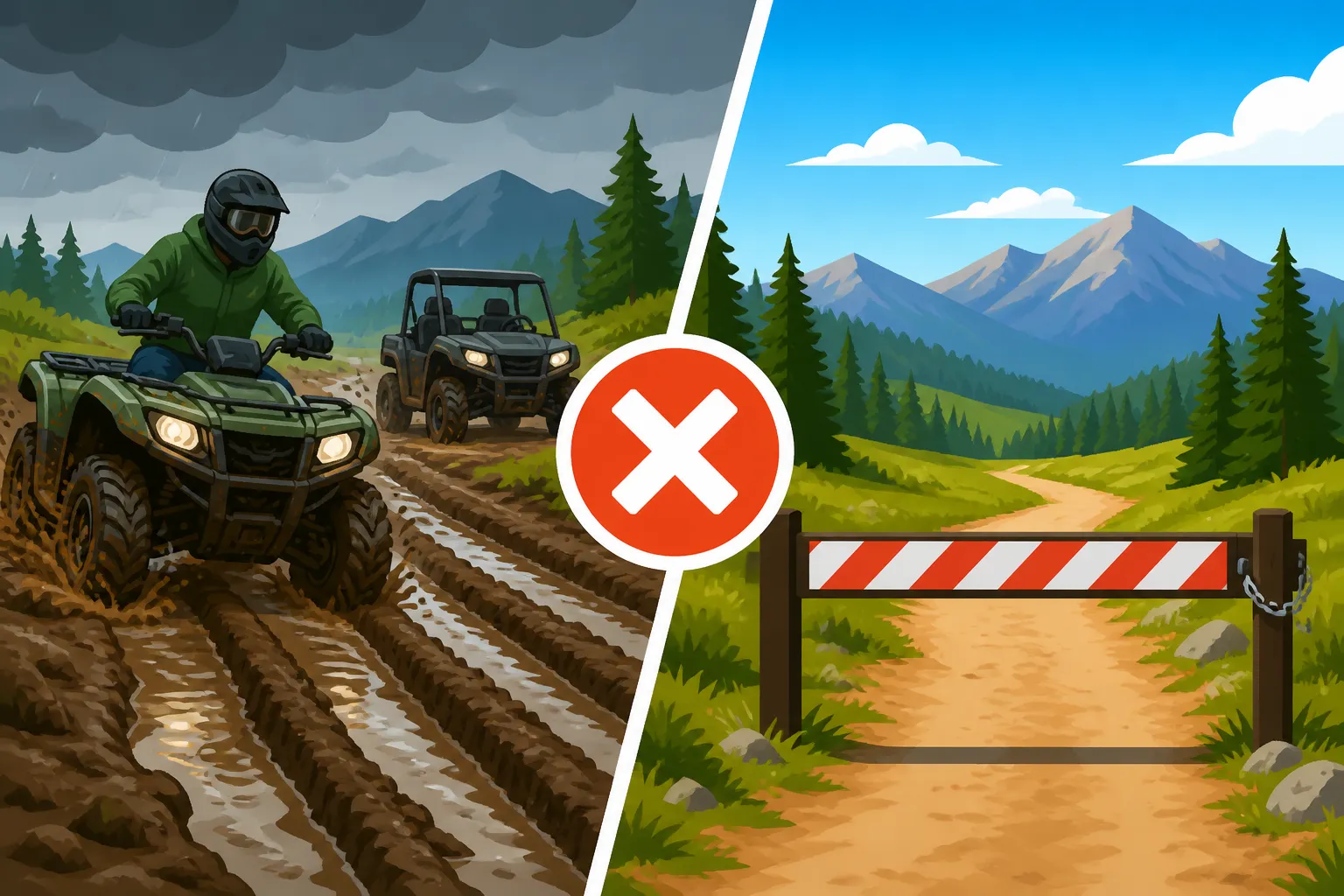
A trail that is firm in late summer may behave very differently after snowmelt or a stretch of rain. When soil is saturated, it loses much of its ability to support a vehicle. Tires can sink into the surface, compact some areas, and push loose soil outward. The result is a rut: a groove that may begin as a shallow tire mark and deepen with each pass.
The damage can build quickly when several machines follow the same line. A rider may think, “I’ll just ease through this one muddy spot,” but the next machine may have to steer around the first set of tracks. If several riders skirt the mud, the trail becomes wider. If they stay in the groove, the rut may deepen and become harder to cross.
This is one reason trail condition matters as much as the machine’s size or power. A light ATV can still damage soft ground, and a capable side-by-side can make a deep rut worse. Adding throttle to get through a boggy section can also spin tires and throw more soil, especially on a slope.
Ruts change where water flows
A rut is not only a mark left by tires. It can become a channel that collects and carries water. Instead of draining gently off the trail, runoff may follow the groove downhill, washing away soil and exposing roots or rocks. On a hillside, a rut can concentrate water over a long distance and accelerate erosion.
That damage can affect more than the track itself. Sediment may travel toward a stream, wetland, or drainage area. Trail managers may also need to repair the route, close it temporarily, or reroute drainage. These are practical reasons behind many wet-weather restrictions—not simply a preference to keep riders out of mud.
Montana’s varied terrain makes conditions uneven. A sunny stretch near a trailhead may be dry while shaded sections, north-facing slopes, and higher elevations remain wet or snow-covered. A route in the Flathead or Lolo National Forest can have different conditions from a lower, warmer trail closer to a town. A few dry miles at the start do not prove that the whole route is ready.
For a closer look at how these conditions affect trails, see Spring Mud and Montana Trail Damage and Trail Conditions After Snowmelt.
Why managers close a trail after wet weather
A closure prevents small damage from becoming expensive damage
Trail closures are often preventive. Managers may close a route when soil is too soft to support normal use, when runoff is damaging the tread, or when vehicles are creating ruts that could become difficult to repair. Waiting until the trail is badly torn up can mean more intensive work later, including reshaping the surface, restoring drainage, or addressing erosion beyond the immediate tire tracks.
A closure can also protect the work already done on a trail. Local clubs, agency crews, and volunteers may spend time clearing drainage, repairing washouts, and maintaining routes. Riding on a saturated trail can undo that work in a short time. When the route is closed, even a rider who is careful and travels slowly can add to the impacts if the surface cannot support traffic.
Closures may apply to one segment, one route, or a broader area. Conditions can change from one drainage to another, and notices may come from the land manager responsible for that particular road or trail. A route shown as open on a general map does not always mean every part is suitable for riding today.
A closed trail may still look passable
A closure is easy to second-guess when the trail looks mostly dry from the road. The problem may be around the next bend, at a shaded crossing, or on a steep section where water has begun to cut into the tread. Some damage is also difficult to see until tires have already entered soft ground.
There are safety concerns, too. Deep ruts can trap a tire, pull a vehicle off its intended line, or make it harder for riders traveling in opposite directions to pass. Mud can hide rocks, holes, and soft shoulders. A narrow detour around a muddy patch may put vehicles onto fragile vegetation or unstable ground.
The table below shows how common conditions can guide your decision. It is not a substitute for an official closure notice: if the route is closed, do not enter it, even if the surface looks rideable.
| Trail condition | What it can indicate | Sensible response |
|---|---|---|
| Shallow mud over a firm, broad surface | The trail may be damp without being deeply saturated | Continue only if the route is open and tires are not cutting into the tread |
| Tires sink or leave deep impressions | The soil may not support vehicle traffic | Turn around before creating or deepening ruts |
| Water runs along a tire groove | The rut may be acting as a drainage channel | Avoid riding the affected section and check for a closure or alternate route |
| Riders are making new tracks around mud | The trail may be widening into surrounding ground | Do not follow the informal bypass |
| A sign, gate, or official notice indicates closure | The land manager has restricted access | Turn around and use a legal, open route |
| Conditions change sharply with elevation or shade | The route may be wet or snowbound farther along | Do not assume the whole route is ready because the trailhead is dry |
For more on maintenance and repair, see Who Fixes a Washed-Out Montana Trail. To understand how trail use and maintenance efforts connect, Montana Trails Kept Open by Local Clubs is also useful.
How to judge trail conditions before you leave
Check the route, the land manager, and recent conditions
Start by identifying the route you intend to ride and who manages it. In Montana, a planned ride might involve Forest Service land, Bureau of Land Management land, state land, county roads, or private property. Each may have different access information, seasonal restrictions, and ways of communicating closures.
Look for current notices from the responsible land manager before driving to the trailhead. A general route map can help you plan, but it may not include a temporary closure or a recent change in access. If you are planning to ride in a national forest, check the relevant forest’s official route and closure information. For a broader planning approach, see Checking Montana Trail Status Before You Drive and Finding a Forest’s Motor Vehicle Use Map.
Weather is only one clue. Recent rain, snowmelt, temperature, elevation, shade, and soil type all affect how quickly a trail dries. A forecast for a dry afternoon does not necessarily mean a trail is ready after several days of rain. Likewise, a warm spell at lower elevations may not have cleared snow or softened ground higher up.
Tools such as onX Offroad can help you review route options and organize a ride plan. Use mapping tools as a planning aid, then confirm closures and access with the responsible land manager. A route displayed in an app should not be treated as permission to ride or proof that conditions are suitable.
Make a turnaround plan before you reach the mud
It is easier to make a good decision when your group agrees on a plan before arriving at a questionable section. Decide that a posted closure means turning around, and set a limit for how much mud or rutting the group is willing to encounter. If the first vehicle is sinking or spinning, the rest of the group should not keep following just to see whether the trail improves.
A sensible turnaround plan might include:
- Check the route and closure information before departure.
- Identify a legal alternate route or a point where the group can safely turn around.
- Stop before entering a muddy section if the surface appears soft or deeply rutted.
- Look for signs of water flowing through the tread, fresh tire grooves, or informal bypasses.
- Turn back if continuing would deepen ruts, widen the trail, or require aggressive throttle.
- Report a damaged or blocked route to the appropriate land manager if the situation warrants it.
Avoid making a new path around a wet spot. That tempting dry-looking strip beside the trail may be vegetation, fragile soil, or private land. A detour can turn one muddy section into a wider disturbed area, and it may create access problems for future riders.
For general seasonal planning, Montana Trails Open in June can help frame expectations, but opening patterns vary by location and conditions. A calendar date alone does not determine whether a particular trail is dry, open, or ready for vehicles.
What to do when you encounter a wet or closed trail
If it is officially closed, turn around
Signs, gates, barricades, and land-manager notices should be treated as clear instructions. Do not move a barrier, ride around it, or assume that a closure is unnecessary because another vehicle has passed through. A closure may be in place to prevent damage, protect resources, support repair work, or address a hazard that is not obvious from the entrance.
If you are already several miles into a route, turning around can feel frustrating, especially after hauling machines and planning the day. Still, continuing onto a closed segment can worsen the problem and may lead to enforcement consequences. Keep the group together, return by a legal route, and check for an open alternative.
Do not rely on another rider’s social-media post or an old map screenshot as the final word. Conditions and notices change. If the status is unclear, contact the responsible land manager before committing to the route. The same careful approach applies when planning around fire-related closures; Montana Trail Closures in Fire Season explains why access can change for reasons beyond trail condition.
If it is open but too soft, choose not to ride it
Not every poor-condition decision comes with a gate or official closure sign. If the trail is open but your tires are sinking, the route is carrying water, or the group would need to drive around damaged sections, turning around is still the responsible choice. An open status does not require you to ride in conditions that are likely to damage the trail or put your group at risk.
This is especially important when riding with mixed experience levels. A confident rider may be comfortable maneuvering through a rut, while a newer rider may panic, apply too much throttle, or get stuck. If one machine damages the trail or becomes immobilized, others may be tempted to use the shoulder to get around it. A conservative choice early can spare the group a long recovery and leave the trail in better shape for the next visit.
When conditions are dry again, use the established route rather than the edges of the trail. Ride smoothly, avoid unnecessary wheelspin, and do not create new lines through vegetation. If you see significant damage or a closure notice that appears unclear, share the location and observations with the appropriate land manager instead of attempting your own repair.
The basic rule is simple: if the ground cannot support your machine without deep tire marks, flowing water in the track, or a new bypass, it is not a good time to ride that section. Waiting for firmer conditions protects the trail, reduces the chance of getting stuck, and helps keep Montana’s riding areas available for future trips.
Disclaimer
This article is for general informational purposes only and does not constitute professional advice. Laws, prices and regulations vary by location and change over time. Consult a qualified professional for guidance on your specific situation.