Non-Residents Taking the Montana Course
Non-Residents Taking the Montana Course
If you’re bringing an ATV or UTV to Montana, the safety-course question can be easy to mix up with permits, registration, and road access. Non-residents may need to check Montana’s course rules just like residents, especially when a young rider is involved. Here’s how to tell whether to take the Montana course, what an out-of-state certificate may do, and what the course does not authorize.
Who needs to think about the Montana safety course
The first question is not where you live. It is who will operate the machine, how old that rider is, and where the ride will take place. Montana has safety-education rules for some OHV riders, with particular attention to younger operators. A visitor should not assume that living in another state automatically exempts them.
For an adult rider, the course may not be the main permit issue. For a rider under 16, it deserves an early check: Montana has age-related OHV rules, and the course requirement can depend on the rider’s age and circumstances. Review the current requirements with Montana Fish, Wildlife & Parks (FWP) before traveling, rather than relying on a general statement from a rental shop, a friend, or an old certificate.
The course question is also separate from whether the machine is allowed on a particular route. A rider may satisfy an education requirement and still need a trail permit, have to follow age restrictions, or be prohibited from riding a road or trail. Conversely, having the right permit does not necessarily satisfy a safety-course requirement.
Start by answering these questions for every person who may drive:
- How old is the operator?
- Will they ride on public land, a public road, private land, or a mix?
- Is the machine an ATV, UTV, dirt bike, or another kind of OHV?
- Does the rider already have a safety certificate from another state?
- Is an adult expected to supervise the rider, and does the rule for that activity allow supervision as an alternative?
The answers matter because “riding in Montana” is not one single legal situation. A young rider using a trail, a passenger in a side-by-side, and an adult operating on a road may face different rules. The course itself is not a substitute for checking the requirements that apply to that specific ride. For youth-specific details, see Montana OHV Safety Education Requirements and Montana Age Rules for Riders Under 16.
If the operator is under 16, check both the course rule and any age or supervision rule that applies to the location. Taking the course does not necessarily make every trail or road available to a young rider. A course certificate is evidence of education, not a general permission slip.
A different concern applies to adults who completed a course years ago. Do not assume that an old card, a certificate from another activity, or a standard driver’s license automatically answers Montana’s OHV-course question. Confirm that the certificate covers the relevant OHV education requirement and that Montana accepts it for the intended use.
Taking Montana’s course as a visitor
A non-resident can look into taking the Montana OHV safety course before traveling. Montana’s course information and approved-provider details are the place to check for available formats, eligibility, completion steps, and proof of completion. Some courses may be offered online, but availability, age limits, identity checks, and testing arrangements can vary by provider. See Taking the Montana Course Online and Approved Online Course Providers for related details.
Do not select a course based only on a search result that says “ATV safety.” Courses can differ by state, subject, and intended use. Before paying or beginning a class, make sure the course is specifically accepted for the Montana OHV requirement you are trying to meet. A snowmobile course, general recreation course, or manufacturer’s safety video may be useful, but that does not mean it qualifies as the Montana course.
A careful process helps avoid taking the wrong class:
- Check whether the rider needs a course. Use the rider’s age and planned activity to identify the relevant rule.
- Ask whether an existing certificate is acceptable. If the rider already completed training elsewhere, confirm that Montana recognizes that specific certificate.
- Choose an approved option. Use the providers or course information identified by Montana, and check that the course is intended for the rider’s age group.
- Complete every required step. An online lesson may include a test, identity verification, or another completion step. Finishing the instructional material alone may not be enough.
- Save proof. Keep the certificate or completion record available while traveling, ideally in a form that can be retrieved without a cell signal.
- Recheck trip-specific rules. Confirm permits, road access, supervision, and machine requirements separately.
A non-resident may find it convenient to finish training at home instead of fitting it into a trip. The trade-off is that online enrollment can involve eligibility requirements, provider-specific processes, and a certificate that may not be accepted for the particular situation. Verify first, especially when a minor is involved.
If the rider’s home state has already issued a recognized safety certificate, ask Montana whether that precise certificate is accepted. Do not infer acceptance from the fact that the course was state-approved elsewhere. Course titles and subjects can look similar while covering different rules. Out-of-State Certificates Montana Accepts is a useful related topic, but the answer for an individual certificate should be confirmed with FWP or the course administrator.
Keep a copy of the certificate with the trip documents. That is sensible even if the rider is not required to carry it constantly. A phone photo can be useful, but a downloaded copy or paper version is more dependable in an area with poor reception or a dead battery. For additional paperwork planning, see What Montana Riders Need Before They Ride.
A course is not a trail permit or road authorization
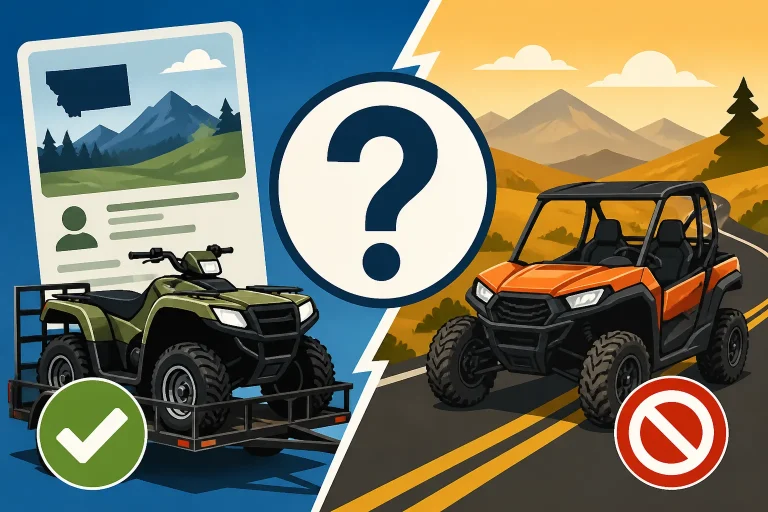
One of the most common misunderstandings is treating the safety course as the document that makes a machine legal to ride. It does not. The course is about operator education. Permits, registration, route rules, and road-use requirements are separate questions.
Non-residents should check whether the machine needs Montana’s temporary use permit for the planned public-land riding. The permit requirement is distinct from safety education: having a course certificate does not replace a permit, and buying a permit does not prove that a rider has completed a required course. Start with Montana’s Non-Resident Temporary Use Permit and [What the Non-Resident Permit Covers].
Likewise, a trail permit does not automatically allow road riding. Access to a road depends on the road’s status and the rules that apply to it, not simply on whether the operator has taken a course or has a permit. Check Does the Non-Resident Permit Allow Road Riding? before planning a route that uses a public road or connects trails through town.
| What you’re checking | What it answers | What it does not answer |
|---|---|---|
| Safety course or certificate | Whether the operator has completed relevant education | Whether the machine may use a particular trail or road |
| Non-resident permit | Whether a visitor has the required permit for covered public-land riding | Whether the operator meets age or course rules |
| Registration or other machine paperwork | Whether the machine has the applicable registration documentation | Whether a route is open to that machine |
| Road-use rules | Whether the machine and operator may use a specific road section | Whether a trail permit or course is required elsewhere |
| Land-access rules | Whether riding is allowed on the land or route | Whether the rider’s education and documents are complete |
This separation matters most on mixed trips. A machine might travel from private property to a public trail, cross a road, and then enter a town. The course, permit, land-access, and road-use questions can change along the way. Check each segment rather than assuming one document covers the entire route.
The same caution applies to rentals and borrowed machines. A rental shop may explain its own training and contract requirements, but that does not necessarily settle every state or land-manager rule. Ask what paperwork the shop provides and what remains the rider’s responsibility. For a borrowed machine, the owner’s registration does not automatically settle the operator’s education or permit obligations.
If your trip includes public roads, use the relevant road rules as a separate checklist. Course completion does not grant permission to ride on a road that is closed to OHVs or waive equipment and operator requirements. See Montana Road Rules Riders Get Wrong for the broader road-access issue.
How to check a certificate from another state
If you already have a certificate, the practical question is whether Montana accepts it for the rider and activity in question. The answer can depend on the issuing authority, the course type, the rider’s age, and current Montana requirements. The safest approach is to confirm acceptance before the trip, rather than discovering a mismatch at the trailhead.
When checking a certificate, gather enough information for the course administrator or FWP to identify it:
- The rider’s name and age
- The state or organization that issued the certificate
- The course title and subject
- The completion date, if shown
- The certificate number or other identifying information
- Whether the rider completed an online or in-person course
Ask a specific question: “Does this certificate meet Montana’s OHV safety education requirement for this rider and the type of riding planned?” That is more useful than asking whether “an ATV card” is accepted in general. If the answer depends on the activity or age, ask for those conditions clearly.
A certificate may be valid for one purpose but not another. A course that satisfies an education requirement for trail riding does not necessarily satisfy a separate road-related rule. Similarly, a certificate that was accepted when a rider was younger may not settle a different requirement after the rider’s circumstances change. If the rider is close to an age threshold, ask how the rule applies on the actual date of the trip.
Do not assume a certificate expires, or that it never expires, without checking the issuing program and Montana’s current rules. If the document is old, damaged, or missing, contact the original course provider to ask whether it can verify completion or issue replacement proof. [Does a Montana Safety Certificate Expire?] and Replacing a Montana Safety Certificate cover related questions.
If you cannot get a clear answer about an out-of-state certificate, taking an approved Montana course may be the more straightforward option, provided the rider is eligible. But avoid enrolling in a second course solely out of uncertainty before checking. The provider may be able to confirm whether the existing record is enough, and the correct answer can depend on the exact course rather than the rider’s state of residence.
Carry the details of the certificate even if you have a digital card. Save the certificate offline and keep the provider’s contact information. If a question comes up, being able to show the course name and issuing authority is more useful than remembering that the rider “took an ATV class.”
Plan the course before you load the trailer
The easiest time to resolve course questions is before travel, when you can contact the course provider, check FWP guidance, and adjust the itinerary. Waiting until arrival can be inconvenient, particularly if the rider is a minor, the machine is rented, or the group plans to ride in several jurisdictions.
Use a simple pre-trip checklist:
- Confirm which people will actually operate a machine. A passenger is not necessarily subject to the same operator-course question, but passenger age and equipment rules may still apply.
- Identify the youngest operator and check the rules that apply to that rider.
- Confirm whether each existing certificate is accepted for the intended activity.
- If a course is needed, verify the provider, eligibility, testing, and proof-of-completion process.
- Check permit requirements for each machine, not just each rider.
- Confirm that the planned trails are open to the machine’s type and width.
- Treat road riding as a separate permission and equipment check.
- Keep course proof and permit information accessible during the trip.
A family planning a ride should not make the youngest rider’s eligibility an afterthought. A parent may have a valid course certificate and a properly permitted machine, while a child still needs to meet a distinct course, supervision, age, or passenger rule. Review [Montana Rules for Riders Under 12] and Montana Helmet Requirements Under 18 where they apply.
The machine matters too. A youth ATV, a full-size UTV, and a side-by-side with a passenger are not interchangeable in every rule. If the trip involves a young driver in a UTV, check whether the vehicle’s seating, restraints, and operator requirements match the route. A completed course does not make an undersized or otherwise unsuitable machine appropriate for a particular rider.
For a public-land ride, check the course and permit information together, but do not confuse them. Why the Non-Resident Permit Covers Trails Only explains why a permit should not be treated as broad road authorization. If your group also needs a Montana trail permit, confirm which machine it applies to and whether each additional vehicle needs its own documentation.
There is also a practical safety benefit to taking a course even when a particular rider is not legally required to do so. Training can help newer operators understand basic controls, terrain choices, risk management, and riding etiquette. That benefit is separate from legal compliance: voluntary training can improve preparation, but it does not change the permit or access rules.
Finally, build in time for questions rather than relying on last-minute assumptions. Course providers and state agencies may not be able to resolve a complicated certificate issue instantly, and a provider’s course completion record may take time to become available. Keep confirmations, receipts, and certificate records together with the trip paperwork.
Frequently Asked Questions
Can a non-resident take Montana’s OHV safety course?
A visitor can check Montana’s course options and approved providers, including any online option available to them. Confirm eligibility and acceptance before enrolling, particularly for a young rider.
Does taking the course give me a Montana trail permit?
No. Safety education and permits are separate. Check Montana’s Non-Resident Temporary Use Permit for the visitor permit question.
Will Montana accept my home-state certificate?
It may, but do not assume that every out-of-state certificate qualifies. Confirm the specific certificate, rider, and planned activity with the relevant Montana course administrator or FWP.
Does a safety certificate allow me to ride Montana roads?
No. A certificate does not establish road access. Road permission and requirements depend on the route and applicable rules.
Should I carry proof of course completion?
Keep proof accessible during the trip, preferably in an offline digital copy or on paper. Confirm whether a particular activity requires proof to be presented.
Disclaimer
This article is for general informational purposes only and does not constitute professional advice. Laws, prices and regulations vary by location and change over time. Consult a qualified professional for guidance on your specific situation.