Do Idaho Riders Need a Montana Permit?
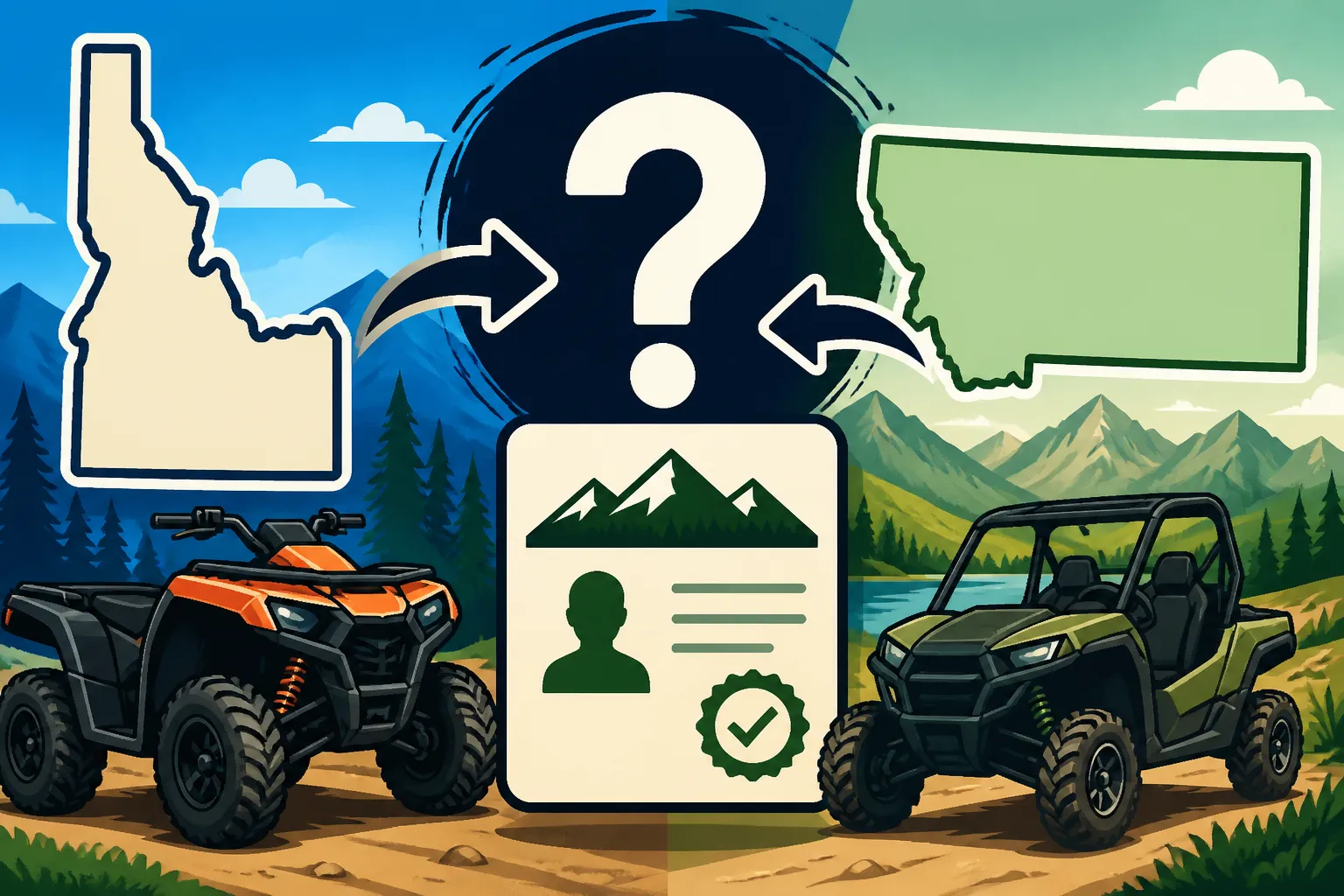
Idaho registration does not automatically give an ATV or UTV access to Montana trails. If you’re bringing a machine across the border, the key question is whether you’ll ride on public land—and whether you have the separate Montana permit that applies to visiting riders. Here’s how to tell what you need and what the permit does not cover.
The short answer for Idaho riders
Generally, yes: an Idaho resident bringing an ATV, UTV or other qualifying off-highway vehicle to ride on Montana public land needs the applicable Montana nonresident OHV permit. An Idaho registration, sticker or trail credential does not, by itself, replace Montana’s requirement. Montana and Idaho have separate systems, so a credential accepted in one state should not be assumed to work in the other.
The permit requirement is tied to the rider’s nonresident status and the machine’s use in Montana. It is not a fee that can be avoided simply by registering the ATV in Idaho, carrying its title, or having an Idaho trail pass. If you plan to ride Montana’s public-land trails, check the current Montana requirements before leaving home. The core rules are summarized in Montana’s Non-Resident Temporary Use Permit and Montana Rules for Visiting Riders.
A permit is not the same thing as vehicle registration. Registration or other ownership paperwork identifies the machine and may be required for certain kinds of use. The nonresident permit addresses Montana’s access requirements for visiting OHV riders. Depending on the machine and where you intend to ride, you may need to consider both paperwork and access rules.
| Your situation in Montana | What to check |
|---|---|
| Riding an ATV or UTV on public-land trails | The Montana nonresident OHV permit and any local trail restrictions |
| Riding only on private land | The landowner’s permission and any rules that apply to roads or public access |
| Using a public road or crossing | Road-specific authorization and equipment or operator rules; a trail permit is not enough |
| Bringing more than one machine | Whether each machine needs its own permit |
| Riding at a state park or other managed site | The site’s current access, vehicle and permit requirements |
The table is a planning aid, not a substitute for checking the rules for a particular route. A trail can cross land managed by different agencies, and a permit does not open a closed route or give permission to travel across private property.
What the Montana permit does and does not cover
Think of the nonresident permit as one part of getting an OHV ready for eligible public-land riding. It does not give you blanket permission to ride anywhere in Montana. You still need to use routes that are open to your type of machine, follow signs and closures, and stay within any width or vehicle restrictions. A route that is legal for a narrow ATV may not be open to a wider side-by-side.
The permit also does not automatically make an OHV street legal or authorize a ride along a public road. Montana road access depends on the road’s ownership, the local rules, and the machine’s equipment and operator requirements. A route may include a road segment that is closed to OHVs, even when nearby trails are open. For more on that distinction, see Does the Non-Resident Permit Allow Road Riding? and Montana Permit Rules on Public Land.
Do not treat the permit as a substitute for:
- Permission to ride on private land.
- A vehicle registration or title required for the machine’s use.
- Compliance with posted closures, route designations or land-manager rules.
- Any separate requirements for road riding, such as equipment or operator qualifications.
- Rules that apply to a particular park, trail system or special-use area.
Private property is a different situation from public-land riding. If your ride is genuinely limited to private land, the public-land permit requirement may not apply in the same way. But permission from a landowner does not authorize you to use a public trail or road to reach that property. If your planned route mixes private property with public access, confirm the rules for each part rather than assuming that the private-land exception covers the whole trip.
Also check what counts as a qualifying OHV for the permit you are buying. ATVs and UTVs are the common examples for many visiting riders, but a machine’s classification and how it is used can matter. A plated vehicle, a snowmobile, a rental or a machine used for work may have different or additional rules. If you are unsure which category applies, ask Montana Fish, Wildlife & Parks or the relevant land manager before riding. What the Non-Resident Permit Covers offers a closer look at the permit’s scope.
Getting the permit before your trip
Plan to confirm the current permit process and requirements before you arrive at a trailhead. Montana offers permit information and sales through official and authorized channels; availability and procedures can vary. Check Where Visitors Buy a Montana Permit for the current purchasing options, and verify the details with the official source before completing your trip preparations.
A practical sequence is:
- List the machines you will bring. Note each machine’s type, registration status and intended use. If your group is hauling several ATVs or side-by-sides, don’t assume that one permit covers the whole trailer.
- Map the areas and routes you plan to ride. Check the current motor-vehicle map or trail information for the managing agency. Confirm the route is open and wide enough for your machine.
- Check the permit rules for each machine. Confirm which permit category applies, whether the permit is issued to the machine or rider, and what identification or decal must be displayed.
- Buy through a current authorized channel. Keep proof of purchase and follow the placement instructions for any permit or decal you receive.
- Recheck before riding. Closures, fire restrictions, seasonal access and local rules can change. Review current notices for the specific trail system, not only general statewide information.
The permit’s cost, validity period and purchase details can change, so check the current official information rather than relying on an old receipt, a friend’s recollection or a past trip plan. In particular, verify when the permit expires and whether it remains valid for the dates of your visit. When a Montana Non-Resident Permit Expires can help you identify what to confirm.
If you are traveling with a rented or borrowed machine, check who is responsible for securing the permit. A rental company may handle some paperwork, but that should not be assumed. Ask which permit is included, which machine it applies to, and whether it is valid for your planned route and dates. A borrowed machine may have the same public-land access questions as one you own. See Montana Permits for a Borrowed Machine for that scenario.
Idaho paperwork, Montana access and common mistakes
Idaho riders sometimes arrive with proof that their machine is properly registered at home and assume that settles the Montana question. It does not. Home-state registration may be relevant to ownership or legal operation, but Montana’s nonresident permit requirement is separate. The reverse is also true: buying a Montana permit does not cancel an Idaho obligation that applies to your machine or its use back home.
This is why “reciprocity” can be misleading. Riders often use the word to mean that one state accepts another state’s sticker or registration for trail access. Do not rely on that assumption for a Montana trip. Check Montana’s current requirements for visitors, and check Idaho’s rules separately for the return journey or any riding there. Why Reciprocity Ended for Montana Riders explains why riders should not treat one state’s credential as a universal pass.
A few common mistakes are easy to avoid:
- Buying only one permit for a group. Confirm whether every machine needs its own permit rather than assuming the permit belongs to the driver or group.
- Confusing the trail permit with road authorization. A permit for public-land OHV use does not automatically let you ride an ATV or UTV on a county road or town street.
- Relying on an old permit. Check its expiration and current validity before the trip.
- Treating every public route as open. Access can differ by land manager, machine width, season and temporary closure.
- Assuming a pass covers private land. A Montana permit cannot replace permission from a private landowner.
- Waiting until a remote trailhead to sort it out. Purchase and display requirements are easier to resolve before you leave home, especially if you will have limited cell service.
Before unloading, make sure the permit is associated with the correct machine and displayed as instructed. Carry proof of purchase or other required documentation, but do not assume paperwork alone makes a closed route legal. If an officer or land manager checks your machine, the relevant questions may include whether you have the right permit, whether the route is open, and whether the machine is being used in a permitted area.
For a straightforward trip, the decision is usually simple: if you are an Idaho resident taking a qualifying ATV or UTV onto Montana public-land trails, plan on getting the Montana nonresident permit. Then verify your machine category, purchase and display instructions, expiration date, and route access with the appropriate official sources. That small check can prevent a home-state registration from being mistaken for Montana trail authorization.
Disclaimer
This article is for general informational purposes only and does not constitute professional advice. Laws, prices and regulations vary by location and change over time. Consult a qualified professional for guidance on your specific situation.