Out-of-State Certificates Montana Accepts
A safety certificate earned in another state may count in Montana, but an out-of-state card is not automatically proof that every rider meets every Montana requirement. The key is whether the course is recognized for the rider and type of use. Here’s how to check the certificate, what to carry, and which permits and riding rules remain separate.
Which out-of-state certificates Montana may accept
Montana may recognize a qualifying off-highway vehicle safety education certificate issued through another state’s program. The important word is qualifying: a course completion card is useful only if it documents training that Montana recognizes for the relevant requirement.
A certificate is stronger evidence when it clearly identifies the rider, the course or provider, and completion. A registration receipt, online account screen, or note from a parent saying the rider took a class is not a substitute for the actual certificate. If the card does not make the course or issuing organization clear, ask the issuing program for confirmation or replacement documentation before travelling.
Do not assume that every training card transfers. A general driver education certificate, a snowmobile course card, a private riding lesson, or a certificate from a commercial tour may cover different subjects and may not satisfy an OHV requirement. Even a card labelled “ATV safety” could be hard to verify if it does not identify the course provider or the state program behind it.
For a non-resident, the practical approach is to confirm acceptance with Montana Fish, Wildlife & Parks (FWP) before relying on the certificate. Provide the issuing state, course name or provider, certificate details, and the rider’s age. If you are asking about a group, check each rider’s record separately; one family member’s certificate does not establish that another completed the required training.
Montana’s rules can depend on age and where the machine will be operated. The overview in Montana OHV Safety Education Requirements is a useful starting point, but a certificate should be checked against the rider’s specific situation rather than treated as a universal permission slip.
| Document or credential | What it may help show | What it does not establish by itself |
|---|---|---|
| Recognized out-of-state OHV safety certificate | Completion of qualifying safety education | A Montana trail permit, vehicle registration, or road-use permission |
| Driver’s license | Permission to drive where a license is required | Completion of an OHV safety course |
| Montana trail permit or pass | Compliance with applicable trail-pass rules | Completion of safety training |
| Registration and decal | Registration status for the machine | The rider’s training, age eligibility, or right to use a particular route |
| Rental paperwork | Permission to use the rental under the shop’s terms | That every public-land requirement has been met |
Treat the certificate as evidence of training, not as a general out-of-state riding permit. Montana’s course requirements and permit rules are separate, and meeting one does not automatically satisfy the other.
Who needs the certificate, and what it does not cover
Safety education rules are especially relevant to younger riders. Whether a particular rider must have a certificate can depend on age and the type of riding involved. An adult visitor should not assume that a child’s out-of-state card is unnecessary simply because the child will ride with an adult, or that having a certificate removes age-related limits on the machine or route.
Check the requirements for the actual ride: public land, a public road, private property, a rental, or a supervised youth activity may raise different questions. The rules that apply to riding on a public road, for example, are not interchangeable with the training requirement for operating an OHV on a trail. Who Must Take the Montana Course can help you identify whether the rider’s age makes course completion relevant.
A driver’s license is another separate issue. It may be required for some road use, but it does not take the place of an OHV safety certificate when training is required. Conversely, a safety certificate does not grant a young rider the right to drive on a road where age or licensing rules do not allow it. The distinction is covered in A Licensed Driver and the Montana Course.
The certificate also does not make an unsuitable machine suitable for a young rider. Parents should consider the machine’s size, power, fit, and controls, alongside any legal age or supervision rules. A certificate shows that training was completed; it does not prove that the rider can safely handle every ATV or UTV in every condition.
When checking an out-of-state card, ask FWP a focused question rather than only asking whether “out-of-state certificates” are accepted. For example:
- Does this issuing state’s OHV course satisfy Montana’s safety education requirement?
- Does acceptance depend on the rider’s age or where the machine will be operated?
- Is the paper or digital certificate sufficient proof, or does Montana require a specific record?
- Does the certificate need to be current, or is the course completion permanent?
- What should the rider carry if the certificate cannot be checked electronically?
Keep the answer with your trip documents. If an officer, land manager, rental operator, or event organizer asks about the training, having the certificate and any confirmation available can make the conversation clearer. It is still wise to carry the original credential or a legible copy rather than relying on an account that requires cell service.
How to verify and carry an out-of-state certificate
Do the verification before travel, especially if a young rider’s eligibility depends on the card. A last-minute check at a trailhead may be difficult if the certificate is incomplete, the issuing provider is closed, or cell service is unavailable.
- Read the certificate closely. Confirm that the rider’s name matches their identification or travel documents. Look for the course name, completion date, provider, state, and any certificate or student number.
- Identify the issuing program. If the card came from a private website or training business, find out whether it was an official state-approved course or a course recognized by the state that issued it. A logo alone may not answer that question.
- Ask FWP about the exact credential. Share the course and provider details, and explain the rider’s age and planned type of use. Save the response or note the office and date of the confirmation.
- Resolve missing information with the issuer. If the card omits the course or provider, ask the issuing organization for a replacement or written verification. Do this before the trip, not after being asked to produce proof.
- Carry a usable copy. Keep the certificate in a waterproof document sleeve or a secure digital file that can be opened without cell service. A second copy with a parent or group leader can help if the rider loses the original.
- Check the other requirements separately. Confirm the trail pass or permit, machine registration, route access, and any road-use rules. The certificate addresses training only.
A certificate with a slightly different name can also create avoidable confusion. If the rider’s name changed, or a parent’s email address was used when registering for the course, contact the issuer and ask how to connect the record to the rider. Bring supporting documentation if the issuer advises that it is needed, but do not assume that a family relationship alone will establish course completion.
If the certificate is digital, download it before leaving home and test that it opens in airplane mode. A screenshot can be a useful backup, but it should show the full certificate rather than only a confirmation page. If the card includes a verification number, keep that number visible. Do not depend on a website login if the route crosses areas with poor reception.
For a group trip, choose one adult to hold copies of youth riders’ certificates and check them before departure. That is not a substitute for each rider having access to their own proof, but it reduces the chance that a document is left in a different vehicle or at a lodging stop. If a rental business or organized event has its own age or training policy, ask it directly; private policies can be stricter than the minimum public-land rule.
What the certificate does not replace in Montana
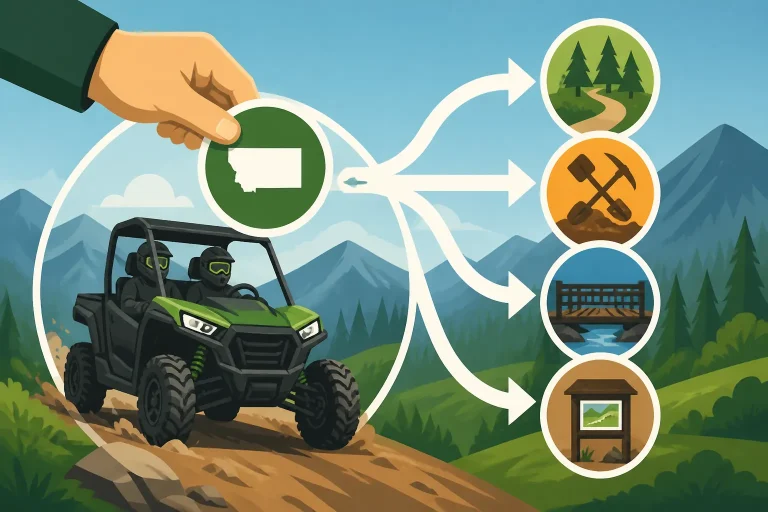
A recognized safety certificate does not automatically give the rider permission to operate a machine in Montana. Visitors should check the separate trail-pass rules before riding public trails. Montana’s non-resident permit requirements are distinct from safety education, and a certificate from another state does not serve as a trail pass. See Montana Rules for Visiting Riders for the visitor-permit context.
Nor does the card establish that the machine is properly registered or that a decal is displayed where required. A rider may have completed an accepted course and still need the correct machine paperwork and permit for the place they plan to ride. If you are travelling on an out-of-state machine, review Riding a Montana Machine in Another State only if your trip involves carrying a Montana machine elsewhere; the relevant rules depend on where the machine is being operated.
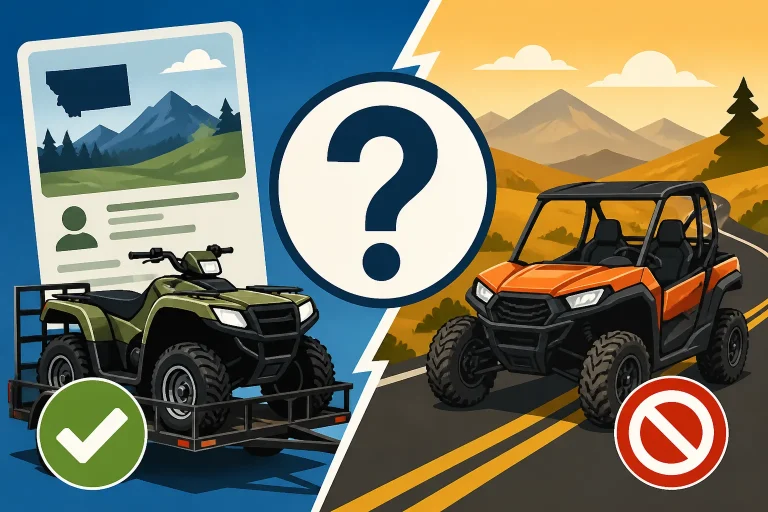
Road access is another separate question. A trail certificate does not open a county road, town street, or highway crossing to OHVs. Road riding may have additional requirements, and permission can vary by road and local rules. Before planning to ride from a trailhead into town, check the route rather than assuming the certificate or trail pass covers it.
Rental businesses may also ask for different proof or impose their own age, supervision, and driver requirements. A business’s acceptance of a certificate is useful for its rental process, but it does not settle whether the credential meets a Montana public-use requirement. Ask the rental provider what it expects, then separately confirm the public rules for the intended route.
If the card is missing, do not assume that a phone photo of a class registration or a parent’s recollection will be enough. Contact the course issuer for a replacement or written proof, and ask FWP whether the available documentation will be accepted for the rider’s circumstances. If you cannot confirm it in time, consider changing the plan so the rider does not operate where the training requirement applies.
The safest rule is simple: verify the exact certificate, keep proof accessible, and treat training, permits, registration, and road access as separate checks. That prevents a valid course card from being mistaken for permission it was never intended to provide.
Disclaimer
This article is for general informational purposes only and does not constitute professional advice. Laws, prices and regulations vary by location and change over time. Consult a qualified professional for guidance on your specific situation.