Montana Certificates Accepted Elsewhere
A Montana OHV safety certificate can be useful when you travel, but it does not automatically give you permission to ride in every other state. The receiving state sets its own rules, and acceptance can depend on the course, your age, the machine, and where you plan to ride. Here’s how to check whether your Montana certificate will count before you load up.
What a Montana Safety Certificate Proves
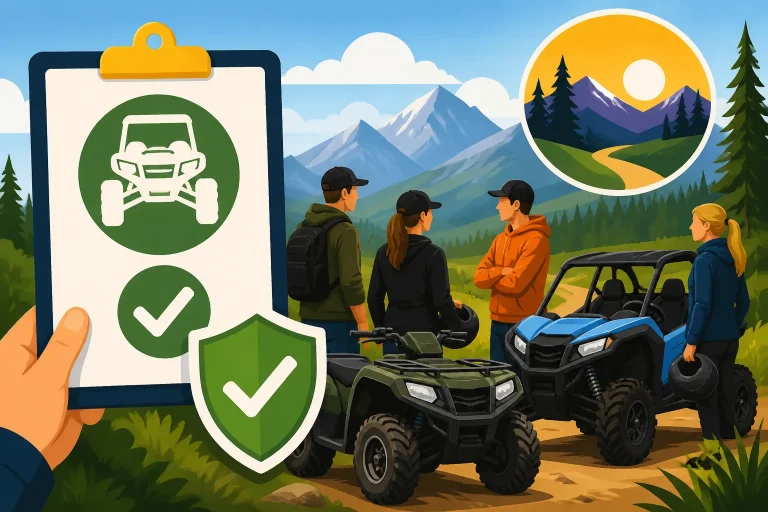
A safety certificate generally documents that a rider completed an approved safety education course. It is evidence of training—not a registration, trail permit, driver’s license, or blanket authorization to operate an ATV or UTV.
That distinction matters because states regulate different parts of riding separately. One state may require a course for riders below a certain age, while another may require a trail permit for a visiting machine. A safety certificate may address the training requirement but not the permit, machine registration, road-use rules, or other conditions.
Montana has its own OHV safety education requirements. If you ride in Montana, check Montana’s Safety Education Requirement and Who Must Take the Montana Course to understand when the course applies to you at home. A certificate earned in Montana may also be useful outside the state, but the other state decides whether it recognizes that particular course or document.
A certificate is not the same as reciprocity
“Accepted elsewhere” can mean different things. A state might accept a Montana course certificate as proof of training, accept only certificates from courses meeting particular standards, or require its own course. Even when a certificate is recognized, acceptance may apply only to a specific rider or activity.
Do not assume that a Montana certificate transfers every part of your riding status. It does not automatically transfer Montana registration, a Montana trail pass, or permission to ride on roads in another state. For the related distinction between home-state rules and travel, see Riding a Montana Machine in Another State and Reciprocity Montana Does Not Offer.
A useful way to think about it is to separate the questions:
- Training: Does the state accept your Montana safety course certificate?
- Age: Does the rule apply to you, given your age?
- Machine: Does the requirement cover your type of ATV, UTV, or other OHV?
- Location: Are you riding on a public trail, road, private land, or another managed area?
- Other permissions: Do you also need a permit, registration, insurance, or road-use equipment?
The answer to one question does not settle the others.
Keep the certificate and course details together
If you took a Montana course, keep the certificate in a place you can access during a trip. Save a clear image or electronic copy as a backup, but do not rely on a phone image alone if the receiving state or a land manager requires a particular form of proof. Keep the original document when you have one.
It also helps to save details about the course provider and completion. A title on a certificate may not tell an out-of-state official whether the course meets that state’s standard. If you have a separate course-completion record, retain it with the certificate.
For information about Montana’s own training process, see Montana OHV Safety Education Requirements and Taking the Montana Course Online. If you are still deciding whether you need to take the course, Does a Montana Safety Certificate Expire? can help clarify the certificate question for Montana, but another state may apply its own rules.
How to Check Whether Another State Will Accept It
The safest approach is to ask the state that governs the place where you plan to ride. Do this before the trip, rather than relying on a seller, friend, rental shop, or an online discussion that may describe a different age group or kind of riding.
Use the receiving state’s official guidance
Look for the state agency responsible for OHV rules, rider education, or public-land recreation. The agency may be a motor vehicle department, natural resources department, parks agency, or another office. The responsible office varies, so start with the state’s official government information and follow its directions.
Search specifically for language about out-of-state safety certificates, nonresident riders, and approved courses. Do not stop at a general page about ATV rules if it does not answer whether a Montana certificate qualifies. If the guidance is unclear, contact the agency and ask for a direct answer.
When you contact the agency, provide enough detail for a useful response:
- Identify the state and the area where you intend to ride.
- Give your age, or the age range if you are checking for a family.
- Name the course and provider shown on your certificate.
- Explain whether you will ride an ATV, UTV, dirt bike, or another type of OHV.
- Ask whether the certificate satisfies the state’s training rule for that rider and activity.
- Ask what proof you must carry and whether any other permit or registration is required.
If an area is managed by a land agency, confirm whether there are additional site-specific requirements. Statewide training rules and the rules for a particular trail system are not necessarily the same thing.
Compare the certificate with the rule—not just the state name
A certificate issued in Montana may be recognized in one context and not another. The receiving state could distinguish between a course it approves and a course that merely covers similar topics. It could also apply requirements differently to residents and visitors, adults and minors, or road riding and off-road riding.
| What to verify | Why it matters | What to ask |
|---|---|---|
| Course recognition | The state may accept only certain courses or providers | Does this specific Montana course meet your approved standard? |
| Rider age | Training rules can depend on age | Does the requirement apply to this rider’s age? |
| Machine type | ATV and UTV rules may not be identical | Does the rule cover this type of machine? |
| Riding location | Public land, trails, and roads can have different rules | Does the answer change for this riding area? |
| Proof format | A rider may need to show a certificate or other record | What document should the rider carry? |
| Separate permissions | Training does not replace permits or registration | What else must the rider obtain before riding? |
For a visiting rider, the distinction between a permit and a training certificate is especially easy to miss. Montana’s visitor permit information is separate from course completion, as explained in Montana’s Non-Resident Temporary Use Permit and What Montana Riders Need Before They Ride. The same principle applies when you travel out of Montana: check the destination’s permit rules separately from its safety-course rules.
Get the answer in a form you can refer to
If you receive an answer by phone, note the agency, the date, and the name or office of the person who provided it. If the agency offers written guidance or email confirmation, keep a copy. That record may help you explain what you checked, although it does not override the state’s rules or guarantee that every local land manager will interpret them the same way.
Do not treat a search result, a course provider’s general statement, or a permit vendor’s description as the final word if the official rule is uncertain. Those sources can be helpful starting points, but the receiving state or land manager is the one to confirm the requirement.
What Acceptance Does and Does Not Cover
If a state confirms that it accepts your Montana certificate, read the answer narrowly. “The certificate is accepted” may mean only that it satisfies one training requirement. It does not necessarily mean the rider can operate any machine, at any age, in any location, or without other paperwork.
Separate rider training from machine permissions
A safety certificate belongs to the training side of the trip. Other requirements may concern the machine or the place where you ride. Depending on the destination and activity, you may need to check:
- Whether the machine must be registered or display a permit.
- Whether visiting riders need a local trail pass or temporary-use permit.
- Whether the route is open to your machine’s type or width.
- Whether a road section is legally open to OHVs.
- Whether a driver’s license, insurance, or road equipment is required.
- Whether children must ride with an adult or meet additional conditions.
- Whether the land manager has rules beyond the state’s general requirements.
For example, a certificate could be accepted as proof of training while the machine still needs a separate trail permit. Or the rider may meet the training rule but be too young to operate the machine on a particular road or trail. Check each issue on its own.
This is also why Montana’s certificate should not be confused with another state’s trail pass. Montana’s own permit system distinguishes between registration, resident trail passes, and nonresident permits; those are not interchangeable with a course certificate. The destination state may use different names, so read what each document actually authorizes.
Confirm requirements for children and teens separately
Families should verify each young rider’s situation rather than assume one answer covers everyone. Age-based rules can determine whether a course is required, what machines a young person may operate, whether adult supervision is needed, and whether road riding is allowed. A certificate does not cancel those limits.
If a teen has completed Montana’s course, provide the receiving agency with the teen’s age and the exact certificate information. Ask whether the certificate satisfies the training requirement and what other restrictions apply. For Montana-specific age questions, Montana Age Rules for Riders Under 16 and [Montana Rules for a Rider Turning 16] cover related issues at home, but they do not establish another state’s requirements.
Check again when the riding plan changes
An answer for one trail, county, or type of machine may not apply to a different plan. Recheck if you change states, switch from trail riding to a road route, bring a different machine, or add a younger rider. A rental machine may also come with its own paperwork and operating conditions; ask the rental provider what it supplies, then confirm any independent state or land-manager requirements.
Before departure, use a short checklist:
- Take the Montana certificate and keep a backup copy.
- Confirm the destination state recognizes the specific course.
- Check whether acceptance depends on age or machine type.
- Confirm permits, registration, and trail access separately.
- Review road-use requirements if your route includes public roads.
- Carry the proof the state or land manager requires.
- Recheck official guidance if the route or riding party changes.
This approach avoids the most common misunderstanding: treating a training certificate as if it were a universal riding pass. It may satisfy an out-of-state course requirement, but only the receiving jurisdiction can confirm that, and the rest of the trip’s rules still apply.
A Practical Pre-Trip Check
When the answer is uncertain, do not guess based on the certificate’s appearance or the fact that it came from Montana. The destination may recognize the course, require another one, or apply no course requirement to your particular rider and activity. A short check with the responsible agency can prevent a frustrating stop or a ride that has to be abandoned.
Start with the most specific question: “Will you accept this Montana OHV safety certificate for this rider, on this machine, in this area?” Then ask what additional documents the rider needs. Avoid asking only whether “Montana certificates are accepted,” because the broad question may not capture the age, course, or location details that determine the actual answer.
Keep a simple trip folder with the certificate, machine information, permit records, and any agency response. If you travel with more than one rider, label documents clearly so each person can show their own proof. Confirm requirements for every state crossed if the trip involves more than one jurisdiction, especially if you plan to ride rather than simply transport the machine through it.
The practical takeaway is straightforward: a Montana safety certificate can be accepted elsewhere, but acceptance is not automatic or universal. Verify the exact course and rider with the destination’s official agency, and treat training, permits, registration, and road access as separate checks.
Disclaimer
This article is for general informational purposes only and does not constitute professional advice. Laws, prices and regulations vary by location and change over time. Consult a qualified professional for guidance on your specific situation.