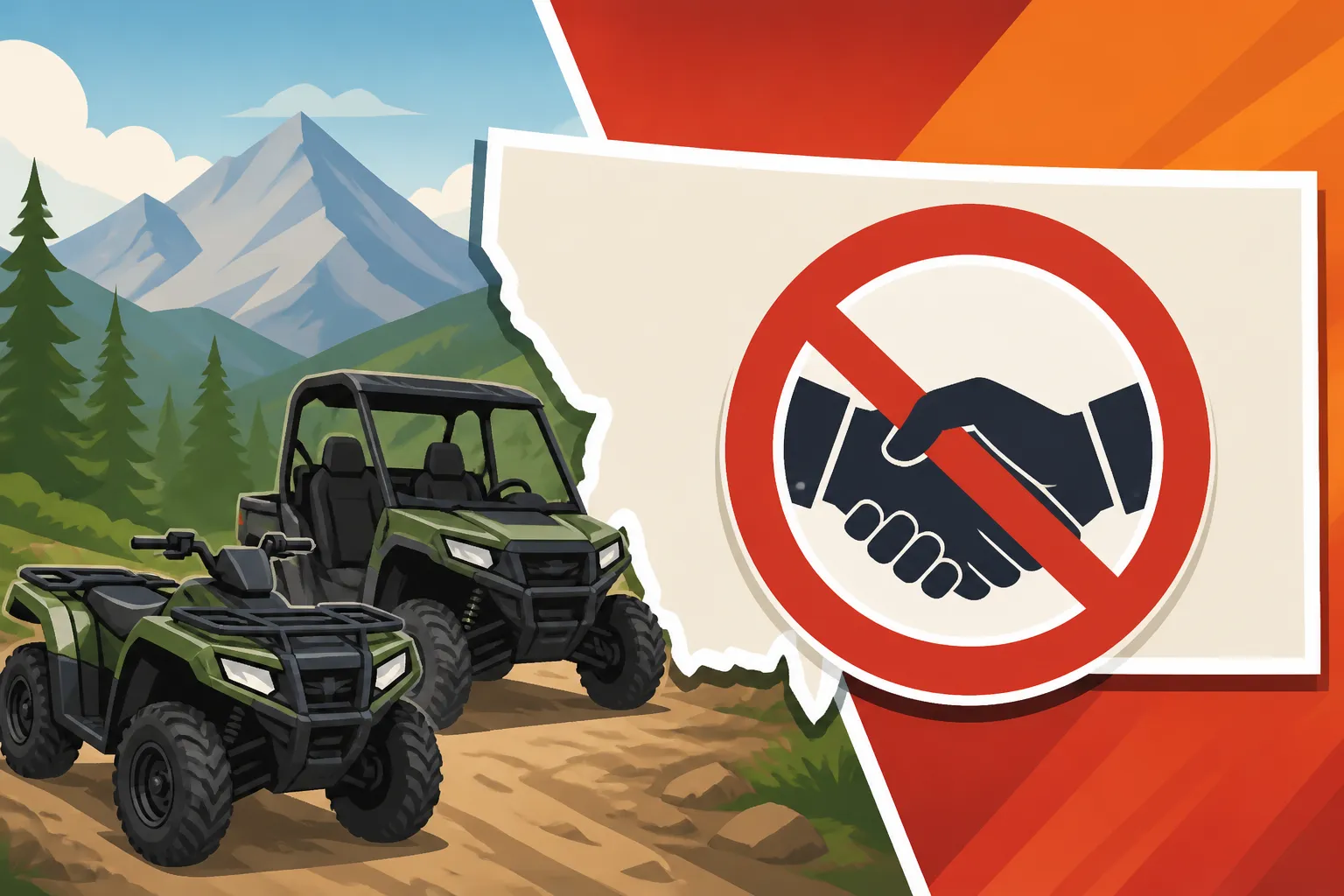
Reciprocity Montana Does Not Offer
Taking an ATV or UTV across a state line can leave you wondering whether its home-state registration or trail permit will count in Montana. The short answer is that you should not assume it will. Montana’s visitor permit requirements are separate from your home-state paperwork, and a Montana permit does not automatically give you riding privileges elsewhere.
What “No Reciprocity” Means for Montana Riders
Reciprocity is an agreement or policy under which one state recognizes certain credentials issued by another. For OHV riders, that might mean accepting an out-of-state registration, decal, or trail permit instead of requiring a visitor to obtain local paperwork.
The practical point for a trip to Montana is simple: an out-of-state registration or riding permit generally should not be treated as a replacement for Montana’s required nonresident trail permit. If you are bringing an ATV, UTV, or other OHV from another state, check what Montana requires for that machine and the places where you plan to ride. Start with Montana’s Non-Resident Temporary Use Permit and What Montana Charges an Out-of-State Rider.
That does not mean every part of your home-state paperwork becomes meaningless at the border. Registration may still help establish that the machine is properly documented where it is based. A plate or other road-use credential may matter when the vehicle is being operated on a road, subject to the applicable rules. But those documents do not, by themselves, prove that you have satisfied Montana’s separate trail-access requirements.
It also does not mean a Montana permit carries over when you leave the state. The destination state sets the requirements for riding there. Montana’s permit is not a national pass, and another state may require its own registration, decal, permit, or proof of road legality. See Riding a Montana Machine in Another State and Does Any State Honor Montana Registration? before planning a trip across state lines.
| Paperwork or credential | What it may be relevant to | What not to assume |
|---|---|---|
| Home-state registration | Identifying or documenting a machine registered at home | That it replaces Montana’s nonresident trail permit |
| Montana nonresident trail permit | Meeting Montana’s visitor trail-permit requirement where it applies | That it makes a machine legal on public roads |
| Road-use plate or registration | Road operation when the vehicle and route meet applicable requirements | That it provides access to every trail or public-land route |
| A permit from another state | Riding under that state’s rules | That Montana or a different destination state recognizes it |
| Montana OHV registration | Montana registration and associated privileges, as applicable | That another state must accept it as a substitute for its own requirements |
A useful way to think about reciprocity is to separate three questions:
- Is the machine documented or registered? This depends on the machine, its ownership, and the relevant registration rules.
- Does the rider have the permit required for the place? A state trail permit and land-manager access rules can apply even when the machine has paperwork from home.
- Is the route open to that kind of vehicle? A permit does not open a closed route or authorize riding on land where motorized access is prohibited.
Those questions are related, but they are not interchangeable. A common planning mistake is to answer the first question and assume the other two are settled.
When a Visitor May Need a Montana Permit
Montana has a nonresident permit system for visitors using OHVs. If you are bringing a machine from outside Montana, find out whether the permit is required for your intended use, whether your vehicle falls within the relevant category, and what rules apply to the land or route. The state-specific overview is Montana Rules for Visiting Riders.
The key distinction is often between the machine’s paperwork at home and its use in Montana. A valid home-state registration may document the vehicle, but it does not automatically satisfy Montana’s trail-permit requirement. The same is true of an out-of-state trail sticker or permit: it was issued under another jurisdiction’s rules and should not be assumed to work in Montana.
Before leaving, confirm the current details through the official Montana source responsible for OHV permits. Requirements can depend on factors such as vehicle type, the rider’s status, whether the vehicle is operated on public land, and whether an exception applies. The details in Montana Permit Rules on Public Land are a useful starting point for sorting out where the permit question matters.
Check the machine, not just the owner
A household may bring more than one vehicle, and a permit or credential that applies to one machine may not cover the others. Make a list of each ATV or UTV you plan to ride, including who owns it and whether it is registered in another state. Then check the requirement for each vehicle rather than assuming one permit covers a group.
This matters for rented or borrowed machines too. The owner, rental business, or another rider may have handled some paperwork, but it is still worth confirming who is responsible for any required permit and whether it applies to the machine you will operate. A rental agreement or a friend’s registration is not a substitute for checking the actual state requirement.
Check where you plan to ride
A permit requirement is only one part of access. A trail may be on state, federal, or other land, and the land manager may have separate rules about designated routes, seasonal closures, vehicle width, or permitted uses. A permit does not grant general access to public land. It also does not turn an unmarked road into an authorized OHV route.
Before a trip, identify the riding area and look up the current route information for the land manager. Match your machine’s width and type to the route designation, and check for temporary closures. Finding a Forest’s Motor Vehicle Use Map explains why checking the correct map matters when routes are managed by a national forest. For broader visitor requirements, see What Montana Riders Need Before They Ride.
If your trip includes more than one riding area, repeat the check for each one. Access conditions can differ between nearby trails, and a route that allows an ATV may not allow a wider side-by-side. Seasonal restrictions may also affect a trip even when the machine and permit are otherwise in order.
Verify the current permit process
Use an official sales channel or state information page to confirm how the permit is obtained and what proof you need to carry or display. The process may change, so do not rely solely on an old forum post, a past trip, or another rider’s recollection. Buying a Trail Pass Through FWP Online Licensing can help orient you to the purchase process.
When you confirm the rules, note the permit’s scope and validity, as well as any placement or display instructions. Save the confirmation or receipt and follow the official instructions for the decal or other proof. If the instructions are unclear, ask the relevant state office before you ride rather than trying to resolve it at a trailhead.
What a Montana Permit Does and Does Not Authorize
A trail permit addresses a specific requirement. It is not a general license to operate an ATV or UTV anywhere in Montana. Understanding that boundary helps prevent the frustrating assumption that buying a permit settles every legal and access question for the trip.
A trail permit is not road authorization
A nonresident trail permit should not be treated as permission to ride on a public road. Road use is governed by separate requirements, and it may depend on the road, local rules, the machine’s equipment and status, and the rider’s qualifications. Some roads may be open to OHVs under specific conditions; others may not be.
If road riding is part of your plan, check the specific route and applicable rules separately. A trail permit will not make an otherwise prohibited road ride lawful, and a road-use plate does not necessarily satisfy trail-permit requirements. The distinction is covered in Why the Non-Resident Permit Covers Trails Only and Does the Non-Resident Permit Allow Road Riding?.
Do not infer that a road is open just because it is gravel, connects two trails, or appears on a navigation app. Confirm access with the responsible public agency or local authority. Where a route crosses land with different managers, check each segment.
A permit is not permission to ride off route
Public land is not automatically open to motorized travel. A permit does not authorize cross-country riding, travel on a closed trail, or access across private property. The route itself must be open to the type of machine you are using.
Use current official maps and notices, and obey signs at the trailhead. If an authorized route is muddy, damaged, or temporarily closed, do not ride around the closure to continue your trip. Ruts and off-route travel can damage the trail and may lead to enforcement. Montana Permit Rules on Public Land is relevant here, but the agency managing a particular area is the source for its route rules and closures.
A permit is not a substitute for machine and rider requirements
Other requirements may apply to the machine or the person operating it. Depending on the situation, these can involve registration, required equipment, age or safety education rules, helmets, insurance, or special road-use conditions. Which rules matter depends on where and how you ride.
For instance, someone operating only on an authorized trail may face a different set of requirements than someone planning to use a road section. A young rider may have additional restrictions. A street-legal machine may still need to comply with rules for the trail system it enters. Check the requirements for your specific plan rather than relying on a single decal as proof that everything is covered.
A permit does not guarantee access to every landowner’s property
Permission is still needed to ride on private land unless an applicable access arrangement provides otherwise. A Montana permit is not a pass to cross a ranch, use an unmarked private road, or follow a trail beyond its authorized public section.
This can be easy to overlook when a route appears continuous on a map. Pay attention to signs and boundaries, and confirm permission before entering private property. If the route’s status is unclear, stop and check rather than assuming the public trail continues.
Planning an Interstate OHV Trip Without Assuming Reciprocity
The safest approach is to plan each state and each riding area as its own set of requirements. That takes a little more effort before departure, but it avoids arriving at a trailhead with the wrong permit, an unclear route, or an assumption that home-state paperwork settles the issue.
Make a document and permit checklist
Before loading the machine, write down what you need to verify:
- Identify every machine. Record the make or description, ownership, and the state where it is registered, if applicable.
- Check Montana’s visitor permit requirement. Confirm whether each machine needs a nonresident permit for your planned use.
- Separate trail use from road use. If you intend to ride any public road, check the rules for that specific road and the machine’s eligibility.
- Confirm route access. Use current official maps and closure information for each riding area.
- Check rider-specific requirements. Review age, safety education, helmet, and other applicable rules for each person who will operate or ride as a passenger.
- Keep proof accessible. Follow official instructions for displaying any decal and carrying receipts, registration, or other documents.
- Recheck before departure. Closures, access conditions, and administrative requirements can change.
This checklist is especially useful when a trip includes multiple machines, several states, or both trail and road riding. For more detail on visitor paperwork, use Montana’s Non-Resident Temporary Use Permit alongside the official information for the specific area you plan to visit.
Do not confuse a state trail permit with reciprocity
A state may sell a permit to nonresidents without having a reciprocal agreement with the states where those visitors live. A permit is simply the credential required under that state’s rules. It does not indicate that the state accepts another jurisdiction’s credentials, nor that another state will accept its permit.
That distinction works both ways. If you have a Montana-registered machine and plan to ride in another state, check that state’s rules before you leave. Do not assume that Montana registration, a Montana trail pass, or a Montana decal will satisfy a destination state’s requirements. Start with Riding a Montana Machine in Another State and confirm the destination’s current requirements with its responsible agency.
Ask the right questions when rules are unclear
A focused question is more likely to get you a useful answer than asking whether your machine is “legal.” Explain the vehicle type, where it is registered, whether you are a resident or visitor, where you intend to ride, and whether the route includes public roads. Then ask whether you need a Montana permit, what proof must be displayed or carried, and which rules apply to the specific land or route.
If the answer comes from a dealer, rental shop, campground, or another rider, use it as a lead rather than the final authority. Those businesses and riders can be helpful, but they may be describing a different machine, a different land manager, or a previous set of rules. For a definitive answer, contact the state program or land manager responsible for the specific requirement.
Build a buffer into the trip plan
Do not wait until you reach the trailhead to discover that you need a permit or that the route is closed. Confirm the paperwork before travel, and have a second riding option in case the intended area is inaccessible. That backup still needs to be checked for permit and route requirements; it is not automatically covered because the first location was.
Keep a record of the official information you checked, including route maps and permit instructions. This is useful if you need to explain your plan to other riders in your group, and it helps avoid last-minute confusion when someone assumes a home-state sticker is enough.
Frequently Asked Questions
Does Montana accept my home-state ATV registration instead of a Montana trail permit?
Do not assume it does. Home-state registration and Montana’s visitor trail-permit requirement are separate matters. Check Montana’s current rules for your machine and intended use before riding.
Will a Montana nonresident permit let me ride on public roads?
A trail permit does not, by itself, authorize road use. Road access has separate requirements and depends on the route, machine, and applicable local rules. Check each road before riding it.
Does a Montana permit work in another state?
Not automatically. The other state sets its own requirements. Check with that state’s responsible agency before riding there, even if your machine has Montana registration or a Montana permit.
If my machine is registered in another state, can I ride it on Montana public land?
The fact that it is registered elsewhere does not settle the permit question. Confirm whether Montana’s nonresident permit applies to your machine and activity, and check the land manager’s route rules and closures.
Disclaimer
This article is for general informational purposes only and does not constitute professional advice. Laws, prices and regulations vary by location and change over time. Consult a qualified professional for guidance on your specific situation.