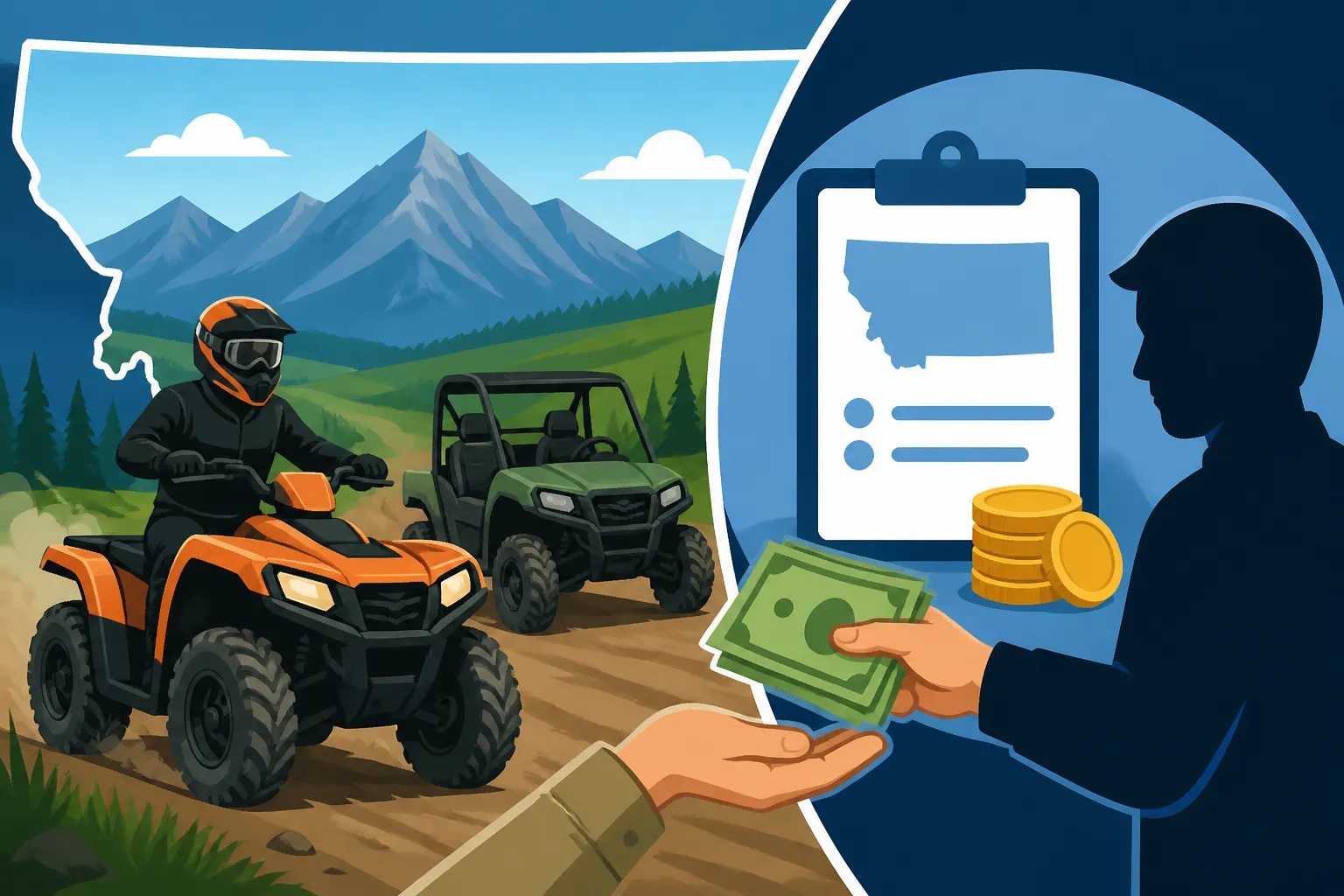
What Montana Charges an Out-of-State Rider
An out-of-state rider can arrive in Montana with a registered ATV, a trail map, and a weekend planned, then discover that the machine still needs a Montana trail permit for certain public-land riding. This guide explains which fee may apply, what it covers, what it does not cover, and how to check the requirements before you unload at a trailhead.
The Montana charge most visiting riders need to understand
A nonresident trail permit is separate from your home-state registration
For an out-of-state rider, the central question is often not “Is my ATV registered at home?” but “What does Montana require for the riding I plan to do here?” A machine’s home-state registration and a Montana nonresident trail permit are different things. Registration identifies or authorizes a vehicle under the rules of the state where it is registered; a Montana permit addresses use under Montana’s recreation rules.
That distinction can be easy to miss when you are traveling. You may have paid registration fees at home, brought the paperwork, and reasonably assume you have met every requirement. But a visiting rider may still need a Montana permit to ride an OHV on covered public lands. Having a plate or registration card is not, by itself, proof that you have met every Montana trail-access requirement.
The permit category to investigate is Montana’s nonresident temporary use permit. Its application depends on your residency, the type of machine, and where you intend to ride. For the official overview, see Montana’s Non-Resident Temporary Use Permit. Before a trip, check Montana Fish, Wildlife & Parks information and any land manager’s rules for the specific area.
What the fee is for and what it is not
Think of the permit as an access-related requirement, not a catch-all payment that settles every vehicle issue. It does not automatically register your ATV in Montana, transfer your home-state registration, make a machine street legal, or authorize travel on every road. It also does not replace a land-use permit if a particular activity, group event, or managed area requires one.
The charge can also be confused with the costs of using a machine that belongs to someone else. A rental shop may include permit arrangements in its rental process, or may tell you what you need to obtain yourself. That shop’s rental charge is not the same thing as a state permit fee. If a friend lends you a machine, do not assume the owner’s permit or registration covers your individual ride.
The safest way to budget is to list each obligation separately: the Montana permit, any registration or operating requirements that apply to the machine, any rental or access charges, and any additional permissions for the land or activity. That simple separation prevents an unpleasant surprise at the trailhead and makes it easier to ask the right questions when you call a county office, park, rental shop, or land manager.
Why the exact amount should be checked before departure
Permit fees and procedures can change, so use the official fee information available when you are planning the trip rather than relying on an old forum post, a friend’s memory, or a screenshot saved from a previous season. A past receipt can help you identify the permit type, but it is not a reliable guide to the current fee or validity period.
Check the cost before you travel, and confirm that the permit you are looking at is for a nonresident and for the machine you will operate. If you are bringing more than one ATV or UTV, ask whether each machine needs its own permit. Do not assume one payment covers everyone in a group or every machine on a trailer.
A practical approach is to keep a small trip budget with separate lines for permits, fuel, lodging, rental costs, and any trailhead or event expenses. If the permit must be displayed or carried in a particular way, check that detail at the same time. That way, the cost is not the only thing you have confirmed; you also know what you need to show if a warden or other authorized officer asks.
Which rides may trigger Montana’s nonresident permit requirement
Public-land trail riding calls for careful checking
The words “public land” can sound simple, but they cover a patchwork of places managed by different agencies. A route may cross a Forest Service road, a designated OHV trail, a state recreation area, or land managed under a different set of rules. The fact that the land is public does not mean every machine is allowed everywhere, or that one permit automatically covers every type of access.
Before you ride, identify the specific trail system and the agency responsible for it. Then check the agency’s current motorized-use map and any posted restrictions. A trail may be open only to certain vehicle widths, closed seasonally, or subject to rules about where an OHV may travel. Montana permit requirements are only one part of the answer; the route itself still has to be open to your machine.
This is especially important if your trip mixes destinations. A rider might start on a trail in a national forest, cross a county road, and continue onto a different recreation area. Each segment may have a different rule set. Montana Permit Rules on Public Land is a useful place to begin thinking about how the land-management setting affects your obligations, but confirm the details for the exact route you plan to use.
Private property is not a blanket workaround
Some visitors hear that a permit applies to public land and assume that private ground is automatically open or exempt. That is not a safe assumption. A private ranch is available only with the owner’s permission, and permission does not necessarily settle every other requirement that may apply to the machine or activity. If the property is leased, managed, or part of a larger recreation operation, ask the person who controls access what rules apply.
A ride can also move between private and public land without the rider realizing it. A trail entrance near a ranch road may lead onto a public route, or a route shown in an app may cross a private parcel. Do not treat a line on a map as proof that you have permission to cross. Check land boundaries, follow signs, and ask before riding where access is unclear.
For a visiting rider, the best practical rule is to sort out both permission and permit obligations before unloading. Ask the property owner or host where you may ride, whether the route leaves private land, and whether any public-land segment requires a Montana permit. That conversation is much easier at home than after you have reached a gate or trail junction.
Road riding and trail riding are different questions
A Montana trail permit should not be mistaken for permission to ride an ATV or UTV on a public road. Road use may depend on the road’s ownership, local ordinances, the vehicle’s equipment, the rider’s age or license status, and other requirements. A trail pass alone does not make a route legal for road travel.
This distinction matters in small towns and trail communities. A route may connect a trailhead with a store or campground, but a convenient connection is not automatically an authorized road route. A local ordinance may allow OHVs on some streets and prohibit them on others. County roads can have separate rules, and a state highway is not interchangeable with a forest road simply because both appear as lines on a map.
If your plans include a road section, check the road-specific requirements before riding it. The related guide Does a Montana Non-Resident Permit Allow Road Riding? addresses the important difference between holding a trail permit and having authority to use a road. For broader visiting-rider questions, see Montana Rules for Visiting Riders.
What the permit covers and what it leaves out
The permit is tied to a defined use, not unlimited access
A permit can meet one requirement without granting a rider unrestricted access. It does not open a closed trail, cancel a seasonal restriction, override a land manager’s route designation, or authorize off-trail travel. If a route is marked closed or is not open to your type of machine, the permit does not change that.
This can feel frustrating when you have already paid and planned around a ride. But a permit and a route authorization answer different questions. The permit addresses whether you have met a particular Montana use requirement. The map and local restrictions tell you where you are allowed to operate. A rider needs both answers, not one or the other.
Before heading out, compare your planned route with the relevant official map and posted signs. If the map is unclear, contact the office responsible for that area. Avoid relying only on a phone navigation app or a user-submitted track. Those tools may help with orientation, but they are not a substitute for current motorized-use information.
A permit does not replace registration or equipment rules
A Montana permit is not a substitute for requirements imposed by your home state or for rules that apply to your machine in Montana. Keep your registration documents and any proof of ownership or rental authorization with you, as appropriate. If the machine is borrowed, know whose name appears on its paperwork and how to reach the owner.
Equipment requirements depend on the kind of riding. A machine used on a trail may be subject to rules different from those that apply if you are trying to use it on a road. Lighting, brakes, mufflers, helmets, insurance, and rider qualification can matter in particular settings. Do not assume a permit is evidence that every other requirement has been satisfied.
A useful comparison is:
| Question | What to verify | What a Montana trail permit does not automatically do |
|---|---|---|
| Is the machine registered? | Home-state registration and applicable vehicle rules | Register the machine in Montana |
| Is the route open? | Current land-manager map, signs, closures, and machine limits | Open a closed trail or authorize off-trail travel |
| Is road use allowed? | Road ownership, local ordinance, equipment, and rider rules | Make the machine street legal |
| Is a permit required? | Residency, machine type, location, and activity | Replace registration, insurance, or other permissions |
| Is the machine rented or borrowed? | Rental agreement or owner permission and permit responsibilities | Automatically cover every operator or machine |
A simple checklist can prevent the common mistake of treating one document as a universal pass. Check the permit, route, machine, and rider separately. If one of those answers is uncertain, pause and confirm it before riding.
Other charges may belong to the trip, not the permit
The total cost of an out-of-state ATV trip may include more than the Montana permit. A rental, campground, guided ride, event, or vehicle transport arrangement can have separate charges. Some places may require reservations or additional permissions. Those costs should not be lumped together with the state permit, because they go to different providers and may have different terms.
If you are renting, ask the shop whether permit paperwork is included, whether it is your responsibility, and whether the machine is restricted to certain routes. A rental business may handle some steps while expecting you to follow specific route limits. Ask for the answer in plain language before signing, especially if you are unfamiliar with Montana’s public-land system.
If you bring your own machine, set aside money for the permit and check whether each machine needs a separate one. Keep a copy of the fee confirmation with your trip documents. A small amount of preparation is far less annoying than reaching the staging area and discovering that you have to interrupt the group to sort out paperwork.
How permit duration and machine coverage work
Confirm how long your specific permit remains valid
Do not assume the permit lasts for the entire season, calendar year, or length of your vacation. The validity period is part of the permit’s terms, and it can affect how you plan a multi-day visit or a return trip. Check the expiration or use period printed on the permit and confirm that it covers the dates you intend to ride.
This is especially important when travel dates shift. A storm, wildfire closure, family delay, or mechanical problem can push a planned ride to another day. If a permit is time-limited, a changed itinerary may leave you with a gap. Do not rely on the fact that you bought it recently; read the actual validity information.
For additional planning detail, see When a Montana Non-Resident Permit Expires. Keep the permit information accessible, whether that means a paper copy, an electronic confirmation, or both. A phone can lose service in remote areas, so a printed backup is sensible when the permit process provides one.
Check whether each machine needs its own permit
A family or group can arrive with several machines and assume one permit purchase covers the whole party. That may not be how the requirement works. Confirm whether the permit applies to an individual operator, a specific machine, or a particular combination of rider and vehicle. The answer matters if two people take turns riding, or if one person operates multiple ATVs during the trip.
A family example makes the issue clear. If two adults bring separate machines and a teenager rides a third, the family should not infer that one adult’s permit covers all three vehicles. Likewise, a friend borrowing an ATV for part of the day should not assume the owner’s paperwork settles the borrower’s obligation. Ask before the trip rather than trying to interpret the rules at the trailhead.
When buying or arranging permits, match the paperwork to the actual machines and riders. Write down each machine’s make, model, and identifying information so you can answer questions accurately. This is also helpful if a vehicle is rented, borrowed, or part of a group reservation.
Group trips need a clear person responsible for paperwork
Groups often divide planning among several people: one books lodging, another brings the trailer, and someone else chooses the route. That division can leave permit details unattended. Assign one person to confirm requirements for every machine, then share the answer with the rest of the group before departure.
For a club ride or organized event, ask the organizer whether the event has any additional requirements. A participant’s individual permit may not be the only issue if the activity involves a coordinated route, a managed site, or a large gathering. The event organizer should be able to explain what participants must obtain and what the organizer is handling.
A concise group message can reduce last-minute confusion: list the permit type to check, the official place to verify it, whether each machine needs its own documentation, and what each rider should carry. That is more reliable than assuming everyone saw the same social-media post or remembers the rules from a prior trip.
How out-of-state riders can check and obtain the right permit
Start with residency, machine, and route
Before searching for a permit, answer three questions: Are you a Montana resident or nonresident under the applicable rules? What type of machine are you bringing? Where will you ride? The permit category depends on those details, so starting with the route and machine helps prevent choosing the wrong product.
A rider from Idaho taking a registered ATV to a Montana trail system has a different situation from a Montana resident riding a machine locally, a person renting a UTV, or someone using a farm machine on private property. Do not choose a permit based only on what a friend bought. Their residency, vehicle, and riding location may not match yours.
The official permit information should explain the current process and the appropriate category. If you are unsure which category applies, contact the agency or seller responsible for issuing the permit and describe your exact situation. A specific question such as “I am visiting from another state, bringing two registered ATVs, and riding this named trail system” is much easier to answer than “What do I need?”
Buy or arrange the permit before you reach the trailhead
It is usually more comfortable to handle paperwork while you have reliable internet, time, and access to your records. Start with Buying a Non-Resident Permit Before You Drive and follow the current official instructions. If the permit is available through more than one authorized channel, use a source that clearly identifies the permit and provides proof of purchase.
Keep confirmation details in more than one place. Save the receipt on your phone and, where possible, print it. If you are traveling with a group, make sure each rider knows where their own proof is stored. A screenshot that only one person can access is not especially helpful if the group splits up.
If you need to buy or print supplies before leaving, Amazon may be one convenient option for ordinary trip items such as a waterproof document pouch or map case. That is a gear purchase, not a permit source. For the permit itself, rely on the official Montana process or an authorized seller listed by the responsible agency.
Carry enough information to explain your compliance
A rider may be asked to show proof of a permit or explain the machine’s registration and authorization. Keep the relevant documentation accessible rather than buried under luggage in the trailer. If you are on a group ride, each operator should know what documents apply to their machine and how to retrieve them.
Paperwork can be exposed to rain, dust, and trail grime, so protect it. A small waterproof pouch kept in a secure, accessible location can help. You can find basic document-storage options through Amazon, but choose something that does not interfere with safe riding or create a loose item that could fall from the machine.
Do not carry documents in a location that creates a safety issue or violates the machine’s instructions. If the permit has a display requirement, follow that requirement rather than improvising. And if your phone is your only copy, consider the dead-zone problem: much of a backcountry ride may not offer reliable service, even if a digital record is accepted.
Reciprocity and why a home-state pass may not be enough
Do not assume another state’s permit transfers to Montana
A home-state trail pass or OHV registration may be valid for riding under that state’s rules, but it does not necessarily satisfy Montana’s nonresident requirements. Different states create different systems, and there is no safe general rule that a pass purchased elsewhere will be honored automatically.
That can be frustrating for riders who travel regularly. You may have a current sticker in your home state and have paid similar fees there, so buying another permit can feel like paying twice. Still, the two charges may support separate state programs or apply to different uses. Check the rules for Montana rather than treating another state’s document as a substitute.
The broader issue is covered in Reciprocity Montana Does Not Offer. Before crossing a state line, make a short checklist for each state on your route. A Montana permit does not settle what is required in Idaho, Wyoming, or another destination, just as a permit from those states does not automatically settle Montana’s requirements.
Montana’s permit does not travel with you into another state
If you plan to ride in Montana and then continue into another state, check that next state’s rules separately. The Montana permit is tied to Montana’s requirements; it is not a national OHV pass. Your home registration, Montana permit, and any additional state or local permit may all have different scopes.
Consider a rider hauling a side-by-side from western Montana into Idaho for the next leg of a vacation. The rider should confirm where the Montana permit applies, where Idaho rules take over, and whether the machine’s registration and equipment meet the requirements for both locations. A route may also include roads or lands managed by different agencies, making the map and local restrictions important at each stage.
A route-planning app can be useful for navigation, but it cannot reliably answer every legal access question. Some riders use a printed map and GPS tools together; a device or map accessory found through Amazon may help with navigation, but the user still needs current official route information. Navigation helps you find the route. It does not establish that the route is open or that your permit is accepted there.
Separate permit reciprocity from road and registration reciprocity
The word “reciprocity” can mean different things in casual conversation. A rider might be asking whether Montana recognizes another state’s registration, whether a trail permit is accepted, or whether a machine can use roads. Those are separate questions. A yes to one does not mean yes to all three.
For example, a machine may be properly registered at home but still need a Montana trail permit for certain riding. A Montana permit may meet a public-land use requirement without authorizing road travel. And a road may have local restrictions even if the machine’s paperwork is in order. Keeping those questions separate helps avoid false confidence.
When you call an agency, be precise about what you mean: “Does Montana accept my home-state registration for this purpose?” “Do I need a nonresident trail permit for this public-land ride?” or “Can this machine use this particular road?” Specific questions are more likely to get useful answers than a broad question about whether Montana has reciprocity.
Common mistakes that lead to extra cost or a wasted ride
Treating the registration sticker as the only requirement
One of the most common misunderstandings is assuming that a valid home-state registration sticker means no Montana paperwork is needed. Registration and trail-use permits may serve different purposes, so a rider can be fully prepared under one system and still have an unmet Montana requirement.
This mistake often happens late in trip planning. The machine has been serviced, the trailer is loaded, lodging is booked, and everyone assumes the paperwork is finished. A five-minute check of Montana’s visitor requirements earlier in the process can prevent a scramble at the staging area.
Make a separate line in your trip checklist for the Montana nonresident permit. Do not hide it under “vehicle registration.” Write down where to confirm the requirement, what type of machine is involved, and whether every machine in your group is covered. That small bit of organization is especially helpful when multiple households are traveling together.
Assuming the permit makes every road legal
A trail permit does not convert an ATV into a road-legal vehicle or grant access to a public road. Riders sometimes make this assumption because a trail route appears to connect to a town or because they see other machines on a road. Other riders may have a different authorization, or the road may have different rules.
Check the specific road and the local requirements before using it. Look for municipal ordinances, county rules, signs, and machine equipment requirements. If you cannot confirm that the road is open to your machine, do not use it as a shortcut. A detour is inconvenient; a citation or an unsafe encounter with regular traffic is worse.
Road access can also vary within one community. A town may permit OHV use on certain streets but restrict other roads, or a route may require a particular connection between a trail and a staging area. The trail permit answers only the permit question. It does not answer the road question.
Waiting until the trailhead to sort out the details
A trailhead is a poor place to untangle unclear paperwork. Cell service may be weak, the group may be waiting, and the relevant office may be closed. If the permit must be purchased online, an unreliable connection can turn a quick task into a frustrating delay.
Check the rules while you have time to compare information and contact an agency. Save the official instructions, verify the fee and validity period, and keep proof of purchase available offline. If the ride involves a rental, contact the shop before booking or before pickup to clarify who handles permits and what routes are allowed.
This preparation is not about turning a fun weekend into a paperwork project. It is about doing the small administrative tasks once, calmly, so you can spend your time riding rather than refreshing a page beside a trailer.
A pre-trip checklist for an out-of-state Montana rider
Confirm the permit and the route
Start by identifying the actual trail system, not just the nearest town or campground. Check the land manager’s current map, the route’s open status, and any limits that apply to your machine. Then confirm whether your residency and vehicle type require a Montana nonresident permit for that ride.
Use What the Non-Resident Permit Covers to clarify the scope of the permit, and keep in mind that the permit does not itself open every route. If you are visiting several areas, repeat the route check for each one. A trail that is open in one forest or recreation area may be closed, restricted, or managed differently in another.
Finally, check road connections separately. If your plan includes a county road, town street, or highway crossing, find the rules for that exact section. Do not assume that a legal trail ride automatically makes every connecting road legal.
Confirm the paperwork for every machine and rider
Make a list of all ATVs and UTVs in the group. Note whether each is owned, borrowed, or rented, and identify who is responsible for registration paperwork and any permit. If a rider will switch machines during the day, confirm how the permit rules apply rather than assuming the first machine’s paperwork covers the second.
Check the permit validity dates, purchase confirmation, and any display or carry instructions. Keep proof of home-state registration and owner permission available where appropriate. If a rental shop is handling any part of the process, ask what it handles and what remains the renter’s responsibility.
For youth riders, passengers, and anyone operating on a road, check age, supervision, safety, and equipment rules independently. An adult’s permit or registration does not automatically make a young rider eligible to operate a machine. A well-planned family trip includes both the paperwork and the rider rules.
Pack for the practical realities of Montana riding
Remote riding can involve changing weather, dust, rough surfaces, and long stretches without reliable cell service. Bring water, basic repair supplies, a first-aid kit, and a navigation plan appropriate to the terrain. Keep your permit and vehicle information protected but accessible, and let someone know where your group intends to ride.
If you are buying ordinary trail supplies, Amazon may offer convenient access to items such as a waterproof storage pouch, a compact first-aid kit, or a paper map holder. Treat those as optional gear choices, not official guidance. The route map, permit instructions, and land-manager notices should come from the responsible agency.
Before pulling away from the staging area, take one last look at the group: every machine accounted for, every rider clear on the route, permits and documents accessible, and no one relying on a guess about road access. That final check is a simple way to catch the little problem that could otherwise unravel the day.
Disclaimer
This article is for general informational purposes only and does not constitute professional advice. Laws, prices and regulations vary by location and change over time. Consult a qualified professional for guidance on your specific situation.