Montana Penalties for Riding Off Trail
Riding an ATV or UTV beyond an authorized route in Montana can turn a fun trip into a citation, a trespass complaint, or a bill for damage. The consequences depend on the land, the route rules, and what the riding harmed. Knowing what counts as off-trail travel—and what to do if you’re stopped—can help you avoid a preventable problem.
What counts as riding off trail in Montana
“Off trail” generally means operating a machine somewhere motorized travel is not authorized: outside a designated route, across closed ground, or beyond a route boundary. The exact rule depends on who manages the land and how that area is designated. A visible track in the dirt is not proof that you’re allowed to ride it.
On public land, the controlling information may come from a route map, signs, a closure order, or land-manager regulations. A trail can be open to some vehicles but not others, or open only during certain conditions or seasons. A road may permit motorized travel while the land beside it does not. Riding along the edge to get around a gate or muddy section can still put you outside the authorized route.
A permit does not automatically grant permission to ride anywhere. A trail pass or permit may satisfy an access requirement without changing which routes are open. Check the route rules as well as the permit requirements in Montana Permit Rules on Public Land.
Private property has its own boundary: you need permission from the landowner or another person with authority to grant access. A public trail running near a ranch, cabin, or field does not mean you can cross onto the adjoining property. Nor does a track made by another rider establish permission. For more on boundary and access issues, see Montana Trespass Law for Riders.
Before riding, distinguish among these situations:
- Leaving an authorized route: You ride beyond the route boundary, even if you can see a path or other tire tracks.
- Using a closed route: You enter a trail or road that is temporarily or permanently closed to motorized travel.
- Riding in a restricted area: You cross into land where motorized vehicles are prohibited, such as a designated wilderness area.
- Using a route your machine cannot legally use: A route may be open to some vehicle types or widths but not yours.
- Crossing private land without permission: A public route may end at a property boundary, and the adjoining land may be off limits.
These situations can overlap. For instance, driving around a closure barrier might mean both using a closed route and causing damage to the ground beside it. The consequences depend on the facts and the applicable rules, not just on whether a rider intended to break them.
Possible penalties and other consequences
There is no single penalty that applies to every off-trail incident in Montana. The outcome can depend on the land manager, the specific restriction, the rider’s conduct, and whether the machine caused damage. A minor route mistake and deliberate travel across a closed, fragile area may be treated differently.
| Situation | What may follow | Why the details matter |
|---|---|---|
| Riding beyond an authorized route | A warning or citation may be possible | The route designation and applicable rules control |
| Entering a closed area | A citation or other enforcement action may follow | Closures can have different purposes and terms |
| Crossing private property without permission | A trespass complaint or enforcement action may result | Property boundaries and permission matter |
| Damaging soil, plants, fences, or other resources | Restoration or damage-related costs may be assessed, in addition to a citation | The type and extent of damage can affect the response |
| Repeated or deliberate violations | More serious enforcement may be possible | Prior conduct and the circumstances can matter |
| Ignoring an officer’s direction or a posted closure | Additional consequences may apply | The original route issue may not be the only issue |
A warning is not guaranteed, and a citation does not necessarily capture every consequence. If a machine damages a trail, vegetation, a streambank, a fence, or other property, the responsible rider may face costs connected with repairing or assessing the damage. The process and potential amounts depend on the circumstances and the authority involved. Montana Resource Damage Citations explains why damage can be a separate issue from the underlying riding violation.
An off-trail violation may also affect access or riding privileges, depending on the rule and enforcement process. Do not assume that paying a citation, if one is issued, resolves every related matter. If a land manager alleges damage or trespass, ask what specific allegation is being made and what process applies.
The type of land matters. Federal, state, county, and private lands may be governed by different rules, and more than one authority may be involved. Some locations also have special restrictions. For example, motorized access is generally incompatible with designated wilderness restrictions; check the applicable boundary and route information rather than assuming a trail continues through an area. See Montana Wilderness Areas Closed to Motors and Montana Trails Closed to Motorized Use for related access issues.
A permit violation is another matter to keep separate. Riding without a required permit can lead to a different enforcement issue from leaving an authorized route. Having a permit does not excuse off-route travel, and staying on a route does not necessarily satisfy a separate permit requirement. See Fines for Riding Montana Without a Permit for the permit side of the question.
How to check a route and stay within its limits
Route planning is the most reliable way to avoid accidental off-trail riding. Before setting out, identify the managing authority and check the current route information for the exact area. A general trail map, an old GPS track, or a sign at the trailhead may not show every restriction that applies to your machine or the day you ride.
For Forest Service routes, check the applicable Motor Vehicle Use Map and follow its designations. A route shown for one class of vehicle may not be open to every ATV or UTV, and seasonal dates or other limits may apply. Learn how to read the map in Reading a Montana Motor Vehicle Use Map, and review Montana Rules on Forest Service Roads when your route includes forest roads.
A practical pre-ride check:
- Confirm who manages the land. Identify whether the area is federal, state, county, or private. Boundaries can shift within a single ride.
- Check the current official route information. Look for open and closed routes, vehicle restrictions, seasonal dates, and temporary closure notices.
- Match the route to your machine. Verify any width, vehicle-type, or other access limits that apply.
- Compare the map with signs on the ground. A sign or closure barrier may reflect a current restriction. Do not ride around it because your map appears to show an open route.
- Carry a usable map or navigation tool. Keep track of where the authorized route runs, especially at intersections, near private land, or where tracks branch.
- Turn around when uncertain. If you cannot tell whether a track is authorized, do not use it until you confirm its status.
Conditions can also make a route appear to continue when it does not. Informal tracks, old logging roads, game trails, and paths left by previous riders may be outside the permitted network. A worn line through vegetation is not a substitute for an official route designation. Likewise, getting around a puddle, rut, or blocked section by making a new track can damage the surrounding ground and may put you outside the route.
If an official map, a sign, and a navigation app seem to disagree, use caution. Check the land manager’s current information or contact the responsible office before riding the disputed section. Apps and saved tracks can be useful for navigation, but they may not reflect temporary closures or current access rules. Montana Rules on BLM Roads may also help when your planned route crosses Bureau of Land Management land.
What to do if you’re stopped or receive a citation
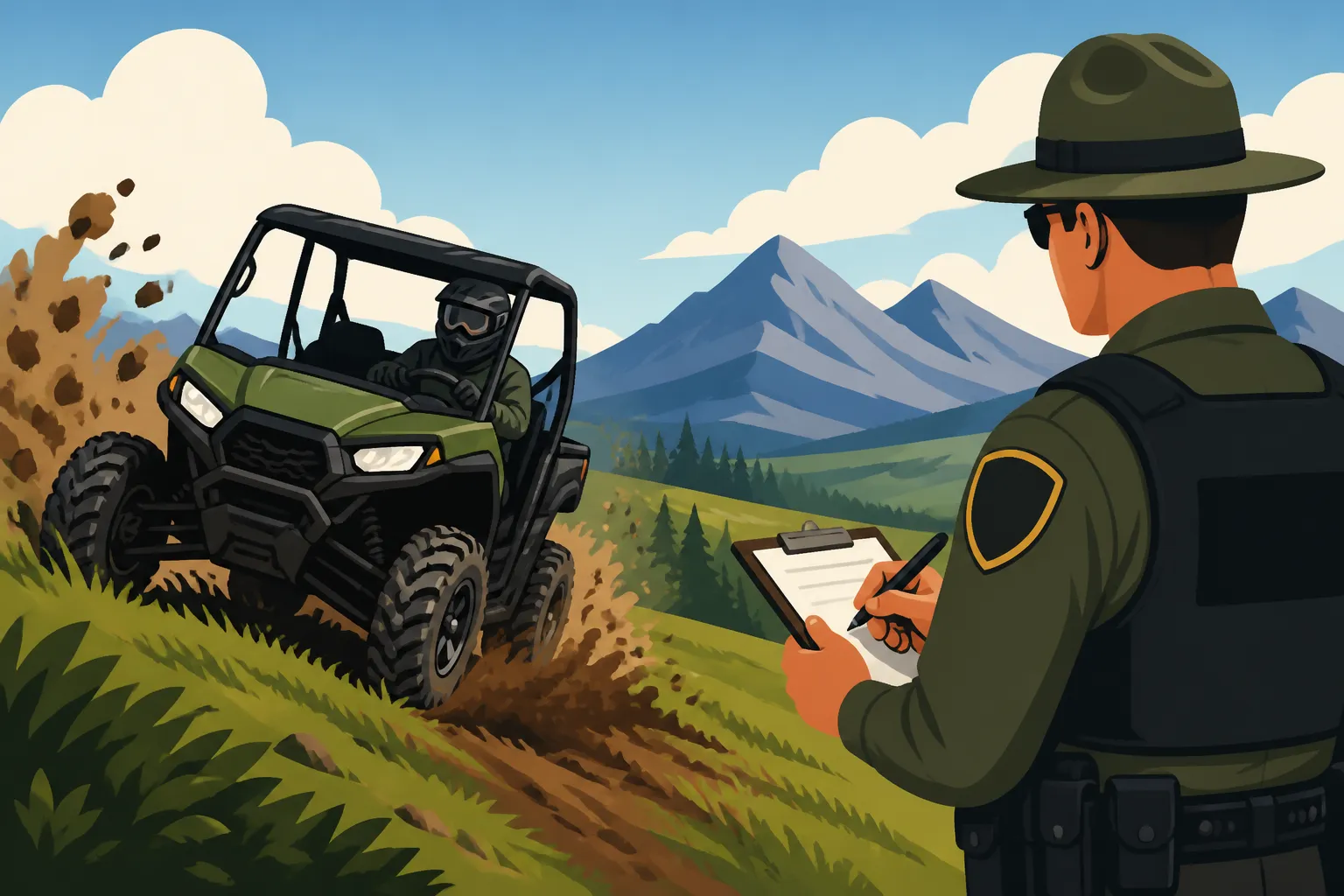
Stay calm, stop where directed, and keep your machine under control. Be respectful and listen to the officer or land manager. If you are asked for documents or identification, respond according to the applicable rules. Do not continue riding into a restricted area or attempt to leave to avoid the contact.
If someone says you were off trail, ask which route or boundary you allegedly crossed and what restriction applies. If you can do so safely and without interfering, note the location, nearby signs, and route conditions. Make a record of the date, the name or office of the person you spoke with, and any instructions you received. Photos of the area may help you remember details, but do not cross a barrier or enter a closed area to take them.
Read any citation or notice carefully. It should identify the alleged violation and explain what to do next. Deadlines and procedures can vary, so follow the instructions on the document and contact the issuing authority if anything is unclear. Do not assume that a conversation at the trailhead is a formal decision, or that an informal warning means a separate damage or trespass concern has been resolved.
If the incident involves property damage, a disputed boundary, or a serious allegation, consider speaking with a qualified attorney familiar with the relevant land and rules. Avoid posting assumptions about the incident or contacting a landowner in a confrontational way. If you need to challenge a citation, use the stated process rather than ignoring it. For a broader look at roadside or trail checks, see Montana Warden and Deputy Checkpoints.
The simplest way to reduce risk is to treat every route boundary, closure sign, and property line as meaningful until you confirm otherwise. Stay on the authorized route, verify current access before the ride, and turn back when the route becomes uncertain. Those habits protect both the rider and the land—and are much cheaper than trying to sort out a citation or damage claim afterward.
Disclaimer
This article is for general informational purposes only and does not constitute professional advice. Laws, prices and regulations vary by location and change over time. Consult a qualified professional for guidance on your specific situation.