Montana Rules for Canadian Visitors
Canadian visitors can bring an ATV or UTV to Montana, but a Canadian registration or permit does not automatically grant access to every Montana road or trail. The key is to check the machine’s paperwork, the nonresident permit rules, and the rules for each route before unloading. This overview explains what to verify so a border crossing or trailhead visit does not become an avoidable problem.
What Canadian visitors need to know first
Montana treats visitors from Canada as nonresidents for its OHV permit rules. That does not mean a Canadian machine is automatically prohibited, but it does mean you should not assume that a provincial registration, plate, insurance policy, or trail pass replaces Montana requirements.
Start with four separate questions:
- Is the machine legally registered or otherwise documented where it is based?
- Does Montana require a nonresident permit for the places and types of routes you plan to ride?
- Is the route open to your machine, and do you have permission to use it?
- Can the machine legally cross the border and return to Canada with you?
These questions involve different rules and, sometimes, different agencies. A Montana trail permit does not establish ownership, make a machine road-legal, or give permission to cross private land. Likewise, a Canadian registration or plate does not necessarily satisfy Montana’s trail-permit requirements.
Before planning a route, identify the machine type and how you will use it. A road-registered side-by-side used on a public road may face a different set of requirements from an ATV used only on an authorized trail. A machine carried on a trailer to a trailhead raises different questions from one driven on public roads. If you are renting or borrowing, the owner or rental company may have specific rules about permits, route boundaries, and who can operate the machine.
For a broader overview of visitor obligations, see Montana Rules for Visiting Riders. This article focuses on the additional checks that matter when your home jurisdiction is in Canada.
Permits, registration and reciprocity
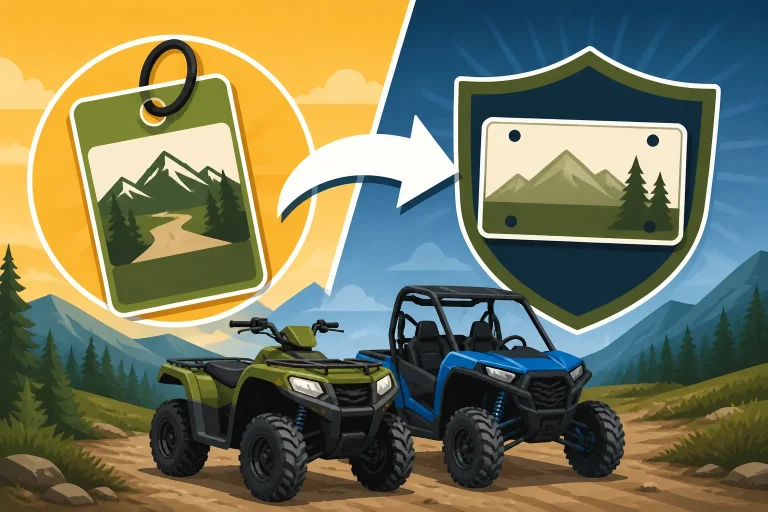
A Canadian document is not a Montana trail permit
The most important permit issue to investigate is Montana’s nonresident temporary use permit. Nonresident OHV riders generally need to consider this permit when using an off-highway vehicle on public land or public routes in Montana. The exact scope, exceptions, purchase options, and current requirements can change, so check with Montana Fish, Wildlife & Parks before your trip rather than relying on an old receipt, an online discussion, or a previous season’s advice.
The permit is about authorized use; it is not a universal registration document. It does not necessarily replace:
- The machine’s registration or ownership paperwork from its home jurisdiction
- Any Montana requirements that apply to road use
- Required safety equipment or rider qualifications
- Permission from a landowner, land manager, or road authority
- A rental company’s own permit or route requirements
The distinctions are explained in Montana’s Non-Resident Temporary Use Permit and [What the Non-Resident Permit Covers]. In particular, do not assume that a permit that covers trail use also gives you permission to ride on a public road. Why the Non-Resident Permit Covers Trails Only explains why permit coverage and road access need to be checked separately.
Confirm whether the permit is issued for a machine, a rider, or a particular use, and whether each vehicle in your group needs its own authorization. Do not rely on another rider’s permit as coverage for your ATV or UTV. If you are taking several machines, check the requirement for every machine before paying or traveling.
Reciprocity is not automatic
“Reciprocity” means one jurisdiction recognizes a document or authorization issued by another. It is tempting to assume that because your machine is properly registered in a Canadian province, Montana will treat that paperwork as a substitute for its own nonresident permit. Do not make that assumption. Montana’s permit rules and a provincial registration serve different purposes, and a valid document at home may not satisfy every requirement for riding in Montana.
It is also useful to separate reciprocity for registration from reciprocity for trail access. A document that helps establish that a machine is registered or road-legal does not necessarily provide access to a Montana trail system. Conversely, a Montana trail permit does not make a machine legally registered for highway travel in Canada or elsewhere. For more on the limits of cross-border recognition, see Does Any State Honor Montana Registration? and confirm how the rules apply to your own provincial documents.
When checking with Montana authorities, be specific. Give the machine’s type, whether it has a plate, where it is registered, and whether you intend to ride public trails, forest roads, county roads, or private property. “I have a Canadian permit” is too broad to get a reliable answer; the issuing jurisdiction and document type matter.
Buy and carry the right authorization
Check current permit instructions through Montana Fish, Wildlife & Parks before leaving home. The official purchasing information is the safest place to confirm the current process, acceptable proof, and whether a permit can be obtained online or from a seller in Montana. Buying a Trail Pass Through FWP Online Licensing can help you understand one purchase channel, but confirm that the specific permit you need is available through that option.
Keep evidence of purchase accessible while riding. Save the confirmation electronically, but do not rely on a phone as your only copy in remote areas where a battery can fail or service may be unavailable. If the permit must be displayed on the machine, follow the current instructions for its placement. If it is not a decal, carry the proof in a secure, accessible place.
| Document or permission | What it may help establish | What it does not establish by itself |
|---|---|---|
| Canadian provincial registration or plate | The machine’s registration status under the rules of its home jurisdiction | Montana trail access or permission to ride every Montana road |
| Montana nonresident OHV permit | Authorization for the use specified by Montana’s current permit rules | Ownership, road legality, or access to closed or private routes |
| Proof of ownership | Your right to possess or transport the machine | A Montana permit or authorization to ride on restricted land |
| Insurance documents | Coverage under the terms of your policy | Permit compliance, route access, or legal road equipment |
| Landowner or agency permission | Access to the land or route specified in the permission | Access to other parcels, roads, or trails |
Where you ride changes the rules
A permit is only one part of the decision. Montana routes can have different rules depending on who owns or manages the land, who controls the road, and what type of machine is allowed. A route shown on a consumer map is not proof that it is open to motorized use.
Public trails and public land
On public land, check the specific land manager’s rules, route designations, seasonal closures, and machine restrictions. Some routes may be open only to certain vehicle widths or types. Others may be closed because of seasonal conditions, maintenance, fire danger, or resource protection. A trail pass does not override any of those limits.
Use official maps and route information for the area you plan to visit. For Forest Service routes, consult the relevant motor vehicle use map and verify that the route is open to your machine. Reading a Montana Motor Vehicle Use Map can help explain how designated routes are shown. Also review Montana Permit Rules on Public Land before treating a public trail as available.
A general navigation app can be useful for orientation, but it may show roads and tracks without making clear whether motorized travel is allowed. A GPS device or paper map bought through Amazon can supplement route planning; it should not replace current land-manager maps, closure notices, or posted signs. Download or carry the information before entering areas with limited cell coverage.
Public roads and road sections
Do not assume that an OHV trail permit allows you to ride a road. Road access can depend on the road’s owner, local rules, posted restrictions, and the machine’s equipment and registration status. A route might allow OHVs on a signed segment while a nearby road remains closed. Road access can also change at a town boundary, a county boundary, or a junction with a state or federal highway.
Before using any road, confirm the rule for that exact segment. Check signs at the route and consult the relevant local authority or land manager when the status is unclear. A route shown as a connector on a recreational map is not automatically an approved connector for an ATV or UTV.
Even where a road section is open to OHVs, other requirements may apply, including rules about required equipment, operator eligibility, passenger seating, helmets, insurance, and speed. A machine that is legal on a designated trail is not automatically legal on a road. For road-specific issues, Riding an OHV on the Road in Montana is a useful starting point, but confirm the current local requirements for your intended route.
Private property and mixed routes
A public trail can pass near or between private parcels. Do not assume that a trail permit grants access across private property, even if a track appears to continue. Use signed and legally designated routes, respect gates and closures, and get permission before entering private land. Montana Rules on Private Land covers the distinction between riding permission and public-land authorization.
This matters especially when using an informal route recommended by a friend, a social media post, or a downloaded GPS track. The person sharing a route may have permission that does not extend to visitors, or the route may have changed since it was recorded. If a route crosses several ownership types, verify every segment rather than treating the entire track as one continuous public trail.
Rentals and borrowed machines
If you rent an ATV or UTV, ask the shop which permits are included and what paperwork you should carry. A rental company may handle some requirements, but its agreement may also restrict where the machine can go. Verify the route limits before booking, not after you reach a trail junction. Montana Permit Rules for a Rented Machine explains why rental coverage and personal permit assumptions should not be conflated.
For a borrowed machine, ask the owner for written permission and confirm who is responsible for permits, registration documents, insurance, and any required safety equipment. Do not assume that the owner’s Montana registration or permit automatically covers a nonresident operator or a different kind of use. If the machine belongs to a Canadian resident but is stored in Montana, that ownership and use arrangement may raise different questions from a short visit with a machine brought across the border.
Prepare for the border crossing and the ride
Confirm transport and ownership documents
Before departure, check the current requirements of the Canadian and U.S. border agencies for temporarily transporting a recreational vehicle across the border. Requirements can depend on who owns the machine, who is transporting it, whether it is financed, and whether it will be returned to Canada. Do not assume that a trailer load of recreational equipment is exempt from declaration or documentation requirements.
Carry documents that clearly connect you to the machine. Depending on your situation, useful records may include:
- The machine’s registration or ownership documents from its home jurisdiction
- A bill of sale or other ownership record, if relevant
- Written authorization from the owner if you are not the owner
- Lender or lienholder authorization if the machine is financed and the lender requires it
- Insurance information and a contact number for the insurer
- Montana permit confirmation and any other required trail authorization
- Rental paperwork, if the machine is rented
A photocopy or digital image can be helpful, but check whether the border authority, insurer, or land manager requires an original or a particular document. If the machine is leased, financed, borrowed, or owned by a business, resolve permission questions before reaching the border. Crossing the Border With a Quad on a Trailer offers a focused checklist for cross-border transport.
Clean the machine and trailer before travel. Remove mud, plant material, and debris from tires, tracks, undercarriage, and cargo areas. This is a sensible way to reduce the chance of transporting seeds, soil, or other material between regions, and it makes inspection easier. Confirm any current border or biosecurity instructions rather than assuming that a clean appearance alone satisfies them.
Check insurance separately from registration
Contact your insurer before the trip. Ask whether the policy covers the machine in Montana, whether it applies to the type of riding you plan to do, and whether it covers a borrowed or rented machine. Also ask what proof of coverage to carry and what to do after a collision or theft.
Do not treat registration as proof of insurance. A Canadian policy may have geographic limits, exclusions for off-road use, or different rules for riders who are not named on the policy. A credit card or auto policy should not be assumed to cover an ATV or UTV unless the provider confirms it in writing. Liability coverage may also be treated differently for road use and trail use.
If your route includes public roads, ask the insurer about road use specifically. If it is a trail-only trip, ask whether the policy covers off-road operation and any passengers. Keep the insurer’s contact information accessible in case the machine is damaged or involved in a crash.
Review rider, passenger, and equipment rules
Rules for age, safety education, helmets, passengers, and required equipment can vary with the rider’s age and whether the machine is on a road or a trail. A Canadian safety card may not automatically satisfy a Montana requirement. If a young person will operate or ride as a passenger, check the applicable Montana rules before the trip. Montana OHV Safety Education Requirements is a useful place to start.
For practical safety, use a properly fitted helmet and eye protection, even when a particular activity or rider might not be required to wear them by law. Check that the machine’s seat belts, doors or nets, lights, brakes, tires, and other safety equipment are in good working order. For a side-by-side, use every available restraint and keep passengers in designated seats. Do not carry a passenger on an ATV unless the machine is designed and equipped for that passenger.
Pack for the route rather than just the forecast at the trailhead. In remote country, bring water, appropriate clothing, a first-aid kit, basic recovery equipment, navigation, and a way to communicate when cell service is unavailable. Tell someone where you plan to ride and when you expect to return. A permit is not a substitute for preparation, and help may take time to reach a remote trail.
A practical pre-trip checklist
Use this sequence before loading the machine:
- Identify the machine and its use. Record whether it is an ATV, UTV, dirt bike, or another type of OHV; whether it is registered in Canada; and whether you plan to use public trails, roads, private land, or a combination.
- Verify the Montana permit requirement. Check the current nonresident rules directly with Montana Fish, Wildlife & Parks. Confirm whether each machine needs its own permit and how the permit must be carried or displayed.
- Map the exact routes. Use official land-manager maps and current closure information. Confirm that each route allows your machine’s type and width, and do not rely only on a GPS track or an old recommendation.
- Check road access independently. For every road segment, confirm that OHV use is allowed and determine whether additional equipment, registration, insurance, or operator requirements apply.
- Confirm border documentation. Check current instructions for transporting the machine into the United States and returning it to Canada. Carry proof of ownership or authorization, plus any required registration and import-related documents.
- Call the insurer. Confirm coverage in Montana for the machine, operator, passengers, and planned type of riding. Ask for proof of coverage and claims instructions.
- Resolve rental or borrowing rules. Get written permission where appropriate and ask who is responsible for permits, route restrictions, and paperwork.
- Prepare the machine and group. Check safety equipment, helmets, passenger limits, weather, communication, fuel, and emergency supplies.
- Keep documents accessible. Store permit evidence, ownership papers, insurance details, and permission documents where they can be retrieved during a roadside or trailhead check.
- Recheck shortly before riding. Closures, fire restrictions, local road rules, and permit procedures can change. Confirm the status of the exact route before you set out.
This sequence keeps the issues separate: border paperwork does not replace a Montana permit; a permit does not prove ownership; and neither one makes a closed route legal. If a point remains unclear, ask the relevant authority with the machine details and route in hand. That is much more reliable than asking whether “Canadian ATVs” are allowed in general.
Frequently Asked Questions
Does a Canadian registration replace Montana’s nonresident permit?
Do not assume it does. Canadian registration and Montana trail authorization serve different purposes. Check the current Montana nonresident permit rules for your machine and intended use, and carry the required documents from both jurisdictions.
Does a Montana permit let me ride on any road or trail?
No. A permit does not open closed routes or grant access across private land. Road access, trail designation, landowner permission, and machine restrictions must be checked separately for each route.
Can I bring a Canadian ATV or UTV across the border for a short trip?
A short recreational visit may be possible, but border requirements depend on ownership, transport, and other circumstances. Confirm current instructions with the border agencies and carry the machine’s documentation and any required owner authorization.
If I rent a machine in Montana, does the rental company handle the permit?
Some rental arrangements may include permit-related paperwork, while others may not. Ask the shop exactly what is included, what documents you must carry, and which routes the rental agreement permits.
Disclaimer
This article is for general informational purposes only and does not constitute professional advice. Laws, prices and regulations vary by location and change over time. Consult a qualified professional for guidance on your specific situation.