Re-Registering a Machine You Just Bought
So, you just snagged a fantastic ATV or UTV, maybe from a private seller or even a local dealer here in Big Sky Country. You're probably itching to hit those stunning Montana trails, but hold on a minute! One of the biggest head-scratchers for new owners, especially those new to Montana's specific rules, is understanding that "re-registering a machine you just bought" isn't just a formality; it's a non-negotiable step because registrations simply don't transfer between owners. This guide will walk you through exactly why and how to get your new-to-you off-highway vehicle properly registered and legal for adventure.
Why Your New OHV Needs New Registration
It's a common misconception, especially with that "permanent" registration Montana offers, that once a machine is registered, it's good to go for life, no matter who owns it. Oh, if only it were that simple! The truth is, that registration is tied directly to the owner, not the machine itself. When you buy an ATV or UTV, whether it's a shiny new one from a dealership or a trusty used side-by-side from a private party, the previous owner's registration becomes immediately invalid. This is often a point of frustration for new buyers who think they can just ride off into the sunset.
Understanding Montana's "Permanent" OHV Registration
When you hear about Montana's "permanent" OHV registration, it sounds like a dream come true, doesn't it? No more annual renewals! But the key here is that this "permanent" status applies to the owner for that specific machine. It's a one-time fee paid by you, the individual owner, for your machine. The moment that machine changes hands, that "permanent" registration effectively vanishes. It's like a library card; it belongs to the cardholder, not the books they check out. So, while the machine itself doesn't need to be re-registered every year, it absolutely needs to be registered anew under your name and ownership. If you're curious about the specifics of this, our article on [What Permanent Registration Actually Buys You] dives deep into this topic.
The Immediate Impact of a Sale on Registration
Imagine you've just bought a pristine Polaris RZR from a friendly rancher down the road. They hand you the title, maybe a bill of sale, and say, "It's permanently registered!" While they're not lying about their permanent registration, that registration is now effectively moot for you. You cannot legally operate that machine on public lands or designated OHV trails until it's registered in your name. Trying to ride with the previous owner's decal is a surefire way to run into issues with law enforcement, potentially resulting in fines for an unregistered machine. This is why understanding [Why a Montana Registration Does Not Follow the Machine] is so crucial right from the start.
Essential Documents for Your New Registration
Getting your newly acquired ATV or UTV registered in Montana is pretty straightforward, but like all things government-related, it hinges entirely on having the correct paperwork in order. Missing even one piece can send you back home, empty-handed, and delay your riding plans. Think of it as assembling your gear for a big backcountry trip; you wouldn't forget your map or bear spray, so don't forget these vital documents.
Proof of Ownership: The Title and Bill of Sale
This is the absolute cornerstone of your new registration. Without proper proof that the machine is legally yours, you won't get far.
- The Certificate of Title: For most ATVs and UTVs purchased in Montana, you'll need the original, signed-over certificate of title. This document proves who legally owns the machine. Make sure the seller has signed off on their portion, and that their signature is exactly as it appears on the title. If you're dealing with a brand new machine from a dealer, they'll usually handle the initial titling paperwork, and you'll receive a manufacturer's statement of origin (MSO) which will then be converted into a Montana title. For used machines, ensure the title is free of any liens, or that the lien has been properly released. If you're coming from out-of-state, your existing title will be needed to [Titling an OHV in Montana] in the state.
- Bill of Sale: While not always strictly required if you have a perfectly signed-over title, a bill of sale is an incredibly smart document to have, especially when buying from a private party. It serves as a clear record of the transaction, including the buyer's and seller's information, the machine's VIN, the purchase price, and the date of sale. This can be invaluable if there are ever any questions about the sale later on. Resources like LawDepot can help you generate a comprehensive bill of sale specific to your needs, ensuring all necessary details are covered. Having a detailed bill of sale is also vital for clarifying details that might not be on the title, such as accessories included in the sale or any agreed-upon conditions. Our guide on [What a Montana Bill of Sale Should Say] has more details on this.
Your Identification and Payment for Fees
Beyond proving ownership, you'll also need to prove who you are and be ready to pay the associated fees.
- Valid Photo ID: Bring your current, valid driver's license or another government-issued photo identification. This is standard procedure to confirm your identity and ensure the registration is being issued to the correct person.
- Payment for Fees: There are a few fees involved in the re-registration process. These typically include a title fee (if you're also titling the machine in your name, which you almost certainly will be doing) and the one-time permanent OHV registration fee. While specific amounts can vary slightly or change over time, expect to pay these fees at the county treasurer's office. It's always a good idea to call ahead to your local county treasurer or check their website for the most current fee schedule and accepted payment methods. Having a debit card, credit card, or checkbook ready is usually your best bet. Keep in mind that Montana does not charge a general sales tax on machines, which is a nice perk, but there are still these administrative fees.
Table of Required Documents for OHV Re-Registration
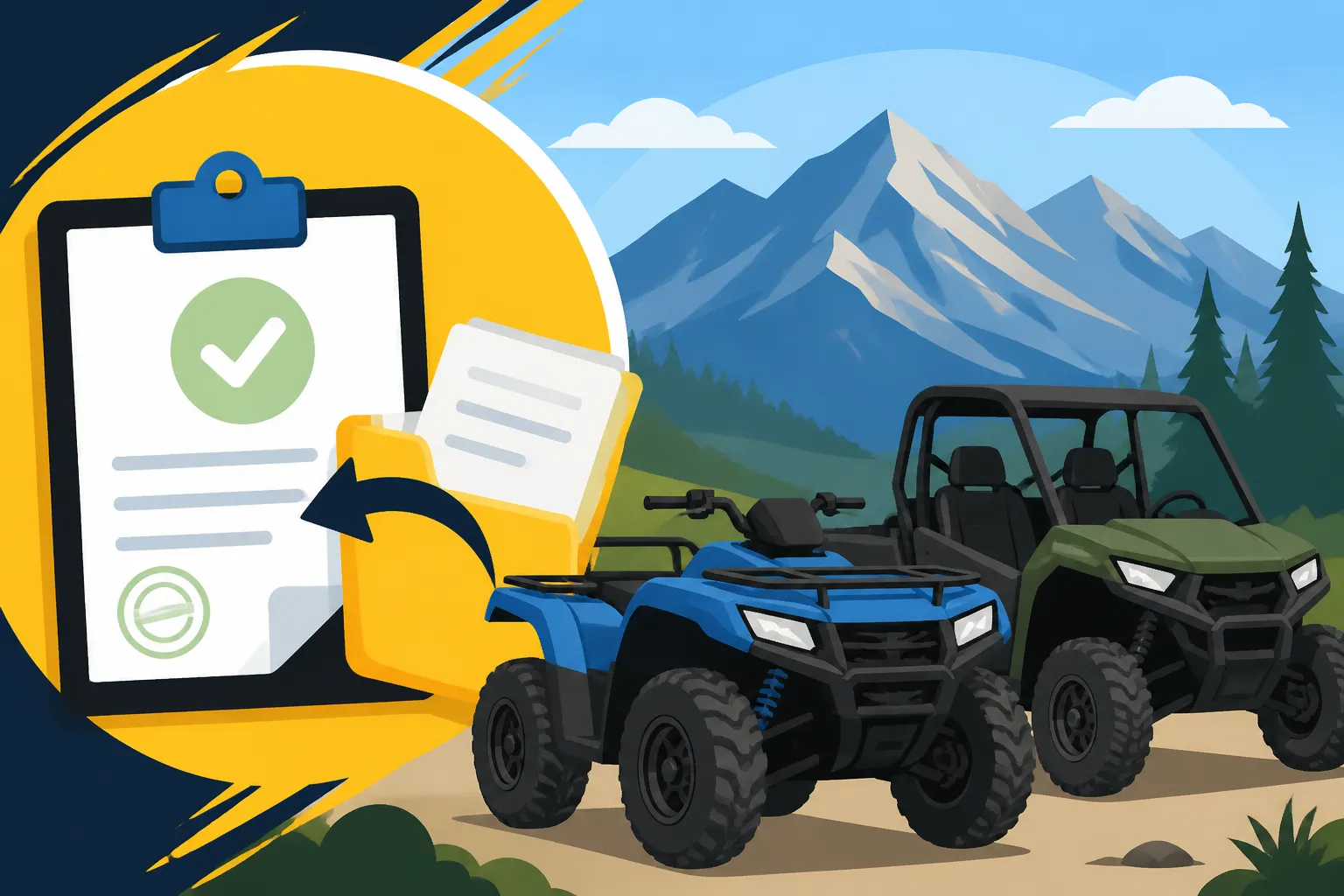
To help you get organized, here's a quick checklist of the documents you should bring with you to the county treasurer's office:
| Document Type | Description | Importance | Notes |
|---|---|---|---|
| Certificate of Title | Original title, properly signed over by the previous owner. | Essential | If new, Manufacturer's Statement of Origin (MSO) from dealer. Check for liens. |
| Bill of Sale | Detailed document of sale, especially for private party purchases. | Highly Recommended | Can use services like LawDepot to create. |
| Photo Identification | Valid driver's license or other government-issued ID. | Essential | Proves your identity. |
| Payment for Fees | Funds for title and registration fees. | Essential | Check with county treasurer for current amounts and accepted methods. No sales tax in Montana, but there are other fees. |
| Lien Release (if applicable) | If the previous owner had a loan, proof the lien has been satisfied. | Conditional | Often stamped on the title or a separate form from the lender. |
The Re-Registration Process: Where to Go and What to Expect
Once you've gathered all your documents, the actual process of re-registering your OHV is fairly straightforward. It's not nearly as daunting as it might seem, especially if you're prepared. Here in Montana, the bulk of this work is handled at your local county treasurer's office.
Your Destination: The County Treasurer's Office
Unlike some states where you might go to a DMV or specific motor vehicle department, in Montana, your primary stop for OHV registration and titling is your county treasurer's office. This is where all the magic happens! Whether you live in Yellowstone County, Flathead County, or Gallatin County, each county has an office ready to assist. It's usually located in your county seat, often within the county courthouse building. For detailed information on what to expect, check out our guide on [Montana County Treasurer OHV Registration].
Before you head out, it’s always a good idea to check their operating hours and any specific instructions they might have. Some offices might require appointments, while others operate on a first-come, first-served basis. A quick call or a visit to their county website can save you a lot of time and a potentially wasted trip.
What to Expect at the Counter
When you arrive at the county treasurer's office, you'll present your documents to a clerk. They will review your title, bill of sale, and identification to ensure everything is correct and matches up.
- Document Verification: The clerk will carefully examine the title for proper signatures, ensuring the seller has released their interest and that the VIN matches the machine. If you've brought a bill of sale, they'll review that too. This is where having a clear, accurate bill of sale, perhaps generated through a service like LawDepot, can smooth things over.
- Titling the Machine: If the machine wasn't previously titled in your name (which it won't be if you just bought it), this is when it will be titled to you. This means a new certificate of title will be issued in your name, indicating you are the legal owner. There's a fee for this, which you'll pay at this time. Our article on [Titling an ATV at a Montana County Treasurer] provides more insight into this step.
- Applying for Permanent OHV Registration: Once the titling is sorted, you'll then apply for the actual OHV registration. This is where you pay the one-time permanent registration fee. Once processed, you'll receive your new registration decal and paperwork. This decal is critical to display on your machine as proof of registration.
- Receiving Your Decal and Paperwork: You'll typically walk out of the office with a temporary registration document and your new OHV decal. The physical title in your name will usually be mailed to you within a few weeks. Make sure to affix the decal to your machine in the correct location, which is usually on the rear of the machine, clearly visible. Our article on [Where a Montana OHV Decal Goes] explains this in detail.
Understanding the Fees and What They Cover
As mentioned, while Montana proudly boasts no general sales tax on vehicle purchases, there are still a few fees associated with re-registering your OHV. These typically include:
- Title Fee: This is for the processing and issuance of your new certificate of title.
- Permanent OHV Registration Fee: This is the big one-time fee that grants you the permanent registration status for that machine under your ownership.
- Administrative Fees: There might be small additional processing or administrative fees charged by the county.
These fees go towards supporting Montana's OHV program, including trail maintenance, enforcement, and safety education. It's a small investment for the endless riding opportunities our beautiful state offers.
Common Pitfalls and How to Troubleshoot Them
Even with all your ducks in a row, sometimes things don't go perfectly. Missing paperwork, a vanished seller, or an unclear title can turn what should be a quick trip into a frustrating ordeal. But don't despair! Most of these issues have solutions, though they might require a bit more legwork.
The Seller Didn't Sign the Title Properly (or at all!)
This is perhaps one of the most common and frustrating scenarios. You get home, look at the title, and realize the seller either didn't sign it in the right spot, or worse, didn't sign it at all. Without their proper signature releasing ownership, the county treasurer cannot transfer the title to you.
- Solution: Your first step is to contact the seller immediately. Politely explain the situation and arrange to meet them to get the title signed correctly. Emphasize that you can't register the machine without it. If the seller is local and cooperative, this can be a quick fix. However, if the seller is uncooperative, out of state, or simply unreachable, things get more complicated. In such cases, you might need to explore options like a bonded title. Our article [When the Seller Never Signed] goes into depth on this tricky situation. A well-drafted bill of sale from a service like LawDepot, detailing the seller's obligation to provide a clear title, can offer some leverage here.
Missing Title or Proof of Ownership
What if the seller tells you they don't have the title, or they give you a machine with no paperwork whatsoever? This is a red flag, but not always a deal-breaker if you know the steps.
- Solution: First, never buy a machine without a title or other clear proof of ownership unless you are fully prepared for a potentially lengthy and complex process. If you've already made the purchase and the title is missing, you'll need to work with the seller to obtain a duplicate title from their state (if out-of-state) or from Montana's MVD. If the seller is truly unresponsive or impossible to locate, you might need to pursue a bonded title. This process involves obtaining a surety bond for the value of the machine, which essentially protects the state and any previous owners from claims against the machine. It's a last resort, but it can provide a path to legal ownership. Read more about [Replacing a Lost Montana Title] and [Bonded Title for an ATV in Montana].
Incorrect VIN on the Title or Machine
Another snag can be a VIN (Vehicle Identification Number) discrepancy. Perhaps the VIN on the title doesn't match the VIN stamped on the machine itself, or maybe the VIN on the bill of sale doesn't match either! This is a serious issue that needs immediate attention.
- Solution: Do not proceed with registration until this is resolved. A VIN mismatch suggests either a clerical error or, more alarmingly, that the machine might be stolen or have a shady history. If it's a simple clerical error on the title, the seller might need to get it corrected with the issuing authority. If the VIN on the machine appears altered or unreadable, this could be a sign of a stolen machine, and you should contact law enforcement. Our article [Fixing a Wrong VIN on a Montana Title] offers guidance on how to address these types of issues. Always double-check the VIN on the machine against all paperwork before finalizing your purchase. You can also run the VIN through online databases to check for theft reports, as described in [Checking a Used Quad for a Theft Report].
Paying Use Tax When Taking Your Machine Out-of-State
While Montana doesn't have sales tax, if you're an out-of-state buyer who purchased your OHV here and plan to take it back to your home state, be aware of "use tax."
- Solution: Your home state will almost certainly expect you to pay a use tax, which is essentially their version of a sales tax on items bought out-of-state and brought in for use. It's crucial to understand your home state's laws regarding this. Ignoring it can lead to penalties down the road. This is covered in more detail in [Use Tax Your Home State Still Wants]. Make sure you understand these obligations to avoid any unpleasant surprises once you get back home.
Re-registering your newly purchased ATV or UTV in Montana is a necessary step to ensure you're a responsible and legal rider. While the process requires attention to detail regarding your documents and a trip to the county treasurer, it's a manageable task. By understanding why registrations don't transfer, gathering all your essential paperwork (and perhaps utilizing tools like LawDepot for custom documents), and knowing how to troubleshoot common issues, you'll be well on your way to enjoying the incredible trails Montana has to offer. Happy riding!
Disclaimer
This article is for general informational purposes only and does not constitute professional advice. Laws, prices and regulations vary by location and change over time. Consult a qualified professional for guidance on your specific situation.