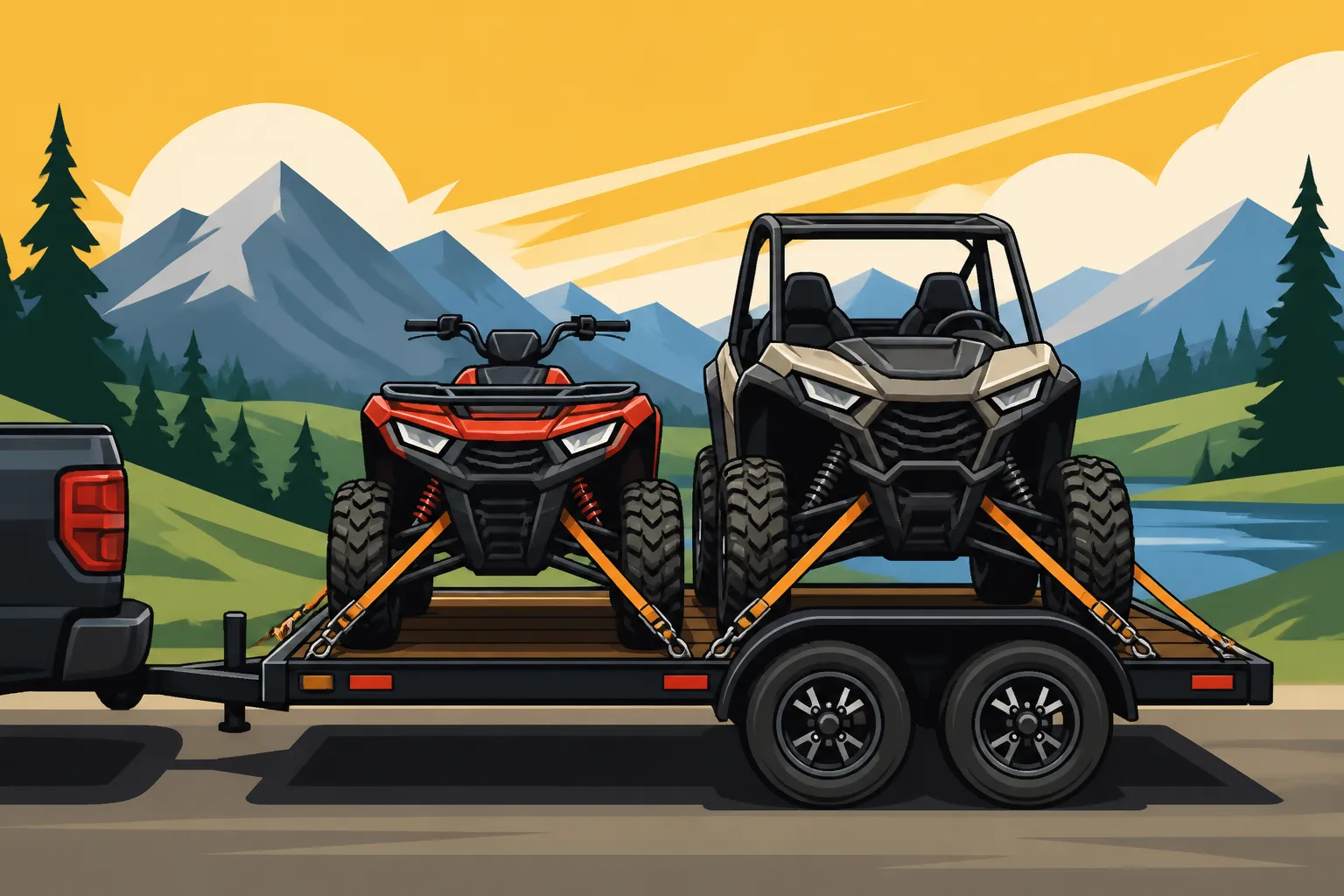
Fitting Two Machines on One Trailer
Oh, the age-old puzzle of getting all your toys to the trailhead! We've all been there, standing in the driveway, scratching our heads, wondering how on earth to fit two hefty ATVs or a couple of side-by-sides onto one trailer without it looking like a precarious Jenga tower ready to collapse on I-90. It's a real frustration, especially when you're planning a weekend adventure across Montana's incredible landscapes, and every inch of trailer space feels like gold. This guide is here to tackle that exact headache, diving deep into the practicalities, clever tricks, and essential safety measures for safely and efficiently loading two machines onto a single trailer, so you can spend less time packing and more time riding.
Assessing Your Trailer and Machines
Before you even think about backing up a ramp, you've got to play detective with your equipment. Not all trailers are created equal, and neither are all off-highway vehicles (OHVs). Understanding the limitations and capabilities of what you're working with is the absolute first step in a successful, safe haul. Skimping on this part can lead to bent trailers, damaged machines, or worse, a dangerous situation on the road.
Trailer Type and Capacity
Let's get real about your trailer. Is it a compact utility trailer you picked up for yard work, or a robust flatbed built for hauling? The type and, more importantly, the capacity of your trailer dictate everything.
- Utility Trailers: Often have side rails and ramps that fold down. They're great for a single ATV, but fitting two usually means the machines need to be quite narrow or one needs to be significantly shorter, like a youth quad. The side rails can actually become an obstacle, limiting your usable width. You might find yourself having to remove a rail or get creative with overhang.
- Flatbed Trailers: These are often the easiest to work with for multiple machines because they lack side rails, offering maximum width flexibility. However, you'll need robust tie-down points securely welded to the frame, and usually separate ramps.
- Enclosed Trailers: While they offer excellent protection from the elements on those long drives across Montana, they present their own set of challenges for fitting multiple OHVs. You're completely constrained by the interior dimensions, and loading two side-by-sides might require a very specific, staggered approach. Plus, you need to consider the height clearance for any roll cages or racks.
No matter the type, the Gross Vehicle Weight Rating (GVWR) is your North Star. This figure tells you the maximum total weight your trailer can safely carry, including the trailer itself, your machines, and any gear. You'll usually find this on a sticker or plate on the trailer's frame. Don't forget to factor in the axle capacity – a tandem axle trailer distributes weight better and offers more capacity than a single-axle setup. Overloading is a recipe for disaster, putting strain on your trailer's frame, axles, and tires. Speaking of tires, give them a good once-over. Are they properly inflated? Do they show signs of dry rot or wear? Their load rating should match or exceed the demands you're putting on them.
Then there's the actual usable space: the deck length and width. Grab a tape measure and get precise. Measure from the very front of the usable deck to the very back. For width, measure between the inner edges of any side rails, or the full flat deck if it's a flatbed. These measurements will be crucial when you start envisioning how your machines will sit. For example, a common 12-foot utility trailer might struggle to fit two full-size ATVs nose-to-tail if they both have longer wheelbases or front-mounted accessories.
Machine Dimensions and Weights
Now, turn your attention to the stars of the show: your ATVs and UTVs. Just like trailers, these machines come in all shapes and sizes, and ignoring their specific dimensions can lead to a very frustrating loading experience.
First, dig out the specifications for each machine. You'll need their overall length, width, and height. Manufacturers typically list a "dry weight," but that doesn't account for a full tank of gas, any aftermarket accessories you've added (winch, heavy-duty bumper, spare tire), or your tools and gear. Try to estimate a realistic "wet" weight for each machine. For a reference, you can often find a machine's VIN in key places, like on the frame near the left front wheel or under the seat, to help you look up exact specs. [Where to Find the VIN on a Polaris Ranger] can be a helpful guide if you're not sure where to start.
The width of your machines is often the biggest hurdle, especially with modern side-by-sides that seem to get wider every year. A common full-size ATV might be around 48 inches wide, while a sport side-by-side can easily hit 64 inches or more. If your trailer's usable deck is only 72 inches wide, trying to load two 48-inch ATVs side-by-side means you've suddenly got 24 inches of overlap, which is just not going to work. Understanding these dimensions upfront helps you rule out impossible loading configurations immediately.
Finally, consider how your machines will sit on the trailer in relation to your tow vehicle. Will a long side-by-side overhang the front of your trailer so much that it restricts the turning radius of your truck? You don't want to make a tight turn in a parking lot and have the front of your UTV smash into the back of your cab. Thinking through these details now can save you a lot of headache and potential damage down the line. If you're buying a used machine and need to verify its details, knowing [What a Montana Bill of Sale Should Say] can help ensure you have all the necessary information.
Strategic Loading Techniques
Once you've sized up your trailer and your machines, it's time to figure out the actual logistics of getting them on board. This isn't just about brute force; it's about smart planning, precision, and understanding physics. The goal is to maximize space while ensuring optimal weight distribution and, above all, safety.
Nose-to-Tail or Side-by-Side?
This is the central question when loading two machines onto one trailer, and the best answer depends heavily on your trailer's dimensions and the specific OHVs you're hauling.
-
Nose-to-Tail (or Tail-to-Tail): This is often the go-to method for longer trailers, particularly utility or flatbed trailers that might not have the width for side-by-side loading.
- How it works: You load one machine facing forward and the other facing backward, or both facing forward but offset. The key is staggering them slightly to allow handlebars or bumpers to overlap in the vertical plane without colliding.
- Pros: Works well with narrower trailers. Can distribute weight effectively if loaded correctly, with each machine's weight centered over an axle.
- Cons: Requires a longer trailer. You might need to use ramps for both machines, or carefully drive one on and then position the second. With a side-by-side, you might find the steering wheel or roll cage impedes the other machine. Be very mindful of the machines' overall length versus your trailer's usable deck. Two large ATVs, for instance, might exceed a 12-foot trailer's length when loaded directly nose-to-tail.
- Example: A 14-foot flatbed might perfectly fit a full-size ATV and a smaller [Youth Machine Size Rules Montana Parents Ask About] ATV nose-to-tail, with the smaller one tucked snugly behind the larger.
-
Side-by-Side: This method is ideal for wider flatbed trailers or if your machines are particularly narrow.
- How it works: Both machines are loaded side-by-side, usually facing the same direction.
- Pros: Great for shorter, wider trailers. Can be quicker to load.
- Cons: Requires a very wide trailer. Even small ATVs might be too wide to fit two abreast on a standard 7-foot wide trailer. Side-by-sides are almost universally too wide for this method on anything but a dedicated, extra-wide custom trailer. You also need to consider your tow vehicle's mirrors – an excessively wide load can obscure your view.
- Example: Two older, narrower ATVs (perhaps 45 inches wide each) might fit on an 8.5-foot (102-inch) wide flatbed, leaving minimal clearance in between.
-
Diagonal Loading: This is a lesser-known but sometimes surprisingly effective strategy for maximizing limited space on a moderately wide trailer, especially with a side-by-side and an ATV, or two slightly different-sized ATVs.
- How it works: You position the machines at an angle across the trailer deck. This effectively "lengthens" the usable space, as you're using the diagonal measurement of the deck.
- Pros: Can allow machines that are slightly too long for a direct nose-to-tail, or too wide for a direct side-by-side, to fit. It's a creative way to use every available inch.
- Cons: Requires careful maneuvering during loading and strapping. Weight distribution can be trickier to balance over the axles. You might need more anchor points for secure tie-downs at these angles.
- Example: A 60-inch wide side-by-side and a 48-inch wide ATV might fit diagonally on an 8-foot wide flatbed, provided the trailer is also long enough to accommodate the diagonal length. You'd load the larger machine first, angle it, and then fit the second in the remaining space.
Securing Your Load Safely
Once your machines are positioned, the real work begins: strapping them down. This is not the time to cut corners or rush. Improperly secured machines can shift, cause your trailer to sway dangerously, or even come loose on the highway – a terrifying thought, especially on a winding Montana pass.
- Tie-Downs Are Your Best Friends: You need good quality, strong ratchet straps. Forget the cheap cam buckle straps from the discount store for anything heavy; they're fine for light gear but won't hold a 1,000-pound ATV bouncing down a bumpy road. Invest in heavy-duty ratchet straps with a high working load limit (WLL) – not just the break strength.
- Four Points, Minimum: Every single machine should be secured at a minimum of four points. That means four straps per ATV, or four straps for a UTV, ideally pulling down and slightly out in opposing directions. This creates tension that prevents forward, backward, and side-to-side movement.
- Anchor Points Matter: Attach your straps to strong, structural parts of the machine's frame, not to plastic bodywork, control arms (which can flex and stretch the straps), or handlebars (which can bend). Look for sturdy frame members, tow hooks, or dedicated tie-down points often found on utility machines or factory bumpers. Loop the strap around the frame member and hook it back to itself, or use soft loops if direct metal-on-metal is a concern for scratching.
- Balance the Weight: As you load, pay close attention to where the bulk of the weight sits. You want the heaviest parts of your load (typically the engines of your OHVs) to be positioned over or slightly forward of the trailer's axles. Too much weight on the very front (excessive tongue weight) can overload your tow vehicle's rear suspension, while too much weight on the rear (negative tongue weight) is a recipe for terrifying trailer sway. Adjust the machine's position incrementally until you get a good balance. A general rule of thumb is 10-15% of the total trailer-plus-load weight should be tongue weight.
- Additional Security: For really heavy machines or peace of mind, consider adding chock blocks in front and behind the wheels, or even wheel nets that go over the tires. These prevent the machines from rolling even if the straps loosen slightly, which can happen with road vibrations.
- Final Check: Before you pull away, give every strap a good tug. Rock the machines. Do they move? If so, tighten or add more straps. Double-check all hooks are fully seated.
- Documentation: If you're frequently hauling multiple machines, or even helping friends transport theirs, a simple checklist or liability waiver can be incredibly useful. Resources like LawDepot offer templates for these kinds of documents, helping ensure everyone is clear on responsibilities and procedures for safe transport. For instance, a pre-trip inspection checklist ensures you don't miss anything critical before hitting the road.
Remember, strapping down isn't a "set it and forget it" task. Always check your straps after the first 10-15 miles of driving, and then periodically during your journey, especially after bumps or rough sections of road. If you're hitting the trails through a [Montana Pass] for your adventure, you can be sure of some varied terrain, so ensuring your load is secure is paramount.
Essential Gear and Safety Considerations
Getting your machines onto the trailer is only part of the equation. Hauling them safely down Montana's highways and backroads involves a host of other considerations, from the ramps you use to your habits behind the wheel. Overlooking these details can turn a fun outing into a stressful, or even dangerous, ordeal.
Ramps and Loading Aids
Choosing and using the right ramps is absolutely critical. This is where many people get hurt or damage their machines.
- Right Ramps for the Job:
- Length: Longer ramps provide a shallower angle, which is safer and easier, especially for heavy UTVs or machines with lower ground clearance. Trying to load a large side-by-side up short, steep ramps is asking for trouble – the machine might high-center, or you could lose traction and control.
- Weight Capacity: Just like your trailer, your ramps have a weight limit. Ensure they can individually (if using two separate ramps) or together (if using a wider single ramp) support the heaviest machine you're loading, plus the weight of the rider if you're driving it on.
- Type:
- Arched ramps are excellent for preventing high-centering, particularly with UTVs or longer ATVs.
- Straight ramps are simpler but require a longer length for a safe angle.
- Folding or tri-fold ramps offer convenience for storage but check their hinges for strength and stability.
- Secure Placement: Ramps must be securely fastened to the trailer deck to prevent them from slipping off as you load. Many ramps come with safety straps or pins for this purpose. Never, ever rely on gravity or friction alone.
- Loading Technique:
- Load on level ground. Avoid loading on an incline or decline unless absolutely necessary and with extreme caution.
- Use a spotter, especially when loading a UTV or a machine for the first time.
- Go slowly and steadily. Don't gun the engine up the ramps. Maintain a consistent, low speed.
- If you have a very heavy UTV and short ramps, a winch can be your best friend. Hook it to a secure point on the trailer and slowly winch the machine up, providing a controlled pull that minimizes risk.
Pre-Trip Checks and Road Rules
Before you hit the road, a thorough pre-trip inspection is non-negotiable. This isn't just about good practice; it's about adhering to safety standards and Montana's road rules.
- Trailer Vital Signs:
- Lights: Check your trailer's brake lights, turn signals, and running lights. They must all be functional and visible. A burned-out bulb can lead to a ticket or, worse, an accident.
- Brakes: If your trailer has brakes (and it should if you're hauling two heavy machines), ensure they are working properly and adjusted correctly.
- Tire Pressure: Inflate your trailer tires to the manufacturer's recommended pressure. Under-inflated tires can overheat, lead to blowouts, and affect towing stability.
- Coupler and Safety Chains: Ensure the trailer coupler is securely latched to your hitch ball and the safety chains are properly crossed and attached to your tow vehicle's frame, not just the bumper. The breakaway cable (if your trailer has electric brakes) should also be connected.
- Visibility: Your loaded machines shouldn't obstruct your view through your tow vehicle's mirrors. If they do, invest in extended towing mirrors. You need to see what's happening behind and beside you.
- Driving Habits: When towing, everything takes longer.
- Slower Speeds: Reduce your speed, especially on curves, downhills, and in windy conditions. Montana's wide-open spaces can mean sudden crosswinds that will grab a loaded trailer.
- More Stopping Distance: Your combined vehicle and trailer weight is significantly higher, meaning you'll need much more distance to stop. Increase your following distance.
- Wider Turns: Account for the extra length and width of your trailer when making turns. Avoid sudden lane changes.
- Montana's Trailering Laws: Be aware of basic Montana regulations regarding trailer width, length, and required lighting. For instance, any load extending more than four feet past the rear of your trailer typically requires a red flag during the day and a red light at night. While you're on the road, ensure your trailer has its current registration. Information on [Trailer Registration for Hauling ATVs in Montana] and [Montana Trailer Plate Cost] can keep you informed.
- Emergency Kit: Always have an emergency kit in your tow vehicle, including a spare tire for your trailer, a jack capable of lifting your trailer, a lug wrench, basic tools, reflective triangles or flares, and a first-aid kit.
- Pre-Trip Checklist: To keep everything straight, especially if you're hauling machines for others, a detailed pre-trip checklist can be invaluable. This is another area where resources like LawDepot can be useful. You can use their templates to create a customized checklist for your specific hauling needs, ensuring you cover everything from tire pressure to strap tension, or even a simple liability agreement if you’re transporting a friend’s ATV. This kind of preparation goes a long way in preventing headaches and ensuring a smooth journey.
Common Challenges and Smart Solutions
Even with the best planning, fitting two machines on one trailer can present some unique challenges. The good news is that many of these issues have practical, real-world solutions that experienced riders and haulers have honed over years of trial and error.
Overhang and Tongue Weight
One of the trickiest aspects of loading multiple machines, especially when one or both are large, is managing overhang and the critical balance of tongue weight.
- Dealing with Overhang:
- Front Overhang: If a machine extends past the front of your trailer deck, you need to ensure it doesn't interfere with your tow vehicle's cab or bed, especially during turns. For a UTV, this might mean positioning it slightly further back, or loading it tail-first if feasible. For an ATV, sometimes turning the handlebars sharply to one side can buy you a few precious inches.
- Rear Overhang: Machines extending beyond the rear of the trailer are common. Montana law, like many states, requires a red flag (at least 12 inches square) during daylight hours on any load extending four feet or more past the rearmost point of your trailer. At night, a red light visible from 500 feet is required. Never let overhang extend so far that it scrapes the ground on inclines or speed bumps.
- Calculating and Adjusting Tongue Weight:
- The "Why": Tongue weight is the downward force the trailer exerts on your hitch. Too little (negative tongue weight) leads to extreme trailer sway, making your rig dangerously unstable. Too much can overload your tow vehicle's rear axle, affecting steering, braking, and tire wear. The ideal range is generally 10-15% of the total loaded trailer weight.
- The "How": You can estimate tongue weight by using a bathroom scale (for lighter trailers), or a specialized tongue weight scale for heavier setups. If your tongue weight is too low, you need to shift more of the machine's weight forward. If it's too high, shift some weight backward. This often involves trial and error, moving the machines in small increments until you achieve the correct balance. Remember, a fully loaded front storage rack on a UTV or a full cooler strapped to the front of an ATV can significantly impact tongue weight.
- Consequences: Improper tongue weight is a leading cause of trailer accidents. Always prioritize proper balance over perfectly fitting your machines in a visually pleasing way.
- Consideration for Ranch Machines: If you're hauling heavy equipment like a utility UTV loaded with tools for a ranch job, understanding and adjusting tongue weight becomes even more crucial. [Montana OHV Rules for Ranch Machines] may also apply to how these workhorses are transported.
Creative Solutions for Tight Spaces
Sometimes, you're just a few inches short of making it work. That's when you need to get creative.
- Temporary Modifications:
- Bumpers/Racks: If a front bumper or a utility rack is the only thing preventing a snug fit, consider if it can be temporarily removed for transport. Many aftermarket accessories are designed for easy removal.
- Tire Bonnets/Chocks: Instead of traditional straps, specialized tire bonnets that fit over the tires and strap down can sometimes secure a machine in a tighter footprint, as they don't require external frame points that might push machines further apart.
- Mix and Match: If you routinely haul two machines and one is always significantly smaller, such as a youth ATV, plan your loading around that. A full-size side-by-side might fit easily with a smaller ATV on the same trailer if the smaller machine can be tucked into a corner or loaded diagonally. For tips on age-appropriate sizing, you can look into [Youth Machine Size Rules Montana Parents Ask About].
- Hitch Extenders: For specific situations, a hitch extender (like those for RVs to tow a second vehicle) might be considered, but these reduce your tow vehicle's hitch capacity significantly and can introduce sway. Use with extreme caution and only if rated for the weight.
- Vertical Storage Solutions: For very specific, smaller machines, some custom trailers or racks can carry one machine vertically on the side of a larger one, or over the tongue of the trailer. These are often custom fabrications and might not be practical for most riders.
- Paperwork and Agreements: When dealing with modifications or complex loading strategies, having clear documentation is smart. If you're borrowing a specialized ramp or modifying a machine for a one-time transport, a simple agreement drafted using a tool like LawDepot can prevent misunderstandings or disputes down the line. It ensures everyone is on the same page about how the equipment is being handled and returned.
Ultimately, successfully fitting two machines on one trailer comes down to meticulous measurement, thoughtful planning, and a strong emphasis on safety. Don't be afraid to try different configurations in your driveway before your trip. A little extra time spent planning can prevent a lot of frustration and potential danger on the road.
| Loading Method | Best For | Pros | Cons | Trailer Type Needed |
|---|---|---|---|---|
| Nose-to-Tail | Long trailers, narrower machines (ATVs) | Utilizes length effectively; good for managing width constraints | Requires longer trailer; potential for overhang; careful staggering needed for handlebars/bumpers | Utility or Flatbed (12ft+ recommended) |
| Side-by-Side | Wide flatbed trailers, very narrow machines | Efficient for shorter, wider trailers; quicker loading | Requires very wide trailer; side-by-sides rarely fit; can obscure tow vehicle mirrors | Wide Flatbed (8.5ft+ recommended) |
| Diagonal Loading | Moderately wide/long trailers, mixed machines | Maximizes usable diagonal space; creative for "just-doesn't-fit" scenarios | Tricky weight distribution; more complex tie-down angles; requires precise maneuvering | Flatbed (7ft-8ft wide, 12ft+ long) |
Disclaimer
This article is for general informational purposes only and does not constitute professional advice. Laws, prices and regulations vary by location and change over time. Consult a qualified professional for guidance on your specific situation.