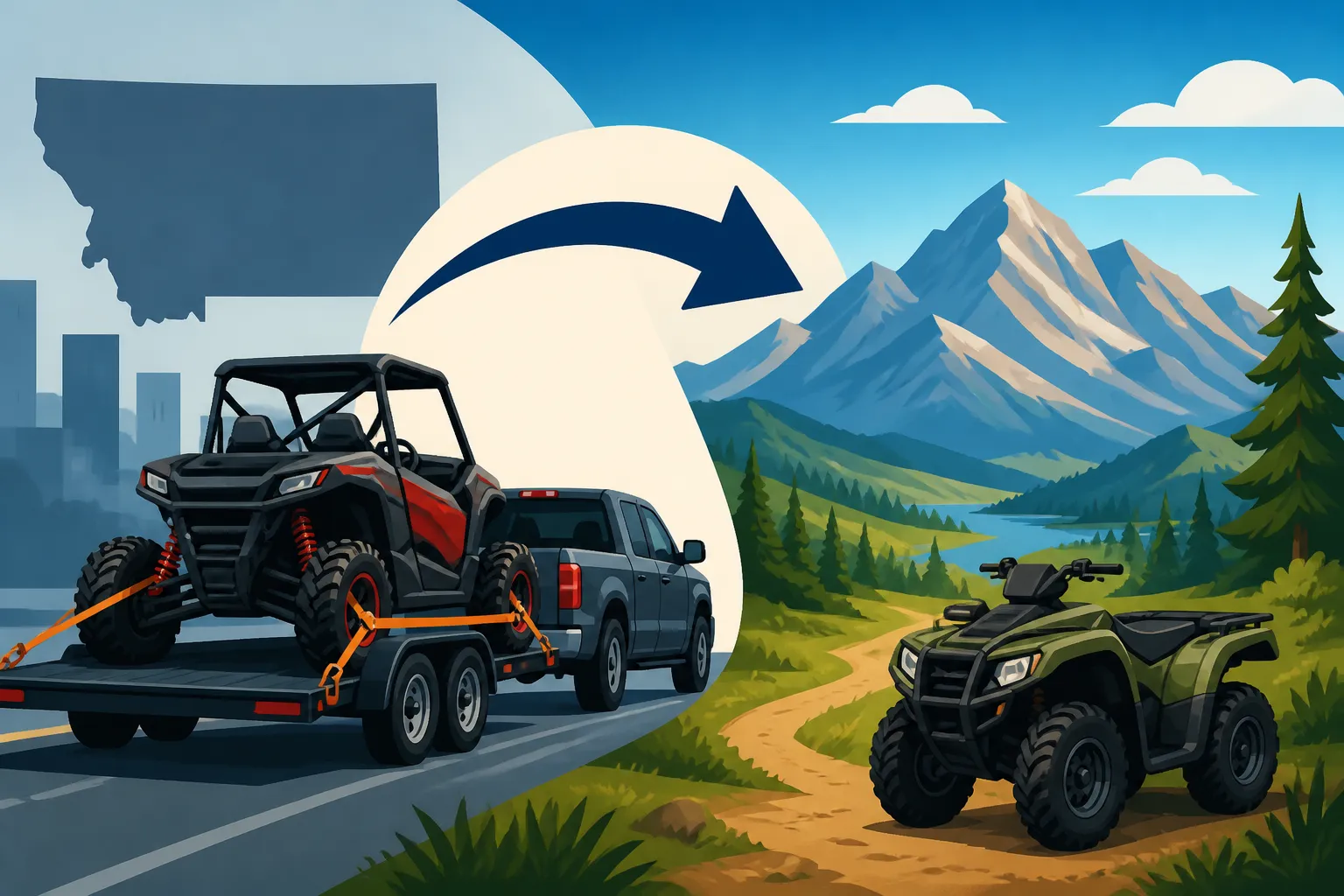
Moving to Montana With an Out-of-State Machine
Welcome to Montana! Moving to Big Sky Country is an incredible journey, often filled with dreams of wide-open spaces and endless trails. But let's be honest, bringing your trusty ATV or UTV with you can introduce a whole new set of questions, especially when it comes to getting it properly registered and titled here. This guide will walk you through the process, easing the transition for your out-of-state machine into its new Montana home, so you can focus on hitting those trails.
Understanding Montana's OHV Registration for New Residents
The thought of more government paperwork after a big move can feel like the last straw, but getting your off-highway vehicle (OHV) squared away in Montana is usually a straightforward process, designed to welcome you and your machine to our incredible outdoor opportunities. The key difference you'll find here, compared to many other states, is Montana's unique approach to OHV registration, particularly the "permanent" aspect for residents.
When you move to Montana, your existing out-of-state registration for your ATV or UTV isn't going to cut it for long. Montana law requires new residents to register their vehicles, including OHVs, once they establish residency here. This isn't just a bureaucratic hoop; it's how the state ensures that a portion of the fees collected goes directly back into maintaining the very trails and staging areas that we all love to ride. It's a way of contributing to the shared outdoor experience.
Montana truly embraces its outdoor enthusiasts, and part of that embrace comes with an efficient system. You won't be dealing with yearly renewal headaches for your OHV once it's registered here. This is a huge relief for many riders who are used to annual stickers and payments. For new residents, the process starts with understanding that you’ll need to officially declare Montana as your home, and then bring your machine's documentation to your local county treasurer.
The "Why" Behind the Change for Your OHV
It's natural to wonder why you have to re-register a machine you already own, especially if you just paid for a year's registration in your previous state. Think of it this way: each state has its own system for managing its trails, enforcing safety, and collecting funds that directly benefit local riding areas. When you move to Montana, you're transitioning into a new system that supports our local trail maintenance, search and rescue operations, and general management of public lands. [Montana Registration for a New Resident] is not just a formality; it's how you become part of the Montana OHV community, contributing to the upkeep of the trails that await you.
Beyond the practical aspects of funding, Montana's registration system helps law enforcement and land managers identify vehicles operating within the state. This is crucial for responding to accidents, addressing trespass issues, and ensuring responsible recreation. Having an official Montana registration ensures that if there's ever an issue or an emergency while you're out riding our vast landscapes, your machine is clearly linked to you as a Montana resident. It removes any ambiguity about where your machine belongs and where it's legally allowed to operate.
Moreover, adhering to Montana's registration requirements is simply the smart thing to do. Riding with expired or incorrect out-of-state tags on public lands here could lead to fines and other penalties. You've just made a big move; the last thing you want is an unexpected citation on your first few rides. Taking the time to properly register your machine now will save you headaches and allow you to fully enjoy your new home.
What "Permanent" Registration Really Means in Montana
The term "permanent registration" for OHVs in Montana often raises eyebrows, and for good reason—it’s not something many other states offer! What it means is that once you've paid the one-time registration fee for your OHV as a Montana resident, that registration stays with you for as long as you own that specific machine. You won't receive annual renewal notices or have to pay recurring fees to keep your registration current. It truly is a set-it-and-forget-it system, which is a fantastic perk for long-term residents.
This permanent status applies to the registration itself, which links the machine to you as the owner for riding purposes. However, it’s important not to confuse permanent registration with a permanent title. The title, which is proof of ownership, is a separate document and functions as it would in most states. When you eventually sell your OHV, the permanent registration does not transfer to the new owner; it ceases when ownership changes. The new owner, if they are a Montana resident, will then go through their own process to obtain a new permanent registration in their name. This ensures that the system accurately tracks current ownership and responsibilities.
So, while the fee is one-time, and you won't get annual stickers, you will still need to replace your decal if it gets lost or damaged. But the underlying registration doesn't expire. [Does a Montana OHV Registration Ever Expire?] only if you sell the machine. This system is designed for convenience, allowing you to ride for years without worrying about upcoming deadlines or budget lines for renewals. It's truly one of the underrated benefits of being an OHV owner in Montana, and it makes moving here with your machine even more appealing.
The Step-by-Step Process for Registering Your Out-of-State Machine
Navigating any new state's vehicle registration process can feel daunting, but getting your out-of-state ATV or UTV registered in Montana is pretty straightforward once you know the steps. The good news is that Montana doesn't have a sales tax, which simplifies one aspect of ownership compared to many other states. [No Sales Tax in Montana and What That Means] means you won't be hit with an unexpected tax bill just for bringing your machine into the state. Your primary point of contact for this entire process will be your local county treasurer's office, so knowing what to bring and what to expect there is key.
Before you even think about driving down to the county office, gather everything you need. This preparation phase is crucial for a smooth and quick visit. Double-checking your documents at home saves you the frustration of having to make multiple trips. We've all been there, standing in line only to realize you left a critical piece of paper on the kitchen counter! A little foresight goes a long way in avoiding that particular headache.
Once your paperwork is in order, the rest of the process involves a visit to the treasurer's office, a bit of form-filling, and payment. It’s typically a quick and efficient experience, especially if you arrive prepared. You'll leave with a temporary registration and your new Montana decal, ready to explore our vast landscapes.
Gathering Your Essential Paperwork
This is arguably the most critical step in the entire process. Walking into the county treasurer's office with all your ducks in a row will make the experience as painless as possible. First and foremost, you'll need the original title for your ATV or UTV from your previous state. This document is the ultimate proof of ownership. If you still have a lien on your machine, your lender might be holding the title, so you’ll need to coordinate with them to get a copy or have them send the original directly to the county office. [Titling an OHV in Montana] is a fundamental part of establishing your ownership here.
Next, bring your current out-of-state registration. While it won't be valid here indefinitely, it serves as an additional layer of proof that you're the rightful owner and helps confirm details like the VIN. A bill of sale is also incredibly helpful, especially if the title from your previous state is less-than-perfect or if the ownership transfer was an informal process years ago. Even if you've owned the machine for ages, a bill of sale can shore up your claim of ownership. For a robust document, particularly if you need to create one for internal records or for an older transaction, services like LawDepot can provide customizable templates for bills of sale or affidavits of ownership, ensuring all necessary details are covered.
Finally, bring a valid photo ID (like your driver's license), proof of Montana residency (utility bill, lease agreement, etc.), and money for the registration fee. It's always a good idea to call your specific county treasurer's office beforehand to confirm their exact requirements, as there can sometimes be minor variations. Being over-prepared is always better than being under-prepared when dealing with official documents. [Documents to Bring to a County Treasurer] outlines all the specifics.
Locating Your VIN and What to Expect at the County Treasurer
Before you head to the county office, it's wise to locate your machine's Vehicle Identification Number (VIN). This 17-character code is unique to your ATV or UTV and will be required for all the paperwork. VINs are typically stamped onto the frame of the machine. On an ATV, it's often on the lower left frame rail near the footpeg or under the handlebars. For UTVs or side-by-sides, it can be a bit more hidden, perhaps under the driver's seat, on a door jamb, or on a frame rail near the engine compartment. [Where a Side-by-Side Hides Its VIN] can give you specific pointers. Having it written down or photographed can speed things up, especially if the number is in a hard-to-read spot or slightly obscured by mud or grime.
When you arrive at your local county treasurer's office – whether it's in Kalispell, Bozeman, Missoula, or a smaller town – you’ll present your collected paperwork. A clerk will review your documents, verify the VIN, and help you fill out the necessary Montana registration forms. They’ll also collect the one-time registration fee. This fee, while subject to change, is typically a modest amount and a small price to pay for years of worry-free riding. [Montana OHV Registration Cost at the Treasurer] details what you can expect to pay. Once everything is processed and paid for, you'll receive a temporary registration receipt and your new Montana OHV decal.
The decal is a very important piece of the puzzle. It’s what officially marks your machine as registered in Montana. You’ll be instructed on where to place it, usually on the rear of the machine, clearly visible. Remember, this decal is your proof of registration when you're out on the trails. Keep your temporary registration receipt with you until your official title arrives in the mail, which can take a few weeks. This process, as detailed in [Montana County Treasurer OHV Registration], is how your beloved machine officially becomes a Montana resident, just like you!
| Document Type | Description | Importance | Notes |
|---|---|---|---|
| Out-of-State Title | Original title from your previous state, showing you as owner. | Required for ownership transfer and titling. | If lien, coordinate with lender. |
| Current Registration | Your most recent registration card from your previous state. | Highly Recommended for verification. | Helps confirm VIN and ownership details. |
| Bill of Sale | Document from your purchase, showing transfer of ownership to you. | Highly Recommended, especially for older machines. | [What a Montana Bill of Sale Should Say] or use LawDepot for templates. |
| Proof of Residency | Montana Driver's License, utility bill, lease agreement. | Required to establish Montana residency. | Must have your current Montana address. |
| Photo ID | Valid government-issued identification (e.g., driver's license). | Required for identity verification. | Must match name on title/registration. |
| Payment | Funds for the one-time permanent registration fee. | Required to complete registration. | Check with treasurer for accepted payment methods. |
| VIN | Vehicle Identification Number (17 digits). | Required for all forms. | Locate it beforehand; write it down. |
Common Hiccups and How to Smooth Them Out
Even with the best intentions and thorough preparation, sometimes things don't go perfectly. Moving to a new state and dealing with vehicle paperwork can throw a curveball or two. From lost titles to incorrect information, these minor setbacks can feel frustrating, especially when you're eager to get out and ride. The good news is that most common issues have established solutions, and knowing what to do ahead of time can save you a lot of stress. Montana's system is designed to be helpful, not punitive, so don’t hesitate to ask questions if something feels unclear.
It's also worth remembering that the folks at the county treasurer's office have seen it all. They're there to assist you, and they deal with unique situations every day. Approaching them with patience and a clear explanation of your situation will go a long way in finding a resolution. Often, what seems like a huge roadblock can be easily overcome with the right information or a specific form.
This section will cover some of the more frequent issues new residents face when bringing their OHVs to Montana. We'll discuss how to handle missing paperwork, incorrect details, and what to do if there are lingering issues from your previous state. Armed with this knowledge, you'll be well-equipped to tackle any minor challenges that pop up.
Dealing with Missing or Incorrect Paperwork
One of the most common issues that new residents encounter is missing or incorrect paperwork. Perhaps you bought your ATV years ago and the title has gone missing in the move, or maybe the previous owner in your home state never quite finalized everything perfectly. If your original title is lost or was never properly issued, don't panic. Montana has procedures for this. You might need to apply for a replacement title from your previous state's DMV or equivalent agency first. This can take some time, so start this process as soon as you realize the title is missing. [Replacing a Lost Montana Title] provides more details on what to do if your Montana title is lost, but the principles of needing a valid title remain.
Another hiccup could be an incorrect VIN on your existing documents. This is a serious issue because the VIN is the unique identifier for your machine. If there's a discrepancy, the county treasurer won't be able to process your registration until it's resolved. You’ll need to work with your previous state's DMV to correct the VIN on your title before Montana can accept it. In some cases, if the error is minor or an affidavit can clarify the situation, the county treasurer might be able to guide you. However, for significant VIN issues, resolving it at the source (your previous state) is usually the safest bet. [Fixing a Wrong VIN on a Montana Title] gives context on how Montana handles these situations.
Sometimes, for older machines, the paperwork from your previous state might be sparse, or you might not have a formal bill of sale if the transaction was informal. In such cases, Montana may accept an affidavit of ownership in conjunction with other supporting documents. This is another area where tools like LawDepot can be incredibly helpful. You can often find templates for affidavits or sworn statements that can attest to your ownership, providing the county treasurer with the necessary legal documentation to move forward. Having these prepared can prevent delays and prove your legitimate claim to the machine.
Understanding Liens and Old Registrations
If you're still making payments on your ATV or UTV, meaning there's a lien against the title, the process requires a little extra coordination. In most states, the lienholder (your bank or credit union) will hold the physical title until the loan is fully paid off. When you move to Montana, you'll need to contact your lienholder and inform them that you are relocating and need to register the machine in Montana. They will typically have a procedure for this, which may involve them sending the original title to the Montana County Treasurer or providing you with a letter authorizing the Montana titling process, after which Montana will record the new lien.
It’s crucial to get this right, as you cannot transfer ownership or title the machine in your name alone if an active lien exists. The Montana County Treasurer will ensure the lien is properly recorded on your new Montana title, protecting both your interests and the lender's. This ensures continuity of the loan agreement while allowing you to legally register and operate your OHV in your new home state. It's simply transferring the financial record keeping to Montana's system.
Another point of confusion can arise with existing out-of-state registrations. While you must get a Montana registration, your old state's registration might still be technically "active" until its expiration date. However, for legal riding in Montana as a resident, you need the Montana registration and decal. Don't rely on your old state's registration, even if it seems current, as Montana law requires its own registration for residents. The goal is to get your permanent Montana registration as soon as you establish residency, eliminating any doubt about your compliance with local laws. This ensures you're ready to hit the trails without worry.
Important Considerations for Your Montana Ride
Once your ATV or UTV is officially registered in Montana, the real fun begins! You're now ready to fully embrace the incredible riding opportunities that Big Sky Country has to offer. However, there are a few important considerations and best practices that every new Montana OHV owner should be aware of. This isn't just about legal compliance, but also about safety, responsible recreation, and being a good steward of our beautiful public lands.
From understanding general expectations for OHV operators to knowing what happens when you eventually decide to sell your machine, these details will help you navigate your new life as a Montana rider. We want you to have the best possible experience, and that means being informed and prepared for all aspects of OHV ownership in our state. It's about more than just a piece of paper; it's about being part of a community that values its outdoor heritage.
Montana's vastness means that rules can sometimes vary slightly by specific land management agency (Forest Service, BLM, State Parks, etc.) or even by local county ordinances. While your state registration is universal, always be mindful of local postings and specific regulations for the areas you plan to explore. A little research before a new adventure can go a long way in ensuring a smooth and enjoyable ride.
Navigating the 30-Day Rule and Safety Education
While your out-of-state machine that you already own doesn't fall under a strict "30-day rule" for purchase, Montana does expect new residents to register their vehicles within a reasonable timeframe after establishing residency. There isn't an explicit "30-day deadline" for already-owned OHVs moved into the state, as there might be for newly acquired vehicles. However, it's best practice to get your machine registered promptly once you have your Montana driver's license and proof of residency. This ensures you're fully compliant and ready to ride without issues. [Montana Registration Deadline for New Residents] primarily discusses the deadlines for newly purchased vehicles, but the spirit of prompt registration applies to all vehicles you bring into the state.
Beyond registration, Montana has specific requirements for OHV riders, particularly concerning safety education and age. If you or anyone in your family operating an OHV is under the age of 16, they generally need to complete an approved OHV safety education course. This course teaches crucial skills, safe operating practices, and an understanding of state laws. Even for adult riders, taking a safety course is highly recommended, as it can refresh your knowledge and introduce you to best practices for Montana's unique terrain.
This safety education is not just a formality; it's a vital component of responsible riding, especially in our rugged and sometimes unpredictable environments. Understanding things like proper trail etiquette, environmental considerations, and emergency procedures can make a huge difference in your safety and enjoyment. You can find approved courses online or through local providers, and it's an investment in your well-being on the trails. [Montana's Safety Education Requirement] ensures that riders are prepared for the challenges of our backcountry.
What Happens When You Sell Your Permanently Registered OHV
One of the unique aspects of Montana's permanent OHV registration is what happens when you decide to sell your machine. Unlike some states where the registration might transfer with the vehicle for the remainder of the term, in Montana, the permanent registration is tied to the owner and effectively ends when the machine is sold. This is a crucial point to understand for both sellers and buyers. [Why a Sold Machine Loses Its Registration] is a common question, and it boils down to the fact that the "permanent" nature is for your ownership period.
When you sell your ATV or UTV, you will transfer the title to the new owner. They, in turn, if they are a Montana resident, will then need to go through the process of obtaining their own new permanent registration and decal from their county treasurer's office. This ensures that the state's records are always accurate regarding the current responsible owner of the machine. It's a clean break of responsibility from you to the next person.
This process simplifies things in some ways, as you don't have to worry about prorating registration fees or the new owner being responsible for renewals under your old registration. You simply handle the title transfer, and they handle their new registration. It's always a good practice to provide the new buyer with a clear bill of sale and to encourage them to register the machine in their name promptly. This final step ensures that the transition of ownership is complete, and you're free from any future liabilities associated with that machine.
Disclaimer
This article is for general informational purposes only and does not constitute professional advice. Laws, prices and regulations vary by location and change over time. Consult a qualified professional for guidance on your specific situation.