Montana Trailhead Parking and Staging
A Montana ride can start with a surprisingly stressful question: where can you leave the truck and trailer without blocking a gate, crowding other riders, or parking somewhere your machine cannot legally reach? This guide explains how to choose a suitable trailhead, plan your parking and unloading, check access conditions, and stage your ATV or UTV thoughtfully before heading out.
Choose a trailhead that fits your route and rig
Confirm the route and parking access
A trailhead is not automatically open to every kind of vehicle just because it appears on a map. Before you drive there, check whether the approach road is open to your truck and trailer, whether the riding route is designated for your machine, and whether the lot or roadside pullout allows the kind of parking you need. Access may cross land managed by different agencies or owners, and a route that looks continuous on a screen can have restrictions that are easy to miss.
For National Forest routes, a Motor Vehicle Use Map can help you understand where motorized travel is allowed and what seasonal or vehicle-specific restrictions apply. It is worth comparing the map with signs at the entrance and any current closure notices; posted directions on the ground matter. If you are not used to reading route designations, [Reading a Montana Motor Vehicle Use Map] can help you know what to look for before committing to a drive.
Mapping apps, including onX Offroad, can be useful for planning a route and spotting nearby access points. Treat any digital map as one planning aid, not permission to ride or park. When a map, sign, or closure notice leaves you uncertain, avoid assuming that the most convenient-looking option is allowed. Look for information from the land manager responsible for the area, or choose a trailhead with clearly designated parking and access.
Match the parking area to your vehicle and trailer
A small turnout that works for a pickup may be awkward for a long truck pulling an enclosed trailer. Before setting out, think through the full footprint of your setup: the truck, trailer, space needed to turn or back up, and room to unload. If you are hauling more than one machine or traveling with several families, a trailhead that seems roomy on a map may still be difficult to use once other visitors arrive.
Consider the approach as carefully as the destination. Narrow forest roads, steep grades, loose surfaces, sharp turns, low branches, and soft shoulders can make towing stressful, especially when visibility is limited. Ask whether your trailer can reach the parking area without blocking traffic or needing a difficult turn-around. If the access road looks questionable, it may be safer to park at a larger, suitable area and ride only if the route and rules allow it.
A good parking spot should let you unload without forcing other people into the travel lane. It should also leave space for emergency vehicles, agency staff, and other trail users. For ideas on planning a route around designated motorized access, see [Montana's National Forest Trail Systems]. If your group is heading into a less familiar area, use a route plan that includes both the riding route and the place where your truck and trailer will stay.
Park and unload without creating a bottleneck
Set up your truck and trailer thoughtfully
When you arrive, take a moment to assess the lot before pulling into the first open-looking space. Look for signs, marked stalls, gates, turnarounds, and areas that need to remain clear. A convenient patch of gravel may actually be the access path for another vehicle or the only room large enough for someone to turn around. If the site is busy, wait briefly for a clear opening rather than squeezing into a spot that could block movement.
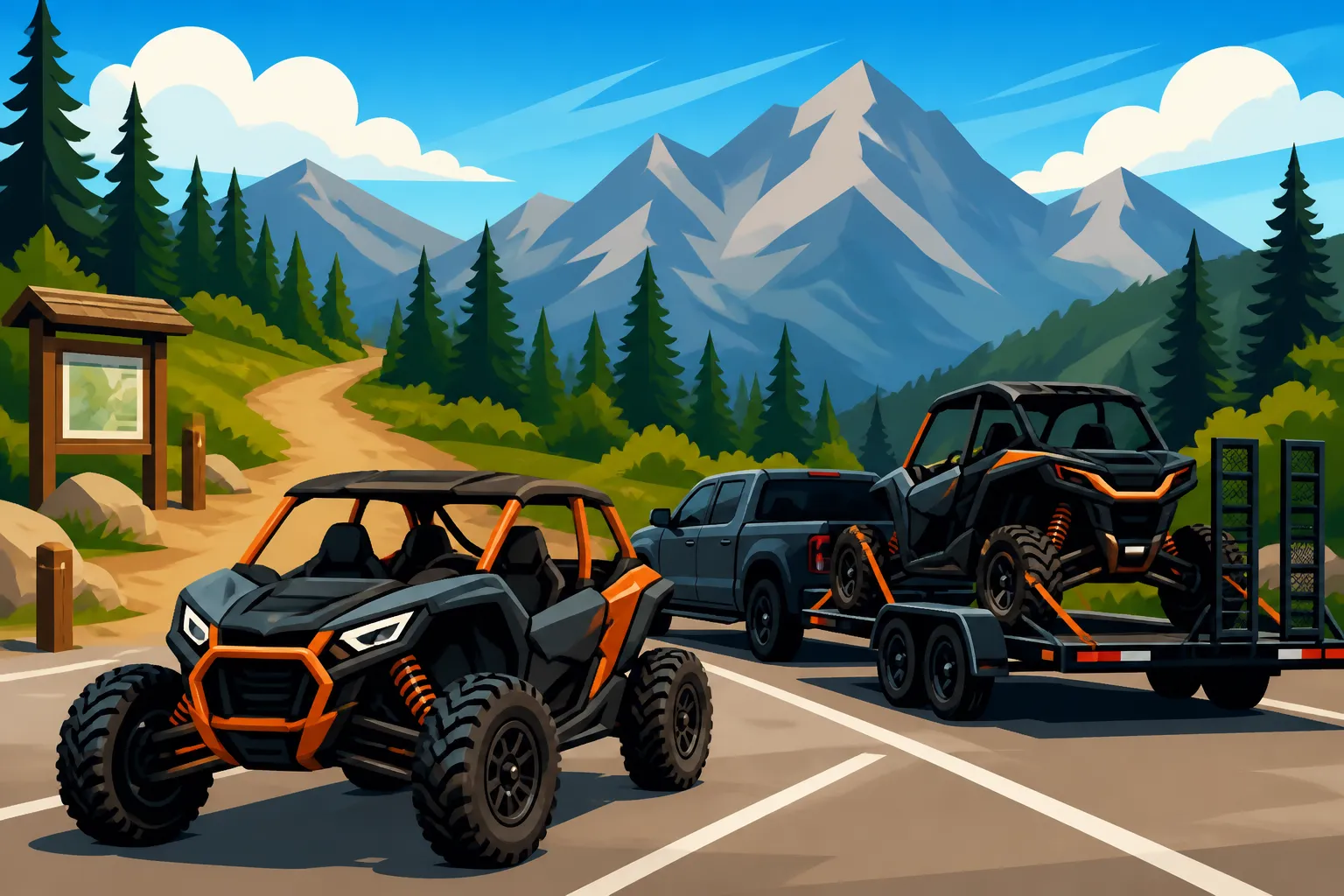
Try to park in a way that makes unloading straightforward and keeps your gear contained. If you need room behind the trailer to lower a ramp, leave enough space without projecting into the main drive aisle. Set the parking brake, secure the tow vehicle, and keep ramps, tools, and loose items close to your setup. Avoid spreading equipment across adjoining spaces or leaving a trailer positioned so another visitor cannot safely get past.
| Parking situation | What to check | A considerate approach |
|---|---|---|
| Marked trailhead lot | Signs, stall limits, and access lanes | Use designated spaces and keep gates and lanes clear |
| Gravel pullout | Whether it is a legal parking area and wide enough for turning | Park fully off the travel surface where safe and permitted |
| Narrow forest road | Road width, visibility, and room for other traffic | Do not block the road or park where passing becomes hazardous |
| Busy staging area | Space for unloading and other groups | Keep gear together and move machines out of the way promptly |
| Overnight parking | Local rules, land-manager restrictions, and security | Confirm overnight use is allowed before leaving a vehicle |
If a spot is full, do not assume that parking along the nearest road edge is an acceptable substitute. A shoulder can be soft, narrow, or needed by passing traffic, and a vehicle parked around a blind curve can create a hazard. Look for another designated area or postpone the ride. For more trip planning around a larger tow vehicle, [Montana Trailhead Parking for a Toy Hauler] offers a related angle on parking space and access.
Unload machines in a controlled area
Unloading is one of the easiest moments for a small parking problem to turn into a bigger one. Before lowering a ramp, check the ground for slope, loose gravel, mud, and obstacles. Make sure the trailer is stable and the ramp is securely positioned. Keep children and bystanders away from the unloading path, and have one person guide the process if the driver cannot clearly see the rear of the trailer.
Unload one machine at a time and move it to a safe place rather than leaving it across the drive aisle. Riders should be ready to start and move only when the area is clear and the group knows where it is going. Avoid revving, rapid turns, or unnecessary riding around the lot. Trailheads are shared spaces, and a quiet, predictable unload is easier on other visitors and on anyone trying to park or leave.
When you finish, gather ramps, straps, tools, and loose gear before shifting into ride mode. A forgotten strap can become a road hazard; a ramp left on the ground can obstruct someone else. If you need to make adjustments to a machine, do them in a place where you are not blocking access. This simple pause also gives the group a chance to check helmets, safety gear, fuel, and route plans before moving away from the vehicles.
Stage your ride before leaving the lot
Organize people, machines, and gear
A little coordination at the trailhead can prevent confusion a few miles later. Agree on who is leading, who is sweeping at the back, and where the group will stop if it gets separated. Make sure everyone knows the planned route and the general return point. For a mixed group with different experience levels, keep the pace appropriate for the least experienced rider rather than letting the fastest machine set the rhythm.
Before heading out, check that every machine is ready for the conditions you expect. That means looking over tires, brakes, lights, fuel, and essential controls, and making sure the load is secured. Carry the gear that makes sense for the route, including water, weather layers, basic tools, and communication equipment suited to your trip. The farther you are from services, the more important it is to be prepared to handle a delay. [What to Carry on a Remote Montana Ride] is useful when you are deciding what belongs in the machine or tow vehicle.
Keep your staging area tidy and compact. Put personal bags and extra gear in the truck or trailer instead of leaving them scattered across the lot. Store keys and valuables securely, and do not leave a vehicle running unattended while the group sorts itself out. If several machines are traveling together, identify each machine and rider clearly so no one takes off without the right people or equipment.
Confirm route, fuel, and return plans
Before riding away, compare your planned route with the signs and any current information you have. A trail shown on an older map may be seasonally closed, affected by a fire restriction, or unsuitable for your machine. Route conditions can change, and a route that looked manageable from home may feel very different after rain, snowmelt, or recent trail damage. Check for current notices before leaving, and be prepared to turn around if conditions do not match your plan.
Fuel planning deserves the same attention as route selection. Do not assume you will find fuel near a remote trail system or that a machine’s estimated range will match the day’s terrain, load, and riding style. Know where you can refuel before and after the ride, and leave a reserve for detours or slow travel. [Fuel Planning for a Montana Trail Day] can help you think through range and the practical details of a longer ride.
Use a clear turnaround plan. Tell someone who is not riding where you expect to be and when you plan to return, especially if the route is remote. Agree on what the group will do if a machine breaks down or a rider needs to stop. A quick check-in plan does not make a trip risk-free, but it can reduce the chance that a small delay becomes a long, confusing search.
Check local conditions before you drive out
Look for closures and seasonal changes
Montana trail access can shift with weather, maintenance, fire activity, and seasonal restrictions. A road that was passable on a previous trip may be muddy, snow-covered, damaged, or closed when you return. High-country routes can hold snow later than lower areas, while heavy rain or spring runoff can make some approaches difficult even when the destination appears close. Conditions also vary across the state, so a general assumption about the season is not a substitute for checking the specific area.
Check information from the land manager, local agencies, and posted signs before you commit to the drive. If you use onX Offroad or another mapping tool to plan, compare its route information with current official notices and what you see on the ground. Do not ride around a closure gate or treat a closed route as an invitation to find an alternate track. A closure can protect people, wildlife, property, or a damaged trail, and the detour may not be authorized.
Give your group a backup plan. Choose another legal riding area or a different activity in case the intended trailhead is inaccessible or full. This is especially helpful if you have driven a long distance with a trailer. [Checking Montana Trail Status Before You Drive] is a useful companion topic for building that pre-trip habit, while [Trail Conditions After Snowmelt] covers why early-season access can differ from what a map suggests.
Account for remoteness and limited services
Some trailheads are close to town, while others require a long drive on roads with limited services and little or no cell coverage. Do not count on a strong phone signal to navigate, call for help, or check a map once you leave the highway. Download or save the information you need before the trip, carry a backup navigation option, and let someone know your plan if you expect to be out of contact.
Think about the return drive as well as the ride. A late finish can mean unloading in low light, navigating an unfamiliar access road, or towing in poor weather. Plan to leave enough time to get back to the trailhead, load safely, and reach a main road before conditions worsen. If the forecast or trail conditions look uncertain, shorten the ride rather than relying on an optimistic turnaround estimate.
Remote access also makes vehicle readiness important. Check the tow vehicle and trailer before leaving, and bring supplies for common problems such as a flat tire or a loose strap. Let another person know where the vehicle will be parked and when you expect to return. [Cell Service in the Montana Backcountry] explores the communication challenge, and [Carrying a Paper Map in Grizzly Country] is a reminder that a phone screen should not be your only navigation plan.
Leave the staging area safer and better than you found it
Protect shared access and the surrounding land
When you return, keep the same care you used when unloading. Move machines to the trailer or a designated area, avoid unnecessary laps through the lot, and watch for people walking between vehicles. If other groups are waiting to load, keep your gear organized so you can clear the space promptly. Do not leave trash, food scraps, broken straps, or machine parts behind.
Be especially careful around gates, fences, livestock, and private property. A trailhead or access road may be near working land, and an open gate can have a purpose you do not know. Follow posted instructions and do not move barriers to create more parking. If the lot is muddy or soft, avoid spinning tires or driving onto vegetation in search of a drier spot. Damage to the access area can affect everyone who uses it.
The same principle applies to informal pullouts. A place where someone else has parked before is not necessarily an authorized staging area. Avoid widening an existing turnout by driving over plants or disturbing soil. If the designated area cannot accommodate your vehicle safely, find another legal option rather than making the site bigger yourself.
Have a plan for a full lot or a problem
A full trailhead is frustrating, particularly after a long haul, but squeezing in can block emergency access or create conflict with other visitors. Do not park in front of a gate, across a turnaround, on private land without permission, or where your trailer narrows a road to the point that others cannot pass safely. If there is no suitable legal space, leave and use your backup plan.
If your truck or trailer becomes stuck or disabled, avoid making the situation worse by digging up the shoulder or blocking a narrow road. Keep people out of traffic, use warning equipment where appropriate, and contact roadside assistance or local help if you have a safe way to do so. In remote areas, conserve phone battery and share your location or route information when possible. If you have a mechanical issue with a machine rather than the tow vehicle, move it out of the way only if doing so is safe.
For an overnight stop, verify that leaving a vehicle is permitted and consider how you will protect keys, valuables, and equipment. Parking rules can differ between recreation areas and nearby towns, and a roadside space should not be treated as a campsite by default. If you are considering staying near an access point, [Dispersed Camping Near Montana Trailheads] can help distinguish overnight camping questions from ordinary day-use parking.
Disclaimer
This article is for general informational purposes only and does not constitute professional advice. Laws, prices and regulations vary by location and change over time. Consult a qualified professional for guidance on your specific situation.