Montana’s $20 Resident OHV Trail Pass Explained
Montana’s resident OHV trail pass is easy to confuse with vehicle registration, a title, or permission to ride a particular trail. If you live in Montana and ride an ATV, UTV, or other off-highway vehicle on public land, this guide explains what the pass is for, how it fits with registration, where to look for it, and what it does not authorize.
What the resident OHV trail pass is for
The resident trail pass is a Montana permit for qualifying residents who operate an OHV on public lands where a pass is required. The $20 figure in the title is the commonly cited resident-pass amount, but fees and procedures can change. Confirm the current amount and requirements with Montana Fish, Wildlife & Parks or the office handling your transaction before you buy.
The pass is about access to public-land OHV riding. It is not a blanket license to ride anywhere, and it does not replace permission from a landowner, a route’s seasonal opening dates, or other rules that apply to a particular trail. A route may be closed, limited to certain vehicle widths, or open only to machines that meet its requirements. A pass does not override those restrictions.
It also helps to keep the pass separate in your mind from registration and title paperwork:
- A trail pass addresses the applicable public-land riding permit requirement.
- Registration identifies the machine under Montana’s vehicle-registration system and may be required independently.
- A title is evidence of ownership for a machine that is titled.
- Road permission and equipment rules determine whether a route open to the public can be ridden on a particular road, and under what conditions.
Those requirements can overlap, but one document does not automatically satisfy all the others. For a broader overview of resident requirements, see Montana’s Resident OHV Trail Pass and What Montana Riders Need Before They Ride.
Who should check whether they need one
If you are a Montana resident planning to ride an OHV on public land, check the current pass requirement before you head out. Do not assume that owning the machine, having a Montana driver’s license, or keeping the OHV at a Montana home settles the question by itself. The applicable category can depend on residency, the type of machine, where you plan to ride, and whether a separate registration or exemption applies.
Private land is a different situation from public land, but “private” does not always mean “no rules.” You need the landowner’s permission, and other requirements may still apply depending on the location and activity. A trail that crosses private property may also have access conditions that are not obvious from the road or trailhead. For that reason, treat the pass and permission to enter as separate questions.
Visitors should not buy the resident pass just because they are riding a Montana-registered machine or staying in Montana for a trip. Nonresidents have a separate permit framework, so start with Montana’s Non-Resident Temporary Use Permit if the rider is visiting rather than a Montana resident.
How the pass relates to registration
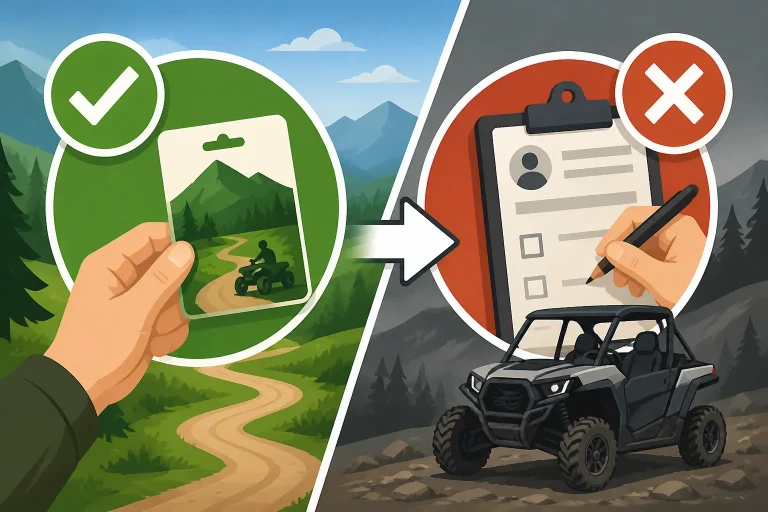
A common point of confusion is whether buying a trail pass means the OHV is registered. It does not. The pass and registration address different requirements, even when the purchase or paperwork process connects them.
A Montana resident may need to deal with the county treasurer for registration and with FWP or an authorized seller for a trail-pass transaction. The steps can depend on whether the machine is already registered, whether it is newly purchased, and how the current process handles the fee. If you are registering a machine, ask the office whether the pass is included, must be purchased separately, or can be credited under the current rules. Do not assume the same answer applies to every transaction.
If you have already bought a pass and are now arranging permanent registration, keep the receipt and ask whether it can be applied to the registration process. The relationship between the two is explained in Trail Pass Credit Toward Permanent Registration. Confirm any timing or documentation conditions before relying on a credit; a pass receipt that is missing, expired, or outside the applicable process may not be treated the way you expect.
The basic distinction is:
| Item | Main purpose | What it does not prove |
|---|---|---|
| Resident OHV trail pass | Meets the applicable resident pass requirement for covered public-land riding | Ownership, completed registration, or permission to use every route |
| Montana registration | Registers the machine under the applicable state process | That a trail is open or that the rider has landowner permission |
| Title | Records ownership for a titled machine | That the machine is currently registered or permitted for a specific ride |
| Road authorization or local permission | Allows use of a particular road or access area when required | General access to public trails elsewhere |
A newly purchased used machine deserves extra care. The seller’s registration or pass does not necessarily become yours with the machine. Before riding, confirm what must be transferred, replaced, or purchased in your own name. The registration question is covered in Re-Registering a Machine You Just Bought, while Why a Montana Registration Does Not Follow the Machine explains why a previous owner’s paperwork should not be treated as a shortcut.
Keep the purchase record
Save the receipt, confirmation email, and any pass or registration document you receive. If a retailer or online system issues proof that is separate from a physical decal, keep that proof accessible and follow the instructions for displaying or carrying it. If you are unsure what must be on the machine and what must be carried by the operator, ask the issuing office rather than guessing.
This is especially useful when you buy the pass before completing registration. A receipt can help show what you paid for and when, but it is not necessarily a substitute for the final credential. Make sure you know what document or decal you still need before riding.
Where and how to buy the pass
Purchase through an official or authorized channel, and verify that you are selecting the resident OHV trail pass rather than a nonresident permit or a different recreational license. FWP’s online licensing options may be useful for eligible transactions. Some county treasurers and other authorized vendors may also handle pass sales, but availability and processing can vary.
Before starting, have enough information to identify yourself and the machine, and know whether you are purchasing the pass on its own or as part of a registration transaction. If the machine is newly bought, ask whether you should complete registration first or buy the pass beforehand. The sequence matters if you expect the pass fee to count toward a later registration payment. See Buying the Trail Pass Before Registering for the questions to resolve before choosing an order.
A practical purchase checklist:
- Confirm that you are eligible for the resident pass. If your residency status is uncertain, ask FWP or the office processing the purchase which category applies.
- Identify the machine and intended use. An ATV, UTV, dirt bike, or other OHV may have different paperwork needs from a road-registered vehicle.
- Ask whether registration is separate. A pass purchase alone should not be treated as completed registration.
- Confirm the current fee and validity details. Check the official transaction page or issuing office, including when the pass becomes valid and when it expires.
- Find out what proof you must keep or display. Follow the instructions that come with the pass rather than relying on what another rider does.
- Save the confirmation and receipt. Keep a copy somewhere you can access if the credential is lost or questioned.
For online purchases, start from FWP’s official licensing route rather than a search result or a third-party page that merely discusses permits. Buying a Trail Pass Through FWP Online Licensing covers the online route. If you prefer to handle paperwork in person, call ahead to confirm that the office sells the pass and can process the transaction you need. County Treasurers and Trail Pass Sales is a useful next step for that option.
Buying it before a ride
Do not leave the purchase until you are at a remote trailhead. Cell service may be weak, payment pages may not load, or the nearest vendor may be a long drive away. Arrange the pass in advance and check that your receipt or credential is available offline if the issuing instructions allow it.
That does not mean a pass bought in advance automatically covers every trip or every machine. Check the credential’s machine, rider, and validity conditions, and ask about separate passes if more than one OHV will be used. A household with several machines should not assume that one purchase covers the whole group.
What the pass allows and what it does not
The most useful way to think about the resident pass is as one part of the access checklist. It may meet the applicable pass requirement for covered public-land OHV use, but it does not guarantee that a specific route is open, suitable for your machine, or legal for your planned ride.
Before leaving, check the managing agency’s current route information, signs at the trailhead, and any temporary closures. Forest routes can have seasonal dates, fire restrictions, maintenance closures, and vehicle-width limits. A wide side-by-side may not be allowed on a trail open to a narrower machine. A trail shown on a map may also have changed status or may require access across land where separate permission applies.
The pass does not authorize:
- Riding off the designated route where off-trail travel is prohibited.
- Entering private property without permission.
- Using a route during a closure or outside its open season.
- Operating a machine on a public road where OHVs are not allowed.
- Ignoring age, safety, equipment, or road-use rules.
- Using a trail that is unsuitable for the machine’s width or type.
For public-land rules, use Montana Permit Rules on Public Land as a starting point, then check the land manager’s route information for the place you plan to ride. If your plan includes riding on roads, review the separate road rules and local permissions; a trail pass does not make an OHV street-legal.
Private land and exemptions
Riders often ask whether a pass is needed on their own property, a family ranch, or land where they have permission to ride. The answer can depend on the exact land status and activity, so do not use a broad rule of thumb in place of checking the applicable requirement. Permission to ride on private land does not automatically settle every registration, safety, or equipment question.
Likewise, an exemption from one requirement does not necessarily exempt the rider from all others. If you believe your use qualifies for an exemption, confirm what it covers and keep any supporting documents. When a Montana Rider Needs No Permit can help frame that question, but the actual facts of the land and ride matter.
A public route through or beside private land can be particularly confusing. The fact that you can see a track, or that another rider has used it, does not establish legal public access. Check signs, maps, and land-manager information. If access is unclear, choose a route with confirmed public access rather than risking trespass or a confrontation.
A simple pre-ride check for Montana residents
Before each ride, take a few minutes to confirm the paperwork and route conditions. This is quicker than discovering at the trailhead that the machine has the wrong credential or the route is closed.
Use this checklist:
- Residency: Make sure you are using the correct resident or nonresident permit category.
- Pass status: Confirm the pass is valid for the planned ride and that you can show or display the required proof.
- Machine paperwork: Check that registration and title documents are in order for that machine and ownership situation.
- Route access: Verify that the trail or road is open to OHVs and to your machine’s type or width.
- Land access: Confirm permission where the route crosses private land or otherwise requires it.
- Rider requirements: Review age, supervision, helmet, safety education, and equipment rules that apply to your ride.
- Plan B: Have an alternate route in case of a closure, poor conditions, or a trail that turns out to be too narrow.
If you ride with family members or friends, make sure each operator has the correct permit status. The machine owner’s pass should not be assumed to cover every rider or every second machine unless the issuing rules explicitly say so. Ask the agency or seller how the pass is assigned and what the credential applies to.
Keep the proof where you can reach it. Some riders carry printed paperwork in a protected pouch; others keep an accessible digital copy when permitted. A small waterproof document pouch or phone mount can help keep information readable and available on a dusty ride. Amazon is one possible place to find a basic pouch, but it is not an official pass seller. A pouch from Amazon can protect a paper receipt, while a phone mount from Amazon may make it easier to view saved route information when stopped. Whatever gear you use, download maps and documents before leaving service; buying equipment on Amazon does not replace checking official permit instructions.
If your paperwork is lost, damaged, or difficult to read, contact the office or service that issued it before your next ride. Do not rely on a photograph alone unless the current instructions accept it as proof. The same caution applies to a pass that appears attached to a previous owner’s machine or paperwork: ask whether it remains valid for your situation.
Questions worth asking before you pay
If the instructions are not clear, ask direct questions instead of trying to infer the answer from the checkout screen:
- Is this the resident trail pass or a nonresident permit?
- Does this transaction also complete registration, or is registration separate?
- Does the pass apply to the rider, the machine, or a particular credential?
- What proof must be carried or displayed?
- What are the start and end dates for validity?
- Can the fee be credited toward permanent registration, and what receipt or timing is required?
- Does this purchase cover more than one machine or operator?
- Are there exemptions for the land or use planned?
Those answers can differ depending on the transaction and circumstances. Confirm them with the issuing source, especially when the machine was recently purchased, registration is pending, or the rider’s residency classification is not straightforward.
The short version: a Montana resident OHV trail pass is a public-land riding permit, not a substitute for registration, title, route access, or landowner permission. Check the current fee and validity, buy through an official or authorized channel, keep the proof, and verify that the specific route is open to your machine. When any part of the paperwork is unclear, a quick call before the ride is much easier than sorting it out at a trailhead.
Disclaimer
This article is for general informational purposes only and does not constitute professional advice. Laws, prices and regulations vary by location and change over time. Consult a qualified professional for guidance on your specific situation.