Who Must Take the Montana Course
Montana’s ATV and UTV course requirement is easy to confuse with trail permits, registration, and rules for riding on roads. The key question is usually the operator’s age and whether the ride is on public land. Here’s how to tell whether a rider needs the course, what it does not replace, and what visitors should check before heading out.
Who must take Montana’s OHV safety course
For Montana ATV and UTV riders, the main age cutoff to know is 16. A rider under 16 generally must complete an approved off-highway vehicle safety education course before operating an OHV on public land. That can include public trails and other public riding areas, not just a marked trail. Check the rules for the specific location and machine before a young rider starts.
This requirement is about the person operating the machine. A parent’s certificate does not cover a child, and having a permit for the machine does not satisfy the education requirement. Each young operator who is required to take the course needs their own qualifying course completion.
The course is intended to cover safe operation and responsible riding, not just paperwork. Training can help a young rider understand how to handle the machine, recognize hazards, and make safer decisions. It is also a chance for families to discuss rules that matter on the ride, such as staying on open routes and giving other trail users space.
The cutoff does not mean every rider under 16 can operate any machine once they finish a course. Youth operation rules can depend on age, the type and size of machine, supervision, and where the ride takes place. A course certificate is one requirement; it is not a universal authorization to ride. For the broader age-related rules, see Montana Age Rules for Riders Under 16.
Adults generally do not need the youth safety course solely because they operate an ATV or UTV. But an adult may still choose to take it, and a particular program, employer, event, or land manager could set its own training conditions. Those conditions are separate from the statewide education requirement.
A useful starting point is to think through four questions:
- Is the rider under 16?
- Is the machine an OHV covered by the relevant rule?
- Will the ride take place on public land or a public road?
- Does the rider already have a certificate that Montana recognizes?
If the rider is under 16 and the ride is on public land, plan on verifying the course requirement before the trip. For a broader explanation of the education rule, see Montana OHV Safety Education Requirements.
| Rider or situation | What to check |
|---|---|
| Rider under 16 on public land | Whether the rider has completed an approved course and meets other youth-operation rules |
| Rider 16 or older | Whether the riding location, event, or other rule has a separate training condition |
| Visitor with an out-of-state certificate | Whether Montana recognizes that particular certificate |
| Ride on a public road | Road-use requirements in addition to any course requirement |
| Ride on private property | Landowner permission and any applicable private-land or youth rules |
| Machine is rented or borrowed | The rental agreement, owner’s instructions, and permit requirements |
The table is a screening tool, not a substitute for checking the rule that applies to the specific ride. A machine can move between different legal settings during one outing: a private driveway, a public road crossing, a public trail, and a trailhead parking area may each have different requirements.
Where you ride changes what to check
Public land and designated riding areas
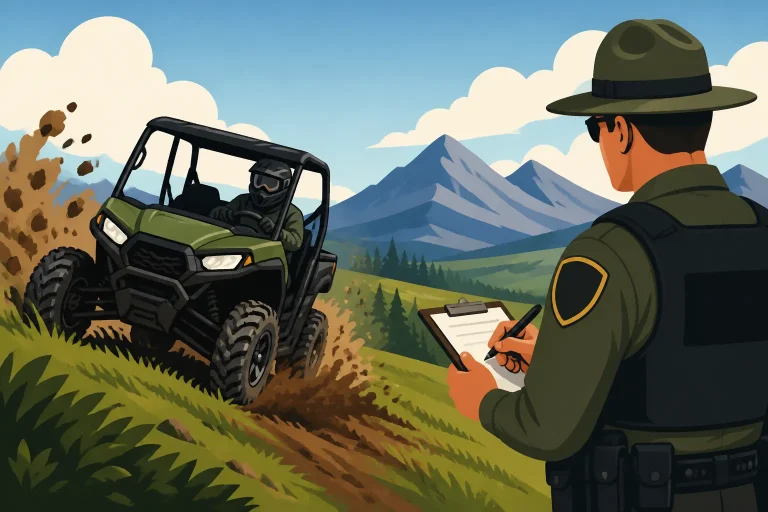
The course question most often matters when a young rider will operate on public land. A family may be headed to a forest trail, a public staging area, or another managed recreation site. Before leaving, confirm that the intended route is open to the machine and that the rider has the required training and other documents.
Do not assume that “public land” means every road, trail, or open area is available to every machine. Managers can restrict routes by vehicle type, width, season, or other conditions. A safety certificate does not grant access to a closed route, replace a required permit, or change the machine’s registration status. Check the current route information and the land manager’s rules as part of trip planning.
Where a nonresident permit is required, it remains a separate matter from the safety course. A permit does not prove that a young operator has completed training, and a course certificate does not serve as a permit. Visitors can review Montana’s Non-Resident Temporary Use Permit and Montana Rules for Visiting Riders to sort out the separate requirements before travel.
Private land
A ride on private land can raise a different set of questions from a ride on public land. Permission from the landowner matters, and families should confirm whether the safety-course rule applies to the specific property and activity. Private land is not a reason to assume that all youth, machine-size, or supervision rules disappear.
There may also be public-land segments within what feels like a private outing. For example, a route from a ranch or cabin might connect to a public trail, cross a public road, or use a public staging area. Treat each segment according to the rules for that place rather than treating the entire trip as private simply because it begins on private property.
The course is still useful on private ground, even where a particular public-land requirement does not apply. Young riders benefit from learning basic controls, hazard awareness, and safe riding habits before they are asked to manage unfamiliar terrain or ride near other people.
Public roads and road sections
Road use is not the same as off-road trail riding. Montana has separate conditions for operating an OHV on roads, and a course certificate by itself does not make a machine road-legal or make a rider eligible to use a road. Equipment, registration, age, supervision, and local access rules may also matter.
A planned route that uses a short road section deserves special attention. Check whether that section is open to OHVs, what the rider must carry, and whether the same age and education rules apply to the particular road use. The details can depend on the road and the kind of operation, so do not rely on a general trail rule. See Who Needs the Course on a Public Road for that separate question, and Montana Road Rules for Young Riders for the wider youth-road context.
Rental, borrowed, and family machines
A rental company or machine owner may set conditions beyond the general state rule. A shop may require a particular age, a valid driver’s license for a road-legal rental, a signed agreement, or an adult’s involvement. Those conditions do not replace state requirements; they add another layer to check.
If a young person will operate a borrowed family machine, agree in advance who is responsible for confirming the route, carrying proof, and supervising the ride where required. Do not assume that the adult who rented or registered the machine can satisfy an operator requirement for the youth riding it.
Visitors, certificates, and proof of completion
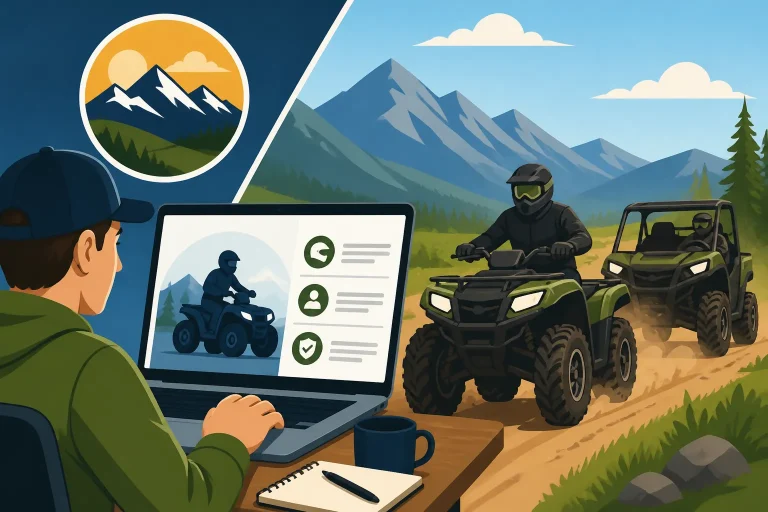
A visitor should not assume that an out-of-state course certificate is automatically accepted in Montana, but should not assume it is rejected either. Recognition depends on the certificate and the applicable Montana rule. Before travel, check with the relevant state program or land manager and confirm what documentation they accept.
This is especially important if the certificate is from another state, an online provider, or a course taken a long time ago. Keep the course-completion record accessible, and make sure the rider’s name and certificate details are legible. If there is any question about whether a certificate qualifies, resolve it before reaching the trailhead rather than expecting an officer or land manager to decide based on an unclear screenshot.
Montana course requirements are not the same thing as a nonresident trail permit. A visiting rider may need a permit for public-land riding even if the rider has a recognized safety certificate. Conversely, buying a permit does not fulfill a course requirement for a young operator. Think of them as separate checks:
- Training: Has the operator completed the required course?
- Permit: Does this rider or machine need a permit for the planned public-land use?
- Registration: Is the machine properly registered or otherwise eligible for the planned use?
- Road access: Is the road open to this type of machine, and does the rider meet its conditions?
- Local rules: Does the land manager, rental company, event organizer, or landowner impose additional requirements?
If you are comparing a Montana certificate with one from another state, use Out-of-State Certificates Montana Accepts as a starting point. Do not rely on the title of a course alone. Ask whether the actual certificate satisfies the requirement for the rider, machine, and location involved.
Proof is most useful when it can be produced promptly. A practical approach is to keep a digital copy on a phone and a backup copy with the trip paperwork. If the certificate is issued as a card or other physical record, bring it when practical. A phone may lose service or power, and a photo that is too blurry to read may not resolve a question.
Parents and guardians should check the document before the ride. Confirm that it belongs to the operator who will be riding, that the name is readable, and that it shows course completion. If the certificate has been replaced or the original is lost, find out how to obtain acceptable proof before traveling. For questions about how long a certificate remains valid, see Does a Montana Certificate Expire?.
How to prepare a young rider before the trip
A course certificate is a useful starting point, but good preparation includes more than a document. A young rider may be new to the machine, unfamiliar with the terrain, or excited to keep up with adults. Set expectations before the engine starts, and choose a route and pace that match the rider’s ability.
Confirm the course and the route
First, establish whether the rider is required to take the course for the planned activity. If so, make sure the course is approved for that purpose and that the rider has completed it before the trip. If the rider has a certificate from outside Montana, confirm that it qualifies rather than relying on a general assumption about reciprocity.
Next, check the route itself. Verify current access and any vehicle-size or seasonal restrictions. A family-friendly trail is not automatically suitable for every young rider, and trail difficulty can change with weather, surface conditions, and traffic. A route that is manageable for an experienced adult may be too demanding for a child on a smaller or less powerful machine.
Match the machine to the rider
The operator should be able to reach and use the controls comfortably and understand how the machine responds. Parents should consider the child’s ability, experience, judgment, and the conditions of the planned route, not just the machine’s advertised size or the rider’s age.
For a UTV, check seating, seat belts, doors or nets, and any passenger rules that apply. For an ATV, make sure the rider can control the machine safely without being pushed into riding beyond their ability. No course certificate can compensate for a machine that is too large, too heavy, or too difficult for the rider to handle.
Set supervision and group expectations
Discuss who will supervise the youth rider and how the group will stay together. Agree on a pace, stopping points, and a signal to use if the rider feels uncomfortable or the machine has a problem. Keep a young rider within a distance that allows an adult to notice trouble and respond, rather than letting the group spread out across a long trail.
Talk through practical rules before departure:
- Stay on open, designated routes.
- Slow down for dust, blind corners, other riders, and changing surfaces.
- Do not ride beyond the group’s agreed route.
- Stop and ask for help when something feels wrong.
- Do not carry a passenger unless the machine and applicable rules allow it.
- Wear the required protective equipment and use it correctly.
For the required equipment and age-related helmet rules, review Montana Helmet Requirements Under 18. Safety equipment does not replace training, supervision, or access permission, but it is an important part of preparing a young rider.
Keep the paperwork distinct
Organize the course certificate, permits, registration information, and any rental or landowner authorization so it is clear what each document proves. A single document rarely answers every question an officer or land manager may ask. Do not describe a trail pass as a safety certificate or a registration as proof of course completion.
Before departure, make a simple checklist for the specific ride:
- Confirm the rider’s age and whether a course is required.
- Verify that the course and certificate meet Montana’s requirements.
- Check route access and any location-specific rules.
- Confirm required permits and machine registration.
- Review road sections, if the route includes them.
- Carry readable proof and any other required documents.
This small check can prevent a frustrating situation at the trailhead, especially when the operator is a visitor or the trip includes multiple kinds of riding area.
Frequently Asked Questions
Do adults have to take Montana’s OHV safety course?
The course requirement most commonly concerns operators under 16 on public land. Adults may take the course voluntarily, and a land manager, employer, event, or rental company may set additional conditions. Confirm the rule for the planned activity.
Does a trail permit replace the course?
No. A trail permit and a safety-course certificate serve different purposes. A permit does not show that an operator completed training, and a certificate does not provide any permit that may be required.
Can a visitor use an out-of-state safety certificate?
Possibly, but check whether Montana recognizes the specific certificate for the operator and activity. Keep readable proof available and resolve any uncertainty before the trip.
Does completing the course let a young rider use any ATV or UTV?
No. Training does not override youth-operation limits, machine suitability, supervision conditions, road rules, route closures, or permit requirements. Check each one separately.
Does a course certificate allow an OHV on a public road?
Not by itself. Road access and operation have separate requirements. Check the road, machine, rider, and any applicable local rules before using a road section.
Disclaimer
This article is for general informational purposes only and does not constitute professional advice. Laws, prices and regulations vary by location and change over time. Consult a qualified professional for guidance on your specific situation.