Riding a Montana Trail After a Wet Week
A trail that looked easy on a dry Montana ride can turn slick, rutted, and unexpectedly difficult after a week of rain. The safest choice is not always to push through: this guide explains how to check conditions, judge whether a route can handle traffic, and decide when to turn around before your ATV or UTV causes damage or gets stuck.
Check the route before you leave
Confirm access, not just the weather
Rainfall in one Montana town does not tell you exactly what is happening on a trail several valleys away. A storm may have soaked a forest road while a nearby south-facing route has already dried out. Elevation, shade, soil, drainage, and recent snowmelt all matter. A forecast can help you plan, but it cannot confirm that a specific route is open or firm enough to ride.
Before loading up, check the land manager’s current alerts and route information for the area you want to visit. Forest Service roads and trails, BLM routes, state land, and county roads may each have different access rules. A route shown on a map is not automatically open to motorized use, and a route that was open on your last visit may have a temporary closure or seasonal restriction now. Checking Montana Trail Status Before You Drive is a useful reminder to verify conditions before committing to a long drive.
For Forest Service routes, consult the applicable Motor Vehicle Use Map, often called an MVUM, and check for any current closure notices as well. The map identifies designated motorized routes and applicable restrictions, but it is not a mud or trail-condition report. Reading a Montana Motor Vehicle Use Map can help you understand what the map does—and does not—tell you.
This extra checking is especially worthwhile when you are heading into a remote area. For example, a rider planning a loop near the Flathead National Forest should confirm the specific roads and trails they intend to use, not rely only on a remembered route or a line on a general recreation map. Apps such as onX Offroad can help with route planning and navigation, but treat any digital map as one part of your preparation. Confirm access and closures with the responsible land manager.
Ask what the surface is doing
If you can, seek a recent, firsthand report from someone who has been near the route—not just someone who rode it in a different season. Useful questions include: Is the trail holding water? Are there deep ruts? Are there washouts, standing water, or soft shoulders? Did riders turn around at a particular point? A vague report such as “it was muddy” may not be enough to guide your decision.
Pay attention to the kind of terrain involved. A rocky, well-drained route may become rideable sooner than a shaded trail with soft soil or low spots that collect runoff. A road can also vary from one stretch to the next: the entrance may feel firm, while a muddy hollow or steep section farther in becomes a trap. Avoid assuming that the whole route has the same conditions because its first mile seems fine.
Early-season conditions deserve extra caution. Some high-country routes remain snow-covered or saturated after lower-elevation trails begin to dry. If your plans depend on riding in the early part of the season, check both the route’s opening status and its surface conditions. Montana Trails Open in June offers related context for planning around seasonal access, but the actual condition of a particular trail can change quickly.
Decide whether the trail can take your machine
Recognize when mud is more than an inconvenience
A little dampness is not automatically a reason to cancel. The important question is whether the trail surface can support your machine without excessive slipping, rutting, or widening the route. If the tires start digging into soft ground, spinning hard, or pushing mud aside, continuing can deepen the damage. A route that appears passable for one vehicle may also become worse with every machine that follows.
Watch for warning signs as you approach a questionable section. These include standing water with no visible firm edge, fresh deep tire tracks, water flowing along the trail, a muddy incline where tires are losing grip, or a rut that is forcing riders toward vegetation. If you cannot tell how deep a puddle is or what lies beneath it, do not assume it is a harmless splash. It could conceal a soft bottom, a rock, or a sudden drop.
Wet conditions can turn a familiar trail into a very different ride. A narrow section may feel especially challenging if your tires begin sliding toward the edge, while a climb that is manageable on dry ground can become difficult to control. For a closer look at why surface conditions matter, see Ruts and Why a Wet Trail Gets Closed and Spring Mud and Montana Trail Damage.
Match the route to your machine and experience
A full-size side-by-side, a narrow ATV, and a dirt bike do not leave the same footprint or handle every surface in the same way. Your machine’s size, tires, weight, and ground clearance all affect how it behaves in soft terrain. So do your experience level and the number of vehicles in your group. A rider who is comfortable managing a mild muddy patch may reasonably choose to turn around when the route becomes deeply rutted or slippery.
Consider the whole group before setting out. If one person is new to riding, has a less capable machine, or is uneasy on steep terrain, choose a route with a clear, conservative exit plan. A challenging section can create pressure to keep going because the rest of the group has already crossed it. Agree in advance that anyone can call for a turnaround without having to argue their case in the moment.
| Trail condition | What it may mean | Safer response |
|---|---|---|
| Damp but firm surface with little tire slip | The route may be rideable, depending on posted restrictions and local conditions | Continue cautiously and reassess often |
| Shallow puddles with a visible, firm route around or through them | Conditions may vary beneath the surface | Proceed only if you can identify a safe line without leaving the designated route |
| Tires spin or sink into soft ground | The trail may be too saturated for continued traffic | Stop before creating deeper ruts and turn around if safe |
| Water runs along the trail or fresh ruts are forming | Continued riding could worsen erosion and surface damage | Do not push through; choose another route |
| Deep or concealed water with an uncertain bottom | Depth and traction are unknown | Do not enter simply to find out |
| A posted closure or land-manager restriction | Access is not allowed, regardless of how dry the route looks | Follow the closure and select a legal alternative |
Trail ratings can help you compare routes, but a published rating may not account for a recent wet week. Montana Trail Difficulty Ratings can help you think about terrain and skill level; still, use current conditions to decide whether a route is appropriate today.
Ride with a plan and know when to turn around
Make the turnaround part of the plan
Before leaving the trailhead, agree on where you will reassess and what conditions will end the ride. That might be the first muddy climb, a particular low spot, or simply the point where tires begin spinning instead of gripping. Setting that boundary ahead of time makes it easier to stick to your decision when you have already driven a long way or have a group eager to continue.
When you reach a questionable section, stop somewhere stable and take a moment to look. Avoid parking in the middle of the route or blocking other users. Check whether there is a legal, firm line that stays within the designated trail. Do not widen the trail to get around mud, and do not ride into vegetation to avoid a puddle. If there is no safe route forward, backtrack only if you can do so without creating more damage or putting riders at risk.
Turning around is not a failed ride. It can be the most responsible choice for your group and for the trail. If a route is saturated, choosing a different area, a lower-elevation option, or another activity may protect both your machine and the trail surface. OnX Offroad can be useful for planning alternate routes and keeping track of your location, but confirm that any alternative is open and designated for your vehicle type before taking it.
Avoid common wet-trail mistakes
The most tempting mistake is to power through a muddy section because stopping feels inconvenient. Spinning tires can dig deeper, reduce your control, and make the section harder for riders behind you. If a machine becomes stuck, repeated attempts to force it out may worsen the rut. Pause, assess the ground and your recovery options, and avoid turning a small problem into a damaged trail or a more serious recovery.
Another common mistake is riding around a puddle. That shortcut may look like the cleanest option, but it can crush plants, widen the track, and create a second route that other riders follow. Stay on the designated route, and do not assume that a bypass is acceptable just because it already has tire marks. If the only apparent path requires leaving the trail or driving through a questionable obstacle, turning back is usually the better call.
Finally, do not let a phone or GPS line replace your judgment. onX Offroad may help you understand where you are and what routes are nearby, but it cannot tell you whether the mud in front of your tires is firm, whether water is hiding a hazard, or whether a closure was posted after your map data was reviewed. Use it alongside land-manager information, trail signs, and what you can safely observe on the ground. If you are preparing for a remote day, What to Carry on a Remote Montana Ride can help you think through the practical gear and backup planning that matter when assistance is far away.
Prepare for wet conditions before you arrive
Pack for a slower, more demanding ride
A wet-week ride can take longer than the same route in dry weather. Slippery surfaces may require slower speeds, more careful spacing, and frequent stops to reassess. Build extra time into your plan rather than treating your dry-weather travel estimate as fixed. Tell someone where you are going, which route you expect to take, and when you plan to check in or return.
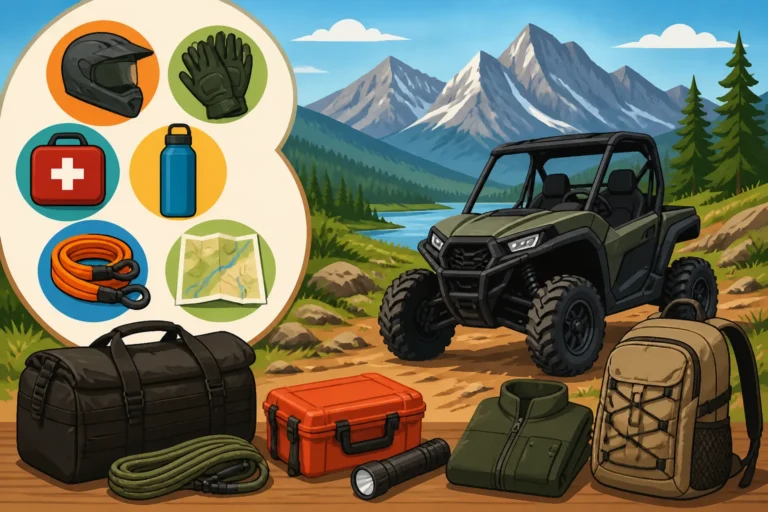
Bring equipment suited to the route and your machine, including basic tools, a tire-repair kit if appropriate, recovery gear you know how to use, water, food, and weather-appropriate layers. Montana weather can feel different at a shaded trailhead, an exposed ridge, and a higher-elevation section. A rain layer and spare dry clothing can make a slow or unexpectedly damp day much more manageable.
Think through recovery before you need it. If your group carries a winch or tow strap, make sure someone knows how to use it safely and that the equipment is appropriate for the situation. Recovery gear is not permission to enter a trail that is too wet; getting unstuck can itself damage the surface or put people in danger. Leave space between machines, communicate clearly, and avoid placing anyone where a strap or vehicle could move unexpectedly.
Leave the area as you found it
At the end of the ride, check your machine and trailer for caked mud, damaged tires, loose equipment, and anything that needs attention before the next trip. If you encountered a washout, blocked route, or severe rutting, report it through the appropriate land manager’s channel rather than trying to repair or reroute the trail yourself. A clear location and a concise description are more useful than a general report that a trail was “bad.”
Give other trail users room, especially when visibility is limited by trees, bends, or muddy spray. Slow down near trailheads and shared-use areas, and keep machines on designated routes. If you need to wait for a riding partner, choose a place that does not obstruct access or force others onto soft ground. Montana Trailhead Parking and Staging has related advice for keeping the trailhead experience orderly.
The best wet-week ride may be the one you postpone. When conditions are firm, the route is open, and your group is prepared to turn around, you can enjoy the ride without asking a saturated trail to carry more traffic than it can handle. Check conditions again before you go, and be ready to change plans if the ground tells you the timing is wrong.
Disclaimer
This article is for general informational purposes only and does not constitute professional advice. Laws, prices and regulations vary by location and change over time. Consult a qualified professional for guidance on your specific situation.