Does the Non-Resident Permit Allow Road Riding?
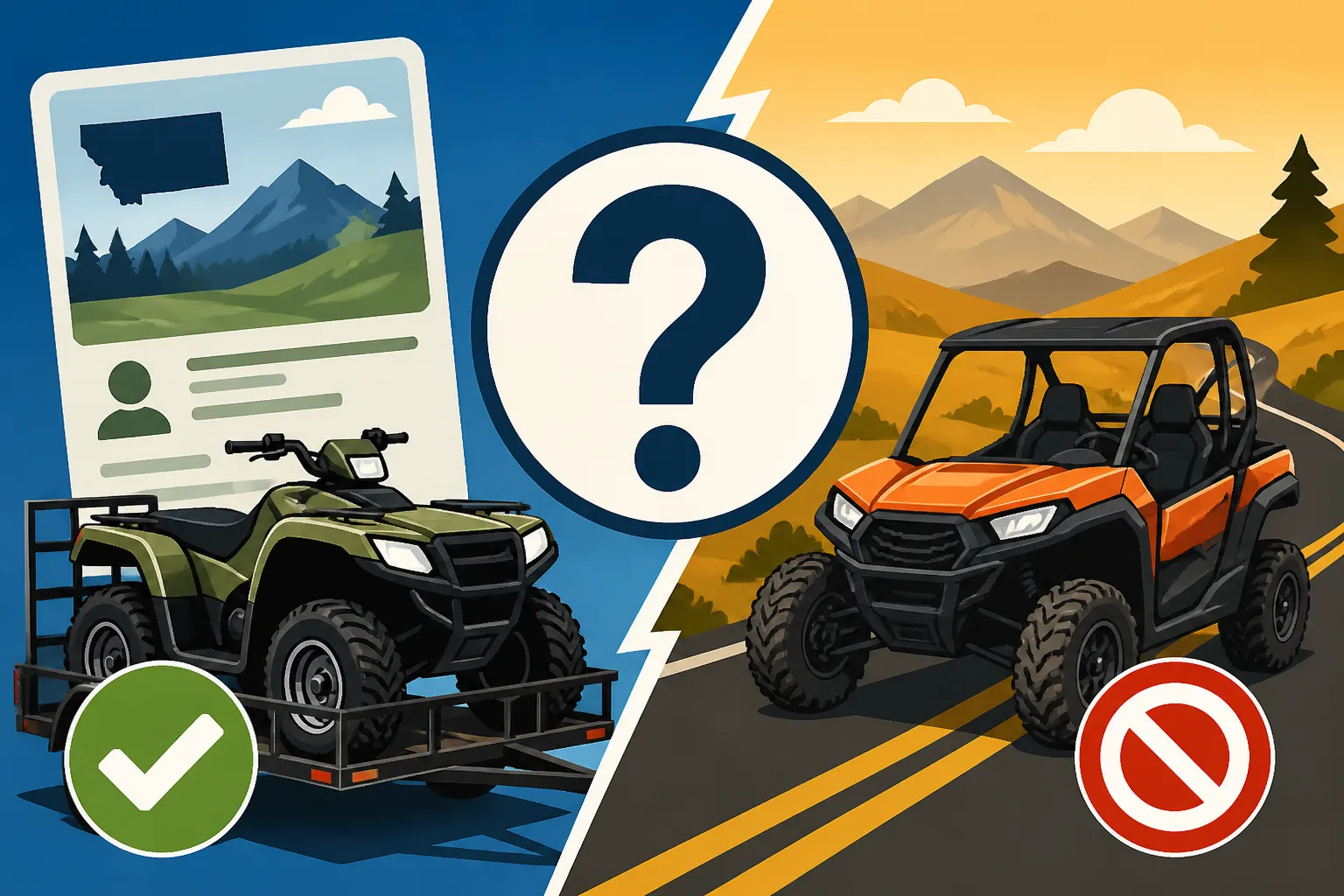
A Montana nonresident OHV permit does not, by itself, authorize road riding. It is for eligible off-highway use, while access to a public road depends on that road’s designation and the rules that apply to the machine and rider. Keep those permissions separate to avoid assuming a trail permit makes a route legal.
The permit does not grant general road access
The short answer is no: a nonresident permit is not a blanket authorization to ride an ATV or UTV on Montana roads. It does not make a machine street legal, open a closed road, or replace permission from the authority responsible for a road.
The permit’s purpose is tied to off-highway use. For details about which visitors need one and what it covers, see Montana’s Non-Resident Temporary Use Permit and Why the Non-Resident Permit Covers Trails Only. Permit requirements can depend on how the machine is classified and where it will be operated, so confirm your situation with the Montana agency responsible for the permit before riding.
Road access is a separate question. A county, town, state agency, or federal land manager may have authority over a route, and its rules can differ from those for nearby trails. Some roads may be open to certain OHVs under specific conditions; others may be closed to them, open only to particular vehicle types, or subject to seasonal restrictions.
That means a route can involve more than one set of rules. A trail may require an OHV permit, while a connecting road may require a local designation, particular equipment, or other legal conditions. Having the permit does not make the road portion legal automatically. For a broader look at the distinction, see Riding an OHV on the Road in Montana.
What the permit covers and what road riding may require
Think of the permit and road access as separate permissions. The permit addresses eligible off-highway riding; a road’s rules determine whether the machine can use that particular route.
| Question | What the nonresident permit does | What you may need to check separately |
|---|---|---|
| Can it be used for eligible off-highway riding? | It provides the permit required for applicable nonresident OHV use. | Whether the route is open to your machine and whether other land-use rules apply. |
| Does it make an ATV or UTV street legal? | No. | The vehicle’s registration, equipment, insurance, and operator requirements for road use. |
| Does it open a county or town road? | No. | Whether the responsible local authority has authorized OHV use on that road. |
| Does it allow travel on a forest road? | Not automatically. | The managing agency’s route designation, vehicle restrictions, and seasonal closures. |
| Does it allow crossing a paved road? | The permit alone does not answer that. | The crossing location and applicable state or local crossing rules. |
| Does it authorize use on private property? | No. | Permission from the property owner or other authorized landholder. |
Even a road that appears suitable for an ATV or UTV may not be legally open to it. Signs, maps, local ordinances, and the road’s managing authority matter more than the road’s appearance. A gravel surface or a route commonly used by local riders is not proof of authorization.
The vehicle itself matters too. A street-legal vehicle and an off-highway machine may be treated differently under registration and equipment rules. A plate or registration from another state does not necessarily settle every question about Montana road use, and a nonresident permit does not replace any registration or documentation the road-use rules require. If the machine has been modified or registered for road use, check how Montana classifies it and whether its paperwork matches the way you plan to ride.
How to check a road before you ride it
Identify the exact road segments in your planned route, then check each one with the authority responsible for it. Don’t rely on a general trail map to establish road access: trail maps and road-use rules may show different information, and a route can cross land managed by multiple authorities.
Find out who manages the route
For a town street, check the town’s ordinance or contact its local government. Some towns allow OHVs on specified streets or under particular conditions; others do not. The rules may apply only to marked routes or certain connections between town and trail. Montana Towns That Allow OHVs on Their Streets explains why local permission matters.
For a county road, ask the county whether OHV use has been authorized on the particular road. A road’s public status does not necessarily mean every type of vehicle can use it. See County Commissioners and Montana County Roads for more on the county role.
For a road on public land, check with the agency that manages that land. On national forest land, use the official motor vehicle use map for the relevant forest and pay attention to vehicle-width limits, route designations, and seasonal dates. On other public land, check the managing agency’s current route information. Do not assume that a road open to a highway vehicle is also open to every OHV.
If the route crosses private land, seek permission from the owner or authorized landholder. A public trail or road nearby does not grant access across private property.
Confirm the conditions, not just the route name
When you contact an authority, ask about the specific segment and machine type. A general answer that “OHVs are allowed” may not cover the route you intend to use, the width of your UTV, the season, or the direction of travel.
Confirm:
- Whether the exact road is open to an ATV, UTV, or both.
- Whether the authorization is limited to a signed or mapped section.
- Whether the road has a seasonal closure or other time restriction.
- Whether the machine must meet equipment or registration requirements.
- Whether the route permits travel along the road or only a crossing.
- Whether the operator needs a particular license, safety credential, or other qualification.
- Whether liability insurance or proof of insurance is required for that road use.
For state-road riding details, including equipment and operator questions, see What Montana Requires on an OHV Road Ride. Requirements can vary with the route and vehicle, so confirm the specific rules rather than relying on a checklist for a different road or machine.
A road crossing also deserves its own check. Permission to ride a trail on one side of a road does not necessarily mean you can cross wherever it is convenient. Use only a crossing that is allowed, follow the applicable crossing rules, and do not travel along a road unless that section is authorized for your machine.
A practical checklist for visitors
Before setting out, treat the permit, route access, and machine requirements as separate items to verify. That small distinction can prevent a trip from turning into an avoidable citation or a ride onto a closed road.
- Confirm the permit requirement. Check whether your machine and planned public-land use fall under Montana’s nonresident permit rules. If you are unsure how your out-of-state registration affects the requirement, ask the permit authority.
- Write down the planned road segments. A route name alone may not be enough. Note where the road begins and ends, and identify any town, county, state, or federal land transitions.
- Check the route with the responsible authority. Look for an official ordinance, map, or closure notice, and contact the agency or local government if the status is unclear.
- Verify the machine and rider conditions. Ask about vehicle classification, equipment, registration, insurance, and operator qualifications for each road section.
- Carry documentation. Keep proof of the permit and the vehicle’s registration or other required paperwork available. If road use requires proof of insurance or another credential, have that with you too. For more on visitor requirements, see Montana Rules for Visiting Riders.
- Recheck shortly before departure. Closures and seasonal access can change. A route that was open when you planned the trip may be restricted later.
- Follow signs and stay on the authorized route. If a road is marked closed or the route status is uncertain, stop and verify rather than treating the permit as permission to continue.
A few common situations illustrate why these checks matter:
- A visitor has a nonresident permit and wants to ride from a trail to a cafe on a town street. The permit alone is not enough. The town must allow the relevant OHV use on that street, and the rider and machine must meet the applicable conditions.
- A forest road connects two trails. The permit does not establish that the road is open to the machine. Check the forest’s official route information, vehicle restrictions, and seasonal dates.
- A route crosses a paved road. The trail permit does not decide whether or where the crossing is allowed. Check the crossing rules and use an authorized location.
- A machine is registered for road use in another state. That registration does not automatically answer whether the vehicle may use every Montana road or whether a Montana OHV permit is needed for off-highway use. Confirm both issues.
- The road is on private ranch land. Neither the permit nor a public-land map provides access across private property. Get permission from the owner or authorized landholder.
The key takeaway is simple: a nonresident permit is not a road pass. It may satisfy a permit requirement for eligible off-highway riding, but it does not authorize general road use. Check the road, the responsible authority, and the rules for your machine and rider before adding any public-road segment to your route.
Disclaimer
This article is for general informational purposes only and does not constitute professional advice. Laws, prices and regulations vary by location and change over time. Consult a qualified professional for guidance on your specific situation.