Registering an OHV in Montana
Getting your off-highway vehicle (OHV) ready for the vast and incredible landscapes of Montana often brings with it a surprising amount of paperwork and questions. Many folks, excited to hit the trails, can feel overwhelmed by the process of registration, wondering if they're doing it right or if they'll miss a crucial step. This comprehensive guide is here to cut through the confusion, walking you through everything you need to know to properly register your ATV, UTV, or dirt bike in Big Sky Country, ensuring you're legal and ready for adventure.
Why Registration Matters for Your Montana OHV Adventures
It's easy to think of registration as just another bureaucratic hurdle, a piece of paper that stands between you and the open trail. But in Montana, registering your off-highway vehicle isn't just about ticking a box; it's about legality, responsibility, and ensuring the continued health of the very trails we all love to ride. Skipping this step can lead to some serious headaches, not to mention missing out on the full Montana experience.
The Legal Ramifications of an Unregistered Machine
Imagine finally getting that new-to-you side-by-side home, loading it up, and heading to your favorite trailhead near Missoula or Bozeman. You're eager to ride, but you decided to put off the registration because it seemed like a hassle. Suddenly, a game warden or sheriff's deputy pulls up. In Montana, operating an unregistered OHV on public lands or designated trails can lead to fines and penalties. It’s not just a slap on the wrist either; these can quickly add up and put a serious damper on your day or even your entire trip.
Beyond the immediate financial hit, an unregistered machine could also complicate things if you're involved in an accident. Without proper documentation, proving ownership or dealing with insurance claims can become a tangled mess. Even if you're just riding on private land, taking it onto any public access point, trail, or even crossing a public road can instantly put you in violation. It's truly not worth the risk when the process is fairly straightforward once you know the steps. You want to focus on the ride, not on looking over your shoulder.
Accessing Montana's Vast Trail Systems
Montana boasts an incredible network of OHV trails, from the high country of the Lolo National Forest to the rugged terrain of the Custer Gallatin. These aren't just random paths; they're managed trails, often maintained through dedicated funding. To legally ride on these designated trails and public lands, your OHV needs to be registered. The registration decal acts as your permit, signaling to land managers and law enforcement that your machine is compliant.
Think of it this way: your registration is your ticket to exploring some of the most breathtaking backcountry in the country. Without it, you're limited to private property, missing out on hundreds of miles of thrilling rides. Whether you're planning a weekend trip to the Wild Bill OHV Trails in the Flathead or a multi-day excursion into the Little Belt Mountains, that small decal on your machine is your passport to adventure. It’s the easiest way to ensure you can enjoy all the riding opportunities Montana has to offer without fear of being turned away.
What You're Supporting with Your Registration Fees
While registration feels like a fee, it's actually an investment back into the OHV community and the environment. The money collected from OHV registrations in Montana goes into dedicated funds. These funds are used for a variety of critical purposes, including maintaining existing trails, developing new ones, enforcing regulations, and educating riders on safety and responsible land use. Your registration helps ensure that the trails remain accessible, well-marked, and safe for everyone to enjoy for years to come.
Without these funds, many of the trails we take for granted would fall into disrepair, become overgrown, or even be closed due to lack of resources. So, when you pay your registration fee, you're not just getting a piece of paper; you're contributing directly to the preservation and improvement of Montana's incredible OHV infrastructure. It's a small but significant way to give back to the sport and the state that provides so many fantastic riding opportunities. It's all about ensuring the future of our shared passion.
Understanding Montana's OHV Registration Types
Montana offers a few different ways to register an OHV, each designed for specific situations. It's not a one-size-fits-all approach, and understanding the distinctions is key to getting your machine properly set up. Most residents opt for one particular type, but visitors and those with unique situations have other options available to them.
The Appeal of Montana's Permanent OHV Registration
For many Montana residents, the [Montana's One-Time Permanent OHV Registration] is the holy grail. This unique option allows you to register your OHV just once, and it's good for the lifetime of the machine while it's owned by you. You pay a single fee, receive your registration and decals, and you're typically set. This saves you the hassle of annual renewals, remembering deadlines, and making repeated trips to the county treasurer's office. It’s an incredible convenience for long-term owners and a real perk of living in Big Sky Country.
This permanent registration includes both a title and the necessary decals for legal operation on Montana's designated trails. It's important to understand that "permanent" means permanent for your ownership. If you sell the machine, the permanent registration does not transfer to the new owner, as explained in [Why a Montana Registration Does Not Follow the Machine]. The new owner will have to go through the registration process themselves. Still, for as long as you own it, you can enjoy peace of mind knowing your machine is legally compliant without any recurring fees.
When a Machine Gets Annual Registration
While permanent registration is common, there are scenarios where an OHV might receive annual registration. This usually applies to machines that don't quite fit the standard definition for permanent OHV registration or certain types of vehicles. For example, some commercial or fleet vehicles might fall into a different category, or machines that are dual-sported for limited road use may have different plate and registration requirements. It's always best to clarify with your local county treasurer's office if you're unsure which category your particular machine falls into, especially if it's a specialty vehicle or one that sees mixed use.
Another instance where annual registration might be relevant is for snowmobiles, which have a similar but distinct registration process often handled by the same county treasurer offices. While they are often grouped with OHVs in discussion, snowmobiles have their own set of rules and generally require annual renewal. For the typical ATV or UTV owner planning to hit dirt trails, the permanent registration is usually the goal, but it's good to be aware of these other possibilities.
Non-Resident Temporary Use Permits for Visitors
If you're visiting Montana from out of state and bringing your own OHV, you generally won't be able to get a Montana permanent registration for it, as that's typically reserved for residents and titled machines within the state. However, Montana absolutely wants you to enjoy its trails! For non-residents, the solution is a temporary use permit. This permit allows your out-of-state registered or titled machine to legally access Montana's OHV trail systems.
These permits are typically valid for a set period, like a year, and can be purchased through the Montana Fish, Wildlife & Parks (FWP) online licensing system or from authorized vendors across the state. They are crucial for avoiding fines and ensuring you're contributing to the trail maintenance you'll benefit from. Don't assume your home state's registration is sufficient; Montana has its own specific requirements for all machines using its public lands, and the non-resident permit is the way to go for visitors.
The Step-by-Step Process for Registering Your OHV
The idea of going to a government office to deal with paperwork can feel daunting, but registering your OHV in Montana is generally a straightforward process once you know what to expect. Most of the action happens at your local county treasurer's office, and being prepared with the right documents will make your visit quick and painless.
Gathering Your Essential Documents for the County Treasurer
Before you even think about heading to the county treasurer's office, you need to have all your ducks in a row. The most critical document is your proof of ownership. This will typically be your manufacturer's statement of origin (MSO) if your machine is brand new, or a signed-over title if you bought it used. If you bought a used machine from a private party, ensure the seller properly signed the title over to you and that any lienholders have released their interest. A bill of sale, while not always required for the title transfer itself, is always a good idea to have as secondary proof of purchase, and you can find templates for these through services like LawDepot.
You'll also need a valid form of identification, like your driver's license. If there are multiple owners, all owners may need to be present or provide notarized authorization. If you're registering a machine that was previously registered in another state, be sure to bring all of its previous registration documents and title. Sometimes, a VIN inspection might be required, especially if there are discrepancies or if the machine is coming from out-of-state and has never been titled in Montana. It’s always smart to call ahead to your specific county treasurer's office to confirm their exact requirements, as some local nuances can exist.
Here's a quick checklist of common documents needed:
| Document Type | New Machine Purchase | Used Machine Purchase |
|---|---|---|
| Proof of Ownership | Manufacturer's Statement of Origin (MSO) | Previous Owner's Signed-Over Title |
| Bill of Sale | Often provided by dealer | Recommended, especially for private sales (LawDepot can help) |
| Identification | Valid Driver's License/ID | Valid Driver's License/ID |
| Proof of Residency | Montana Driver's License or other proof | Montana Driver's License or other proof |
| Prior Registration | N/A | Previous state's registration (if applicable) |
| Lien Release | N/A (unless financed, then lienholder info is needed) | If applicable, signed release from previous lienholder |
For more details, check out [Documents to Bring to a County Treasurer].
Navigating the County Treasurer's Office Experience
Once you've got all your paperwork squared away, it's time to visit your local county treasurer. Offices like those in [Registering an ATV in Yellowstone County], [Registering an OHV in Gallatin County], or [Registering an OHV in Flathead County] handle hundreds of these transactions every year. Expect to take a number, find a seat, and wait your turn, especially during peak times like spring or early summer when everyone is getting ready for riding season. When your number is called, present your documents to the clerk. They will review everything, ensure the VIN matches your ownership documents, and process your payment for the registration fees.
Be prepared to answer a few questions about the machine, such as its primary use (recreational, agricultural, etc.) and where it will be primarily operated. If anything is unclear or missing, the clerk will guide you on what further steps or documents are needed. Sometimes, this might mean a quick trip to get a form notarized or to track down a specific piece of information. Patience and politeness go a long way in ensuring a smooth transaction, even if there's a minor hiccup.
What Happens After You File Your Paperwork
After the county treasurer's office processes your registration, you'll typically receive your temporary registration papers and your OHV decals on the spot. These decals are critical, as they must be displayed prominently on your machine. The clerk will usually explain [Where a Montana OHV Decal Goes] and [Where the Decal Goes on the Rear]. You'll also be provided with proof of your new registration, which you should keep with you when riding.
The official title document for your OHV will usually be mailed to you later, often within a few weeks, from the Montana Department of Justice. This is why it's crucial to ensure your mailing address is correct at the treasurer's office. Once you receive the physical title, keep it in a safe place, as it's your ultimate proof of ownership for the machine. Don't carry the physical title on your machine; keep the registration papers (or a copy) with you instead. This multi-step process ensures everything is officially recorded both locally and at the state level.
Special Circumstances and Common Registration Questions
The standard registration process covers most situations, but sometimes life throws us a curveball. What if you bought a machine from a private seller who's now hard to reach? Or perhaps you're using your OHV for business? These situations often require a bit more attention but are usually solvable.
Registering a Used Machine Bought Private Party
Buying a used OHV from a private seller is a common and often cost-effective way to get into the sport. However, it can sometimes introduce complexities compared to buying from a dealer. The most important thing when buying private party is to ensure you get a properly signed-over title. Without it, you’ll have immense difficulty proving ownership and registering the machine. Make sure the seller's name on the title matches their ID, and that they sign in the correct place, often in front of a notary if required by the county or state (though Montana doesn't always require it for a private sale, it's a good practice for clarity).
You'll also want to get a [What a Montana Bill of Sale Should Say], even if the title is crystal clear. A detailed bill of sale, which you can easily draft using resources like LawDepot, can serve as crucial secondary proof of purchase, documenting the sale price, date, and condition of the machine. This can be especially helpful if any questions arise later or if you need to demonstrate proof of ownership for other purposes. Having both the properly signed title and a comprehensive bill of sale will make your trip to the county treasurer for [Registering a Machine You Just Bought] much smoother.
Dealing with a Missing Title or Proof of Ownership
This is a common headache that many buyers face: you bought an OHV, perhaps from a friend or through an online ad, and somewhere along the line, the title got lost, or the seller simply never provided one. Montana requires proof of ownership for titling and registration. If the title is truly missing, the process becomes more complicated. You cannot register a machine without establishing proper ownership. In some cases, if you can prove you made every effort to contact the original owner and meet certain criteria, you might be able to pursue a bonded title for your ATV. This is a legal process where you essentially put up a bond to protect against future claims of ownership.
Another scenario is if the seller never signed the title over properly, or if it was never titled in the first place, perhaps it was an older machine. For machines that are very old or where the paper trail is incredibly weak, sometimes a [Titling a Machine Older Than the Records] process can be initiated. These situations often involve more extensive paperwork, possibly a VIN inspection by law enforcement, and potentially a longer wait time. It's always best to try and resolve title issues before you purchase a machine, but if you're in this bind, know that there are processes, albeit more involved, to help you eventually get it registered.
The Nuances of Registering Under a Montana Business or LLC
For some individuals, especially those with multiple machines, those operating a business (like a guide service or rental fleet), or out-of-state buyers exploring options like the [The Montana LLC and Why Out-of-State Buyers Use It], registering an OHV under a business or LLC in Montana is a consideration. [Registering an OHV Under a Montana Business] or [Titling a Side-by-Side Under an LLC] involves additional steps beyond individual registration. First, the LLC or business must be properly registered with the Montana Secretary of State.
When registering the OHV at the county treasurer's office, you'll need to provide documentation proving the existence of the business/LLC and your authority to act on its behalf (e.g., Articles of Organization, Operating Agreement, or a resolution). The title and registration will then be issued in the name of the business or LLC, not your personal name. This can have implications for liability, taxation, and sometimes even insurance. Many people use services like LawDepot to set up the foundational legal documents for their LLCs, which can then be used to facilitate vehicle registration, ensuring all the paperwork is correctly prepared from the start. It’s a common strategy for certain buyers, but understanding the full implications, including those discussed in [Montana LLC Risks for an Out-of-State Owner], is paramount.
What Your Montana OHV Registration Actually Includes
When you walk out of the county treasurer's office with your new OHV registration, you're not just holding a piece of paper. You're getting a set of distinct components that collectively make your machine legal and identifiable. Each element serves a specific purpose, from proving ownership to signaling compliance out on the trail.
Decals: Where They Go and Why They're Important
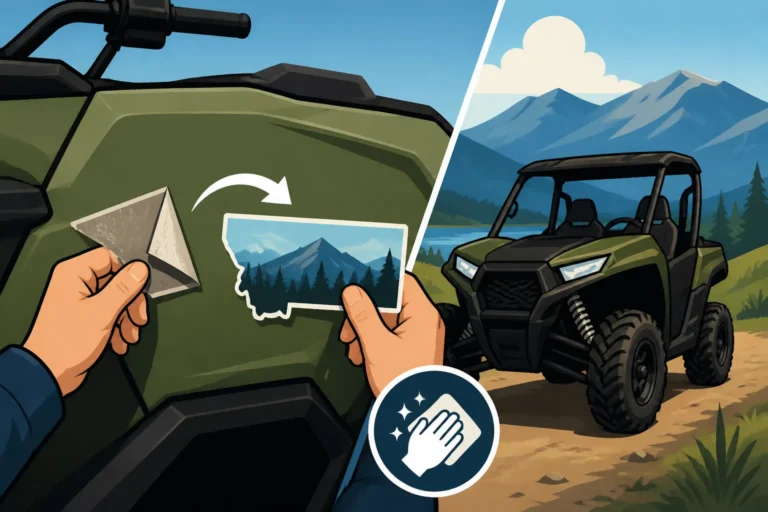
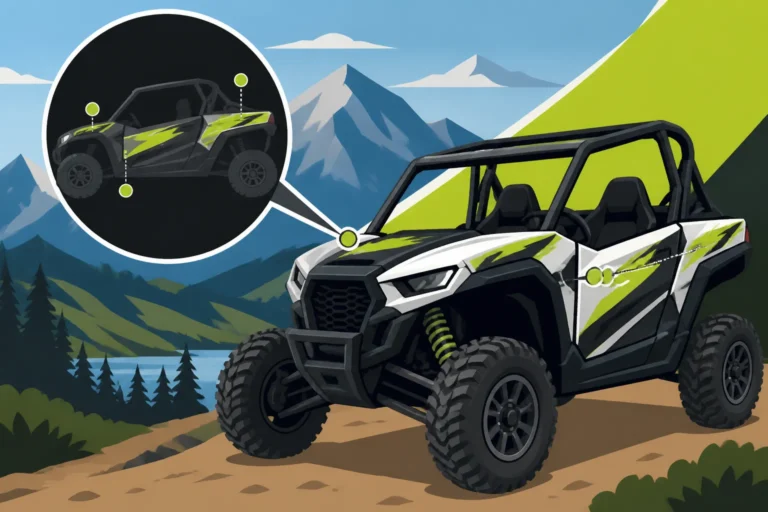
The most visible part of your OHV registration is the decal. Montana issues specific decals for off-highway vehicles, and they typically consist of a sticker that shows the year of registration (even for permanent registration, you often get a current year sticker for identification) and a unique registration number. These decals are not just for show; they are your proof of current registration and must be displayed correctly. For ATVs, they often go on the rear fender or the back of the machine. For side-by-sides, they might be placed on the rear frame or an easily visible part of the back panel. The rules are pretty specific, and you can find more guidance in [Montana OHV Decals and Rear Placement] or [Decal Placement on a Side-by-Side].
Having your decals properly affixed and clearly visible is crucial. If a game warden or law enforcement officer encounters your machine on public lands or trails and your decals are missing, obscured, or expired (if you have an annual registration or a non-resident permit), you could face a citation. These decals are the quickest way for officials to verify your compliance without having to stop and question every rider. They're a small but mighty part of ensuring smooth and legal riding in Montana.
Understanding the "Permanent" Aspect of Registration
As mentioned, Montana's permanent OHV registration is a fantastic benefit for residents. But what does "permanent" truly mean? It means that as long as you own the machine, you won't need to renew its registration annually. You pay one fee, and that registration remains valid under your ownership indefinitely. This eliminates recurring paperwork, renewal fees, and the risk of accidentally riding with an expired tag. It's a testament to Montana's commitment to making OHV ownership hassle-free for its residents.
However, "permanent" does not mean eternal for the machine itself, nor does it transfer to a new owner. If you sell your ATV or UTV, the permanent registration terminates with your ownership. The new owner, even if they are also a Montana resident, must go through the entire registration process themselves, including paying the permanent registration fee. This is a common point of confusion, and it’s a key detail covered in [What Permanent Registration Actually Buys You]. So, while it's a fantastic perk for you, remember that it's tied specifically to your individual ownership.
When Your Registration Doesn't Follow the Machine
Following directly from the "permanent" discussion, it’s vital to grasp that in Montana, your OHV registration is tied to the owner, not just the machine itself. This is a critical difference from how some other vehicle registrations work. When you register your ATV or UTV, the state records you as the responsible party for that machine's registration. This is why when you sell it, the registration effectively becomes void, as detailed in [Why a Sold Machine Loses Its Registration].
The implications of this are significant for both sellers and buyers. As a seller, once you've properly transferred the title, you can consider your part of the registration obligations for that specific machine complete. As a buyer, even if the machine you just purchased has a current Montana decal, you cannot legally operate it until you have completed your own registration process at the county treasurer's office. This ensures that every OHV on Montana's public lands is properly accounted for under its current owner, promoting accountability and compliance across the board.
Fees, Taxes, and What You Can Expect to Pay
Let's talk about money. Nobody likes unexpected costs, especially when you're just trying to get out and enjoy your machine. Understanding the fees associated with OHV registration in Montana, and crucially, how Montana's tax structure (or lack thereof) impacts your purchase, can help you budget effectively and avoid surprises.
Breaking Down the Montana Registration Cost
The cost to register an OHV in Montana is generally quite reasonable, especially considering the "permanent" nature of most resident registrations. For a resident Montana OHV, you'll typically pay a one-time fee for the permanent registration. This fee covers the cost of titling the machine and issuing the permanent decals. While I can't provide exact figures (as these can change), you should expect a flat fee, which is often a combination of a title fee, a registration fee, and a pro-rated fee for the state's OHV trail program. Your county treasurer can give you the precise current amount when you call or visit.
There might also be a small fee for processing the title itself. These fees are collected at the county level by the treasurer's office. For non-residents, the cost will be for a temporary use permit, which is an annual fee rather than a one-time permanent one. These funds, as discussed, are directly reinvested into the state's OHV program, supporting trail maintenance and rider education. Check out [Montana OHV Registration Cost at the Treasurer] for more details on what these costs cover.
Montana's No Sales Tax Advantage and the Home State "Use Tax"
One of the most attractive benefits of buying a vehicle, including an OHV, in Montana is the lack of a general sales tax. This means when you purchase your ATV, UTV, or dirt bike in Montana, you won't pay any state sales tax at the point of sale. This can represent significant savings, especially on higher-priced machines. This is a big draw for many buyers, both in-state and out-of-state, and is a major reason why Montana is a popular place to buy recreational vehicles. [Montana Charges No Sales Tax on a Machine] is a huge benefit!
However, it's absolutely crucial for out-of-state buyers to understand the concept of a "use tax." While Montana doesn't charge you sales tax, your home state almost certainly does. If you purchase an OHV in Montana and then transport it back to a state that has sales tax, your home state will often expect you to pay a "use tax" equivalent to their sales tax rate. This is designed to prevent residents from avoiding sales tax by purchasing vehicles out of state. Many states are quite aggressive in collecting this, so don't be surprised when you need to [Use Tax Your Home State Still Wants]. Failing to pay it can lead to penalties and back taxes if your home state discovers the purchase.
Potential Additional Costs or Penalties
Beyond the standard registration fees, there are other potential costs to be aware of. If you lose your registration documents or decals, there will be a small fee to get replacements, as outlined in [Replacing a Montana OHV Decal] or [Replacing a Lost Montana Title]. If you delay registering your machine past a certain point, or if you're caught operating an unregistered OHV, you could face fines for an unregistered machine in Montana. These penalties are designed to encourage timely compliance and can often be much higher than the initial registration fee.
Additionally, if you’re using a financing company to purchase your OHV, there might be additional fees associated with processing the lien on the title. Sometimes, if there are complexities with your title (e.g., missing information, incorrect VIN), there could be fees for services like VIN verification or bonded titles. While these aren't standard, it's good to be aware that certain situations can lead to extra expenses. The best way to avoid these additional costs is to ensure all your paperwork is in order from the start and to register your machine promptly.
Keeping Your Montana OHV Registration Current and Compliant
Getting your OHV registered is a significant first step, but it's equally important to ensure you remain compliant throughout your ownership. Whether you move, lose a decal, or are new to the state, there are specific procedures to follow to keep your registration valid and avoid any issues on the trail.
Replacing Lost Decals or Registration Documents
Life happens. Maybe a decal peels off after a harsh Montana winter, or perhaps your registration papers get misplaced during a move. Don't panic, but also don't ignore it. Operating your OHV without visible, current decals or without proof of registration can lead to problems. Fortunately, replacing these items is usually a simple process. You'll typically need to visit your local county treasurer's office again. You'll fill out a form, pay a small replacement fee, and usually receive new decals or a duplicate registration card on the spot.
It's important to do this sooner rather than later. Riding without these crucial proofs of registration is an open invitation for a fine. Even if you know your machine is registered, an officer needs to see physical proof. So, if you notice your decal is fading, peeling, or has gone missing, make a note to visit the treasurer's office at your earliest convenience. This small step ensures you're always in the clear when you're out on the trails.
Moving to Montana with an Out-of-State OHV
Welcome to Montana! If you're a new resident bringing an OHV from another state, you'll need to transfer its registration and title to Montana. This isn't just a suggestion; it's a legal requirement once you establish residency. You typically have a set period after moving to Montana to complete this process. The procedure will involve presenting your out-of-state title, your valid Montana driver's license (or other proof of residency), and potentially undergoing a VIN inspection.
The county treasurer will then process your Montana title and permanent OHV registration, similar to how a new machine is registered. Any liens on your out-of-state title will need to be properly recorded on the new Montana title. Don't assume your old state's registration carries over indefinitely; Montana wants its residents' machines properly registered within its system. For more on this, look up [Montana Registration for a New Resident].
When to Update Your Registration Information
There are a few key times when you'll need to proactively update your OHV registration information. The most common is if you change your mailing address. Since your official title and any future correspondence from the state will go to the address on file, it's critical to inform the county treasurer's office of any move. A simple change of address form is usually all that's required.
Another less common but important scenario is if there's a change in ownership details that doesn't involve a full sale, such as adding a spouse to the title or removing a name after a life change. These situations usually require visiting the treasurer's office with the original title and the individuals involved to process the transfer or update. Keeping your information accurate helps ensure you receive important communications and that your ownership records are always correct.
Disclaimer
This article is for general informational purposes only and does not constitute professional advice. Laws, prices and regulations vary by location and change over time. Consult a qualified professional for guidance on your specific situation.