Utah and Colorado Riders in Montana
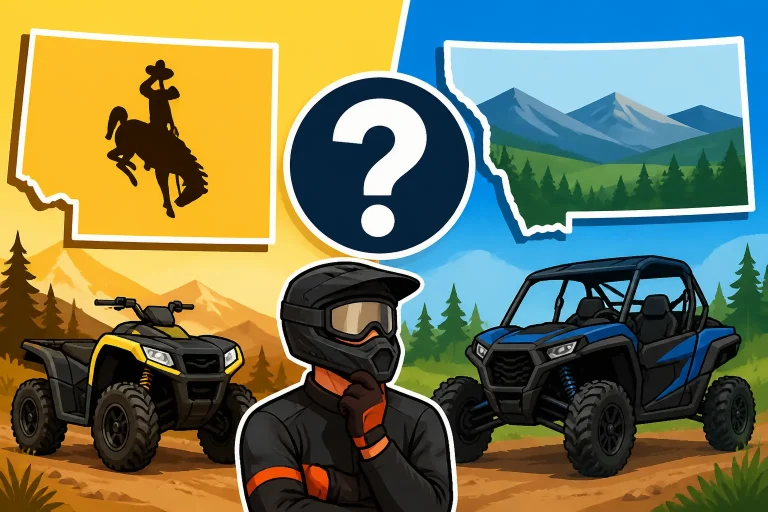
Utah and Colorado riders planning a Montana trip often assume their home-state OHV registration or permit will cover them across the border. It may not. Montana has its own rules for nonresident machines, public-land trail access and road use. The key is to treat your Utah or Colorado paperwork as separate from Montana’s requirements and check each route before unloading.
What Utah and Colorado riders need for Montana trails
For a typical trip on a quad or side-by-side, the main question is whether you will operate it on public land open to OHVs. Montana generally requires a nonresident temporary use permit for an out-of-state OHV used on public lands. Your Utah registration, Colorado registration or home-state trail sticker does not automatically replace that Montana permit.
The permit is a Montana access requirement, not a transfer of your machine’s registration. It does not make an unregistered machine street legal, establish ownership or authorize travel on every road. It is also separate from a title and proof of insurance. For a fuller explanation of the permit itself, see Montana’s Non-Resident Temporary Use Permit and Why the Non-Resident Permit Covers Trails Only.
The practical distinction looks like this:
| What you have | What it generally does in Montana | What it does not automatically do |
|---|---|---|
| Utah or Colorado OHV registration | Shows that you have completed the relevant home-state registration process | Substitute for Montana’s nonresident permit on public-land OHV routes |
| Montana nonresident temporary use permit | Meets Montana’s applicable permit requirement for a visiting OHV on public land | Grant permission to ride closed routes, private land or roads not open to OHVs |
| Highway registration or plate | May be relevant to lawful road use, depending on the vehicle and route | Guarantee access to trails or remove every OHV permit requirement |
| Insurance card | Helps show coverage if requested and supports responsible use | Make a route open or satisfy registration and permit rules |
| Landowner permission | Allows access only within the permission given | Replace permits or other rules that apply on public land |
The permit requirement is about where and how the machine is used, not just where it was bought or registered. A Utah or Colorado sticker can remain important for your home state, but Montana has its own access system. Do not assume that a permit issued by one state is accepted by another unless Montana’s current rules specifically say so. Montana’s position on reciprocity is covered in Reciprocity Montana Does Not Offer.
Before leaving home, identify the machine type and how you plan to ride it. An ATV, dirt bike and side-by-side may all fall under OHV rules, but a machine that is licensed for highway use can raise different questions from one that is trail-only. If yours has a plate, ask whether the Montana permit rule applies to that vehicle and intended use. If the answer depends on the route or vehicle classification, confirm it with Montana Fish, Wildlife & Parks rather than relying on a seller, forum post or an old decal.
Public land, private land and mixed routes
A ride can move through more than one kind of land in a single day. Public routes may cross or approach private property, and a road shown on a map is not necessarily open to motorized travel. The Montana permit does not grant a right to cross land where you lack permission, nor does it override a closure or a route’s vehicle restrictions.
For private land, obtain the landowner’s permission and follow any conditions they set. For public land, check the relevant route and land manager’s current access information. A route can be closed seasonally, restricted by vehicle width, or open only to certain classes of vehicles. These restrictions are separate from whether your permit is valid.
This is why a “we have the permit” plan is not enough by itself. Confirm that the trail or road is open to your type of machine, that the machine meets any width or equipment limits, and that your route does not cross a closed area. Montana Rules for Visiting Riders is a useful companion for the broader responsibilities that apply to out-of-state riders.
How the Montana permit differs from a Utah or Colorado permit
Home-state programs are not identical, and the label on a decal can be misleading. A registration, trail pass, permit and highway plate may each serve a different purpose. The safest approach is to read what your Utah or Colorado document authorizes, then check Montana’s requirements separately.
Do not treat a home-state permit as a national pass. It may be valid only within the state that issued it, or it may satisfy a particular home-state registration requirement without providing trail access elsewhere. Similarly, Montana’s nonresident permit is for Montana use under Montana rules; it does not become a Utah or Colorado permit when you return home. See Does Any State Honor Montana Registration? for the related issue of cross-state recognition.
A Montana trail permit also does not create road access. A public-land trail permit and permission to ride on a road are different things. A county road, town street, state highway or federal road may have its own restrictions. Some routes are closed to OHVs altogether; others may allow use only under specified conditions. A machine that is allowed on a trail may still be prohibited on the road that leads to it.
If your route includes road sections, check the rules for the exact roads and jurisdictions involved. Do not infer road legality from a Montana permit, a home-state plate or the fact that another rider used the same road. Start with Does the Non-Resident Permit Allow Road Riding? and Montana Rules on Forest Service Roads when planning a ride that mixes trails and roads.
The distinction matters for plated machines too. A plate may affect whether a vehicle can legally travel on a particular road, but it does not necessarily establish that every trail is open to it. Conversely, having a Montana nonresident permit does not make a trail-only machine suitable or lawful for public-road travel. Check the vehicle’s classification, its equipment and the route’s rules rather than relying on one piece of paperwork to answer every question.
What to check before riding a road section
For each road segment, find out whether OHVs are allowed there and whether the route has extra equipment, licensing, insurance or rider requirements. A road that is open to some OHVs may not be open to every machine. Local ordinances and route-specific restrictions can matter, especially near towns or where a trail connects to a public road.
A navigation app or downloaded track can help with orientation, but it is not proof that a route is legally open. Use current land-manager information and posted signs. If a route’s status is unclear, choose a confirmed route or contact the responsible agency before riding it.
Getting the permit and planning around it
A little preparation can prevent a wasted trip to a trailhead. Check Montana’s current permit instructions and purchase options before traveling, especially if you are arriving during a busy riding period or plan to start early. Montana’s permit process and accepted sales locations can change, so confirm the current method with the official source. The options are discussed in Where Visitors Buy a Montana Permit.
Follow the instructions for displaying the permit on the machine. Keep any confirmation or supporting paperwork available, and make sure the permit is associated with the machine you intend to ride. A permit for one machine should not be assumed to cover another. If you are bringing several ATVs or UTVs, check whether each one needs its own permit and arrange the permits before the group reaches the trailhead.
Use this checklist for each machine:
- Identify the machine and its paperwork. Note whether it is an ATV, dirt bike or side-by-side, whether it has a highway plate, and what registration or permit it carries from Utah or Colorado.
- Check Montana’s nonresident requirement. Verify whether the Montana temporary use permit applies to that machine and your planned public-land use.
- Confirm the permit’s current purchase and display instructions. Do not rely on a previous trip’s process or assume a digital receipt is all that is needed.
- Check the route, not just the destination. Confirm that each trail or road is open to your machine type and width, and look for seasonal closures or access restrictions.
- Review road requirements separately. A trail permit is not a road-use authorization. Confirm the rules for each road section and any local restrictions.
- Bring proof of ownership and insurance information. These do not replace a permit, but they may be useful if a question arises during the trip.
- Check rider-specific requirements. Age, supervision, safety education and protective equipment rules may apply independently of the permit.
If the vehicle has unusual paperwork—for example, a temporary plate, an out-of-state road registration, a borrowed machine or a rental—ask the relevant authority before assuming it is treated like a standard trail-only ATV. Keep the answer with your trip records if you receive it in writing.
Group trips and borrowed machines
For a group, make a short list of each machine and the person responsible for its paperwork. Do not assume the lead rider’s permit covers the entire group. Confirm the requirements for every machine, including one that belongs to a friend or family member. A borrowed machine can have the same public-land permit question as one you own.
Rentals need a separate check. Ask the rental business whether the machine’s Montana permit and any required paperwork are handled for you, and whether the rental agreement limits where you may ride. A rental company’s instructions may be specific to its machines or routes; they do not necessarily apply to your privately owned ATV.
Weather and closures can also change the plan after permits are purchased. Check current trail status shortly before departure, not only when you make the itinerary. If a route closes, the permit does not authorize riding around a barrier or taking an unapproved alternative. Pick another open route and respect posted restrictions.
Common mistakes to avoid
The most frequent mistake is confusing registration with trail access. A Utah or Colorado registration document can be valid and still fail to meet Montana’s separate nonresident permit requirement. Another is treating the Montana permit as a pass for all public land and roads. It does not override land-management rules, route closures, vehicle limits or road restrictions.
Other avoidable problems include:
- Assuming a permit from a neighboring state is valid in Montana.
- Buying a permit for one machine and using it for another.
- Forgetting to confirm whether every vehicle in a group needs a permit.
- Treating a road-legal plate as permission to ride every trail.
- Treating a trail permit as permission to use a county road or town street.
- Following an online route without checking current closures and access.
- Riding across private land because a map or GPS track appears to show a public connection.
- Assuming a rental shop or another rider’s paperwork answers the question for your machine.
When details are unclear, describe the machine and your planned use precisely when you ask for help. “I have a side-by-side registered in Colorado and want to ride public trails, with a short road connection” is more useful than asking whether your registration “works in Montana.” Ask separately about the nonresident permit, road legality and the specific route. That keeps the answers tied to the issues that actually determine whether your trip is ready.
The basic rule for Utah and Colorado visitors is straightforward: keep your home-state paperwork, check Montana’s nonresident OHV permit requirement, and verify access for each route. Treat trail access, road use and landowner permission as separate questions. That approach is more reliable than assuming one decal or plate covers the whole trip.
Disclaimer
This article is for general informational purposes only and does not constitute professional advice. Laws, prices and regulations vary by location and change over time. Consult a qualified professional for guidance on your specific situation.