Taking a Montana Machine to Wyoming
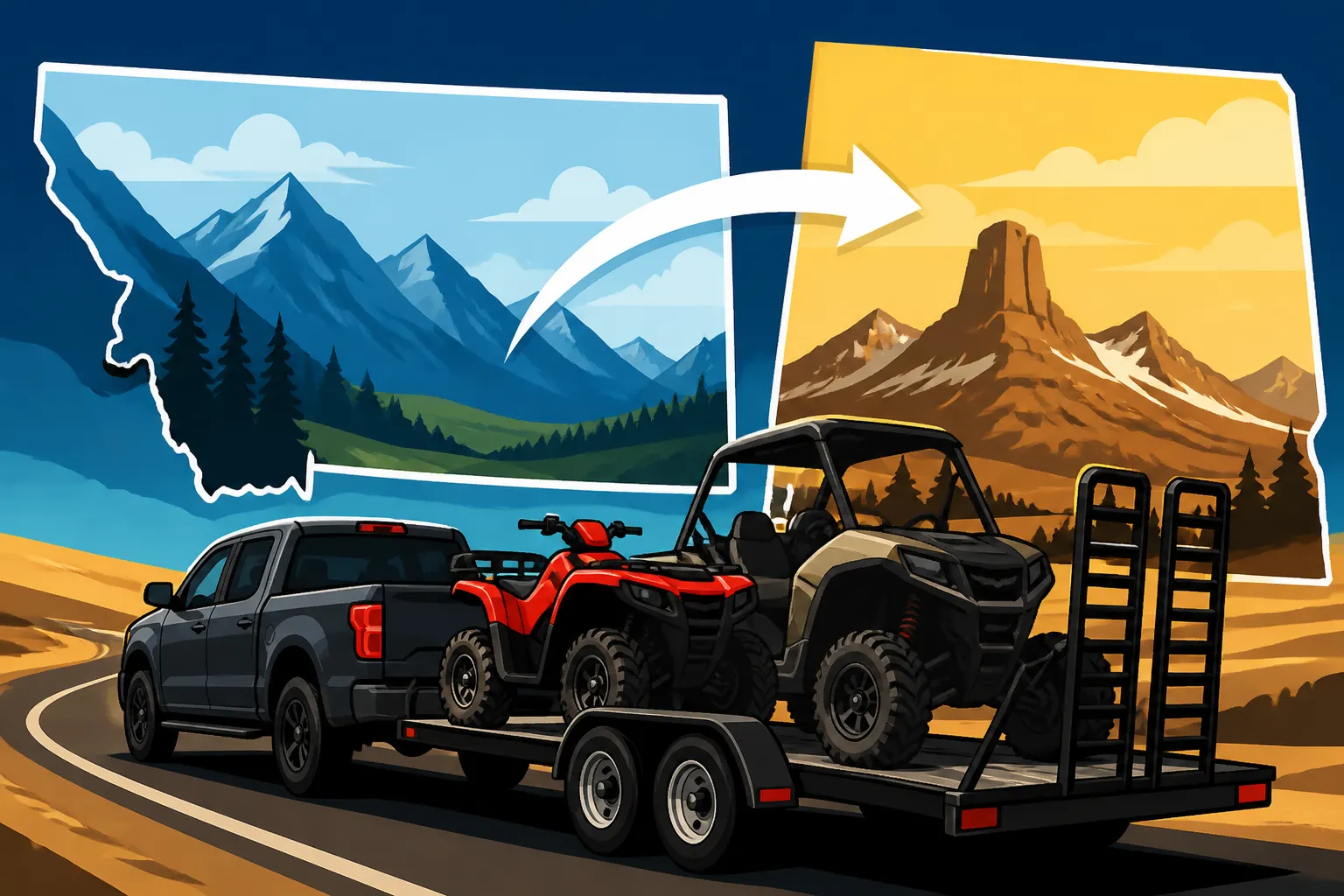
Taking a Montana ATV or UTV to Wyoming raises two separate questions: whether the machine is legally registered for its intended use, and whether the place you want to ride requires a Wyoming permit. A Montana decal or plate does not automatically answer both. Check the vehicle rules and the land rules before unloading or riding across a road.
What Montana registration does and does not cover
A machine registered in Montana does not gain blanket permission to ride every trail, road, or public-land route in Wyoming. Registration, trail permits, and permission to use a particular route are different things. A Montana registration may document the machine’s status under Montana law, but Wyoming requirements can still apply where you ride.
That distinction matters whether you tow the machine to Wyoming or ride it across the state line. If it is trailered, you avoid the question of whether it can be operated on the roads along your route, but you still need to check the rules at your destination. If you plan to ride it on roads, you also need to confirm that the road is open to that type of vehicle and that your machine and operator meet the requirements.
| What you have or plan to do | What to check in Wyoming |
|---|---|
| Montana registration or OHV decal | Whether Wyoming requires a separate permit for the trail, area, or facility |
| A Montana plate for road use | Whether the machine is eligible for that road and meets applicable equipment and operator rules |
| A route on public land | The land manager’s current route designations, closures, and permit requirements |
| A ride on private land | The landowner’s permission and any rules that apply to the route used to reach it |
| A machine transported on a trailer | Trailer and towing requirements, plus the OHV rules at the destination |
Do not treat a Montana registration sticker as a substitute for checking Wyoming’s requirements. Likewise, do not assume a permit bought for riding in Montana carries over the border. Does Any State Honor Montana Registration? explains why registration and out-of-state riding permission are separate questions. For the broader issue of taking a Montana machine elsewhere, see Riding a Montana Machine in Another State.
Check the Wyoming permit and route rules separately
Wyoming has its own OHV permit system, but a machine’s exact permit obligations can depend on where and how it will be used. The safe approach is to identify the specific trail system, public-land route, park, or riding area first, then check what that location requires of a nonresident rider and machine. A Montana registration alone should not be assumed to satisfy any Wyoming permit requirement.
Look for information from the agency or land manager responsible for the place you plan to ride. Wyoming State Parks administers an OHV program; public-land routes may also be subject to rules from the agency managing that land. A permit that applies at one riding area does not necessarily authorize riding elsewhere, and a route shown on a map may have restrictions that are not obvious from the map alone.
Confirm the route is open to your machine
Before you buy a permit or set out, confirm that the route is open to the kind of vehicle you have. Width, vehicle type, seasonal closures, and local restrictions can all affect whether a particular trail is suitable or legal for an ATV or side-by-side. Some routes may be intended for smaller machines; others may not permit motorized use at all.
For public land, use the current route information from the land manager rather than relying only on an old map, a friend’s description, or a navigation app. Check for temporary closures as well as regular seasonal rules. Weather, fire activity, maintenance, or other conditions can change access.
The distinction between land access and OHV registration is familiar in Montana too. Montana Permit Rules on Public Land and What Montana Riders Need Before They Ride cover Montana requirements, but they are not a substitute for checking Wyoming rules. Your destination state’s requirements control the ride there.
Check road access as a separate question
A public road is not automatically open to an ATV or UTV just because it connects two trails or appears on a map. Road access may depend on the road’s owner or managing authority, local rules, and whether the machine is permitted for road use. A machine that is registered for road use in Montana still needs to comply with applicable rules in Wyoming.
Before planning a road link, confirm that the exact road allows your vehicle. Check any local restrictions and requirements that apply to the machine and operator, including equipment, licensing, and insurance where relevant. If the route crosses land managed by a federal or state agency, check that agency’s rules as well. Montana Rules on BLM Roads offers useful background on why road access and land-manager rules need separate checks, but Wyoming routes must be verified with the authorities responsible for them.
Make a short pre-trip check before you leave
A few targeted checks can prevent a long detour or an avoidable ticket. Use this process for each riding area rather than assuming one answer covers an entire trip.
- Name the specific riding area and planned route. Record the trailhead, roads you may use, and the land manager if known. A general destination such as “near the border” is not enough to identify every rule that applies.
- Ask whether a Wyoming OHV permit is required. Confirm whether the requirement applies to your machine and nonresident status, where the permit must be displayed, and whether it covers the place you plan to ride. Check current instructions through the appropriate Wyoming program or site manager.
- Verify route access and closures. Confirm that the trail or road is open to your machine’s type and size, and check for seasonal or temporary restrictions.
- Sort out any road use. If you will operate on a public road, verify that the road is open to the vehicle and that the vehicle and operator meet the rules that apply there. If you are unsure, ask the authority responsible for that road.
- Carry proof and save the route information. Keep your Montana registration or ownership documents, any required Wyoming permit, and relevant insurance information accessible. Save current maps or route details before entering an area with limited cell service.
- Recheck close to departure. A permit decision made for one place or date may not cover a different trail or a closure that takes effect later. Confirm details with the relevant agency or land manager before the trip.
If you are comparing state requirements, Taking a Montana Machine to Idaho provides a useful parallel: crossing a state line means checking the destination’s rules instead of relying on Montana paperwork. The same practical principle applies to Wyoming.
Avoid the common assumptions that cause trouble
The most common mistake is treating a machine’s registration as a travel pass. Registration can be important proof that the machine is properly documented, but it does not automatically authorize use on a Wyoming trail or road. A separate permit may be required, and route-specific restrictions can still apply after you obtain it.
A second mistake is confusing a Montana nonresident permit with a Wyoming permit. Montana’s visitor permit is for riding covered by Montana rules; it does not grant permission in Wyoming. Montana’s Non-Resident Temporary Use Permit explains what Montana’s permit is for. For the related question of why one state’s requirements do not automatically carry into another, see Why Reciprocity Ended for Montana Riders.
It is also easy to assume that all public land has the same rules, or that a route is open because another rider used it previously. Public land can have different managing agencies, designated routes, seasonal limits, and local closures. A trailhead sign, current agency map, or direct confirmation from the land manager is more useful than a general assumption about the area.
Finally, do not overlook the difference between riding on a trail and reaching it. A route that is legal on the riding area may require an illegal road connection to reach from your campsite or trailer. Plan the full route, including crossings and access roads, before the machine comes off the trailer.
The practical answer is straightforward: a Montana ATV or UTV can be taken to Wyoming, but Montana registration should not be treated as automatic Wyoming trail permission. Identify where you will ride, check whether Wyoming requires a permit for that place and machine, and verify road and route access with the responsible authority. If those checks are unclear, resolve them before the trip rather than relying on the decal alone.
Disclaimer
This article is for general informational purposes only and does not constitute professional advice. Laws, prices and regulations vary by location and change over time. Consult a qualified professional for guidance on your specific situation.