Group Size Limits on Montana Forest Land
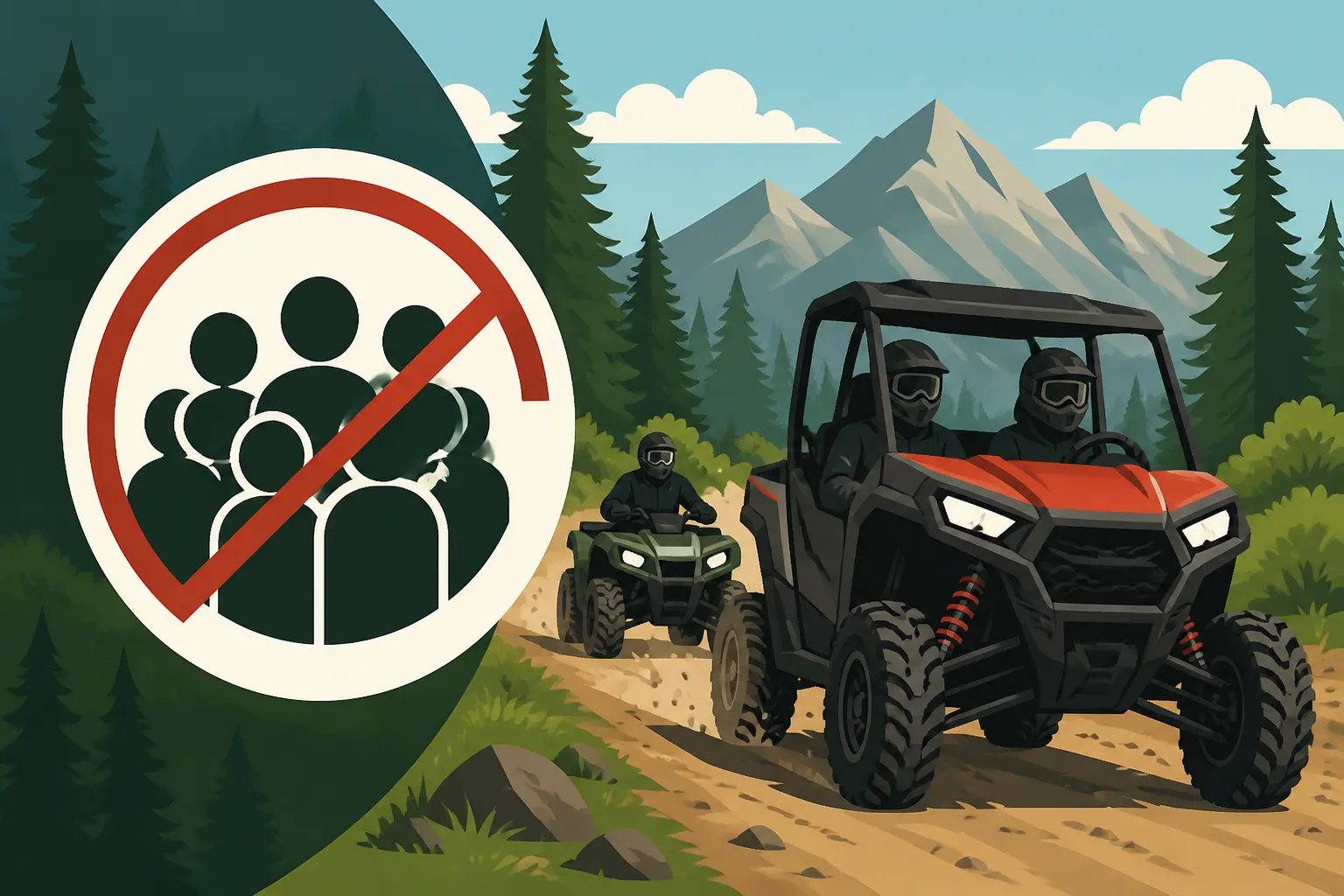
A large ATV or UTV ride can run into more than trail-width problems: a forest order, permit condition, or site-specific rule may limit how many people can travel together. Montana does not have one simple group-size number for every forest road and trail. The safest plan is to check the rules for your exact route and type of ride before you go.
Is There One Group Size Limit on Montana Forest Land?
There is no single group-size limit that applies to every ride on every piece of Montana forest land. The applicable rule may depend on the land manager, forest or district, specific route, activity, and any current restrictions. A limit may count people, machines, or both, so do not assume that a rule written for a hiking party automatically answers how many OHVs can travel together.
For a recreational ride, start by identifying who manages the ground you plan to use. A route may pass through National Forest System land, cross private property, or connect with land managed by another agency. Each section can have different access rules. A Montana trail pass or visitor permit, where required, is a separate requirement from any limit on the size of your group. For permit basics, see Montana Rules for Visiting Riders and Montana’s Non-Resident Temporary Use Permit.
What a group-size rule might cover
A limit may apply to the number of people traveling as one party, the number of machines, or a particular organized activity. It might appear in a forest order, a special-use permit, an event authorization, or other local direction. The wording matters: “group,” “party,” “event,” and “vehicle” may not be used consistently across different rules.
Also check whether the rule covers the whole outing or only a particular location or activity. A limit attached to an event permit, for example, may govern that event and not every independent recreational ride in the area. Conversely, splitting a large ride into smaller clusters on the trail does not necessarily mean the forest considers them separate groups.
| What you are checking | Why it matters | What to confirm |
|---|---|---|
| Land manager and route | Different sections may have different rules | Which agency manages each part of the planned route |
| Current forest orders or restrictions | Local rules may add conditions beyond general access information | Whether an order limits party size, machine count, or activity |
| Route map and access status | A permitted route is not automatically open to every vehicle or use | Whether your machine type and route are allowed |
| Event or commercial activity | Organized rides may require authorization | Whether your activity needs a special-use permit and what limits it sets |
| Group definition | A rule may count people, machines, or both | Whether passengers count and how the rule treats separate ride parties |
A map is an important starting point, but it may not show every temporary restriction or permit condition. A Motor Vehicle Use Map can help establish which roads and trails are designated for motorized use. It should not be treated as a complete answer to group-size questions. Use Finding a Forest’s Motor Vehicle Use Map to locate the relevant map, then check for current orders and activity-specific requirements.
Group size is not the same as trail-pass coverage
A group can meet the size rule and still have a problem if a rider lacks a required permit, the route is closed to that machine, or the outing needs an authorization. Likewise, having the correct permits does not necessarily waive a group-size limit. Check each requirement separately.
If you are riding across more than one jurisdiction or joining a route from another state, do not assume that a permit or registration from elsewhere settles the forest’s rules. Reciprocity Montana Does Not Offer explains why riders should check requirements rather than assume one state’s paperwork is accepted everywhere.
How to Check the Limit for Your Route
Before committing to a large ride, confirm the rule for the specific forest area and the activity you have planned. The answer should come from current official information for that area, not just an old trip report, a general map, or what another rider recalls.
1. Identify the route and land manager
Mark the trailhead, route, turnaround point, and any connector roads. If the ride crosses a boundary, note where the managing agency changes. Forest boundaries and trail names alone may not tell you who controls every segment.
For a National Forest route, identify the relevant forest and ranger district. If you are unsure which district covers the trailhead or route, ask the forest office to direct you to the right contact. For a route near a wilderness boundary, check the boundary carefully: motorized travel is not allowed in designated wilderness. Montana Wilderness Areas Closed to Motors and Riding Near a Montana Wilderness Boundary can help you understand why a nearby open route does not mean you can ride across the boundary.
2. Check maps and current notices
Review the motor vehicle map for the area, then look for current closures, restrictions, and forest orders. Pay particular attention to notices about events, seasonal access, resource protection, or limits that apply only to a named site or route. A trail showing on a map does not by itself confirm that it is open today or that your planned activity is permitted.
Conditions and orders can change. Check close to departure, especially if the group is traveling a long distance or has reserved lodging or transport. Checking Montana Trail Status Before You Drive offers a useful approach to verifying access before making the trip.
3. Ask the ranger district a precise question
If the written information does not clearly answer your question, contact the office responsible for the area. Give staff details rather than asking only, “What is the group limit?” Include:
- The trail or road names and trailhead you plan to use
- The date or general timing of the ride
- The number of people and number of machines
- Whether machines will carry passengers
- Whether the outing is private, organized, guided, or commercial
- Whether the group plans to camp, stage, or gather at a developed site
Then ask what rule applies, how it defines a group, and whether the activity requires a permit or authorization. If the ride is near a forest boundary or passes through more than one district, ask whether the same answer applies to the full route.
Keep a note of the office you contacted, when you checked, and any relevant order or permit instructions. That record does not replace compliance with the actual rule, but it helps the trip organizer brief everyone consistently and revisit the right information if plans change.
4. Confirm any event authorization separately
A private group ride and an organized event are not necessarily treated the same way. A club gathering, commercial tour, fundraiser, competition, or event advertised to the public may require a special-use authorization, depending on the activity and location. Permit conditions can specify attendance, route, timing, staging, or other operational details.
If your ride is organized, ask early whether an authorization is needed and what its conditions say about the group. Do not rely on an ordinary trail pass or a participant’s personal permit as a substitute for event approval. For related information, see Montana Permits for an Organized Ride, Special Use Permits on Montana Forest Land, and Forest Service Permits Montana Riders Need.
Plan a Large Ride Without Creating a Compliance Problem
Even when a ride is allowed, a big group takes more planning. It can occupy a narrow trail for longer, make it harder for other users to pass, and increase the chance that a missed turn or mechanical issue affects everyone. A clear plan can make the ride more manageable without assuming that several smaller clusters are automatically separate groups under the rules.
Decide how the group will travel
Set a realistic number of machines for the route and the riders’ experience. Consider trail width, visibility, passing areas, dust, terrain, and how long it may take to move the whole party through a tight section. A route that is comfortable for a few machines may be a poor choice for a much larger ride.
Before leaving, agree on practical details:
- Choose a lead rider and a sweep rider who knows the plan.
- Set meeting points where everyone can safely stop without blocking the route.
- Explain how to handle a breakdown, injury, missed turn, or separation.
- Make sure each rider knows the planned route and turnaround point.
- Confirm that every machine is suited to the designated route.
- Keep the group together in a way that is safe and does not obstruct other users.
These are planning measures, not a way to change the legal definition of a group. If the rule applies to a party, simply spreading machines farther apart may not make the party smaller. Ask the land manager how the relevant rule applies rather than trying to interpret spacing as an exemption.
Treat a split ride as a real split only when it is allowed
Some organizers consider dividing a large outing into separate ride groups. That may reduce congestion, but it does not automatically avoid a limit. The groups may still be considered one event if they share a route, timing, staging area, organizer, or common activity. The permit or local rule may define how separate parties are counted.
If you plan separate outings, ask whether each needs its own authorization and whether the groups can use the same trail or staging area at the same time. Do not create artificial separation on paper while operating as one large event in practice. The details of the authorization, not just the number of people in each cluster, determine what is allowed.
Be especially careful with staging and camping
The permitted route is only part of the plan. A large gathering at a trailhead, campsite, or other site may be subject to separate site rules or capacity limits. Parking can spill into roadways or block other users even when the trail ride itself is permitted. If you plan to meet, unload, camp, or regroup, check the rules for that location and make sure there is room for the vehicles and trailers.
Do not assume that a forest road shoulder or an undeveloped pullout is available for a large staging area. Ask the land manager about suitable locations, especially for an event or a group arriving in many tow vehicles. If overnight use is part of the trip, check camping rules and current fire restrictions as well.
Build compliance into the group briefing
A group leader can prevent confusion by sharing the route, access requirements, and any applicable limits before departure. Ask participants to confirm their machines and required documents, and make clear that the ride may need to change if a route is closed or conditions make it unsafe.
A concise pre-ride briefing should cover:
- Which route is planned and where the group will turn around.
- Any machine, permit, or activity restrictions that apply.
- How the group will handle stops, passing, and separation.
- Where everyone should regroup if the route is blocked.
- Who will make the decision to change plans or end the ride.
For longer trips, check the route again before driving to the trailhead. A prior season’s map, an old event page, or a social post may not reflect current access. Montana Trail Signs and Route Numbers can help with route identification, but follow current official direction if signs, maps, and older trip details appear to conflict.
When the applicable limit remains unclear, the practical answer is not to guess. Ask the responsible office, scale down or change the plan if necessary, and keep separate requirements—group size, route access, permits, and event authorization—distinct. That approach helps avoid a wasted trip and reduces the chance that a group’s size disrupts other forest users or violates a local condition.
Disclaimer
This article is for general informational purposes only and does not constitute professional advice. Laws, prices and regulations vary by location and change over time. Consult a qualified professional for guidance on your specific situation.