Permits for Ranch Work Machines
A side-by-side used to move feed or check fence lines may be treated differently from one ridden on a public trail, but “ranch work” is not a universal permit exemption. The key questions are where the machine goes, who owns the land, and whether the trip includes a public road. Here’s how to sort those questions before putting a Montana ATV or UTV to work.
Start With Where the Machine Will Be Used
Montana’s rules can depend on the machine’s route, not just its purpose. A UTV used to haul supplies on private ranch ground raises different questions from the same machine riding a public trail or county road. Work use does not, by itself, make every trip exempt from registration, permits, or road-use rules.
If the machine stays on land the ranch owns or controls, a private-land exception may apply to some OHV requirements. The details matter: check whether the exception covers the machine’s use and the land involved, rather than assuming that any property used for ranching qualifies. For background on the limits of private-property use, see Do You Need Registration on Your Own Land? and Montana Rules on Private Land.
A practical first step is to draw the machine’s usual route. Mark private fields and ranch roads, public trails, and any county or state road sections. A route that starts and ends on the ranch can still cross land or a road with separate rules.
| Where the machine operates | What to check |
|---|---|
| Private ranch ground only | Whether a private-land or agricultural-use exception applies to the specific machine and activity |
| A public trail or public riding area | Whether the machine needs registration or a trail permit for the rider’s residency status |
| A county or state road | Whether that particular road allows OHVs and what road-use requirements apply |
| A mix of private and public land | Which requirements apply to each part of the route |
The distinction is about the route, not whether the operator is doing useful work. Moving hay or checking livestock may explain why a machine is being used, but it does not automatically authorize riding across public land or down a road. Likewise, being on private ground does not grant permission to cross a neighbor’s parcel or a public right-of-way.
For a closer look at the agricultural-use question, see Farm and Ranch Exemptions in Montana. Treat an exemption as specific to the activity and location it covers—not as a general pass for every machine owned by a ranch.
Know When a Ranch Exemption May Apply
A rancher may have a strong reason to use an ATV or UTV as a work machine, but the relevant rules can distinguish between exclusive agricultural use and mixed use. A machine used only for ranch tasks on qualifying private property may be treated differently from one also used for recreation or public-land riding. If the same machine serves several purposes, don’t assume the work use covers the recreational use too.
Before relying on an exemption, check the details that could affect eligibility:
- The machine’s actual use: Is it used exclusively for agricultural work, or also for recreational rides?
- The land: Is the route entirely on private property the ranch owns or has permission to use?
- The roads: Does the route enter or cross a public road?
- The public-land portion: Does the trip use a trail or other area open to public OHV riding?
- The operator: Is the machine being used by an employee, family member, guest, or visitor, and does that affect which requirements apply?
These questions help separate an exemption from a general claim that “it’s a ranch machine.” If a machine is used for both feeding cattle and weekend trail riding, ask the county treasurer or the appropriate state office how the rules apply to its registration and use. Keep the explanation tied to the machine’s actual routes and activities.
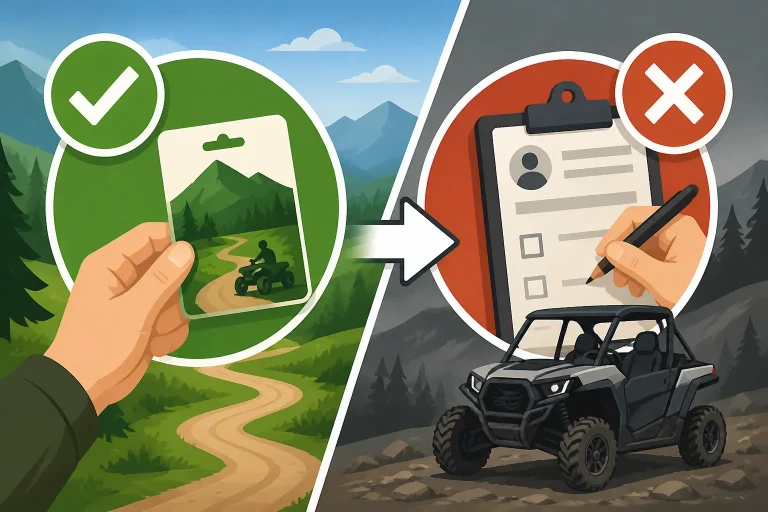
It can also help to distinguish registration from permission to ride. Registration identifies or authorizes a machine under applicable rules; it does not grant access to someone else’s land or make a closed trail open. Conversely, permission from a landowner does not automatically settle whether a permit is required on public land.
More on machine categories and work use is available in Montana Rules for Work Machines and Montana Permits for a Utility Machine. Those distinctions matter because equipment that looks similar can be subject to different requirements depending on how it is classified and used.
Public Land and Road Sections Need Separate Checks
The most common mistake is carrying a private-property exemption over onto a public trail. If a ranch route leaves private ground and continues onto public land, check the permit requirements for the public portion. Montana has different requirements for residents and nonresidents who ride OHVs on public land. The exact requirement can depend on the machine and the type of land or route, so confirm the current rule before riding.
For a nonresident, a Montana trail permit is not the same as permission to use any road. It is associated with eligible trail use, while road riding is governed by separate rules. Residents should also check whether their machine’s registration or trail-pass status covers the public-land trip they plan to make. The details are explained in Montana Permit Rules on Public Land and Montana Rules for Visiting Riders.
A work trip may still count as riding on public land even if the operator is doing a ranch task. For example, a route to reach a remote pasture might cross a public trail or public land. Do not assume that the purpose of the trip replaces a permit requirement. Confirm whether the route is open to motorized use and whether the machine needs a permit for that use.
Roads call for another check. A road beside a ranch, or a road regularly used to reach a pasture, is not necessarily a private ranch road. If it is a county road or another public road, determine whether OHVs are allowed on that specific section and what requirements apply. Montana road access can depend on the road authority and local decisions; a machine’s work status does not automatically make road riding legal. See Riding an OHV on the Road in Montana and Why Montana Road Access Depends on Who Owns the Road.
Before using a public road or trail, confirm:
- Who controls the route. Identify whether it is private, county, state, federal, or another type of road or trail.
- Whether OHVs are allowed. Access can vary by route, and a nearby open trail does not mean every connecting road is open.
- Which permit or registration applies. Check the machine’s status and whether the operator is a resident or visitor.
- What operating rules apply. Road use may involve requirements beyond a trail permit, including equipment, age, or operator rules.
If you cannot verify the road’s status, do not treat its location on a ranch map or its usefulness for work as proof that an OHV may use it.
A Practical Compliance Check for Ranch Owners
A simple route-and-use review can prevent a work machine from accidentally becoming an unpermitted public-land vehicle. Make the review part of the machine’s setup, especially if employees, family members, or guests use it.
- List the machine’s jobs. Note whether it hauls supplies, checks fences, moves livestock, or is also used for recreation.
- Map the routes. Separate private ranch ground from public trails and roads. Ask about any route whose status is unclear.
- Check for an applicable exemption. Confirm that the exemption fits the machine, activity, and land involved. Do not rely on the word “ranch” alone.
- Verify public-use requirements. If the route reaches public land, confirm the permit or registration requirement for the operator’s residency status.
- Check road access separately. Confirm that each public road section allows OHV use and determine what operating requirements apply.
- Keep relevant records accessible. Store registration or permit information and any landowner permissions where operators can find them.
- Review the setup when use changes. A machine that was previously used only on private ground may need a fresh check if it begins visiting trails or crossing public roads.
If several people use the machine, make the route limits clear. A ranch employee may know the private access tracks but not which nearby public trails require a permit or are closed to motorized use. Written instructions and a simple route map can reduce confusion.
When asking an agency or county office for guidance, describe the situation precisely: the machine type, who operates it, whether it is used exclusively for agricultural work, and the roads or land it will enter. A broad question such as “Do ranch machines need permits?” may not capture the details that determine the answer. If a route includes public land, ask about that segment specifically; if it includes a public road, ask who controls that road and whether OHV use is allowed.
The safest approach is to treat work purpose, land access, registration, public-land permits, and road use as separate questions. An exemption may cover one part of a ranch operation without covering the rest. Confirm the current requirements with the appropriate Montana office before relying on an exemption, particularly when a machine has mixed work and recreational use.
Disclaimer
This article is for general informational purposes only and does not constitute professional advice. Laws, prices and regulations vary by location and change over time. Consult a qualified professional for guidance on your specific situation.