County Roads and the Montana Commissioners’ Say
It can be incredibly frustrating to feel like you're jumping through hoops, outfitting your ATV or UTV with all the right gear, only to find that the rules for where you can actually ride on the road are a confusing mess. One county might welcome you with open arms, while the very next one down the highway has "No OHV" signs everywhere, leaving you scratching your head and wondering why it's so complicated. This comprehensive guide will untangle the intricate web of county road access for OHVs in Montana, specifically focusing on the pivotal role your local county commissioners play in determining where you can and cannot ride.
The Patchwork Quilt of Montana Road Access for OHVs
Montana is a state defined by its vast open spaces and the freedom that comes with them, and for many, that freedom extends to exploring its backcountry on an ATV or UTV. However, when it comes to riding these machines on public roads, especially county roads, the reality isn't always as simple as hitting the open road. Instead, riders often encounter a complex and sometimes contradictory set of rules that can make planning a trip feel like navigating a maze. This isn't just a minor inconvenience; it's a genuine source of bewilderment for residents and visitors alike who simply want to enjoy their machines responsibly.
Why "Street Legal" Isn't a Simple Yes or No
When you invest in an ATV or UTV, and then spend the time and money to equip it with turn signals, mirrors, a horn, and all the other bits and pieces to make it "street legal," you'd naturally assume you're good to go on any public road. But in Montana, that assumption can quickly lead to disappointment. The truth is, while the state sets out certain requirements for what makes an OHV capable of being ridden on a road, it doesn't automatically grant you permission to ride on every road. This distinction is crucial and often misunderstood. Your machine might meet every single state equipment standard, but if the local jurisdiction—be it a city or a county—has an ordinance prohibiting OHVs on its roads, then your "street legal" machine is still restricted.
Imagine you've just installed a full turn signal kit and a DOT-approved windshield, thinking you're ready for any adventure. You pull out of your driveway, excited to connect a few miles of gravel road to reach a favorite trail, only to be met with signage that explicitly forbids OHV use on that particular county road. The frustration is palpable because you've done your part, but the local regulations have created a barrier you didn't anticipate. It’s not about whether your machine is safe or properly equipped; it's about who has the authority to permit or deny access to a specific stretch of road, and often, that authority rests closer to home than you might think. This often leads to the exasperating situation where riders find themselves perfectly legal on one side of a county line, only to be in violation the moment they cross into the next.
The Role of Montana's County Commissioners
This is where the county commissioners come into play. In Montana, county commissioners are elected officials who serve as the administrative and legislative body for their respective counties. Among their many duties, they have significant authority over county roads. Unlike state highways, which are managed by the Montana Department of Transportation, or city streets, which fall under municipal jurisdiction, county roads are directly under the purview of the county commission. This means that a three-person board, or sometimes even a single commissioner depending on the county structure, can decide whether OHVs are allowed on the vast network of roads that crisscross their county.
Their authority means that if you're planning a ride that involves county roads, it's the local commissioners who ultimately hold the keys to access. This can lead to a highly inconsistent landscape for riders. One county might have a progressive commission that sees the economic and recreational benefits of OHV tourism and actively works to open roads, while an adjacent county might have commissioners who are more swayed by concerns about noise, dust, or safety from residents, leading them to restrict or even prohibit OHV use. This divergence in policy from one county to the next is a primary source of the "patchwork quilt" effect, making pre-ride research absolutely essential for any OHV enthusiast in Montana. Understanding that these elected officials are the gatekeepers for county road access helps to clarify why the rules can vary so dramatically, even within a relatively small geographic area.
Understanding the Legal Framework: State Laws vs. Local Ordinances
When it comes to riding your ATV or UTV on roads in Montana, it’s not just a matter of having the right machine; it’s about navigating a complex legal landscape that involves both state statutes and local ordinances. This duality can be perplexing, as what might be perfectly legal under state law can still be prohibited by a county or city. It’s a common pitfall for riders who assume state compliance means carte blanche access everywhere.
What Montana State Law Says About OHVs on Roads
Montana state law provides the foundational requirements for an Off-Highway Vehicle (OHV) to be considered "street legal" enough to even potentially operate on public roads. These are the bare minimums that your machine must meet regardless of local rules. For instance, state law generally dictates that your OHV must be equipped with headlights, taillights, brake lights, a horn, and at least one mirror that allows the operator to see 200 feet to the rear. It also typically requires that your machine has an adequate braking system, a spark arrester, and tires that are approved for highway use, if applicable. These requirements are in place to ensure a basic level of safety and visibility for OHVs operating alongside other motor vehicles.
However, and this is a critical point, meeting these state-level equipment standards does not automatically grant you permission to ride on every road in Montana. State law often specifies that OHVs can only be operated on "designated" roads or highways, and that they cannot be operated on interstates. Furthermore, it explicitly empowers local jurisdictions—cities and counties—to regulate OHV use on roads under their control. So, while your machine might be perfectly equipped according to state regulations, that’s just the first hurdle. Think of it like getting a driver’s license; it proves you're capable of driving, but it doesn't mean you can drive down every private driveway or through a farmer's field. For a deeper dive into these requirements, you can refer to [What Montana Requires on an OHV Road Ride].
How County Ordinances Add Layers of Complexity
This is where the real complexity kicks in. Building upon the state's framework, Montana's 56 counties, as well as its many cities and towns, have the power to enact their own local ordinances or resolutions regarding OHV use on roads within their jurisdiction. These local rules can either open up roads to OHVs or, more commonly, restrict or prohibit their use entirely, even if your machine meets all state "street legal" criteria. For example, a county commission might pass a resolution allowing OHVs on all county roads except for those within a certain distance of a residential area, or they might restrict use to specific roads that connect to designated trail systems. Other counties might choose to prohibit OHV use on all county roads, citing concerns over public safety, noise pollution, or potential road damage.
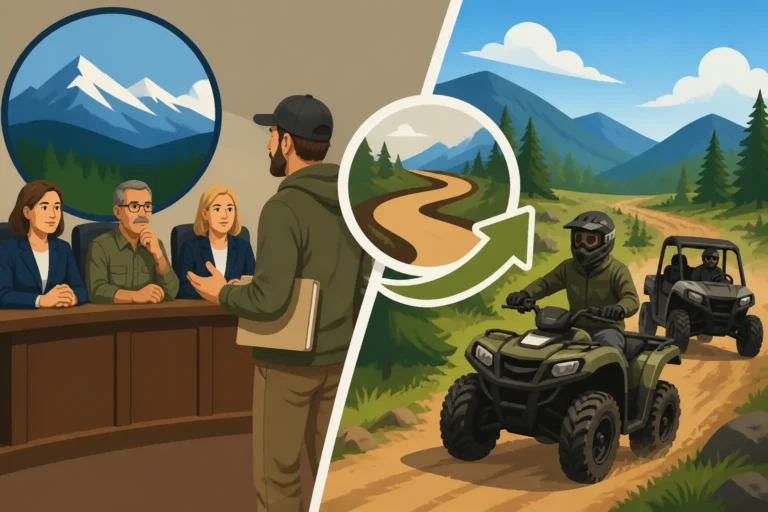
The process for enacting these ordinances typically involves public hearings, where local residents, law enforcement, and OHV enthusiasts can voice their opinions and concerns. County commissioners then weigh these inputs against factors like public safety, economic impact, and administrative feasibility before making a decision. The biggest frustration for riders is that these local rules aren't always widely publicized or easily accessible. You can't just assume the rules from one county apply to the next. What's legal for a morning ride in Missoula County might get you a ticket an hour later in Ravalli County. Finding these specific ordinances often requires diligent research, which we'll discuss further, but it's essential to understand that county-level decisions layer additional, and often decisive, regulations on top of state law. [Finding a Montana Town's OHV Ordinance] can be a real challenge sometimes.
The Process: How County Commissioners Make Decisions on OHV Road Access
Understanding that county commissioners hold the power to dictate OHV access on local roads is one thing; comprehending how they arrive at those decisions is another entirely. Their process is rarely simple and often involves a delicate balancing act between various community interests, safety concerns, and potential economic impacts. It's a testament to local democracy, but it can also be a source of bewilderment for riders who feel their voices aren't being heard.
Public Input and Community Concerns
One of the most significant components of any county commission's decision-making process is public input. When the question of OHV road access arises, commissioners typically open the floor for community members to share their perspectives. This is where the diverse views of a county truly come to light. On one side, you have OHV riders and enthusiasts, often organized into clubs, who passionately advocate for increased access, emphasizing the recreational opportunities, the joy of connecting trails, and the economic boost that OHV tourism can bring to local businesses—from gas stations and restaurants to lodging and gear shops. They often highlight the responsible nature of riders and the quiet technology of modern machines.
On the other side, commissioners often hear from residents who live along county roads. Their concerns frequently revolve around issues like excessive noise from loud exhausts, increased dust impacting air quality and property cleanliness, perceived safety risks to children and pedestrians, and potential damage to poorly maintained gravel roads. Ranchers might worry about machines spooking livestock, and homeowners in quiet rural areas might express concerns about their peace and solitude being disrupted. These are legitimate worries for the people living there, and commissioners are elected to represent all their constituents. The challenge for riders is to effectively counter these concerns with solutions and data, rather than just arguments, and to ensure their organized voice is heard above the cacophony of individual complaints.
Balancing Interests: Safety, Recreation, and Local Economy
County commissioners don't just tally up the pros and cons; they're tasked with finding a balance that serves the broader public interest of the entire county. This often involves weighing several competing factors. Public safety is always paramount. Commissioners must consider how allowing OHVs on roads might impact the safety of motorists, cyclists, pedestrians, and the OHV operators themselves. This means looking at road widths, traffic volumes, sight lines, and the overall condition of the road infrastructure. They might ask questions about enforcement capabilities of the local sheriff's department.
Beyond safety, they consider the recreational aspect. For many Montanans, OHV riding is a cherished pastime, a way to experience the state's incredible outdoors. Restricting access can be seen as limiting recreational opportunities for residents and visitors. Simultaneously, commissioners are often keenly aware of the local economy. An influx of OHV riders can mean significant revenue for small, rural communities that rely on tourism. Gas, food, lodging, and even repairs all contribute to the local tax base. However, this economic benefit must be weighed against potential negative impacts, such as increased road maintenance costs, or a decrease in property values if noise and dust become a persistent issue. It’s a complex equation with no easy answers, and the decision often comes down to the commissioners' assessment of what provides the greatest good for the most people in their specific county.
The Resolution or Ordinance: What It Looks Like
Once the public input has been gathered, discussions held, and all interests weighed, the county commissioners will typically formalize their decision through an official document—either a resolution or an ordinance. This document is the legal framework that dictates OHV access on county roads. It won't be a vague statement; rather, it will explicitly outline what is permitted and what is prohibited. For instance, it might list specific county roads or road segments where OHV operation is allowed, or conversely, those where it is forbidden. It may also stipulate conditions for OHV use, such as specific hours of operation, speed limits that differ from general traffic, or additional equipment requirements beyond state law. For example, some ordinances might require a visible whip flag or specific lighting even during daylight hours.
The resolution or ordinance will also detail how these rules will be enforced, typically by the county sheriff's office. This means that if you're found in violation of a county ordinance, you could face fines, penalties, or even have your machine impounded, much like any other traffic violation. These official documents are usually available through the county clerk and recorder's office, and sometimes on the county's official website. While not always presented in a user-friendly format, they are the definitive source for understanding the specific OHV road access rules in any given Montana county. Reading these documents closely is the only way to be absolutely certain you are complying with local regulations before you venture out on county roads.
Navigating County Road Access as an OHV Rider
Given the varied landscape of county road regulations across Montana, navigating where you can and cannot legally ride your OHV can feel like a daunting task. It requires more than just making sure your machine is running well; it demands diligent research and a commitment to understanding local rules. Ignorance of the law, as they say, is no excuse, and a fun day of riding can quickly turn sour with an unexpected citation.
Researching Local Regulations Before You Ride
This step is absolutely non-negotiable for any OHV rider planning to use county roads in Montana. You cannot assume that because you rode on county roads legally in one part of the state, the same rules will apply elsewhere. Before you load up your machine and head out, you need to proactively research the specific regulations for every county you intend to ride in or through. A good starting point is the county's official website. Look for sections on "county ordinances," "resolutions," or "public works" or "transportation." Often, the county clerk and recorder's office maintains these records. If you can't find clear information online, don't hesitate to call the county clerk's office or even the county commissioners' office directly.
Be prepared for the possibility that the person answering the phone might not have the immediate answer, as OHV regulations can be obscure even to locals. You might need to be persistent and ask to be directed to the right department or individual. Another valuable resource can be local OHV clubs or advocacy groups, as they often have the most up-to-date information and may even have established relationships with county officials. While this research can feel like a chore, it's a vital part of responsible riding. You wouldn't drive your truck without checking the speed limit, and you shouldn't ride your OHV on county roads without understanding the local access rules. Remember, [Finding a Montana Town's OHV Ordinance] is crucial and can save you a lot of headaches, fines, and potential legal trouble down the road.
Equipment Requirements for County Road Riding
Even if a county does permit OHVs on its roads, your machine still needs to meet specific equipment requirements. These are generally mandated by state law, but it's important to remember that local ordinances might sometimes add further requirements. At a minimum, for safe and legal operation on any public road, your OHV must be equipped with functional headlights and taillights that are visible from a set distance, ensuring you can see and be seen, especially during dawn, dusk, or adverse weather conditions. [Headlight and Taillight Rules in Montana] are a fundamental starting point.
Additionally, turn signals are typically required for indicating your intentions to other motorists, along with at least one mirror that provides a clear view of the rear traffic, usually specified to see 200 feet behind the machine. A working horn is also essential for alerting others to your presence. These are not optional accessories; they are safety devices critical for sharing the road responsibly. Many riders turn to reputable aftermarket accessory providers like SuperATV to ensure their machine meets these specifications. Whether you need a proper horn, DOT-approved tires, or a complete signal kit, companies like SuperATV offer a range of products designed to help you get street legal. Ensure your machine is in top shape, with properly inflated tires and functioning brakes, before heading out. For specifics, consult [Mirrors Montana Road Riding Calls For] and [Montana Horn Requirements for Road Use].
Understanding Posted Signage and Enforcement
Once you're out on the roads, pay close attention to any signage you encounter. Posted signs that explicitly state "No OHVs," "Motorized Vehicle Prohibited," or similar language mean exactly that: you cannot legally operate your ATV or UTV on that particular road or section. These signs are the final word on access and must be obeyed without exception. Just because a road looks like a typical county gravel road doesn't mean it's open to OHVs. Signage can override general county ordinances in specific instances, often due to unique local circumstances or safety concerns.
Enforcement of these rules falls primarily to the county sheriff's office and sometimes the Montana Highway Patrol on state routes. Deputies and wardens are knowledgeable about local ordinances and are authorized to issue citations for violations. These citations can carry significant fines, and repeated offenses could even lead to your machine being impounded or your riding privileges being suspended. It's not uncommon for officers to patrol areas known for OHV use, especially near trailheads or popular riding spots, specifically to ensure compliance with registration and road access rules. If you're stopped, be polite, cooperative, and have your registration, proof of insurance, and driver's license readily available. Understanding [Sheriff Enforcement on Montana Back Roads] can help you be prepared and avoid unnecessary trouble.
Advocating for More OHV Road Access
The current reality of OHV road access in Montana, with its complex web of state laws and county ordinances, is not static. It can, and does, change over time. For riders who desire greater access to county roads—whether to connect to trails, reach amenities, or simply enjoy a scenic ride—there's a path for advocacy. It requires organization, respectful engagement, and a clear understanding of how to present a compelling case to those who hold the decision-making power: the county commissioners.
Engaging With Your County Commissioners
Direct and respectful engagement with your county commissioners is the most effective way to advocate for changes or expansions in OHV road access. Don't wait until a restriction is proposed; instead, seek to build relationships proactively. Start by attending county commission meetings, even if OHV access isn't on the agenda. This allows you to observe their process, understand their priorities, and put faces to names. When you do engage, whether in person, by email, or phone, be prepared, polite, and professional. Present your requests or concerns clearly and concisely, focusing on facts and solutions rather than emotional appeals or complaints.
Forming or joining a local OHV club or association dramatically amplifies your voice. A unified group can pool resources, coordinate efforts, and present a more organized and impactful message than individual riders. Commissioners are more likely to listen to a structured group that represents a significant portion of their constituents. These groups can also provide a platform for educating riders on responsible practices, which can in turn alleviate some of the common concerns commissioners hear from other community members. If you're looking to open up roads or prevent new restrictions, collaborating with your fellow riders to [Asking County Commissioners to Open a Road] is a powerful first step.
Presenting a Case: Data, Safety, and Economic Impact
When advocating for OHV access, simply saying "we want to ride here" isn't enough. You need to present a well-reasoned, data-driven case that addresses the concerns of the commissioners and other community stakeholders. Start by emphasizing the economic benefits that OHV recreation brings to the county. This isn't just anecdotal; you can often find studies on the economic impact of outdoor recreation that can be localized to your area. Highlight how riders support local businesses through fuel purchases, dining, lodging, and even taxes on gear. This translates directly into jobs and revenue for the county.
Next, proactively address safety concerns. If commissioners hear complaints about speeding or reckless riding, you can counter this by demonstrating a commitment to safety within the OHV community. Propose specific measures, such as advocating for clear signage, educating riders on speed limits and yielding, and perhaps even organizing volunteer patrols to report irresponsible behavior. You could even suggest that riders be required to meet enhanced safety equipment standards, similar to those that products from SuperATV promote. Provide examples of other Montana counties, or even counties in neighboring states, that have successfully integrated OHVs onto their road systems without significant safety issues. This shows commissioners that it can be done safely and that there are proven models to follow.
Collaborative Solutions: Working with Other Road Users
True progress in expanding OHV road access often comes from collaboration, not confrontation. Commissioners are more likely to support proposals that demonstrate a spirit of cooperation among all road users. This means actively engaging with other groups who share the roads and trails, such as hikers, cyclists, equestrians, and especially ranchers and landowners. Many county roads traverse private land or pass by working ranches, and their concerns must be taken seriously. Building rapport and finding common ground can often lead to solutions that benefit everyone.
For example, if noise is a concern, advocate for riders to use quieter machines or aftermarket exhaust systems that meet sound regulations. If dust is an issue, discuss responsible speed limits on gravel roads or potential dust abatement efforts. Offer to help with road maintenance or clean-up efforts as a demonstration of good stewardship. By showing a willingness to address concerns and work with rather than against other community members, OHV advocates can demonstrate their commitment to being responsible road sharers. Collaborative solutions are always more sustainable and lead to long-term success, helping to foster a more inclusive environment for OHV recreation on Montana's diverse road network.
Practical Scenarios and Considerations for County Road Riding
Understanding the laws and the advocacy process is crucial, but it's equally important to consider the practical realities of riding your OHV on Montana's county roads. These aren't just theoretical rules; they impact your ability to enjoy your machine and safely connect with the vast recreational opportunities Montana offers. Thinking through common scenarios can help you plan your rides more effectively and avoid unforeseen issues.
Riding Town to Trailhead: The Key Connection
For many OHV riders, the primary reason for wanting county road access isn't just to cruise down main street; it's to create a vital link between a town, a staging area, a campsite, or a private cabin, and the vast network of designated OHV trails in national forests or BLM lands. Imagine you're staying in a small Montana town, and the closest trailhead is five miles up a gravel county road. Without the ability to legally ride your OHV on that road, you're forced to load it back onto a trailer, drive the short distance, and then unload again—a cumbersome and time-consuming process that detracts from the spontaneous joy of riding.
The ability to ride [Riding Town to Trailhead in Montana] transforms the OHV experience. It allows riders to minimize trailer use, explore more areas, and support local businesses more easily by riding into town for supplies or a meal. This scenario highlights why county road access is so often a point of contention and advocacy. When county commissioners understand that opening certain roads can unlock significant recreational opportunities and economic benefits for their communities, while perhaps restricting only the most sensitive areas, a more balanced solution can often emerge. Planning your route, knowing which roads are open, and having your machine properly equipped for road use are all essential for making these connections seamlessly.
Crossing State Highways and Interstates
While county roads may offer some access, it's important to differentiate them from state highways and interstates, which generally have much stricter rules for OHVs. In Montana, OHVs are typically prohibited from riding on state highways, and absolutely forbidden from riding on interstates. This isn't just a county rule; it's a state and federal mandate for safety reasons, as OHVs are generally not designed for the high speeds and heavy traffic found on these major arteries. Trying to ride your side-by-side down US-93 or I-90 is a surefire way to get a quick ticket, and more importantly, to put yourself and others in extreme danger.
However, a critical distinction is often made for crossing these roadways. Many state and county regulations do allow OHVs to cross a state highway or a secondary highway at an intersection, provided it's done safely and perpendicular to the flow of traffic. This means coming to a complete stop, yielding to all traffic, and crossing directly across to the other side without traveling along the highway itself. Always be extra cautious, especially on busy highways where traffic speeds are high. Make eye contact with drivers if possible, and ensure you have plenty of time and space to cross safely. Understanding [Crossing a Montana Highway on an OHV] correctly is vital for avoiding accidents and violations. Never assume you can ride the shoulder; typically, that's also prohibited.
Avoiding Trouble: Private Roads and Trespassing
Montana is a state with vast private land holdings, and respecting private property is paramount, especially when riding on what might appear to be a public county road. While county commissioners manage public county roads, many private roads exist, particularly in rural and ranching areas. These private roads might look identical to public ones—gravel, unpaved, no obvious signage—but riding on them without explicit permission from the landowner is trespassing. This can lead to serious legal consequences, strained community relations, and further restrictions on OHV access.
Always be vigilant for signs indicating private property, such as "No Trespassing" signs, gates, or the distinctive "purple paint" markings on fence posts or trees, which under Montana law clearly denote private land where entry is prohibited. If you are unsure whether a road is public or private, err on the side of caution and do not proceed without verification. When planning your route, use detailed maps, GPS units with public/private land overlays, or apps that provide land ownership information. A simple courtesy call to a landowner can often grant permission for passage, but never assume. Adhering to [Montana Trespass Rules Along Roads] isn't just about avoiding a ticket; it's about being a respectful and responsible outdoor recreationist and ensuring future access for everyone.
| Equipment Requirement | State Law (Typically) | County Ordinance (Possible Addition) | Purpose |
|---|---|---|---|
| Headlights | Yes | Yes (e.g., must be on 24/7) | Visibility for operator and others |
| Taillights/Brake Lights | Yes | Yes (e.g., must be on 24/7) | Visibility from rear, indicating stops |
| Turn Signals | Yes | No (usually covered by state) | Indicating turns/lane changes |
| Horn | Yes | No (usually covered by state) | Alerting others |
| Mirrors | Yes (at least one) | No (usually covered by state) | Rearward visibility for operator |
| Spark Arrester | Yes | No (environmental protection) | Preventing wildfires, noise reduction |
| DOT-Approved Tires | Often | No (safety, road wear) | Safe operation on paved surfaces |
| Whip Flag | No | Yes (for specific roads/areas) | Increased visibility in dusty/hilly terrain |
| Speed Limits | General road limits | Yes (lower limits on specific roads) | Safety, noise control |
Disclaimer
This article is for general informational purposes only and does not constitute professional advice. Laws, prices and regulations vary by location and change over time. Consult a qualified professional for guidance on your specific situation.