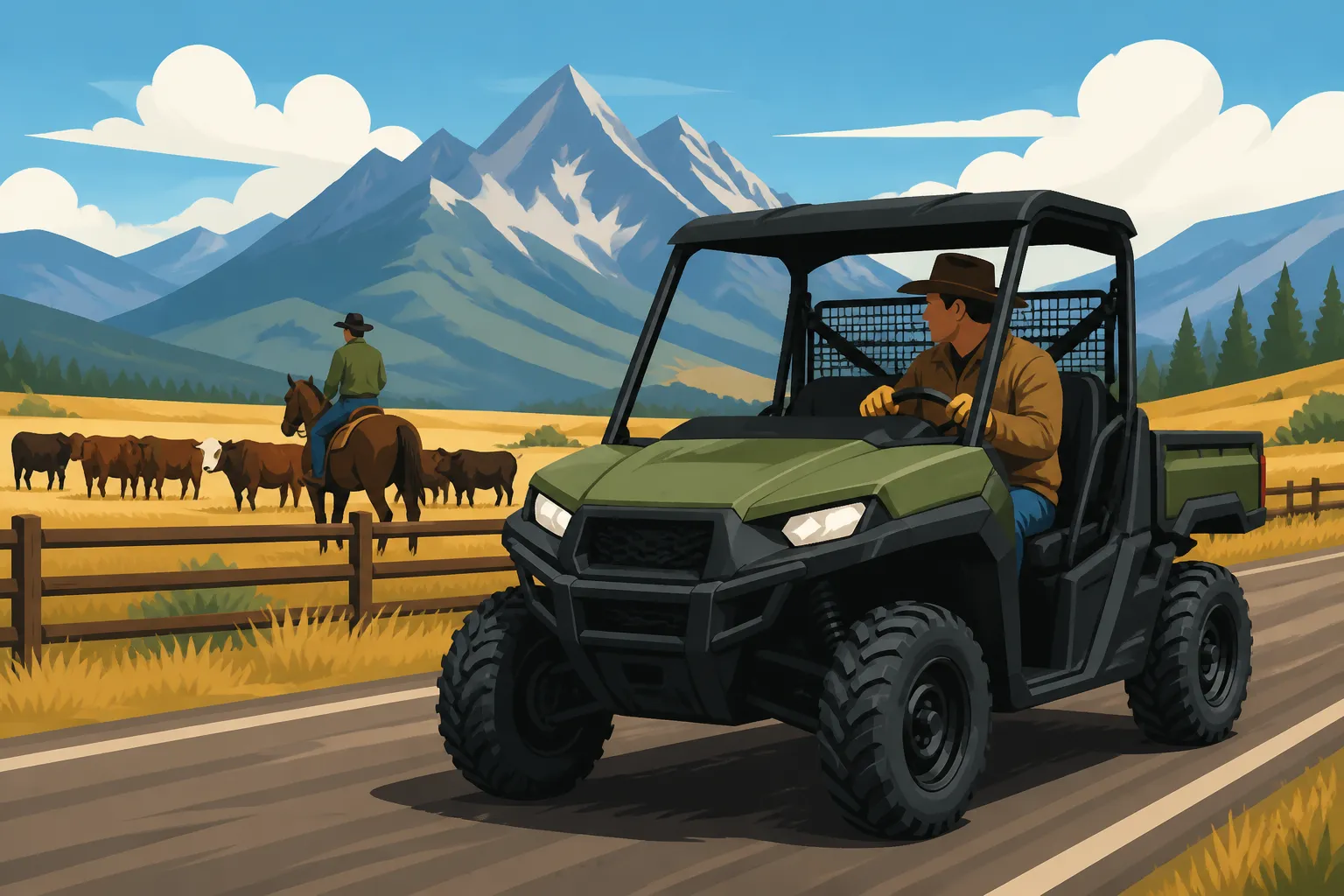
Using a UTV for Ranch Work on a Road
For those of us living the ranching life in Montana, our UTVs are less of a toy and more of an indispensable workhorse. They haul feed, mend fences, check livestock, and get us across rugged terrain where a pickup truck simply can't go. But what happens when that crucial piece of equipment needs to cross a county road, or even travel a short distance on a paved section to reach another pasture or outbuilding? This guide will dive deep into Montana's rules, exemptions, and practical advice for using your utility terrain vehicle for ranch work on public roads, helping you navigate the fine line between utility and legality.
Understanding Montana's Definition of a UTV for Road Use
It might seem straightforward – it’s a UTV, right? But the state of Montana has specific definitions that dictate how these machines are treated, especially when they venture onto a paved or even a well-traveled gravel road. Understanding these distinctions is your first step to staying compliant and avoiding unexpected headaches.
What Constitutes a "Utility Terrain Vehicle" in Montana?
In Montana, a Utility Terrain Vehicle (UTV), often referred to as a side-by-side, generally fits a description that sets it apart from its ATV cousin. Picture a machine with a steering wheel instead of handlebars, foot pedals like a car, and side-by-side seating for one or more passengers. Most UTVs also feature a small cargo bed in the back, perfect for hauling tools, feed, or fencing supplies – essentially, they're built for utility.
This physical setup is key because it influences how the state categorizes your machine for registration and road use. While ATVs are typically ridden straddle-style, UTVs offer a more enclosed, car-like experience. This difference in design, though seemingly minor, dictates many of the equipment requirements and restrictions you'll encounter if you plan to take your ranch machine off your property and onto a public thoroughfare.
The distinction between a UTV and an ATV really matters when you start talking about road legality. Because UTVs have a steering wheel and often multiple seats, they often fall into a different regulatory bucket than a traditional quad. This means different requirements for things like mirrors, turn signals, and even the type of driver's license needed. It's not just about what you call it, but how the state's statutes define its features and intended use that will ultimately determine your ability to use it on the road for ranch tasks.
The Grey Area of "Ranch Work" vs. "Recreational Use"
One of the most common frustrations for Montana ranchers is the blurry line between using a UTV for legitimate agricultural work and simply taking it for a spin. Montana often acknowledges that farm and ranch vehicles are essential tools and sometimes provides exemptions for them. However, these exemptions are usually quite specific and often tied to tasks like crossing a road to access adjacent property or moving equipment short distances. The moment your "ranch work" involves anything that looks like general travel or commuting on a public road, you're likely to be judged by the broader Off-Highway Vehicle (OHV) laws.
Think about it: checking fences along a county road that borders your property might fall under a different set of expectations than driving your UTV into the nearest town for supplies. Ranchers often feel caught in the middle, needing to use their UTVs efficiently for their livelihood but constantly wondering if they’re pushing the limits of what’s considered permissible. It’s a valid concern, and it highlights the need for clear understanding rather than just assuming your "work vehicle" status grants you carte blanche.
This ambiguity is precisely where many of us get hung up. We know our UTV is a work machine, but the Department of Motor Vehicles or a local sheriff might see it as just another off-road vehicle if it's on a public road. This means that while your primary intent is work, the location of that work – on a public road – often trumps the intent itself, bringing you under a more stringent set of regulations. It's a frustrating reality, but one that demands attention to detail to avoid legal trouble.
Essential Requirements for Road-Legal Ranch UTVs
So, you've accepted that your ranch UTV might need to meet some specific standards for road use. Now let's get into the nitty-gritty of what Montana expects. This isn't just about avoiding a ticket; it's about ensuring safety for yourself and others sharing the road.
Registration, Titling, and Decals
Even if your UTV spends 99% of its life on private land tending to livestock, the moment its tires touch a public road, Montana generally requires it to be registered. This isn't just a suggestion; it's a legal mandate. The process for [Registering an OHV in Montana] involves going to your local county treasurer's office, much like you would for a car or truck. You'll need to prove ownership, usually with a title or manufacturer's certificate of origin. Once registered, your UTV will be issued specific decals that must be properly displayed.
Getting your UTV titled is a prerequisite to registration. If you bought your machine new, it would have come with a Manufacturer's Certificate of Origin (MCO) which serves as your initial proof of ownership. For a used UTV, you'll need the seller's properly assigned title. This document proves you are the legal owner, and without it, you can't register the machine for road use. Head over to your county treasurer's office with your MCO or title to begin the process of [Titling an OHV in Montana].
Once registered, your UTV will be issued an OHV decal and, depending on the registration type, a temporary registration permit. It’s crucial to know [Montana OHV Decals and Rear Placement] rules, as these decals must be clearly visible. For UTVs, they are often placed on the rear of the machine, usually on the back panel or a designated spot, where they are easily seen by law enforcement. Failing to display them correctly is an open invitation for a conversation with a warden, and trust me, you want to avoid that when you're just trying to get work done.
Necessary Equipment for Public Road Travel
This is where the rubber truly meets the road, so to speak. Montana has clear expectations for what constitutes a road-legal OHV, and your ranch UTV will need to meet these. It's not just about having some lights; it's about having the right kind of lights, and more. You'll need functional headlights, taillights, and brake lights – and not just for nighttime. Many statutes require these to be on at all times when operating on a public road, even during the day.
Turn signals are also a must. While many UTVs come factory-equipped with some basic lighting, dedicated turn signals are often an aftermarket addition. Similarly, you'll need at least one rearview mirror, and often two side mirrors are recommended for optimal visibility. A working horn is also essential for alerting others, and your UTV's exhaust system must include a muffler and a spark arrestor to comply with noise and fire safety regulations, especially when traversing public lands or areas prone to wildfires. If your UTV has seatbelts from the factory, they must be in working order and used by occupants.
The thought of adding all these components can be daunting, and admittedly, it's an investment. This is where companies like SuperATV come in handy. They offer a wide range of aftermarket accessories, from full street-legal kits with turn signals and mirrors to robust LED lighting and horns, designed to help UTV owners meet these requirements. While it adds to the initial cost, properly outfitting your ranch UTV for road use ensures you're not only compliant with the law but also significantly safer when sharing the road with larger, faster vehicles. It's about protecting your livelihood and your life, making these upgrades a critical part of using your UTV on public thoroughfares.
Driver Licensing and Insurance
Just like your pickup, anyone operating your UTV on a public road in Montana needs to be a properly licensed driver. This isn't a situation where you can just hop on with a learner's permit or without any license at all, even if you’re only going a quarter mile down a gravel road to check a water trough. Generally, this means a standard Class D driver's license, the same one you'd use for your car. This requirement is in place because you're sharing the road with other motorists, and the state expects you to have demonstrated basic driving competency. For a deeper dive, you can explore [Do You Need a Driver's License to Ride a Montana Road?].
Beyond the license, liability insurance is another non-negotiable requirement for road-legal UTV operation in Montana. This insurance protects you financially in case of an accident where you are at fault, covering damages or injuries to other parties. While your ranch might have a broad farm insurance policy, it's critical to verify that this policy explicitly covers your UTV when it’s operated on public roads. Many standard farm policies might only cover machines while they are on your property or in very limited, specific transit situations.
For absolute peace of mind, many ranchers choose to get a separate, dedicated OHV insurance policy that specifically covers their UTV for public road use. This ensures there are no ambiguities should an incident occur. It’s a small annual expense compared to the potential financial devastation of an uninsured accident. Think of it as another essential tool in your ranching arsenal, protecting not just your machine, but your family's future. For more details on what to look for, check out [Insuring an ATV in Montana].
Navigating Road Access for Ranchers
One of the biggest questions for Montana ranchers is often, "Which roads can I actually use?" The answer, like so many things in our state, is "it depends." It depends on who owns the road, what local authorities have decided, and whether specific exemptions apply to your particular situation.
County Roads vs. State Highways
When it comes to road access for your ranch UTV, there's a world of difference between a dusty county road and a busy state highway. County roads, those gravel or lightly paved arteries crisscrossing rural Montana, often offer more flexibility. This is because county commissioners in Montana have the authority to enact ordinances allowing OHV use on certain county roads. These decisions are typically made at a local level, reflecting the needs and characteristics of specific communities. You might find some counties are quite permissive, especially in areas with a strong agricultural base, while others might be more restrictive.
State highways, on the other hand, are almost universally a no-go for UTVs. These major routes are designed for higher speeds and heavy traffic, and the risks associated with mixing slower-moving UTVs with cars and trucks are simply too great. While you might occasionally need to cross a state highway, riding along it for any distance is generally prohibited and extremely dangerous. Understanding [Why Montana Road Access Depends on Who Owns the Road] is paramount here.
Many of Montana's charming small towns also have their own municipal ordinances regarding OHV use on city streets. Some "trail towns" in popular recreational areas have embraced OHVs and allow them on specific streets to access services or trailheads. However, this is rarely the case for ranch vehicles simply trying to get from one pasture to another within city limits. It’s always best to check with the local city or town office regarding their specific rules. You can find more information on [Montana Towns That Allow OHVs on Their Streets]. Ultimately, the local governing body, whether it's the county commissioners for rural roads or the city council for town streets, holds the power to open or close roads to UTV traffic. [County Commissioners and Montana County Roads] are key players in determining your access.
Specific Agricultural Exemptions and Limitations
This is the part that often gives ranchers a glimmer of hope, and sometimes, a dose of reality. Montana does have certain exemptions for agricultural vehicles, but they are typically very narrow in scope. These exemptions usually apply when a farmer or rancher needs to move equipment directly across a public road from one field to an adjacent one, or to transport machinery for a very short distance between parts of their property that are divided by a road. The key here is "very short distance" and "direct access to adjacent property." These are not blanket exemptions that allow for general travel on public roads.
For instance, an exemption might permit you to drive your UTV equipped with a sprayer boom across a county road to get to the back 40, but it likely won't let you drive it five miles down the road to pick up parts in town, even if those parts are for your ranch equipment. The spirit of these exemptions is to facilitate necessary farm and ranch operations without requiring a full road-legal setup for every single short crossing or move. However, pushing the limits of these exemptions can lead to trouble.
It's crucial to understand that these agricultural exemptions are often interpreted strictly by law enforcement. If your UTV isn't actively performing a direct agricultural task that requires road use, you'll likely be expected to comply with standard OHV road rules. This is why clear communication with your local sheriff's office or Montana Fish, Wildlife & Parks wardens can be invaluable. They can offer guidance on specific roads or situations in your area. You can learn more about these specific allowances in [Montana Agricultural Road Exemptions]. Always err on the side of caution and assume that general road travel for ranch work requires full compliance. For further reading, also check out [Montana Rules for Work Machines].
Practical Advice for Ranchers on the Road
When you do find yourself needing to use your UTV on a public road for ranch work, prioritizing safety and visibility is non-negotiable. Ranch UTVs, while robust, are often slower and smaller than other vehicles on the road, making them less noticeable. Maximizing your visibility is key. This means ensuring your headlights and taillights are always on, even in broad daylight. Consider adding a bright orange whip flag, especially if you're on a crest or in an area with limited visibility for oncoming traffic. Reflective tape on various parts of your machine can also dramatically improve your profile, especially in low light conditions.
Additionally, using a slow-moving vehicle sign (the orange triangle with a red border) on the rear of your UTV is highly recommended, if not legally required in certain situations. This signals to other drivers that you're not going to be traveling at highway speeds and gives them ample warning to slow down and pass safely. Companies like SuperATV offer a variety of lighting solutions, from aftermarket LED light bars that increase your presence to brighter brake lights, all of which contribute to being seen. Investing in these small upgrades can make a huge difference in preventing an accident.
Beyond visibility, good driving habits are critical. Be extra mindful on blind curves, over hills, and at intersections. Always yield to faster-moving traffic. Carry all your necessary paperwork – your driver's license, UTV registration, and proof of insurance – with you at all times. A small waterproof pouch attached to your UTV or a durable plastic sleeve in the glovebox is a smart idea. If you're stopped by a warden or sheriff, having your documents immediately accessible demonstrates responsibility and can make the interaction go smoothly. For what an officer typically asks for, see [What a Montana Warden Asks a Rider For].
Potential Penalties and Staying Compliant
Nobody wants to face fines or legal trouble, especially when you're just trying to get your ranch work done. Understanding the consequences of non-compliance and proactive steps to avoid them is just as important as knowing the rules themselves.
Fines for Non-Compliance
Operating your ranch UTV on a public road without proper registration, titling, or the necessary safety equipment can lead to a range of penalties in Montana. The most common consequence is a fine, which can vary depending on the specific violation. For example, driving an unregistered OHV on a public road is a clear violation and will likely result in a citation. The cost of these fines can add up quickly, far exceeding the modest cost of proper registration and equipment upgrades.
Beyond monetary fines, repeated or severe violations could potentially lead to more serious repercussions, such as having your UTV impounded or even facing charges for reckless endangerment if your machine is deemed unsafe for road conditions. Imagine being in the middle of calving season, needing your UTV daily, only to have it seized because you didn't have turn signals or a valid registration. It's a logistical nightmare that impacts your ability to perform essential ranch tasks. You can learn more about potential consequences by reading [Penalties for an Unregistered OHV in Montana].
Furthermore, if you're involved in an accident while operating an unregistered or uninsured UTV on a public road, the legal and financial ramifications can be catastrophic. Without liability insurance, you could be personally responsible for all damages and medical expenses incurred by other parties, potentially leading to lawsuits that could jeopardize your ranch and your family's assets. It simply isn't worth the risk to cut corners when it comes to compliance and safety.
The Importance of Local Communication
Given the nuances of Montana's OHV laws and the potential for county-level variations, one of the smartest things a rancher can do is to proactively communicate with local authorities. A friendly conversation with your county sheriff's office or a local Fish, Wildlife & Parks (FWP) warden can clear up a lot of confusion specific to your area. They are often the ones on the ground enforcing these rules and can provide the most accurate interpretation for your specific roads and ranching operations.
Don't wait until you're pulled over to ask questions. A quick phone call or a visit to their office (perhaps after you've already done your research and have specific questions) can build a positive relationship and help you understand exactly what's expected. For instance, you might have specific circumstances where you need to drive a UTV a short distance on a paved section of a county road to get to a separate parcel of land, and they might offer guidance on whether an agricultural exemption truly applies or if full street-legal conversion is necessary.
Remember, these officers are usually more interested in educating and ensuring safety than in handing out tickets. By showing that you're making an effort to understand and comply with the rules, you're much more likely to receive helpful advice than stern warnings. They can clarify where [Montana Agricultural Road Exemptions] might apply and where they definitely don't, giving you peace of mind that you're operating within the bounds of the law for your specific ranch work needs.
Upgrading Your Ranch UTV for Road Safety
It’s easy to see the cost of adding road-legal components to your UTV as just another expense. However, it's really an investment in safety, compliance, and uninterrupted ranch operations. Think about the peace of mind knowing that when you cross that county road, your UTV has the necessary headlights, taillights, turn signals, mirrors, and a horn to be seen and heard by other drivers. These aren't just legal requirements; they are fundamental safety features that significantly reduce the risk of an accident.
Many ranchers find that aftermarket parts are often more robust and better suited to the demands of ranch work than minimalist factory components. For example, SuperATV offers heavy-duty mirrors that can withstand the bumps and vibrations of field work, or brighter LED turn signal kits that are more visible in harsh Montana sunlight. These upgrades aren't just about avoiding a ticket; they're about preventing a collision that could sideline your valuable UTV, injure you or your employees, and create immense financial strain.
Consider the cost of a few hundred dollars for a comprehensive street-legal kit versus the potential fines, repair costs, or even legal fees associated with an accident due to non-compliance. When framed that way, the decision to properly equip your ranch UTV for occasional road use becomes a clear one. It allows you to continue using your UTV as the versatile workhorse it is, without the constant worry of legal trouble or compromising your safety on public roads.
Key Requirements for Ranch UTVs on Montana Roads
| Requirement | Description | Why it's Important |
|---|---|---|
| Registration | Current OHV registration with displayed decals. | Legal operation on public roads; funding for OHV programs. |
| Titling | Clear proof of ownership via a Montana title. | Essential for registration; proves legal ownership of the machine. |
| Driver's License | Valid Class D driver's license (or higher) for the operator. | Ensures operator has demonstrated basic driving competency and knowledge of road rules. |
| Insurance | Minimum liability insurance as required by Montana law. | Protects against financial responsibility for damages/injuries caused in an accident on public roads. |
| Head/Taillights | Functional headlights and taillights, often required to be on at all times on public roads. | Critical for visibility, especially during dawn, dusk, or adverse weather conditions. |
| Brake Lights | Functional brake lights to signal deceleration. | Alerts following traffic when you are slowing down or stopping. |
| Turn Signals | Operational front and rear turn signals. | Clearly indicates your intention to turn or change lanes to other drivers. |
| Mirrors | At least one rearview mirror; often side mirrors recommended for better visibility. | Allows the operator to see traffic approaching from the rear and sides. |
| Horn | A functional horn for signaling warnings. | Essential for alerting pedestrians, wildlife, or other vehicles in hazardous situations. |
| Muffler/Arrestor | Exhaust system equipped with a muffler and spark arrestor. | Reduces noise pollution and prevents wildfires from escaping sparks, especially on public lands. |
| Seatbelts | If factory-equipped, seatbelts must be present and worn by occupants. | Crucial safety feature for containing occupants in the event of a rollover or collision. |
| Slow Moving Sign | Orange triangle with red border on the rear (often required or highly recommended). | Clearly warns faster-moving traffic of your slower speed, allowing them to adjust and pass safely. |
| Local Ordinances | Compliance with specific county or municipal rules for OHV road access. | Road access can vary significantly by local jurisdiction; ensures you're allowed on specific roads. |
| Agricultural Exemptions | Understanding narrow criteria for specific farm/ranch work on roads (crossing, short transit). | Allows limited road use for specific agricultural tasks without full street-legal conversion, but not for general travel. |
Disclaimer
This article is for general informational purposes only and does not constitute professional advice. Laws, prices and regulations vary by location and change over time. Consult a qualified professional for guidance on your specific situation.