Smoke and Visibility in Montana Fire Season
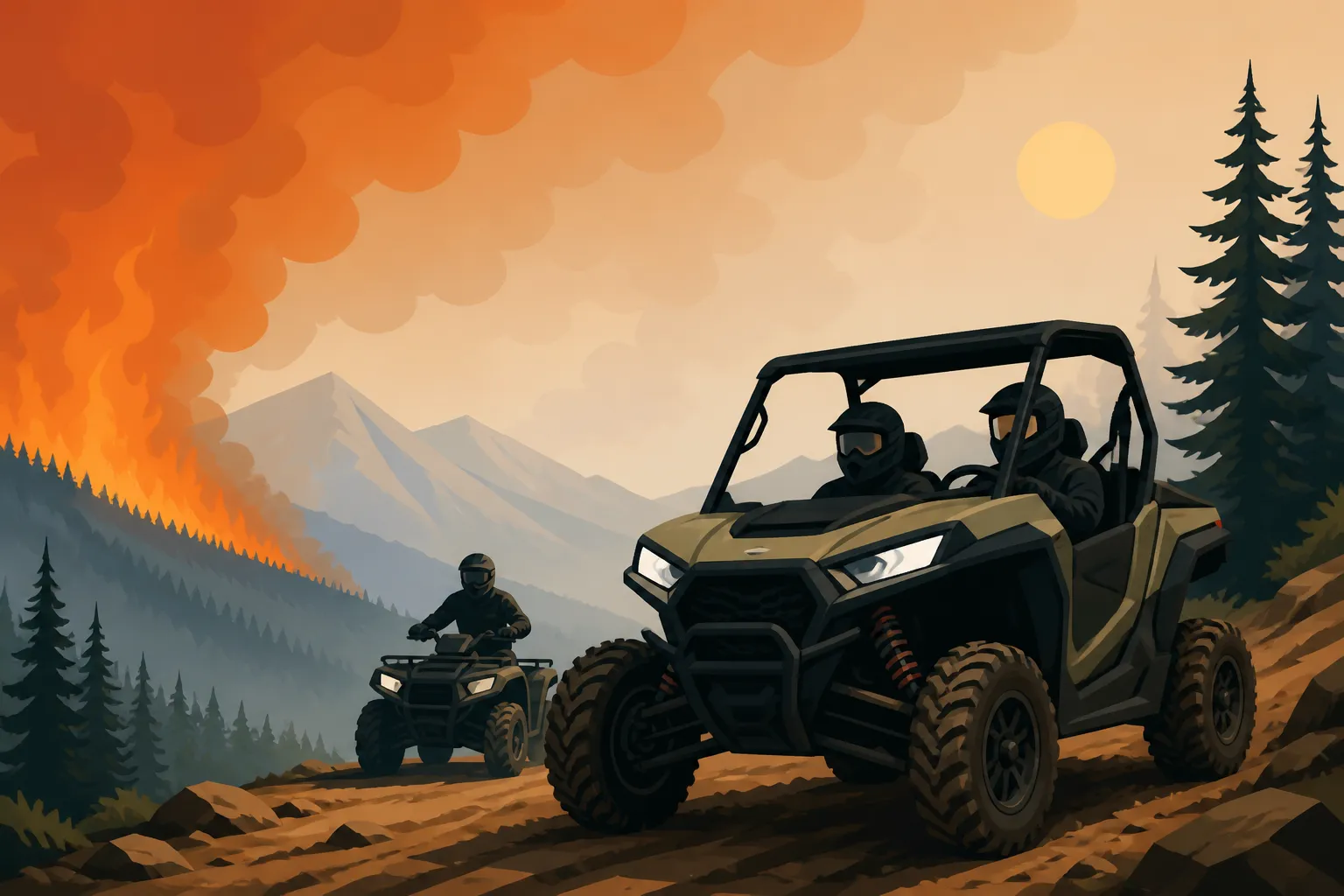
There’s nothing quite like hitting the trails or cruising a backroad on your ATV or UTV in Montana. The crisp mountain air, the sprawling views, the sense of freedom—it’s pure magic. But then late summer rolls around, and suddenly, that clear blue sky turns into a hazy, orange-tinged dome. Wildfire smoke is a frustrating and often dangerous reality for riders, drastically impacting visibility and turning what should be an epic day into a risky gamble. This guide will walk you through understanding Montana’s fire season smoke, the real dangers it poses, how to prepare, and most importantly, when it’s simply time to park the machine and wait for clearer skies.
Understanding the Haze: Why Montana's Fire Season Impacts Your Ride
Montana's summers are legendary, but they often come hand-in-hand with wildfire season. For those of us who live here year-round or plan our trips months in advance, it’s a familiar, if unwelcome, part of the landscape. What many riders don't fully grasp, however, is just how pervasive and impactful this smoke can be on their off-highway vehicle (OHV) adventures. It’s not just a distant haze; it can fundamentally change your riding experience and safety.
The Annual Reality of Wildfire Smoke
From late July through September, and sometimes even into October, Montana becomes a prime candidate for wildfires. Whether ignited by lightning strikes in remote wilderness areas or by human activity closer to populated zones, these fires can grow quickly and spread rapidly, especially during hot, dry, and windy periods. The sheer scale of some of these fires means they pump vast amounts of smoke into the atmosphere, often for weeks on end. It's a natural, albeit devastating, cycle that has significant repercussions for outdoor recreation, including ATV and UTV riding. This isn't just a sporadic event; it's an annual season we must prepare for as riders. You might have planned a fantastic trip to explore [Montana's National Forest Trail Systems] for months, only to arrive and find it socked in.
Often, the smoke might not even be from a fire in your immediate area. Strong winds can carry smoke plumes hundreds, or even thousands, of miles from fires burning in Idaho, Washington, Oregon, or even California and Canada. This means that even if the local fire danger is low and no active blazes are nearby, your favorite riding spot could still be choked with thick, hazardous air. It’s a complex dance of meteorology and ecology that dictates where and when the smoke settles, making it a constant factor to monitor throughout the latter part of the riding season. What started as clear conditions can turn soupy in a matter of hours if the wind shifts.
How Smoke Reduces Visibility for Riders
The most immediate and obvious impact of wildfire smoke on OHV riding is the dramatic reduction in visibility. Smoke is essentially a dense mixture of tiny particles and gases, including ash, soot, and various chemicals. When these particles hang in the air, they scatter and absorb light, making it incredibly difficult to see clearly, especially at a distance. Think of it like a dense fog, but one that smells like a campfire and often has a gritty feel to it. It makes those panoramic views you came for disappear into a monochromatic haze, which is frustrating enough on its own.
But beyond the scenic disappointment, this diminished visibility poses serious safety concerns for riders. Trails that are usually easy to navigate suddenly become obscured, making it hard to spot turns, obstacles like rocks or downed trees, and other riders or wildlife. Road riding becomes particularly dangerous, as the ability to see oncoming traffic, pedestrians, or even the edge of the pavement is severely compromised. Imagine trying to see a deer darting out from the treeline or a sharp curve on a winding forest service road when you can only clearly see a few dozen feet ahead. This dramatically shortens your reaction time, which is something no rider wants to experience.
Local vs. Distant Smoke: What's the Difference?
While all wildfire smoke reduces visibility, there are some subtle differences between smoke originating from nearby fires and smoke that has traveled a great distance. Local smoke, especially from active or very recent fires, tends to be thicker, denser, and often has a more acrid, burning smell. It might contain larger ash particles that can even fall like fine snow, coating everything in a layer of soot. This type of smoke usually means you're closer to the source and the air quality is likely to be quite poor. Road closures and trail closures are far more likely when fires are active nearby, so it’s crucial to check [Montana Trail Closures in Fire Season].
Distant smoke, on the other hand, often appears as a persistent haze that gives the sky a dull, orange, or even reddish tint. While it might not have the immediate sting of local smoke, it still significantly reduces visibility and can linger for days, or even weeks, depending on atmospheric conditions. The particles are usually finer, having traveled farther, but they are still very much present and impactful on air quality and your ability to see. Both types of smoke warrant caution, but local smoke demands immediate attention to fire danger and evacuation warnings, whereas distant smoke primarily affects air quality and long-range visibility. Understanding the source can help you gauge the overall risk and decide if your planned ride is still a good idea.
The Real Dangers of Riding Your OHV in Smoky Conditions
It’s tempting to push through a little haze when you've already hauled your machine to the trailhead or planned a big day out. We've all been there, thinking, "It's not that bad, I'll just go slower." But riding an OHV in smoky conditions isn't just about a diminished view; it introduces a host of serious dangers that can quickly turn a fun outing into a harrowing experience. It's crucial to acknowledge these risks rather than simply hoping for the best.
Compromised Vision and Reaction Time
When smoke reduces visibility to a few hundred feet or less, your visual field shrinks dramatically. This means you have less time to process the terrain ahead, identify hazards, or react to unexpected events. On a winding trail, a sharp turn might appear suddenly, leaving you little room to brake or adjust your line. Rocks, ruts, puddles, or even fallen branches that would normally be easily spotted become invisible until you’re practically on top of them. This is where quality aftermarket lighting can make a difference, with brands like SuperATV offering powerful LED light bars that can cut through some of the haze better than stock lights.
The dangers are even more pronounced on roads where you might encounter other vehicles, pedestrians, or cyclists. When riding on shared county roads, your ability to quickly identify and react to approaching vehicles is paramount. Without clear visibility, the risk of a head-on collision or a rear-end accident skyrockets. Your brain needs time to register what your eyes see and send signals to your hands and feet. Smoke robs you of that precious time, and it’s a risk you really don’t want to take, especially when speed is involved. The temptation to speed up on an open straightaway can be deadly when the visibility is limited.
Respiratory Health Concerns for Riders
Beyond the immediate visual hazards, wildfire smoke poses a significant threat to your respiratory health. The fine particulate matter in smoke, known as PM2.5, can penetrate deep into your lungs, causing inflammation, irritating existing conditions like asthma or bronchitis, and even exacerbating heart conditions. When you're riding an OHV, you're often exerting yourself physically, breathing harder and faster, which means you're inhaling more of these harmful particles. This is especially true if you’re riding on dusty roads, as the combination of dust and smoke is a nasty cocktail for your lungs.
Symptoms can range from coughing and wheezing to shortness of breath, chest pain, and fatigue. For those with pre-existing health issues, the effects can be severe and even life-threatening. Even healthy individuals can experience reduced lung function and a general feeling of malaise after prolonged exposure. Imagine being deep on a trail, miles from help, and suddenly struggling to breathe. It’s a frightening prospect. While a simple bandanna might offer minimal protection from larger dust particles, it does little against the microscopic hazards of smoke. Serious riders concerned about respiratory health might consider specialized respirators, but even then, limiting exposure is key.
Increased Risk of Collisions and Getting Lost
Reduced visibility inherently increases the risk of collisions, whether with other vehicles, natural obstacles, or even wildlife. On trails, hitting a hidden rock or driving into a washout can lead to serious spills, injuries, and damage to your machine. On roads, the danger of not seeing a stop sign, a sharp curve, or an oncoming vehicle until it's too late is profound. [Montana OHV Accident Reporting] procedures become critically important if something does go wrong.
Furthermore, smoke can disorient you, making it easier to get lost, even on familiar routes. Landmarks disappear, and the flat, hazy light can make topography difficult to interpret. What looks like a straight path might actually be veering off course. If you’re riding in unfamiliar territory or on remote [Montana Rules on Forest Service Roads] or [Montana Rules on BLM Roads], this disorientation can become genuinely dangerous. Carrying a reliable GPS device or a [Carrying a Satellite Messenger in Montana] is always wise in the Montana backcountry, but even those tools can't compensate for a total loss of visual cues. It's not just about knowing where you are, but seeing what's around you as you navigate.
Smart Planning and Gear Choices for Riding During Fire Season
Given the annual reality of wildfire smoke, smart planning and thoughtful gear choices aren't just recommendations—they're necessities for anyone planning to ride their ATV or UTV in Montana during the late summer and early fall. Going out unprepared is simply asking for trouble, and we want you to enjoy your ride, not endure it. A little foresight can make a huge difference in staying safe and comfortable.
Pre-Ride Checks and Route Selection
Before you even load up your machine, the most crucial step is to check the current conditions. Don't just look out your window; fire smoke can travel. Utilize resources like air quality monitoring websites and local news outlets for up-to-date information on active fires and smoke plumes. Websites that show particulate matter (PM2.5) levels are invaluable. A quick search for "Montana air quality map" will usually bring up helpful resources. If the air quality index (AQI) is in the "unhealthy for sensitive groups" range or higher, reconsider your ride, especially if you have any respiratory concerns. [Checking Montana Trail Status Before You Drive] can also provide critical information on closures.
When selecting your route, consider its exposure and elevation. High-elevation trails might offer clearer air above inversion layers, but they also tend to be more exposed to distant smoke. Lower-elevation routes might be more protected, but also more prone to inversions that trap smoke. Choose routes you know well if conditions are iffy; familiarity can be a huge advantage when visibility is poor. Avoid highly technical trails that demand precise vision. If you're new to an area, consider sticking to easier [Family-Friendly Montana OHV Trails] until conditions improve.
Essential Gear for Smoky Rides
Even if you decide the conditions are manageable for a ride, bringing the right gear is non-negotiable. First and foremost, proper eye protection is crucial. Smoke particles can irritate your eyes, reducing your ability to see and causing discomfort. Goggles, preferably sealed ones, will offer better protection than sunglasses. Make sure your goggles are anti-fog, as the humidity from your breath combined with cooler smoky air can quickly cloud them up. For your machine, consider upgrading your lighting. High-quality LED light bars and auxiliary lights, such as those from SuperATV, can penetrate haze better than standard headlights, though they are not a magic bullet for truly dense smoke.
| Visibility Condition | AQI Range (Approx.) | Rider Perception | Recommended Action |
|---|---|---|---|
| Clear | 0-50 (Good) | Unrestricted, crisp | Normal riding |
| Hazy/Light Smoke | 51-100 (Moderate) | Distant views blurred, slight odor | Proceed with caution, slow down, use lights |
| Moderate Smoke | 101-150 (Unhealthy for Sensitive Groups) | Significant haze, mid-range visibility reduced, distinct odor | Reconsider ride, wear respirator if riding, avoid strenuous routes |
| Heavy Smoke | 151-200 (Unhealthy) | Very poor visibility (short distances only), strong odor | DO NOT RIDE, seek indoor air, stay off roads and trails |
| Very Heavy Smoke | 201+ (Very Unhealthy/Hazardous) | Extremely limited visibility, burning eyes/throat, health risk | STAY HOME, evacuate if advised, monitor official warnings |
Beyond vision, respiratory protection is key. A simple cloth mask offers little to no protection against PM2.5 particles. Look for N95 or P100 respirators, which are designed to filter out fine particulates. While they can be uncomfortable to wear during physical activity, they offer significant protection if you choose to ride in smoky conditions. Always carry extra water, a first-aid kit, and a communication device like a satellite messenger, especially if you’re headed into remote areas. Having [What to Carry on a Remote Montana Ride] can truly save your skin when conditions are less than ideal.
Machine Maintenance for Dusty, Smoky Air
Wildfire smoke and the dry conditions that accompany it can be tough on your OHV. The fine particles in smoke, combined with dust on the trails, can clog air filters quickly, reducing engine performance and potentially leading to premature wear. Before and after riding in smoky conditions, check and clean or replace your air filter. Many riders opt for higher-performance air filters, some of which are available from brands like SuperATV, which might offer better filtration in these challenging environments.
Keep an eye on your machine's cooling system as well. Engines can run hotter in smoky, dry conditions, and a dirty radiator can exacerbate this. Clean your radiator fins regularly to ensure maximum cooling efficiency. Also, ensure all your lights are in perfect working order, as you'll rely on them heavily for visibility, even during daylight hours. This includes headlights, taillights, and any auxiliary lighting. Having well-maintained brakes is also paramount, as you’ll likely need to react more quickly and stop more frequently than usual.
Knowing When to Stay Home: Monitoring Conditions and Official Warnings
There comes a point where no amount of preparation or specialized gear can mitigate the risks of riding in wildfire smoke. As much as we love our time on the trails and roads, safety must always come first. Knowing when to simply call it a day and postpone your adventure is perhaps the most critical decision a rider can make during fire season. It requires a realistic assessment of the situation and a willingness to prioritize health and safety over immediate gratification.
Interpreting Air Quality and Visibility Reports
Don’t guess about the air quality; rely on official sources. Air quality monitoring stations across Montana provide real-time data on the Air Quality Index (AQI) and PM2.5 levels. Look for resources from the Montana Department of Environmental Quality or the EPA. An AQI above 100 generally indicates air that is "unhealthy for sensitive groups," and above 150 is "unhealthy for everyone." Visibility is also a key indicator. If you can't clearly see landmarks that are normally visible from a certain distance, or if the horizon looks completely blurred, then conditions are likely too poor for safe riding.
Beyond official numbers, use common sense. If your eyes are stinging, your throat feels scratchy, or you're coughing just by stepping outside, those are clear signals that the air is not fit for strenuous activity like OHV riding. Remember, your machine can handle a lot, but your lungs and your ability to see are far more fragile. Even a slight headache or feeling rundown can be a sign that the smoke is affecting you. Pay close attention to these bodily cues, as they are your personal early warning system.
Understanding Road and Trail Closures
Wildfires often lead to proactive closures of roads and trails to protect the public and allow emergency responders to work safely. These closures are not arbitrary; they are made to save lives and resources. Always check with the relevant authorities before you head out, whether it's the Forest Service, Bureau of Land Management (BLM), or local county sheriff's office. You can usually find information on their websites or by calling their local offices. Trying to ride around a closure isn't just illegal; it puts you and emergency personnel at undue risk. Remember, ignoring a closure can lead to [Fines for an Unregistered OHV in Montana] or other penalties, but more importantly, it can put you in harm's way.
Closures can change rapidly, so what was open yesterday might be closed today. Forest Service Motor Vehicle Use Maps (MVUMs) are helpful resources, but during fire season, they need to be cross-referenced with real-time alerts. Sometimes, roads are closed not because of direct fire danger, but because visibility is so low that it's too dangerous for travel. This is particularly relevant for those who plan to ride their OHVs on the road, where [Montana Speed Limits for OHVs on Roads] and other traffic laws still apply, but visibility dramatically compounds the danger. Respecting these closures is not just about compliance; it's about being a responsible and safe rider.
Trusting Your Gut: When to Postpone Your Adventure
Ultimately, you are the best judge of your own comfort and safety limits. Even if official reports say the air is "moderate," if you feel uneasy, or if the visibility just feels too low for you, then it's okay to postpone your ride. Don't let peer pressure or a desire to stick to a schedule override your instincts. There will always be another day to ride, another trail to explore, and another scenic view to capture. No photograph is worth risking your health or safety.
Think about the long-term enjoyment of your hobby. Pushing through uncomfortable or dangerous conditions in smoky weather can lead to negative experiences, potential accidents, or even long-term health issues that might diminish your ability to ride in the future. Embrace the flexibility that comes with being an OHV enthusiast. If the smoke is bad, pivot to an indoor activity, visit a local museum, or spend time planning your next, clearer-day adventure. Staying home when the skies are choked with smoke is not a sign of weakness; it's a sign of wisdom.
Disclaimer
This article is for general informational purposes only and does not constitute professional advice. Laws, prices and regulations vary by location and change over time. Consult a qualified professional for guidance on your specific situation.