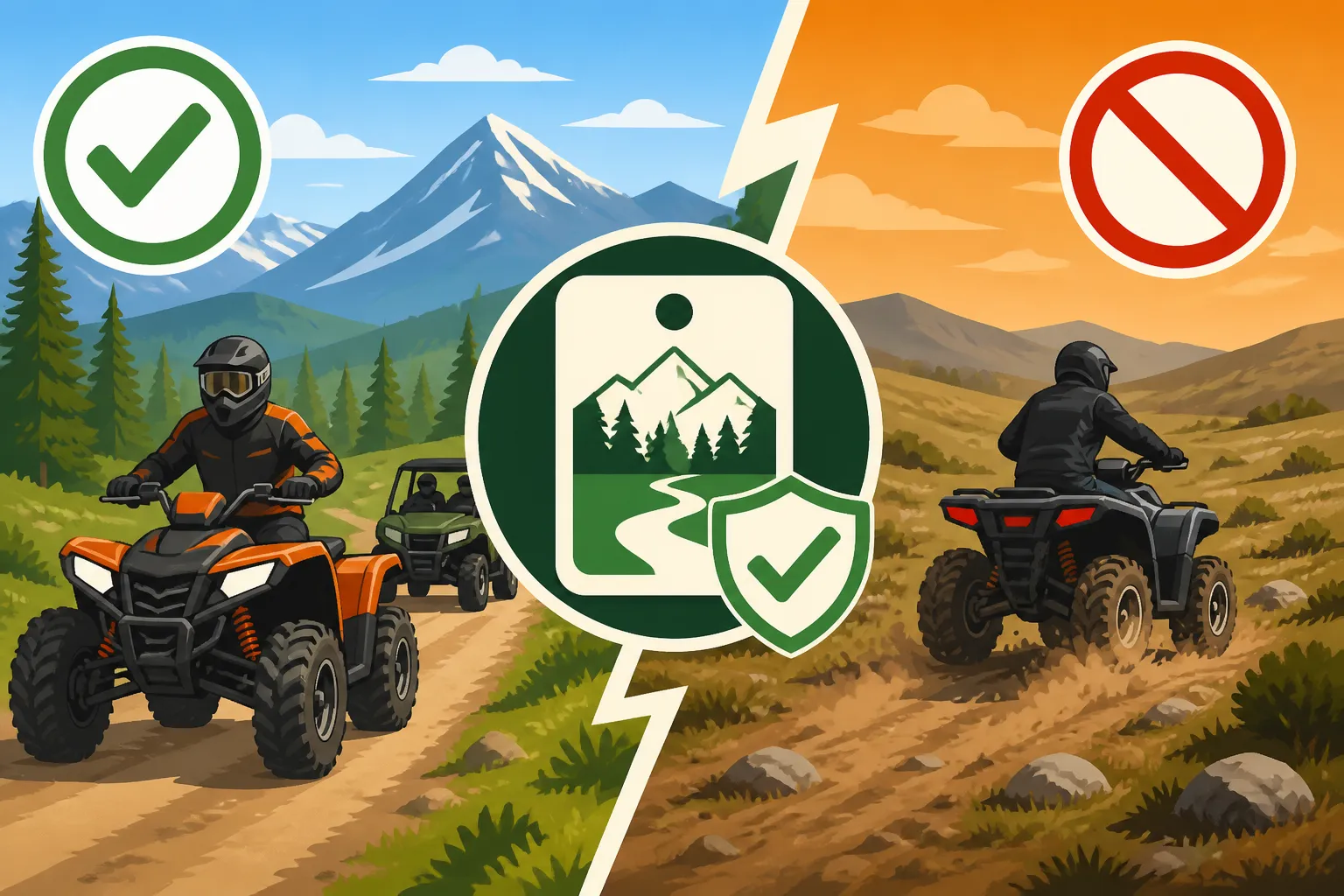
Why the Non-Resident Permit Covers Trails Only
A Montana non-resident OHV permit can be easy to misunderstand: it helps satisfy a trail-use requirement, but it is not a road permit, vehicle registration, or blanket pass to every public route. If you are bringing an ATV or UTV from another state, knowing what the permit does—and what it leaves to other rules—can prevent an expensive mistake before you unload.
What the non-resident permit is for
Montana’s non-resident OHV permit is intended to cover eligible off-highway vehicle use on trails where the permit is required. Think of it as one piece of permission for a specific kind of riding, not a general license for the machine or rider.
That distinction matters because “public land” does not mean “everywhere is open to every vehicle.” A trail can have its own restrictions based on the managing agency, the route designation, the machine’s width or type, seasonal closures, or other conditions. The permit does not override those restrictions. Before riding, confirm that your machine is allowed on the specific route and that the route is open.
The permit also does not establish who owns the ATV or UTV. It is not a title, bill of sale, plate, or substitute for registration paperwork. If you are travelling with a recently purchased machine, make sure you have the ownership documents you need as well as any required permits. Buying a Used Side-by-Side in Montana: The Paperwork explains the documents that can matter when a machine has changed hands.
A practical way to think about the permit is:
- It addresses a trail-use requirement for a qualifying non-resident rider and machine.
- It does not turn an ATV or UTV into a street-legal vehicle.
- It does not grant access to a closed, restricted, or unsuitable trail.
- It does not replace any separate road authorization, registration, or equipment requirement.
- It does not automatically satisfy permit requirements in another state.
Some visitors have a machine registered where they live and assume that registration alone gives them all the permissions they need in Montana. Do not rely on that assumption. Montana’s requirements can depend on the machine, where you plan to ride, and whether an exemption applies. Check current guidance from Montana Fish, Wildlife & Parks before your trip, especially if you have a road-registered side-by-side, a rental machine, or a machine that does not fit the usual ATV or UTV category.
For a closer look at the visitor permit itself, see Montana’s Non-Resident Temporary Use Permit. If you are sorting out the difference between permit, registration, and trail access, What Montana Riders Need Before They Ride is also useful.
Why trail permission does not include road riding
A trail-use permit and permission to ride a road answer different questions.
The permit addresses whether you have met a particular requirement to ride an eligible OHV on covered trails. Road riding involves a separate set of questions: Is this road open to OHVs? Has the road authority authorized that use? Does the machine meet the requirements for that kind of road use? Is the rider qualified to operate it there?
A permit does not answer those questions. A route may look like a road on a map or in the landscape but still be closed to OHVs, or it may be open only under conditions set by a county, town, or land manager. Permission to ride one section also does not necessarily extend to the next road, bridge, highway crossing, or town street.
| What you want to do | What the non-resident trail permit does | What else to check |
|---|---|---|
| Ride an eligible OHV on a covered trail | Helps meet the applicable trail-use permit requirement | Route designation, vehicle-width limits, closures, and land-manager rules |
| Ride a county road | Does not by itself authorize road use | Whether the county has opened that road and what road rules apply |
| Ride a town street | Does not grant municipal permission | The town’s ordinance and any route-specific restrictions |
| Cross a highway | Does not authorize the crossing | Whether that crossing is allowed and the safety and equipment rules |
| Use a machine in another state | Does not carry over as that state’s permit | The destination state’s permit and registration requirements |
This separation is especially important for visitors who want to ride from a campground or trailhead into town. A route that connects a trail to a cafe may include public roads, town streets, or private access. A Montana trail permit alone does not make the whole trip legal. Check each part of the route rather than assuming that a route shown by a rental shop, map app, or other rider is currently authorized.
For road-specific questions, Riding an OHV on the Road in Montana gives a useful overview of how road access differs from trail access. If your plan includes county roads, read County Commissioners and Montana County Roads. For town streets, check Montana City Streets and Municipal Ordinances.
It is also worth separating “road-legal machine” from “road-open route.” A machine may have equipment or registration that allows some kinds of road use, but that does not mean every road is open to it. In the other direction, a route may allow certain OHVs while still requiring the rider and vehicle to meet separate conditions. Both the vehicle and the route need to qualify.
What the permit does not replace
The permit is only one part of trip preparation. Treating it as a catch-all can leave you without another required document or permission.
It is not vehicle registration
A permit for trail use does not register the machine or change its registration status. If the machine requires registration for the way you intend to use it, handle that separately. If you are unsure which paperwork applies to your machine, review Registering an Out-of-State Machine in Montana and confirm the current rules with the relevant Montana office.
Registration, title, and permit documents each serve different purposes. A title is generally about ownership; registration is about the vehicle’s recorded status and authorized use; a trail-use permit addresses access requirements for a particular category of riding. Carry the paperwork that applies rather than expecting one document to stand in for all three.
It is not a trail-opening order
A permit cannot open a trail that is closed. Closures may be seasonal, related to weather or fire conditions, or imposed to protect wildlife, habitat, or trail surfaces. A route can also be open to one class of machine and not another.
Before setting out, check the route with the agency or land manager responsible for it. For forest routes, use the current Motor Vehicle Use Map and check for temporary orders or closures. The article Reading a Montana Motor Vehicle Use Map explains why the map’s route designations matter. For changing conditions, Checking Montana Trail Status Before You Drive can help you build a useful pre-trip check into your plans.
It is not permission to cross private land
A public trail may pass near or connect with private land. The permit does not grant permission to cross private property, use a private road, or enter a route that has been closed by its owner. Follow posted signs and barriers, and do not assume that a line on a recreational map gives you a legal right of access.
It is not a guarantee that your machine fits
Trail access can be limited by width, vehicle type, or the condition of the route. A full-size side-by-side may not fit a trail intended for narrower machines, even when the permit requirement is met. Check any width restrictions and route descriptions before driving to the trailhead. If you are planning around a wider machine, Wide Side-by-Sides on Narrow Trails covers the kind of mismatch that can turn a planned route into a dead end.
It is not a permit for every activity
An ordinary recreational trail ride is different from an organized event, guided commercial trip, or other use that may require separate authorization. If you are arranging a group ride, leading a paid trip, or hosting an event on public land, ask the land manager whether additional permits apply. Do not assume that each rider’s individual trail permit covers the organizer’s activity.
How to check whether your trip is covered
A short check before departure is much easier than sorting out a problem at the trailhead. Use this process for each machine and each planned route.
- Identify the vehicle and where it is registered. Note whether it is an ATV, UTV, dirt bike, or another type of OHV, and whether it carries out-of-state registration or other credentials. If you are unsure whether your machine falls under a particular category, ask Montana Fish, Wildlife & Parks rather than relying on a seller’s description.
- Confirm whether the non-resident permit applies. Check the current Montana requirements for your type of machine and intended use. Read any stated exemptions carefully; do not assume that an out-of-state plate automatically removes a Montana trail-permit requirement.
- Name the route, not just the destination. “We’re riding near town” is not specific enough. Identify the trail, road segments, crossings, and staging area. A loop may include routes managed by more than one authority.
- Check the land manager’s route information. Confirm that the trail is open, that your machine is allowed, and that no temporary closure or seasonal restriction applies. Maps are useful, but current closure information matters too.
- Separate trail sections from road sections. If the route uses a road, determine who controls it and whether OHV use is authorized there. Do not treat the trail permit as road permission.
- Check the rider and machine requirements for any road segment. These can be different from trail requirements and may depend on the road and local authorization. Review What Montana Requires on an OHV Road Ride if you expect to use an authorized road section.
- Carry proof in a usable form. Keep the permit and relevant vehicle documents accessible, and make sure the permit is attached or displayed as required by the current instructions. Don’t wait until you arrive to discover that you have a confirmation email but not the required decal or permit.
If you are visiting with a borrowed or rented machine, ask who is responsible for securing the permit and whether it is already valid for the planned use. A rental agreement, verbal assurance, or home-state registration is not a substitute for checking the actual permit requirement. See Montana Permits for a Borrowed Machine if someone else owns the machine you will ride.
The details can be easy to overlook when you are packing. A small document pouch can keep the permit information and vehicle papers together, and a phone mount or offline-map setup can help you check your route without handling a phone while riding. If you use Amazon to buy a pouch or mount, choose one that can be secured to your machine and won’t interfere with controls or safety equipment. Gear from Amazon does not make an unauthorized route legal, so verify the route before you ride.
Common misunderstandings and better ways to plan
“I have plates from home, so I do not need anything else”
Out-of-state registration and Montana trail access are separate issues. The home-state registration may identify or authorize the machine for some purposes, but do not assume it replaces Montana’s trail-use requirement. Check whether Montana recognizes an exemption for your exact situation and machine.
This is also why reciprocity questions should be handled carefully. One state’s document does not automatically satisfy another state’s requirements. If your trip includes more than one state, check each state separately. Does Any State Honor Montana Registration? discusses the broader reciprocity issue, while Riding a Montana Machine in Another State is relevant when you are taking a Montana-registered machine elsewhere.
“The trail permit means I can ride on any public road”
No. The permit is not a general road-use authorization. Roads have their own access decisions, and the responsible authority may be a county, town, state agency, or land manager. A road that appears to connect two trails is not necessarily open to OHVs.
When in doubt, ask the authority responsible for the road. For county roads, that can mean checking the county’s current rules rather than relying on a route label in a third-party app. For town streets, verify the local ordinance. Finding a Montana Town’s OHV Ordinance explains how to approach that town-level question.
“If the route is on a map, it must be open”
Maps can be outdated, generalized, or intended for a different vehicle type. A marked route may be closed for the season, restricted to narrower machines, or subject to a temporary order. Use maps to plan, then verify the current status with the land manager.
A navigation app can help you follow an authorized route, but it cannot grant access. If you use Amazon to purchase a GPS unit, phone holder, or paper-map case for the trip, treat it as navigation gear only. Confirm the underlying route with official land-manager information before riding.
“One permit covers my entire group”
Do not assume a permit attached to one machine covers every rider or vehicle. Permit requirements can be tied to the machine or use, and group members may have different circumstances. Confirm how many permits are needed, what needs to be displayed, and whether a borrowed or rental machine is already covered.
For a family or group outing, make a simple list before leaving: each vehicle, its permit status, the riders assigned to it, and the route each machine will use. That helps avoid the common problem of one machine having paperwork while another does not.
“A road section is fine if we only use it briefly”
The length of the road segment does not automatically change the rule. A short connection to a trailhead or fuel stop can still be a road-use issue. Verify the authorization and rider and vehicle requirements for the entire segment, including crossings and access roads.
If the route is not clearly authorized, choose a different trailhead or transport the machine by trailer rather than improvising. That may add time, but it is usually simpler than discovering that a shortcut crosses a road where your permit does not apply.
A simple pre-ride checklist
Before you leave home, confirm the following for every ATV or UTV:
- The machine’s registration and ownership documents are in order.
- You have checked whether the Montana non-resident trail permit applies.
- The required permit is obtained and displayed as instructed.
- The planned trail is open and allows your machine’s type and width.
- Any road segments are separately authorized for OHV use.
- You have checked for seasonal, fire-related, weather, or land-management closures.
- Everyone in the group understands that a trail permit is not permission to ride anywhere.
- You have a current route map and a way to navigate if cell service is unavailable.
- You know who to contact if an access point is closed or route information conflicts.
If you are still unsure, describe your exact machine, its home-state registration, and the trail or road you want to use when asking the relevant agency. Specific questions are easier to answer than “Is my permit good in Montana?” Keep the answer with your trip documents, and recheck route conditions close to departure because access can change.
The key point is simple: the non-resident permit addresses trail use within its scope. It does not confer general access, replace vehicle paperwork, or authorize road riding. Treat each of those as a separate check, and you will have a much clearer picture of what your group can legally ride.
Disclaimer
This article is for general informational purposes only and does not constitute professional advice. Laws, prices and regulations vary by location and change over time. Consult a qualified professional for guidance on your specific situation.