Bear Spray on an OHV
A bear encounter feels different when you are seated on an ATV or UTV, wearing gloves and moving along a narrow Montana trail. Bear spray can help in an emergency, but only if you can reach it quickly and know how to use it. This guide covers choosing, carrying, storing, and handling bear spray on an OHV ride.
Choose bear spray that suits a trail ride
Pick a canister intended for bear defense
Bear spray is designed to deter an approaching bear at close range. It is not the same as ordinary personal-defense pepper spray, and it is not a substitute for paying attention, keeping a safe distance from wildlife, or following trail and campsite rules. Look for a product specifically labeled as bear spray and read its directions before you leave home.
Check the canister’s expiration date, safety clip, and instructions for use. A canister that is expired, damaged, or difficult to operate may not work as expected. If you have never handled bear spray before, a practice canister can help you learn how its safety mechanism works without discharging the real one. Practice only according to the product’s directions, and make sure everyone in your riding group understands that the real canister is for an actual emergency.
Bear spray is a precaution, not a guarantee. It will not prevent every encounter, and using it unnecessarily can create another problem, especially if wind carries the spray toward you or your riding companions. Think of it as one part of a broader plan that includes making noise where visibility is limited, watching for wildlife, and giving animals room to leave.
Make sure the canister is reachable from your riding position
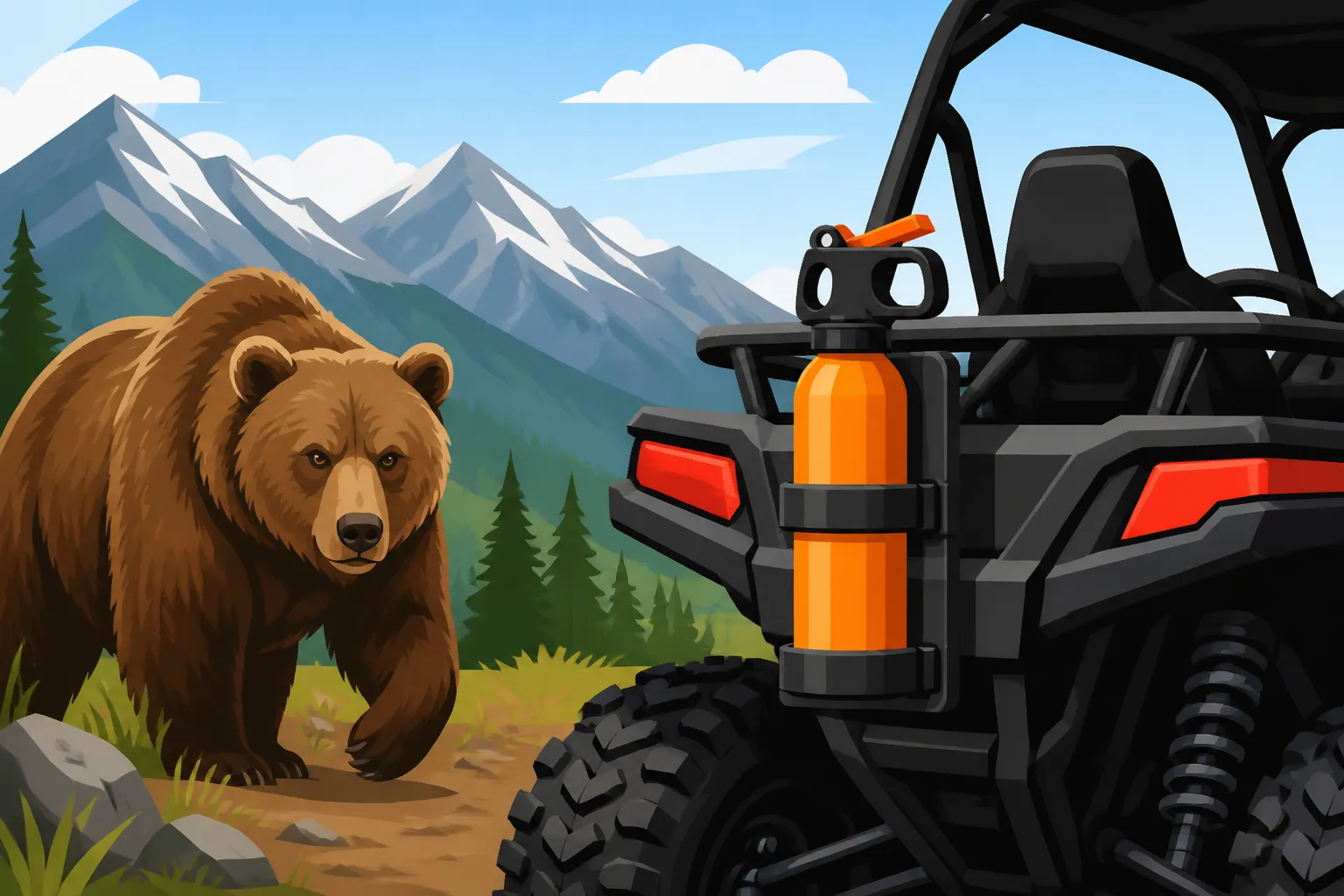
The best place for bear spray is a secure, accessible spot—not buried under a jacket, strapped inside a cargo box, or packed at the bottom of a backpack. An encounter can unfold quickly, and climbing off an OHV or emptying a storage compartment may waste time. Before setting out, sit in the machine with your normal riding gear on and check whether you can reach the canister without awkwardly twisting or taking your eyes off the trail for long.
A belt holster, chest holster, or another purpose-built holder may work, depending on your gear and machine. The canister should be secure enough that it will not bounce loose on rough ground, yet easy to remove when needed. Check that the safety clip remains in place while you ride and that clothing, straps, or a seat belt do not block access.
With a group, make sure each rider knows who is carrying bear spray and where it is. One canister shared between several people may be less useful if the person carrying it is separated from the group or seated in a different machine. A group gear check can be part of the same routine as checking helmets, water, and first-aid supplies. For a wider packing checklist, see [What to Carry on a Remote Montana Ride].
Carry and store bear spray safely on an ATV or UTV
Protect the canister from heat, impact, and rough handling
An OHV can expose gear to vibration, dust, rain, and temperature swings. Keep the canister secured so it cannot roll around, strike hard objects, or get crushed beneath other equipment. Follow the product’s storage directions, and keep it away from exhaust heat and other hot surfaces. Avoid leaving it in a sun-heated machine for long periods; a closed cab or storage compartment can become very warm.
Do not assume that a glove box, rear cargo box, or tool compartment is a good location simply because the canister fits. Those spaces may be hard to open quickly, and the canister could be buried under tools or food. A secured holder within easy reach is usually more practical. If you carry the spray on your body, make sure it cannot snag on a seat belt, jacket, or other gear when you move.
After a rough day, inspect the canister and holder. Look for dents, leaks, a loose safety mechanism, or damage to the holster. If anything seems wrong, follow the product’s instructions for handling or replacing it. Do not test-fire a canister just to see whether it still works; that can leave you without protection and expose you or others to the spray.
Keep it accessible without creating a new hazard
Accessibility matters, but the canister should not interfere with riding controls or safe movement. It should not obstruct your view, catch on the steering wheel, block a seat belt, or sit where a passenger may accidentally activate it. On a side-by-side, think about where the driver and passenger can reach it while seated, and confirm that neither person needs to lean across the other to get it.
Avoid keeping bear spray loose in a shared cabin. A sudden stop or rough section of trail can send unsecured gear sliding. Use a holder made for the canister and place it where the rider carrying it can draw it without searching. Do not attach it somewhere that requires reaching near a hot engine or exhaust.
Before the ride, rehearse the basic sequence without removing or discharging the canister: locate it, reach the safety mechanism, and identify a safe direction to move away from your riding partner. The point is not to create a dramatic drill. It is to catch simple problems—like a blocked holster or a jacket covering the canister—before you are on a trail.
| Carrying choice | Potential advantage | Common drawback | What to check |
|---|---|---|---|
| Purpose-built belt holster | Easy to reach while seated | Can shift or snag if poorly fitted | Secure fit and clear access |
| Chest holster | Visible and close at hand | May conflict with straps or layers | Comfort with riding gear and seat belt |
| Backpack pocket | Keeps spray with the rider | Can be slow to reach | Pocket location and access while wearing the pack |
| Cargo box or glove compartment | Protected from some bumps and weather | Often difficult to reach quickly | Whether it is buried or locked away |
Respond calmly if you see a bear on the trail
Give the bear space and avoid trying to pass
A bear on or beside the trail is a reason to stop and reassess, not to accelerate past it. Slow down, keep a safe distance, and avoid crowding the animal with your machine or group. If you can do so without moving closer, give it an open route away from you. Do not follow it, surround it, or try to make it move for a photograph.
An OHV’s engine noise may startle wildlife, but it does not mean a bear will always move away. A bear may be feeding, protecting young, or reacting to a surprise encounter at close range. Keep your attention on the animal and the terrain around you. If there is a safe way to turn around, retreating may be the simplest option. If other riders are nearby, communicate calmly and make sure nobody attempts to squeeze past.
Plan routes with the possibility of wildlife encounters in mind. Montana’s riding areas include forests, river corridors, and backcountry routes where visibility can change quickly. Review the route before you go and know where you can turn around or wait without blocking a narrow trail. [Montana's National Forest Trail Systems] and [Reading a Montana Motor Vehicle Use Map] can help with understanding route choices and designated access, while [Cell Service in the Montana Backcountry] is worth considering when planning how your group will communicate if separated.
Know where the spray points and follow its directions
If a bear is approaching and you believe an encounter is becoming dangerous, follow the canister’s directions and the safety guidance you have learned. Keep the spray accessible, account for wind, and avoid aiming or discharging it toward another rider. Wind can carry the spray back toward the person using it or into a vehicle cabin, so be mindful of your surroundings and the position of passengers.
Do not spray a bear simply because you see one at a distance. Bear spray is meant for an imminent close encounter, not as a scent barrier or trail repellent. Use it only as directed on the product label and in a situation where you judge it necessary for immediate safety. If you accidentally discharge it, move away from the contaminated area and follow the product’s instructions for exposure and cleanup.
Responses to a bear encounter can depend on what the animal is doing and the circumstances. Do not rely on a single simplified rule for every species or situation. Learn local wildlife guidance before riding, and follow instructions from land managers or wildlife authorities. The guidance in [Riding Safely in Grizzly Country] is a useful companion to preparing for an OHV outing in bear habitat.
Build bear awareness into your Montana ride plan
Prepare before leaving the staging area
A good safety routine begins before the engine starts. Check the canister’s condition and expiration date, confirm that it is secured and reachable, and make sure riders know who is carrying it. Agree on a simple way to alert the group if someone spots wildlife. Brief passengers on staying seated, keeping hands inside the machine, and following the driver’s instructions if the group stops.
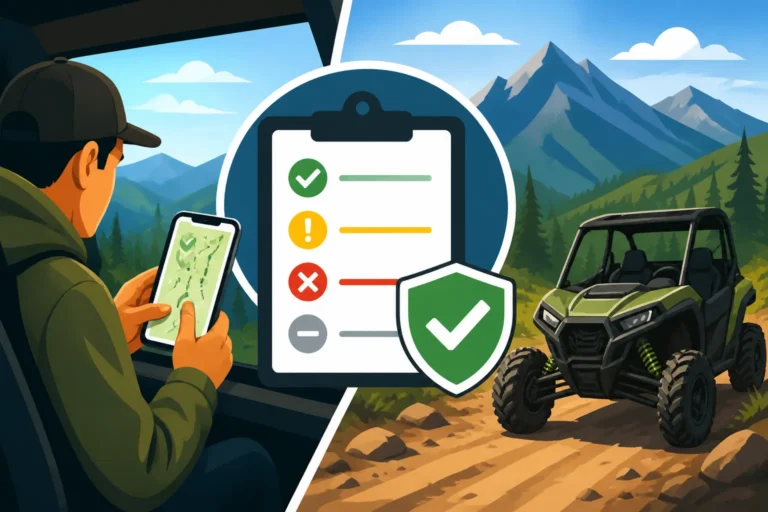
Route planning matters, too. Before you leave, look at the trail’s difficulty, remoteness, and likely stopping points. Download maps for offline use if your navigation tool supports it; a route-planning app such as onX Offroad can help you review and save route information before entering an area with poor reception. Do not treat a map app as a substitute for posted closures, current land-manager notices, or good judgment on the ground.
Pack food and scented items thoughtfully, especially if you are stopping to picnic or camp. Keep food, garbage, and other attractants secured according to the rules for the location. Do not leave snacks or wrappers in an open cargo bed. If you are riding to a campsite, review the site’s food-storage requirements before arriving. Bear spray is for an emergency encounter; it does not make careless food storage safe.
Make a plan for the group, not just the driver
A plan helps prevent confusion when riders are spread out or traveling in several machines. Decide how the group will regroup if a rider stops, what to do if someone sees a bear, and who will carry a first-aid kit and communication device. On a remote route, the person carrying spray should not be so far ahead that others cannot reach them if a close encounter occurs.
Think through practical details before the ride: Can the driver reach the spray while wearing gloves? Can a passenger reach it if the driver is unable to? Is the canister exposed to direct sun or exhaust heat? Could it be knocked loose by a hard bump? These quick checks often reveal problems that are easy to fix at the trailhead but frustrating to discover miles into a ride.
If a bear encounter does occur, once everyone is safely away, report it when appropriate to the relevant land manager or wildlife authority, particularly if the animal appears injured, behaves unusually, or creates a continuing hazard for trail users. Give clear details about the location and what happened, without approaching the bear to get a closer look. Above all, leave the area calmly and do not return to investigate. Bear spray is worth carrying, but the most useful preparation is knowing where it is, how to reach it, and how to make space for wildlife before a close encounter develops.
Disclaimer
This article is for general informational purposes only and does not constitute professional advice. Laws, prices and regulations vary by location and change over time. Consult a qualified professional for guidance on your specific situation.