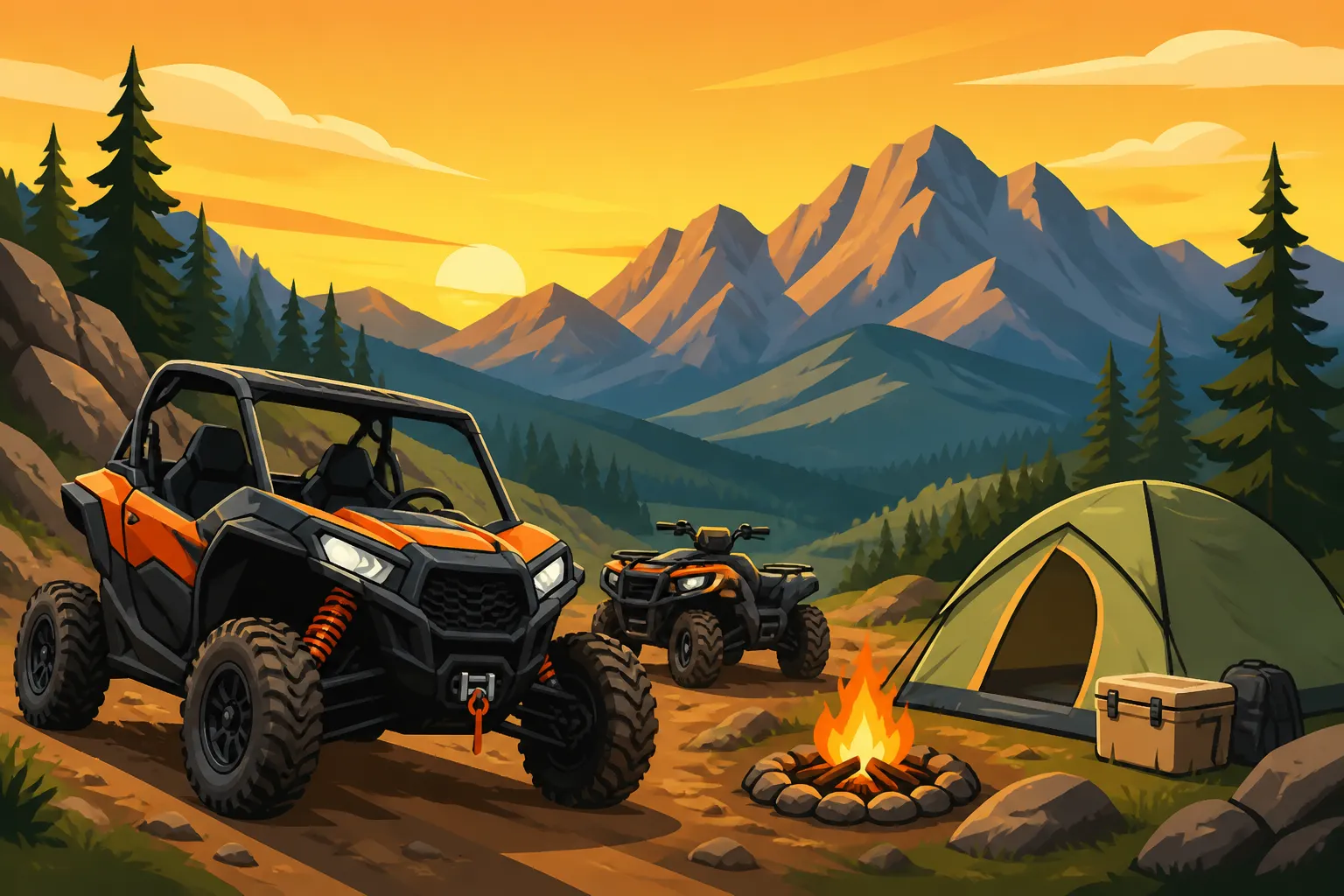
Camping Beside Montana OHV Trails
Camping beside Montana OHV trails sounds simple until you arrive with a trailer, a machine, and no clear answer about where you can camp or ride. This guide explains how to choose a legal campsite, plan trail access, manage food and fires, and prepare for remote conditions without assuming that a nearby trail or campground allows motorized travel.
Choose a campsite that fits your ride
Decide between a developed campground and dispersed camping
A developed campground can be the calmer choice when you need a defined place to park a truck and trailer, access to toilets, or a predictable setup after a long drive. Around popular riding areas near Red Lodge, Bozeman, Missoula, and the Flathead Valley, campgrounds may fill during busy travel periods, so check the site’s rules and availability before building your riding plan around it. Facilities and vehicle limits vary, and a campground that accepts your tow vehicle may not have room for a long trailer or several machines.
Dispersed camping can offer more space and a quieter night, but it puts more responsibility on you. You need to confirm that overnight camping is allowed on the specific land, that your vehicle can reach the site lawfully, and that you can camp without blocking a road, trail, gate, or access point. Rules can differ between National Forest, Bureau of Land Management, state, and private land. The phrase “public land” does not automatically mean “camp anywhere.”
A useful first check is [Dispersed Camping Rules on Montana Forest Land]. Treat that as the beginning of your research, not a substitute for checking the land manager’s current directions for the exact area. A pullout that looks inviting may be a staging area, a no-camping zone, or private property. If you cannot establish who manages the site and what is allowed, choose a clearly designated campground instead.
Match the campsite to your machine and trailer
Measure your whole setup before you leave home: truck, trailer, machines, and the space needed to turn around. A narrow forest spur that looks manageable for a pickup may become a stressful dead end when you are towing a wide trailer. Loose gravel, steep grades, washboard, tight corners, and limited turnaround room can all make a site unsuitable even when the route is technically passable.
Think about the surface where you will park and unload. A level, firm spot helps keep a trailer stable and makes loading easier. Avoid parking where rain could turn the ground soft, where runoff could pool, or where your vehicle would force other visitors to drive around you. Keep machines contained at camp rather than treating an open-looking meadow or nearby path as a place to test them.
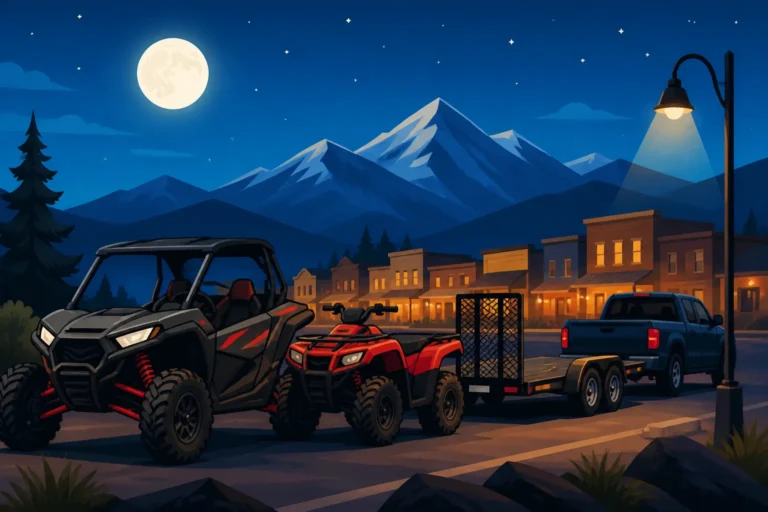
If the site is close to a trailhead, do not assume you can leave your trailer there overnight. Some staging areas have specific parking rules, limited space, or no camping permission. [Montana Trailhead Parking and Staging] is a useful companion when you are deciding whether the place you want to sleep is also an appropriate place to leave your rig.
Confirm that camping and riding access connect
Check the land manager’s rules for each part of the trip
A Montana riding trip may cross more than one kind of land. Your campsite could be on National Forest land while the route you want to ride approaches private property, a county road, or a separate public-land unit. The rules for camping, driving to the trailhead, and operating an OHV are related, but they are not interchangeable. Permission to camp does not grant permission to ride from camp.
Start by identifying the land manager for the campsite and for the routes you plan to use. In areas such as the Flathead and Lolo National Forests, and in parts of the Custer Gallatin National Forest near Bozeman and Red Lodge, route designations and seasonal conditions can shape what is open to motorized use. Local trail systems can include a mix of permitted roads, closed roads, non-motorized trails, and routes with machine-width restrictions.
Use [Montana's National Forest Trail Systems] to orient your search, then confirm the details on the relevant agency’s maps and notices. If you are comparing several possible areas, write down the name of the forest, district, or land agency for each one. That small step makes it easier to ask the right office a focused question instead of calling with only a broad place name.
Use maps to plan a legal route, not just find a line
A digital map can be valuable for seeing roads, trail junctions, and nearby services, but a visible line on a screen does not prove that a route is open to your type of machine. Check the applicable motor vehicle use map and the route’s designated use before planning a ride. Pay attention to machine width, seasonal dates, one-way designations, and whether the route is open to the public at all.
[Reading a Montana Motor Vehicle Use Map] can help you understand what the map is telling you. Keep the relevant map available offline, because cell coverage may disappear as you move away from towns and highways. onX Offroad can be useful for reviewing route context and preparing an offline map, but compare what you see in the app with the land manager’s official information before you ride.
Try to plan a route that begins and ends somewhere you are allowed to operate and park. If the camp is separated from the approved route by an undesignated road or a private parcel, do not improvise a connection across it. Drive your machine to a legal staging area when permitted, or choose a different campsite that makes the trip simpler without relying on uncertain access.
| Planning question | What to verify | Why it matters |
|---|---|---|
| Who manages the campsite? | National Forest, BLM, state, private, or another land manager | Camping rules and closures differ by land |
| Is overnight camping allowed? | Site-specific rules, signs, and agency guidance | A parking area or trailhead may not allow camping |
| Can your rig reach the site? | Road surface, grade, width, turning space, and trailer length | A route suitable for a pickup may not suit a long trailer |
| Is the route open to your machine? | Official motor vehicle use map, width limits, and seasonal dates | A mapped line is not automatically an authorized OHV route |
| Is the area currently accessible? | Closures, fire restrictions, construction, snow, or damage | Conditions can change the practical plan |
| Where will you unload? | Designated staging and parking rules | Unloading at camp may not be allowed or safe |
Make camp work for a full day on the trail
Set up for a safe return after the ride
A ride can take longer than expected when the group stops for views, takes a wrong turn, waits for a repair, or encounters a rough section. Before leaving camp, tell someone where you expect to ride and when you plan to return. Agree on a turnaround time that leaves daylight for getting back, especially if the route is unfamiliar or your group includes newer riders.
Keep keys, maps, water, basic tools, and first-aid supplies where you can find them without unpacking the whole camp. For a remote ride, consider carrying a satellite messenger or another communication option that works beyond cellular coverage. [Cell Service in the Montana Backcountry] is worth reviewing when you are choosing how much to rely on a phone. Do not assume that a phone showing a map can make a call from a deep valley or a forested ridge.
Give the group a short pre-ride check before engines start. Confirm that every machine has enough fuel for the intended route plus a reserve, that riders know the plan, and that nobody is quietly struggling with a loose strap, weak battery, or missing protective gear. At camp, park machines where they will not block the access road or create a hazard for people walking between tents and vehicles.
Pack for changing conditions and small breakdowns
Weather in the mountains can shift quickly, and a warm afternoon at camp does not guarantee a comfortable ride at elevation. Pack layers and rain protection even if the sky looks clear when you unload. Dust, wind, shade, and a sudden temperature drop can make a long ride feel very different from the campsite’s morning conditions.
A practical kit should reflect the route, the group’s experience, and the distance to help. Bring water, food, a first-aid kit, a tire repair option that suits your machine, basic tools, a flashlight or headlamp, and a way to communicate. [What to Carry on a Remote Montana Ride] can help you think through the difference between a casual outing close to town and a route where assistance may take time.
Build a simple recovery plan before setting out. Know who can help if a machine gets stuck, whether the group has suitable recovery gear, and what you will do if one rider has to stop. Avoid attempting a steep or unstable recovery just to keep the schedule. If conditions feel beyond the group’s ability, turning around is a responsible decision—not a failed ride.
Camp responsibly around wildlife, fire, and other visitors
Store food carefully and keep camp orderly
Montana campgrounds and backcountry areas can be wildlife habitat. Food, cooking supplies, garbage, coolers, and scented personal items may attract animals if left accessible. Follow the storage requirements posted for the specific campground or land-management area, and keep the cooking and eating area tidy. A closed vehicle is not automatically an approved storage method everywhere, so check the local guidance rather than relying on a habit from another destination.
Pack out trash and secure it until you can dispose of it properly. Do not leave scraps, rinse food into a creek, or stash a bag beside a tree for “later.” A messy camp can draw wildlife toward the next group, and it can also turn a peaceful trailhead into a place that other visitors have to clean up. [Food Storage at a Montana Trail Camp] offers more context for planning around wildlife and food.
Be thoughtful about where you cook and how you move around camp at night. Keep pets under control, avoid leaving food in tents, and make sure children know not to approach wildlife. If you see an animal near camp, give it room and follow the area’s wildlife guidance instead of trying to get closer for a photograph.
Treat fire rules as a condition of the trip
A fire ring at a campsite does not guarantee that a fire is allowed that day. Fire restrictions can change with weather and local conditions, and they may apply to campfires, charcoal, or other sources of flame in different ways. Check for restrictions before you travel and again when you arrive. If the rules are unclear, skip the fire and use a permitted alternative.
When fires are allowed, use the designated fire area and keep the fire manageable. Do not leave it unattended, and make sure it is fully out before going to bed or leaving camp. A fire that looks extinguished can still contain heat beneath ash. Keep water and the tools required by local rules close at hand, and avoid building a fire during windy conditions or when sparks could reach dry grass and brush.
Smoke, wind, and dry vegetation can make a familiar camp spot a poor choice on a particular evening. Keep an eye on posted notices and be ready to change plans. Respect closures even if other visitors appear to be ignoring them. A cancelled campfire is inconvenient; a preventable wildfire can affect homes, wildlife, roads, and riding access across a much larger area.
Plan around seasons, closures, and trail impact
Expect access and conditions to change
The calendar alone cannot tell you whether a Montana trail is ready for riding. Snow, runoff, mud, fire activity, maintenance, and wildlife or land-management closures can all affect access. High-elevation routes may remain snowbound after lower roads are dry, while a warm spell can make a wet trail vulnerable to damage. Confirm the route’s status shortly before leaving rather than treating last year’s trip notes as a guarantee.
If you are heading toward the Flathead, Missoula, Helena, Bozeman, or Red Lodge, look for information from the agency responsible for that particular route. A general regional forecast is useful, but it will not tell you whether a specific gate is closed or a trail is holding water. [Checking Montana Trail Status Before You Drive] can help you build that last-minute check into your travel routine.
Mud deserves special attention. Deep ruts can damage a trail and create hazards for the next rider. If a route is soft enough that your tires are cutting into it, turn around rather than widening the track to get around the worst section. [Spring Mud and Montana Trail Damage] explains why riding conditions matter beyond the inconvenience of a slow trip.
Leave the site ready for the next visitor
Before packing up, check the campsite for food scraps, small bits of plastic, straps, and equipment. Restore anything you moved where practical, and do not leave firewood, household waste, or broken machine parts behind. If you used a dispersed site, leave it in a condition that does not invite a land manager to close it because of repeated misuse.
Keep OHVs on routes designated for them. Riding around a puddle, through a meadow, or onto an unmarked shortcut can widen damage and create a new track that other riders may mistake for an approved route. If an obstacle or damaged section makes the trail unsafe, stop and report the issue through the appropriate land manager rather than creating an unofficial bypass.
Noise and dust also matter when campsites and riding routes are near homes, cabins, or other visitors. Start machines considerately, keep speeds low around camp and parking areas, and avoid unnecessary engine running. A respectful departure helps preserve access and makes it more likely that campers, riders, land managers, and nearby residents can share the area without conflict.
Build a flexible plan for busy areas
Popular riding destinations can feel very different on a holiday weekend than on a quiet weekday. A site that looks spacious on a map may have limited room for trailers, and a trailhead can become crowded early in the day. Consider arriving with a backup campsite and a second riding area in mind. A backup is only useful if you have checked its access rules too.
If you are combining a ride with a stay near a town such as West Yellowstone, Whitefish, or Red Lodge, decide in advance whether you will ride directly from camp or trailer the machine to a designated staging point. That distinction can prevent a frustrating arrival when the campground does not permit machine use on its internal roads or the connecting route is not an authorized OHV route. Check both the campground’s rules and the trail system’s access requirements.
For a first trip to a new area, keep the first day modest. Set up camp, confirm the route and conditions, and take a shorter ride before committing to a long loop. You will learn how the group handles the terrain, how much fuel the machines use, and whether the chosen camp works for your equipment. That information makes the following day safer and less rushed.
Disclaimer
This article is for general informational purposes only and does not constitute professional advice. Laws, prices and regulations vary by location and change over time. Consult a qualified professional for guidance on your specific situation.