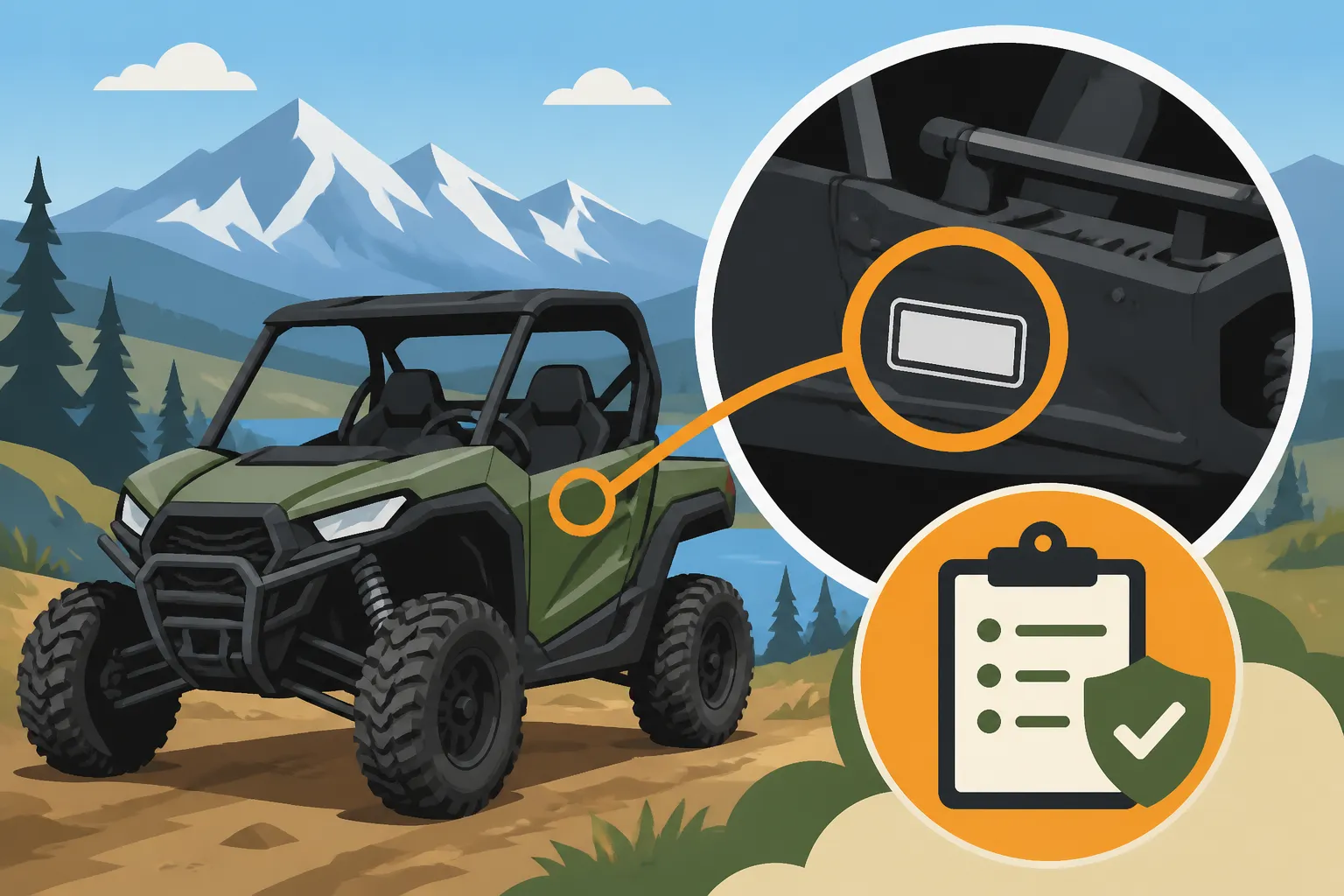
Finding the Model Year in Your UTV’s VIN
Anyone who's ever bought, sold, or even just tried to order a specific part for their beloved UTV knows the unique frustration of deciphering that seemingly random string of numbers and letters known as a Vehicle Identification Number, or VIN. It’s not just a registration formality; it’s the unique fingerprint of your machine, holding vital clues like its country of origin, manufacturer, engine type, and, crucially for many folks, its model year. This guide will walk you through exactly how to find your UTV's VIN and, more importantly, how to decode that tricky tenth character to reveal its true model year, saving you countless headaches down the road, especially here in Big Sky Country where clarity is key for everything from registration to finding the right trail maps.
What is a VIN and Why Does It Matter?
Think of your UTV's VIN as its social security number – a completely unique identifier that sets it apart from every other machine ever made. For OHVs, particularly UTVs and side-by-sides, this 17-character sequence isn't just a regulatory requirement; it's a critical piece of information that dictates everything from what parts you buy to how you insure it and even how it’s titled and registered. Without a clear, decipherable VIN, you're essentially dealing with a ghost, and that’s a situation no one wants to be in when they’re trying to enjoy Montana’s vast outdoors.
Decoding the Universal Language of Your Machine
Every letter and number in that 17-character VIN means something. It's a globally recognized standard, designed to provide a comprehensive profile of your machine at a glance. The first three characters tell you about the manufacturer and geographic region. The next five (positions 4-9) often describe the vehicle attributes, like the engine type, body style, and series. And then, there’s that all-important tenth character, which we’ll dive into deeply, followed by the specific factory and sequential production number.
For Montana UTV owners, understanding your VIN is paramount for several reasons. When you go to [Titling an ATV at a Montana County Treasurer] or [Registering an OHV in Montana], the county clerk will rely heavily on that VIN to ensure all the paperwork matches your machine precisely. Any discrepancies can lead to delays, extra hoops to jump through, or even outright rejection of your registration application. It’s also crucial for tracking ownership, especially when buying a used machine; the VIN allows you to run background checks to ensure it hasn't been reported stolen or to verify previous ownership.
Beyond the Basics: Why Model Year is Key
While the entire VIN is important, the model year often holds particular significance for UTV owners. Knowing the exact model year helps you identify specific design changes, engine updates, or even safety features that might have been introduced in a particular production cycle. This becomes incredibly important when you're ordering replacement parts; a seemingly identical part for a 2018 model might not fit a 2019 model if there were mid-cycle revisions.
Beyond parts, the model year can influence the machine's value. Newer models generally hold more value, but certain older, well-maintained models might have a niche market. Insurance companies also use the model year to assess risk and determine your premiums when you're [Insuring an ATV in Montana]. Furthermore, for parents considering a UTV for their younger riders, the model year can sometimes intersect with [Youth Machine Size Rules Montana Parents Ask About], as manufacturers might have specific recommendations or restrictions based on the machine's design and intended age range. Having the correct model year ensures you're making informed decisions across the board.
Locating Your UTV's VIN
Before you can even think about decoding your UTV's VIN, you first need to find it. Manufacturers generally place the VIN in easily accessible, yet durable, locations, but sometimes they can be a bit tricky to spot, especially after years of mud, dust, and general trail abuse. It’s worth checking a few spots before you throw in the towel, and always consult your owner's manual if you're really stumped – that little booklet is a treasure trove of specific information for your machine.
Common Hiding Spots on Your Side-by-Side
For most UTVs, the VIN is stamped directly onto the frame in a few predictable places. One of the most common spots is along the lower frame rail, often on the driver's side, near the front wheel well. You might need to squat down and wipe away some grime to see it clearly. Another frequent location is on the frame directly under the driver's seat; sometimes you have to lift the seat up or even remove a small plastic panel to expose it.
On many Polaris Ranger and RZR models, you might find the VIN stamped on the frame tube behind the left-rear tire, or in some cases, on the dashboard visible through the windshield area, much like a car. Can-Am Defender and Maverick models often have it on the frame near the front suspension or under the driver's seat as well. Honda Pioneer and Talon UTVs usually have it on the frame near the front wheel or sometimes on the left-side frame rail. Yamaha Wolverine and RMAX models commonly feature it on the frame rail on the left side, often accessible by looking under the fender. Always bring a flashlight and a rag – those dusty Montana trails can really hide things! [Where a Side-by-Side Hides Its VIN] is a great resource if you're really struggling.
When the VIN is Obscured or Missing
It's a frustrating but not uncommon scenario: you know where the VIN should be, but it's either unreadable due to rust, damage, or simply not there. Perhaps an aftermarket accessory or a custom cage was installed right over the top of it. In these cases, don't panic, but be prepared for a bit more legwork.
If the physical VIN on the machine is obscured, your first step should be to check your existing paperwork. The VIN is always printed on the machine's title (if it has one, such as a prior [Titling an OHV in Montana]), current registration certificate, and any bill of sale from a previous transaction. If you're buying a used machine and the VIN is hard to read, insist on seeing the title or a previous registration document and compare it carefully to what you can decipher on the machine itself. A discrepancy or a completely unreadable VIN should raise a red flag. In extreme cases, you might need to contact the manufacturer directly with any partial VIN you can find, or even involve law enforcement if there's suspicion of tampering, as this could indicate a [Checking a Used Quad for a Theft Report] situation. Always ensure the VIN is clearly legible and matches all documentation before finalizing a purchase.
How to Pinpoint the Model Year in Your VIN
Once you've located that 17-character VIN, the real fun begins: decoding it. While the entire sequence provides a wealth of information, pinpointing the model year is surprisingly straightforward, thanks to an international standard that virtually all manufacturers adhere to for vehicles made since 1981. This little trick is a game-changer when you're trying to figure out if that "new to you" UTV is truly a 2015 or a 2016, which can make all the difference for parts and resale value.
The 10th Character Rule
The key to unlocking your UTV's model year lies in the tenth character of its VIN. According to the ISO 3779 standard, which most modern vehicles follow, this specific position is reserved for the model year identifier. It’s a single letter or number that cycles through, representing a particular year. This system was standardized in 1981, so if your UTV was manufactured after that date (which most UTVs today would be), you can rely on this rule.
Manufacturers use a combination of letters and numbers, skipping certain ones to avoid confusion (like 'I', 'O', and 'Q' which can look like 1 or 0). The sequence generally starts with 'A' for 1980, 'B' for 1981, and so on, repeating after 'Y'. When they run out of letters, they switch to numbers (e.g., '1' for 2001, '2' for 2002). This means you just need to match the tenth character of your VIN to the corresponding year in the chart below. It's a quick and reliable way to get the primary detail you're after. Finding the Model Year in Your UTV's VIN will walk you through it.
Here’s a common chart for model year codes using the 10th character:
| 10th Character | Model Year | 10th Character | Model Year | 10th Character | Model Year |
|---|---|---|---|---|---|
| A | 1980 | L | 1990 | Y | 2000 |
| B | 1981 | M | 1991 | 1 | 2001 |
| C | 1982 | N | 1992 | 2 | 2002 |
| D | 1983 | P | 1993 | 3 | 2003 |
| E | 1984 | R | 1994 | 4 | 2004 |
| F | 1985 | S | 1995 | 5 | 2005 |
| G | 1986 | T | 1996 | 6 | 2006 |
| H | 1987 | V | 1997 | 7 | 2007 |
| J | 1988 | W | 1998 | 8 | 2008 |
| K | 1989 | X | 1999 | 9 | 2009 |
| A | 2010 | ||||
| B | 2011 | L | 2020 | V | 2029 |
| C | 2012 | M | 2021 | W | 2030 |
| D | 2013 | N | 2022 | X | 2031 |
| E | 2014 | P | 2023 | Y | 2032 |
| F | 2015 | R | 2024 | ||
| G | 2016 | S | 2025 | ||
| H | 2017 | T | 2026 | ||
| J | 2018 | V | 2027 | ||
| K | 2019 | W | 2028 |
Navigating Pre-1981 VINs and Special Cases
While most modern UTVs will follow the 10th character rule, it's worth noting that if you're dealing with a much older machine – say, something from the late 70s or very early 80s – its VIN might be shorter than 17 characters and won't conform to this standard. Pre-1981 VINs were not standardized, meaning each manufacturer had its own system. This can make decoding them a real challenge, often requiring specific knowledge of that particular manufacturer's VIN structure from that era.
For vintage machines, you'd typically have to consult original factory manuals, a manufacturer's historical department, or specialized enthusiast groups to accurately determine the model year. However, for the vast majority of UTVs and side-by-sides you'll encounter on Montana trails today, the 10th character rule will be your reliable guide. While rare, a handful of very specialized or custom-built machines might also have unique VIN formats or non-standard identifiers, but these are exceptions rather than the norm for commercially produced UTVs. If you ever encounter a VIN that doesn't seem to fit the mold, cross-referencing with documentation is always your best bet.
Verifying the Model Year and Avoiding Headaches
Simply decoding the 10th character is a fantastic start, but it's always wise to double-check and verify your findings. Trust, but verify, as they say! An incorrect model year might seem like a minor detail, but it can ripple through various aspects of UTV ownership, causing unnecessary hassle down the line. Especially when dealing with official processes like registration or legal transfers, having all your ducks in a row with accurate information is crucial for smooth sailing.
Cross-Referencing with Documentation and Online Tools
The easiest and most reliable way to confirm the model year you've decoded from the VIN is to cross-reference it with official documents. Start with the vehicle's title, if it has one. The title is a legal document that should clearly state the VIN and the model year. Next, look at the most recent registration certificate – this also includes the VIN and model year. If you've just bought the machine, check the bill of sale. A well-drafted bill of sale, perhaps created using a service like LawDepot, should explicitly list the VIN and model year, ensuring both buyer and seller agree on the machine's identity. This also protects you if there are ever any questions about [What a Montana Bill of Sale Should Say].
Beyond your personal paperwork, there are numerous online VIN decoder tools available. While these can be helpful, always use them with a grain of salt and never rely solely on them for definitive legal verification. They pull from databases, but errors can occur. Use them as a confirming step, not as your primary source of truth. Always prioritize official documents like titles and registrations. This diligent verification process can save you from complications when you go to [Montana County Treasurer OHV Registration] or try to order a specific part that only fits a particular model year.
Why an Incorrect Model Year Can Cause Trouble in Montana
Having an inaccurate model year associated with your UTV can lead to a surprising number of problems, especially when navigating the various rules and regulations here in Montana. First and foremost, registration and titling at your local county treasurer's office will hit a snag. If the model year on your application doesn't match what their records (or the manufacturer's data) show for that specific VIN, they'll likely reject your submission until the discrepancy is resolved. This can be particularly frustrating if you're trying to meet deadlines or get out on the trails.
Then there's the issue of parts and service. As we discussed, a slight difference in model year can mean a completely different set of parts. Ordering an air filter or a brake pad for a 2017 machine when yours is actually a 2018 could result in you receiving the wrong part and wasting time and money. For insurance, an incorrect model year might lead to an improper valuation of your machine, potentially affecting claims payouts if the UTV is ever damaged or stolen. Moreover, if you decide to sell the machine, any misrepresentation of the model year, even accidental, could lead to disputes with the buyer, legal issues, or questions about [Proof of Ownership for a Montana Title]. It truly pays to be precise with this information from the very beginning.
Disclaimer
This article is for general informational purposes only and does not constitute professional advice. Laws, prices and regulations vary by location and change over time. Consult a qualified professional for guidance on your specific situation.