Hauling Hay by UTV on a County Road
Out in rural Montana, life moves at a different pace, and efficiency is key to running a ranch or simply managing your homestead. Many folks with UTVs look at their trusty side-by-side and think, "This would be perfect for zipping a few bales of hay across the county road to the back pasture, or delivering feed to the horses in the far paddock." It’s a common, practical thought, but the rules around using an Off-Highway Vehicle (OHV) on public roads, even for genuine agricultural work, can feel like navigating a maze. This guide aims to clear up the confusion, helping you understand when and how you can legally use your UTV to haul hay on Montana's county roads.
The Reality of Rural Life: Why UTVs for Hay Hauling?
If you live anywhere outside of a city center in Montana, you know the daily grind involves a lot of moving things from point A to point B. Whether it's feed, tools, fencing supplies, or those pesky tumbleweeds, a vehicle is almost constantly in motion. For many, the UTV has become an indispensable workhorse, filling a niche between a full-sized pickup and a tired old quad.
The Efficiency of the Side-by-Side on the Ranch
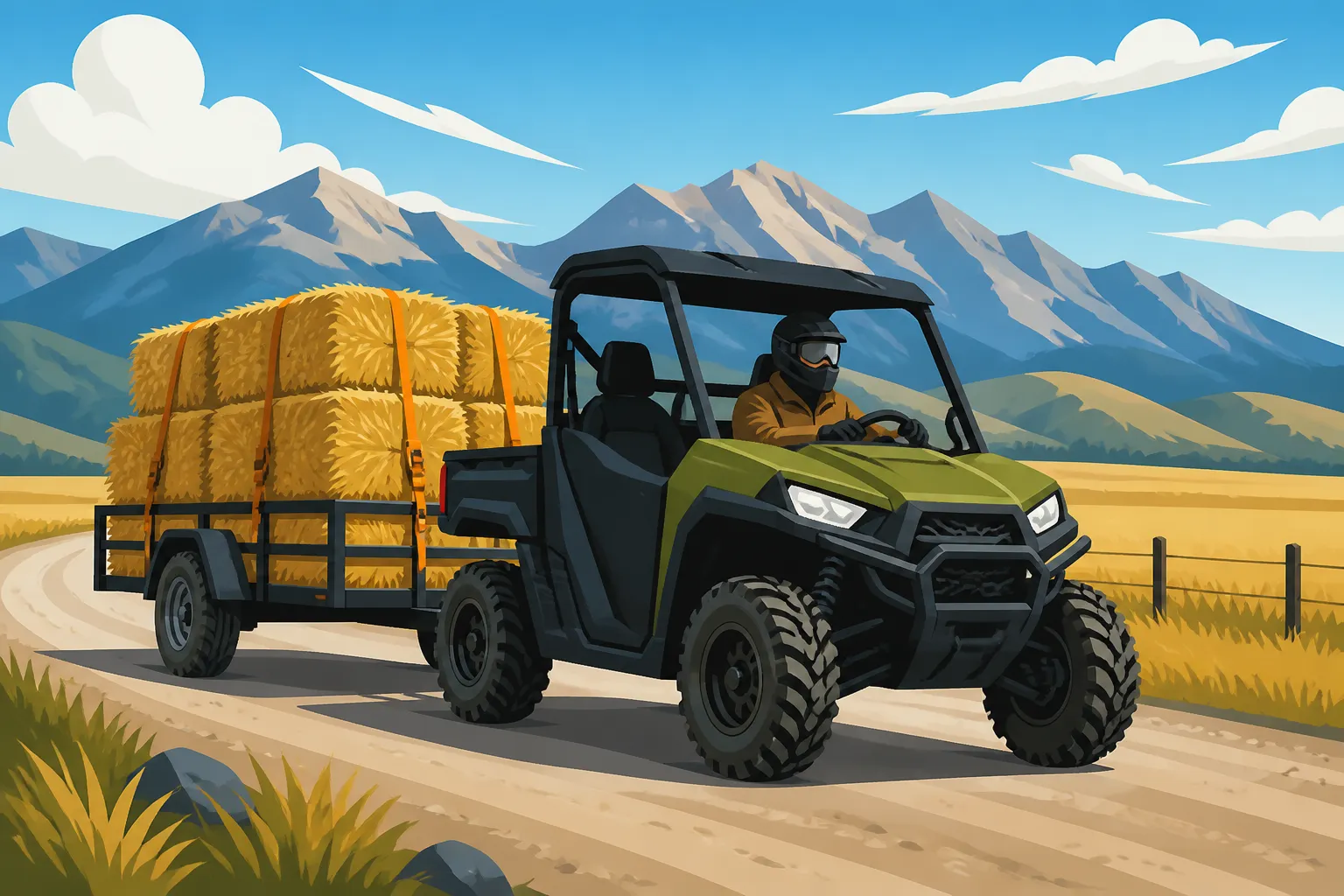
Let's be real: a UTV, particularly a work-oriented model, is incredibly versatile on a ranch. It's nimble enough to navigate muddy corrals, small enough to fit through tighter gates, and often has a generous cargo bed or the capability to tow a small trailer. When you're just moving a few square bales or a round bale feeder a short distance, firing up the big diesel pickup, hitching a full-size trailer, and maneuvering it all can feel like overkill. The UTV, with its lower fuel consumption for smaller tasks and its ease of operation, makes perfect sense for these daily chores. It’s about saving time, fuel, and wear and tear on your heavier equipment for the bigger jobs. Many a rancher has found their Polaris Ranger or Can-Am Defender to be an absolute lifesaver for those quick dashes.
When a Pickup is Overkill for a Short Haul
Imagine you're feeding calves in the back forty, and you realize you're short on hay. The bale stack is just a quarter-mile down a gravel county road. Do you really want to drag out the F-350, hook up the gooseneck, load two bales, drive 1,000 feet, unload, unhitch, and then put the truck away? For many, that's a hard no. A UTV, especially one fitted with a capable cargo bed or a small, dedicated hay trailer, offers a fantastic alternative. It’s easier to start, quicker to load, and much more agile. This is where the practical necessity often bumps up against the legal framework for operating these machines on public thoroughfares. You're just trying to get work done, not joyride, and Montana law does make some provisions for this specific use.
Navigating Montana's OHV Rules for Agricultural Use on Roads
Montana’s laws regarding OHV use on public roads can be nuanced, especially when it comes to agricultural operations. It’s not a blanket "yes" or "no," but rather a set of conditions that, if met, allow for legal road use for specific purposes like hauling hay. Understanding these rules is critical to avoid fines or safety hazards. [Montana OHV Rules for Ranch Machines] covers more detail on this, but let's break down the specifics for county roads.
Understanding "Agricultural Exemption" in Montana
Montana law does provide some leeway for agricultural implements and vehicles used exclusively for farming and ranching operations. The key here is "exclusively." An OHV being used strictly for moving hay, feed, or other farm supplies directly related to agricultural production on a county road might fall under certain exemptions or special permissions. This isn't the same as using your UTV to run to town for groceries. We're talking about direct, unavoidable use as part of a working farm or ranch.
Here's the rub: while your machine might be an "agricultural implement" in spirit, it still needs to meet certain criteria to be legally operated on a county road. For instance, the agricultural exemption typically means these machines are exempt from some of the standard registration and titling requirements that a recreational OHV would face if it were to be ridden on a public road or trail for non-agricultural purposes. However, it doesn't always exempt you from basic safety equipment or local ordinances. [Montana Agricultural Road Exemptions] dives deeper into the specific language.
Registration, Licensing, and Equipment for Road Use
Even with an agricultural exemption, there are still requirements your UTV needs to meet before it can legally carry that hay bale across a county road. It's a common misconception that if you're on a ranch, no rules apply. That's just not true, especially when you hit public pavement or gravel.
Registration: For any OHV used on public land or roads (even short stretches of county road), proper registration is generally required. While some specific agricultural implements might be exempt, a UTV often isn't unless it meets very specific criteria as an "implement of husbandry" and is being used solely for that purpose. In many cases, you'll still need to [Registering an OHV in Montana] with your county treasurer. A permanent OHV registration makes a lot of sense for a ranch machine, as it's a one-and-done process for the life of the machine in Montana.
Driver's License: Operating any motorized vehicle on a public road in Montana, even a UTV, generally requires the operator to possess a valid driver's license. This isn't just for cars and trucks; it extends to OHVs when they transition from private land to public roads. [Driver's License Rules for Montana Road Riding] is a good resource for understanding this.
Essential Equipment: This is where safety and legality intersect. If you're going to be on a county road, even briefly, your UTV needs to be equipped to a certain standard. This includes:
- Headlights and Taillights: Must be on, especially during dawn, dusk, or adverse weather.
- Brakes: Functional and effective.
- Muffler and Spark Arrester: To keep noise down and prevent wildfires. [Mufflers and Spark Arresters in Montana] goes into more detail.
- Rear-view Mirror: For situational awareness.
- Seatbelts/Restraints: For all occupants, if designed with them.
- Whip Flag: Often required in designated areas or for visibility, though less common on county roads unless part of a specific local ordinance.
You're not just driving a UTV; you're operating a vehicle on a public road, sharing it with cars, trucks, and sometimes even large agricultural machinery. Safety and visibility are paramount. Many accessories from companies like SuperATV can help you meet these requirements, from LED light bars for better visibility to mirrors and turn signal kits, making your work machine safer for those road stretches.
| Requirement | Standard OHV (Recreational) | UTV for Agricultural Use on County Road |
|---|---|---|
| Registration | Required | Usually Required (check local specifics) |
| Driver's License | Required for Road Use | Required |
| Headlights/Taillights | Required for Road Use | Required (must be on) |
| Brakes | Required | Required |
| Muffler/Spark Arrester | Required | Required |
| Rear-view Mirror | Recommended | Recommended/Required by ordinance |
| Insurance | Recommended for OHV | Liability Recommended/Required |
| Local Ordinances | Varies by County/Town | Crucial to check |
Practical Considerations for Hauling Hay Safely
Even when you've got all your legal ducks in a row, safety should always be at the forefront when you're using a UTV to haul hay on a county road. These machines, while powerful, have specific handling characteristics, and a poorly secured or overloaded load can quickly turn a simple chore into a dangerous situation.
Securing Your Load: Beyond Just a Few Bungees
Hay bales, especially round ones, are notoriously heavy and unwieldy. They can shift, roll, and even fly off a moving vehicle if not properly secured. A few flimsy bungee cords just won't cut it. You need robust ratchet straps that can handle the weight and pressure, keeping the load firmly in place against the bed or trailer. If you're stacking square bales, think about building a secure perimeter or using a cargo net in addition to straps. Overhangs should be minimal, and certainly not obstruct your view or lights.
Remember that a sudden stop, a sharp turn to avoid wildlife, or even an unexpected dip in the road can cause your load to shift dramatically. This can affect your steering, braking, and stability, potentially leading to a rollover or losing your valuable hay. For UTVs without a dedicated cargo box, many ranchers utilize small utility trailers designed for ATVs/UTVs, which can be equipped with robust sides or a cage to better contain the load. If you're regularly hauling hay, investing in quality straps and perhaps a purpose-built UTV trailer will pay dividends in safety and efficiency.
Road Conditions and Machine Limitations
Montana county roads can be a mixed bag – from perfectly graded gravel to deeply rutted, washboarded nightmares. Your UTV, especially when loaded, will handle differently on these surfaces. Speed is a major factor; a loaded UTV needs more distance to stop, and its center of gravity changes with a heavy, high load like hay. Slow down, especially on curves, hills, or rough terrain. Pay attention to dust, which can severely reduce visibility for you and oncoming traffic.
Also, be mindful of your UTV's payload and towing capacity. Just because you can squeeze another bale on doesn't mean your machine is designed to handle that weight safely, particularly when traveling on a public road at speed. Overloading strains the suspension, brakes, and drivetrain, and significantly increases your risk of an accident. Always consult your UTV's owner's manual for its specific load limits. Consider upgrades like heavier duty springs or reinforced suspension components from manufacturers like SuperATV if you frequently push the limits of your machine for work. [What Montana Requires on an OHV Road Ride] reinforces the general need for a safe operating condition.
Upgrading Your UTV for Hauling
If hauling hay on county roads is going to be a regular part of your ranch routine, it's worth considering specific upgrades to make your UTV more capable and safer for the task.
- Heavy-Duty Suspension: Stock suspension might be fine for light loads, but heavy bales will quickly sag and wear out components. Aftermarket heavy-duty springs or even full shock upgrades can significantly improve stability and lifespan.
- Larger Tires and Wheels: While not directly for carrying capacity, better tires can improve traction and stability on varied road conditions, especially if you're frequently leaving improved surfaces.
- Brake Upgrades: More stopping power is always a good idea when you're carrying extra weight. Performance brake pads or even larger rotors can make a difference.
- LED Lighting: Stock headlights and taillights might be sufficient, but adding brighter LED work lights or a light bar (used responsibly, off-road or when stationary, not blinding oncoming traffic) can drastically improve visibility for dawn/dusk operations, especially when your load might partially obstruct your standard lights.
- Mirrors and Turn Signals: While not always required for agricultural use, adding side mirrors and even a turn signal kit (many aftermarket options exist, including those from SuperATV) enhances your ability to safely share the road with other vehicles.
- Dedicated Trailers: For consistent heavy hauling, a small, purpose-built UTV trailer with its own lights and proper hitch attachment is often the best solution. This keeps the weight off your UTV's suspension and provides more cargo space.
These upgrades aren't just about making the job easier; they're about ensuring you, your machine, and your load are as safe as possible when you briefly venture onto public roads.
Local Ordinances and County Commissioner Decisions
One of the most crucial, yet often overlooked, aspects of using a UTV on a county road for any purpose is the role of local government. Montana gives a good degree of autonomy to its counties and towns regarding OHV access on local roads. This means that while state law might set a general framework, your specific county or even a particular town you pass through can have additional rules, or even outright prohibitions.
The Importance of Checking With Your County
Just because a state statute generally allows for agricultural exemptions or certain types of road access doesn't mean every single county commissioner has signed off on it for their county roads. Many counties in Montana have specific ordinances that dictate if, when, and how OHVs can operate on their paved or gravel routes. [County Roads and the Montana Commissioners' Say] directly addresses this authority.
Before you make that first hay run on a county road, pick up the phone and call your local County Clerk and Recorder's office, or check your county's website. They can usually direct you to the relevant department or provide information on local OHV ordinances. This is especially true if you plan to use a road regularly. What's perfectly fine in Gallatin County might be an issue in Flathead County, or vice-versa. You might find that for a specific road, you need a different type of permit, or that certain times of day are restricted. Don't rely on hearsay from a neighbor; get the official word.
When a Town Road is Part of the Route
Sometimes, that short haul between pastures might require you to briefly pass through the edge of a small town or even a populated rural area that has its own municipal roads. This adds another layer of complexity. Even if the county road leading up to the town allows OHVs for agricultural use, the town itself might have a blanket ban on OHVs on its streets.
Small Montana towns often have very specific municipal ordinances regarding vehicle types allowed on their roads. These are usually designed for noise control, safety, and general peace and quiet. If your route involves even a hundred feet of town street, you must verify their local rules. Don't assume that because it's "just a small town" or "only a block," the rules won't apply. Many communities have specific rules for [Montana City Streets and Municipal Ordinances]. An OHV ticket for illegal road use, especially an unregistered machine, can carry significant [Fines for an Unregistered OHV in Montana] or other penalties, which is the last thing you need when you're just trying to feed your livestock.
It’s always better to be proactive than to face a fine or, worse, an accident due to not understanding the local regulations. Your UTV is a valuable tool for ranch work, and with a little homework and preparation, you can ensure you're using it legally and safely when those county roads call.
Disclaimer
This article is for general informational purposes only and does not constitute professional advice. Laws, prices and regulations vary by location and change over time. Consult a qualified professional for guidance on your specific situation.