Mechanics Near Montana Trailheads
A breakdown near a Montana trailhead can turn a planned ride into a long wait, especially when the nearest town is far away and cell service is patchy. The key is to identify repair options before you unload, know what local shops can actually work on, and carry enough tools and recovery gear to handle small problems on the trail.
How to find an ATV or UTV mechanic near a Montana trailhead
Start with the nearest service town, not just the trailhead
Montana trail systems can sit a considerable distance from a full-service repair shop. A route near Bozeman, Missoula, Kalispell, Red Lodge, or West Yellowstone may have a town within reach, but that does not mean a mechanic is nearby, open, or equipped to work on your particular machine. Even shops that handle powersports may focus on certain brands or types of repair.
Before your trip, identify the closest towns along your route and look for powersports dealers, independent ATV and UTV repair shops, and mobile mechanics. Then call rather than relying only on a map listing. Ask whether they service your make and model, whether they accept repairs from travelers, and whether they can handle the problem you are worried about. A shop may do routine maintenance but not have the equipment or parts for a damaged axle, electrical fault, or belt failure.
If you are riding near the Flathead National Forest, for example, think about how you would get a disabled machine from the trail system to a road-accessible pickup point, then from there to a shop. The same planning matters around the Custer Gallatin, Lolo, and Beaverhead-Deerlodge national forests. The trailhead is a useful reference, but your practical repair plan often depends on the nearest town, road access, and recovery arrangements. For broader trip planning, start with [Montana's National Forest Trail Systems] and [Montana Trailhead Parking and Staging].
Call ahead with the information a shop needs
A mechanic can give you a more useful answer if you have the machine details ready. Write down the make, model, year, engine size, and VIN before you call. If your ATV or UTV has aftermarket parts, mention modifications that could affect repairs, such as a lift kit, nonstandard tires, a winch, or added lighting. A photo of the damaged area can help explain the issue, but do not assume a shop can diagnose a problem remotely.
Describe what the machine is doing rather than guessing at the cause. “The engine turns over but will not start” gives a mechanic more to work with than “the fuel pump is bad,” unless you have confirmed that diagnosis. Mention any warning lights, new noises, fluid leaks, overheating, recent impacts, or changes in handling. If the machine is unsafe to operate, say so clearly.
Ask practical questions before you depend on a shop:
- Do you work on this make and model?
- Can you take in an out-of-town rider’s machine?
- Do you offer pickup, roadside assistance, or recovery?
- Can you inspect the machine before deciding on a repair?
- What information or parts should I bring?
- Do you need an appointment, and how should I arrange one?
- Where should a trailer or recovery vehicle meet you?
Availability, staffing, and parts supply can change, so make a fresh call before leaving for a trip. If the shop cannot help, ask whether it can recommend another local service provider or a towing company familiar with off-road machines.
Match the repair plan to the problem
Decide what is safe to handle on the trail
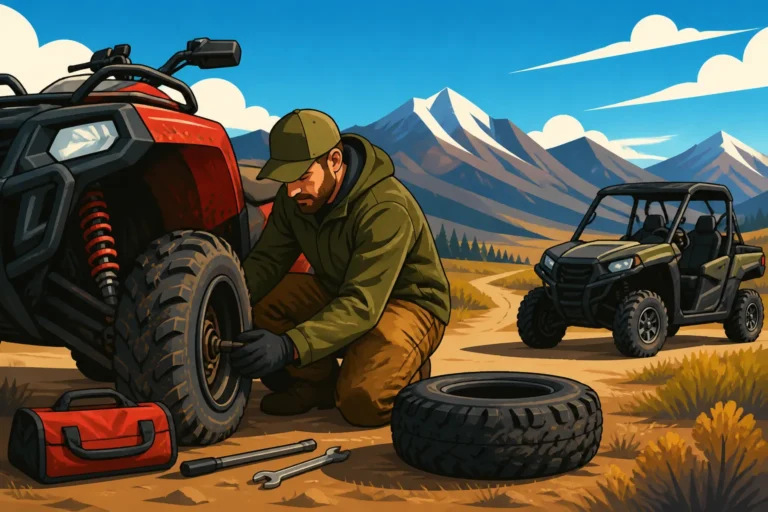
Some problems are manageable with basic tools and a little experience. A loose battery connection, a blown fuse, a minor tire puncture, or a loose fastener may be fixable if you can work safely and have the right supplies. Other issues, including a serious fuel leak, damaged steering or suspension, a seized component, or a machine that repeatedly overheats, are reasons to stop riding and arrange recovery.
A tempting “just ride it slowly back” decision can make a small repair much more expensive. A damaged tire can come off the rim. A loose wheel or steering part can become dangerous on rough terrain. Continuing to run an overheating engine may cause damage that a mechanic cannot fix with a simple trail-side adjustment. If you are unsure, shut the machine down, move riders to a safe location, and call for advice when you have service.
It helps to separate a trail-side fix from a shop repair before your trip. Make a short list of what you can realistically do yourself, based on your skills and the tools you will carry. For example, a rider who has never changed a belt should not count on doing it alone on a steep, exposed trail. Review [Fixing a Flat 60 Miles From the Nearest Shop] and [What to Carry on a Remote Montana Ride] to build a kit that fits your machine and experience.
Plan for towing and recovery before you need it
A disabled UTV may be too heavy or awkward to move by hand, while an ATV can be difficult to tow safely over uneven ground. Before riding, decide who in your group can help, what recovery equipment you have, and how you will reach a road or staging area. Do not assume that a passing rider will have a suitable tow strap, a compatible vehicle, or the time to assist.
A recovery plan should account for the actual terrain. A narrow shelf road, steep grade, stream crossing, or muddy section can make a simple tow risky. Use rated recovery points and equipment intended for the load. Avoid attaching a strap to steering, suspension, or other parts not designed for pulling. Keep people clear of a tensioned line, and do not attempt a recovery that exceeds your equipment or skill. When the machine cannot be moved safely, wait for qualified help rather than risking an injury or damaging the trail.
| Problem | Possible trail response | When to seek shop or recovery help |
|---|---|---|
| Minor puncture | Use a plug or repair method suitable for the tire, if you know how and the damage is repairable | The tire will not hold air, the sidewall is damaged, or the wheel is bent |
| Loose connection or blown fuse | Check the battery connections and replace a fuse only with the correct rating | The electrical fault returns, wiring is hot or damaged, or the machine will not restart |
| Belt or drivetrain trouble | Stop and inspect only if you can do so safely and understand the system | The belt is shredded, components are damaged, or you lack the tools and experience |
| Overheating | Stop, shut down, and allow the machine to cool; do not open a hot cooling system | The warning returns, coolant is leaking, or the engine runs poorly |
| Steering or suspension damage | Stop riding and keep the machine stable | A component is bent, loose, cracked, or affecting control |
| Fuel or oil leak | Shut the engine off and keep flames and ignition sources away | The leak continues or the source is not clear |
For more detailed planning, see [Recovery Gear for a Montana Shelf Road] and [Towing Off a Remote Montana Trail]. A towing service may need the machine’s location, the best access point, and a description of road conditions. Save trailhead names and route details offline so you are not trying to reconstruct them while stressed.
Prepare before you leave town
Check access, weather, and communication
A route that looks close to a town on a map may take much longer to reach than expected. Forest roads can be rough, seasonal closures may change access, and a trailhead may not be accessible to every recovery vehicle. Confirm the route and trail status before loading up. Bring a paper map or download maps for offline use, and mark your staging area, planned route, and likely exit points.
onX Offroad can help riders review mapped routes and keep useful location information available when cellular service is unreliable. Download the relevant maps before leaving coverage, learn how to use the app while you still have service, and carry a backup navigation option. A phone is not a complete rescue plan: cold, impact damage, a depleted battery, or a dead zone can leave you without a working connection. Review [Cell Service in the Montana Backcountry] and [Checking Montana Trail Status Before You Drive] before choosing a route.
Tell someone who is not riding with you where you are going and when you expect to return. Give them the trailhead or staging-area name, your planned route, vehicle details, and a time to check in. If plans change, update them when you have service. On longer or more remote rides, consider a satellite messenger or another communication device suited to backcountry use, and make sure everyone knows how to operate it.
Carry machine-specific supplies and keep repair details handy
A useful repair kit is not simply a collection of tools. It should match your ATV or UTV, the terrain, and the repairs you are capable of making. Check the owner’s manual for required tools and basic maintenance guidance. Depending on the machine, your kit may include a tire repair kit, compact air source, correct fuses, basic hand tools, gloves, zip ties, electrical tape, and spare fasteners. Carry fluids or replacement parts only when they are appropriate for your machine and can be transported safely.
Inspect the machine before the trip, not at the trailhead after something has gone wrong. Check tire condition and pressure, wheel nuts, brakes, steering, lights, battery connections, fluid levels, and visible leaks. Look for damaged belts, worn hoses, cracked plastics, and loose accessories. If the machine is due for service, take care of that at home or in town rather than assuming a remote shop can fit you in.
Keep a small note with your machine information, insurance details, emergency contacts, and the phone numbers of the shops and towing services you called. Store it both on your phone and in a place that remains accessible if your phone fails. If your route includes a long stretch between fuel or service options, plan for that distance with [Fuel Planning for a Montana Trail Day]. For people bringing a machine from out of state, also review [Montana Rules for Visiting Riders] so trail preparation includes the relevant permit requirements.
What to do when a breakdown happens
Make the scene safe before troubleshooting
First, get riders out of the travel path and away from blind corners, steep edges, and moving traffic. If you can move the machine a short distance to a safer location without worsening the damage, do so cautiously. Turn off the engine, remove the key, and avoid touching hot parts or opening a hot radiator cap. If there is fuel leaking, move people away and keep ignition sources clear.
Take stock of the situation before attempting a repair. Is anyone injured? Is the machine stable? Can you see the problem? Do you have enough daylight, tools, and experience to address it? If the answer to any of those questions is no, prioritize contacting help and conserving battery power. If service is available, share your location using a trail name, route marker, GPS coordinates, or a saved map pin. “Somewhere past the creek” is much harder for a recovery driver to use than a clear access point and a coordinate.
Do not split up the group to search for help unless the terrain, communication plan, and safety situation make that the best option. In many cases, staying together is safer. If you do need to send someone for assistance, leave a clear message about who is going, the direction they are traveling, and where the remaining riders will wait.
Give the mechanic a clear account of what happened
When you reach a mechanic, explain the sequence of events. Note when the issue began, what the machine was doing immediately beforehand, and whether it changed after stopping or cooling down. Share any warning indicators, noises, smells, leaks, impacts, or recent repairs. If you attempted a trail repair, tell the shop exactly what you changed or disconnected.
Be candid about how the machine was used and how it was recovered. A hard landing, water crossing, rollover, or long tow can affect diagnosis. Leaving out those details may send the mechanic in the wrong direction or lead to unnecessary work. Ask what the shop can inspect first, what information it needs before authorizing additional work, and whether the machine should remain parked until the repair is complete.
If the machine is not safe to ride, arrange transportation instead of treating a temporary improvement as proof that the problem is fixed. A successful restart does not necessarily mean the underlying fault is gone. Before returning to the trail, confirm that the repair addresses the cause, check that essential systems work, and consider a short test in a safe, accessible area. For another look at remote breakdown planning, [Montana Trailhead Parking and Staging] can help you think through where a disabled machine can be loaded and how your group can regroup.
Disclaimer
This article is for general informational purposes only and does not constitute professional advice. Laws, prices and regulations vary by location and change over time. Consult a qualified professional for guidance on your specific situation.