Montana OHV Rules for Ranch Machines
You're out there, day in and day out, working your Montana ranch, and your ATV or UTV is often your most trusted partner. Whether you're mending fences, moving cattle, or checking irrigation lines, these machines are indispensable. But sometimes, the line between "work machine" and "recreational vehicle" gets blurry, especially when it comes to understanding Montana's off-highway vehicle (OHV) rules. This comprehensive guide aims to clear up that confusion, offering practical, realistic insights into how Montana law applies to your ranch machines.
Understanding Montana's OHV Registration Basics for Ranch Use
When you think about registering an ATV or UTV in Montana, most people immediately picture trail riding or recreational use. However, the rules around registration and titling can feel like a tangled mess, especially when your machine is primarily a tool for your livelihood. The core idea is simple: if you're using your OHV on public lands or public roads, it generally needs to be registered. But what exactly counts as "public" when your ranch often borders or crosses these areas?
Distinguishing Between Private and Public Land Use
The first and most critical distinction for any rancher is whether your OHV exclusively stays on private, deeded land. If your quad or side-by-side never leaves your property, or property that you have explicit permission to operate on, you typically don't need to worry about state registration. This is because Montana's OHV laws are primarily designed to regulate use on public roads and public lands, like those managed by the Forest Service or Bureau of Land Management (BLM). The state doesn't generally dictate how you use your equipment on your own acreage.
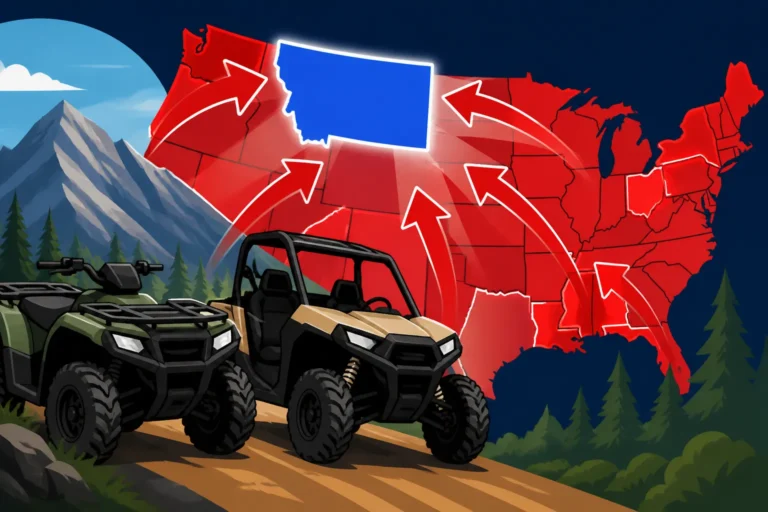
However, life on a ranch isn't always neat and tidy. Many ranches are vast, with sections sometimes bisected by county roads, or they might lease state or federal grazing lands. This is where the simple "private land" rule starts to get complicated. If your machine even briefly touches a public thoroughfare to get from one pasture to another, or if you use it on those leased public lands, the calculus changes significantly. It's not about the intent of your use (work vs. play), but the location of your use that often triggers registration requirements. You might think, "It's just a quick hop across the road," but to a game warden or sheriff's deputy, that's public road use. This nuance is precisely what can trip up even the most experienced rancher. You can learn more about general registration requirements in our guide, [Registering an OHV in Montana].
The Role of Permanent Registration for OHVs
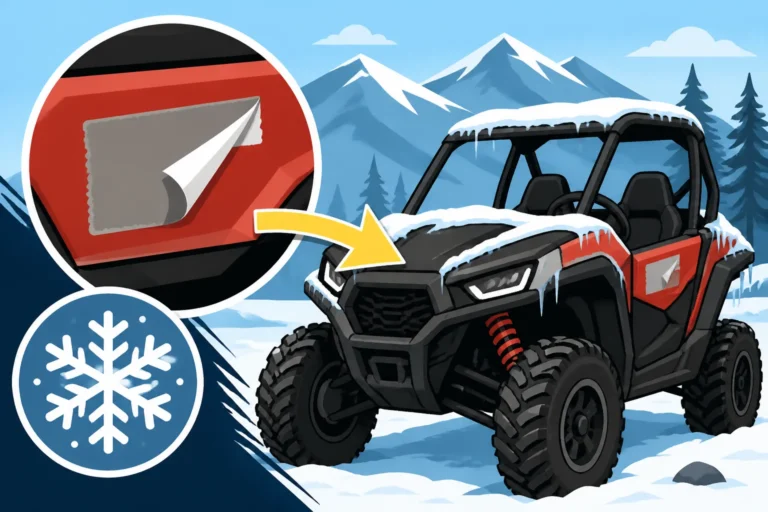
Montana offers what's known as "one-time permanent OHV registration." This sounds pretty good, right? Register it once, and you're done. For a work machine, this can be incredibly convenient, as it eliminates the annual renewal hassle. When you register your machine, you'll pay a fee, and in return, you receive a registration decal that signifies your compliance with the state's OHV laws. This decal needs to be displayed prominently on the rear of the machine.
What does "permanent" actually buy you? It means the registration follows the machine as long as it's owned by you. If you sell the machine, the permanent registration does not transfer to the new owner; they'll need to register it themselves. The benefit for a rancher is peace of mind: if your machine needs to cross a county road occasionally or operate on public grazing allotments, that permanent registration covers you without annual renewals. It's a key difference from standard vehicle registration that requires yearly sticker updates. Our article [Montana's One-Time Permanent OHV Registration] delves deeper into what this means.
Specific Exemptions and Their Nuances for Agricultural Operations
Montana's OHV laws do acknowledge the practical realities of agricultural work, but these exemptions often come with specific conditions that can be easy to misinterpret. It's not a blanket pass for all ranch machines, so understanding the specifics is crucial to avoid unwanted penalties.
Farm and Ranch Exemptions Defined
The Montana code does provide some wiggle room for OHVs used exclusively for agricultural purposes. Generally, if your ATV or UTV is solely employed for duties related to farming or ranching on private land, it may not need to be registered. This exemption is designed for machines that are essentially tools, confined to the working landscape of the ranch. Think about feeding livestock, spraying weeds, moving equipment, or performing maintenance tasks on your own property.
However, the "exclusively" part is the sticky wicket. What if you occasionally let your kid take the side-by-side out for a spin after the chores are done? Or you use it to access a prime hunting spot on your own land during elk season? While these activities might still be on your private land, they introduce a recreational element that can complicate the interpretation of the exemption. The key question law enforcement will ask is about the primary and exclusive use. If there's any recreational use, even on private land, or if it touches public land/roads, the exemption likely vanishes. [Farm and Ranch Exemptions in Montana] provides more detail on this often misunderstood area.
When an "Exempt" Machine Needs Registration
Despite the exemptions, there are common scenarios where a ranch machine will absolutely need to be registered. As discussed, the moment that machine leaves your deeded property and ventures onto public roads or public lands – even for what you consider a work-related task – it typically falls under the registration requirement. This includes:
- Crossing a County Road: Even if it's just to access another field across the asphalt, it's public road use.
- Operating on Leased Public Grazing Land: Federal or state lands, even if you have a permit to graze, are public and generally require registered OHVs.
- Hauling Hay or Supplies on a Public Road: If you're moving feed or equipment between different sections of your ranch, and any part of that route is on a public road, your machine needs to be registered and equipped for road use.
- Using the Machine for Hunting/Fishing Access: Even if you're primarily a rancher, using your OHV to get to your favorite fishing hole on public land or a hunting blind on a state lease takes it beyond "exclusive agricultural use."
The general rule of thumb is: if there's any doubt, register it. The cost of a [Montana OHV Registration Cost at the Treasurer] is usually minimal compared to the fines for operating an unregistered vehicle.
Clarifying Ownership and Purpose with Documentation
Keeping your paperwork in order is paramount, especially when you're relying on agricultural exemptions or explaining the nature of your machine's use. A bill of sale or other proof of ownership is always important, but for a ranch machine, sometimes you need more. If you're operating on leased land, having copies of your grazing permits or lease agreements handy can help clarify the purpose of your presence.
For machines primarily used by employees or family members, an internal use agreement can be helpful, outlining the machine's intended agricultural purpose and any restrictions on its use. This type of documentation can serve as valuable evidence of the machine's primary role should questions arise. Resources like LawDepot can provide templates for various legal documents, including bills of sale or general use agreements, which you can then customize to fit the specific needs of your ranch operations. Having clear, concise documentation proves your intent and adherence to the spirit of the law, even if the letter is sometimes ambiguous.
Navigating Road Use: When Your Ranch Machine Leaves Private Land
This is arguably the trickiest part for many Montana ranchers. Your OHV might be perfectly legal for ranch work on your property, but the instant it rolls onto a public road, you enter a whole new set of rules. Understanding these regulations is key to avoiding tickets and ensuring safety.
Requirements for Road-Legal OHV Operation
Montana does permit OHVs on certain public roads, primarily county roads, but only if they meet specific equipment requirements. This isn't just about having a registration decal; it's about making your machine functionally similar to a low-speed vehicle or motorcycle for safety and visibility. If you plan to use your ranch machine on any public road, even for a short distance, it must be equipped with:
- Headlights and Taillights: These must be functional and on at all times, day or night, when operating on a road.
- Brakes: A working brake system is non-negotiable.
- Mirrors: At least one rear-view mirror is required, typically on the left side, allowing you to see traffic approaching from behind.
- Muffler and Spark Arrester: To control noise and prevent wildfires, standard equipment that is usually already on your machine.
- Safety Flag (Whip Flag): While not universally required on all roads, it's a good practice, especially in areas with limited visibility or heavy truck traffic.
- Operator License: The driver must possess a valid driver's license. [Do You Need a Driver's License to Ride a Montana Road?] elaborates on this.
It's a lot more than just having a "farm plate" – which Montana doesn't actually have for OHVs in the way some states do for tractors. The state treats registered OHVs on roads with similar expectations to other vehicles regarding safety equipment. Always ensure your machine is up to snuff before you venture off the dirt of your fields.
Understanding County Road Designations
The ability to ride your OHV on a public road in Montana often depends on the specific designation of that road and the local ordinances. Generally, county commissioners have the authority to open or close county roads to OHV use. This means that while some county roads might be open, others might not, even in the same county. It's not a uniform rule across the state.
Many rural county roads are open by default, particularly those with less traffic or that primarily serve agricultural communities. However, towns and cities have their own municipal ordinances, and they frequently restrict or prohibit OHV use on city streets, even if the county roads leading into town are open. This creates a patchwork of rules. Before you ride your ranch machine down a county road to grab supplies or fuel, it's wise to check with the local county sheriff's office or the county commissioners' office to confirm the status of that particular road. Don't assume. Ignorance of the local ordinance is not an excuse for a violation. Our article [Riding an OHV on the Road in Montana] offers a broader look at road access.
Age and Supervision for Young Ranch Hands
Montana has specific rules for young riders, and these apply even if they're helping out on the ranch. For OHV operation on public roads, the driver must be at least 12 years old and must possess a valid driver's license (or a safety certificate if under 16). For riders under 16, adult supervision is often required, even on private land, if the machine is operating in a way that could pose a risk to the rider or others.
On private property, strict supervision is always recommended for young operators, regardless of state law. While the state might not regulate every aspect of ranch work, ensuring the safety of your family and employees is paramount. If you have young ranch hands assisting with tasks that require OHV use, make sure they understand the machine's capabilities and limitations, and that they are appropriately supervised. If they're under 16 and driving a machine on a public road for any reason, even a brief crossing, they absolutely need to meet the [Montana Road Rules for Young Riders] for licensing or certification and equipment requirements.
Paperwork and Proof: Documenting Your Ranch Machine's Purpose
Keeping clear and accurate records for your ranch machines isn't just good business practice; it can be crucial for proving their primary use and ensuring you're compliant with Montana's OHV regulations. This is especially true if you ever need to explain why a machine might be considered exempt or why it's configured for specific road use.
Essential Documentation for Ownership and Use
When you acquire an OHV, whether new or used, the foundational piece of paperwork is the proof of ownership. This typically comes in the form of a certificate of origin from the manufacturer (for new machines) or a properly executed bill of sale (for used machines). Even if you're not registering the machine because it stays on private land, keeping these documents is vital. They prove the machine belongs to you and can be essential if it's ever stolen or involved in an accident. A well-written bill of sale should include the VIN, make, model, year, sale price, and the full names and signatures of both buyer and seller. [What a Montana Bill of Sale Should Say] covers the specifics.
For machines used on the ranch, consider also keeping:
- Purchase Records: Receipts for specialized agricultural attachments or modifications that underscore its work utility.
- Lease Agreements: If you operate on leased land (state, federal, or private), have copies of these agreements readily available.
- Internal Use Policy: For larger operations, a simple internal document outlining how specific OHVs are designated for ranch work, who is authorized to operate them, and any safety protocols. Again, services like LawDepot can offer customizable templates for such internal agreements.
This robust documentation helps to establish a clear paper trail of your machine's primary purpose, which can be invaluable in case of an inquiry from law enforcement.
Titling an OHV for Ranch Purposes
Titling an OHV is distinct from registering it, though often done at the same place – your county treasurer's office. A title is the legal document proving ownership. In Montana, most OHVs need a title, especially if they are going to be registered. Even if your machine is strictly for private ranch use and not registered, having a title provides definitive proof of ownership and is necessary if you ever want to sell, finance, or transfer the machine. [Titling an OHV in Montana] explains this process in detail.
The information on your title doesn't usually specify "ranch use," but it's important to ensure the VIN and other details are accurate. When you bring your documents to the county treasurer, make sure you have all the necessary information. This typically includes the manufacturer's certificate of origin (MCO) or a properly assigned title from the previous owner, and a bill of sale. Sometimes, if you're titling a very old machine or one that never had a title, the process can be more complex and might involve a bonded title. Regardless of its intended use, a clear title simplifies future transactions and protects your investment. Our guide on [Documents to Bring to a County Treasurer] can help you prepare for your visit.
Registering an OHV Under a Business or LLC
For many Montana ranches, the operation is structured as a business or an LLC. You can absolutely register an OHV under a business entity in Montana. This is quite common and can make sense for accounting, insurance, and legal purposes. The process is very similar to registering it in an individual's name, but you'll use the business name and information.
When registering under a business, you'll need to provide the business's legal name, address, and often an Employer Identification Number (EIN) or other business identification. The certificate of origin or title will also need to reflect the business name as the owner. This helps establish that the OHV is indeed an asset of the ranching operation, not merely a personal recreational vehicle. Many larger ranches and agricultural corporations find this essential for managing their fleet of work machines. For more information, you can check out [Registering an OHV Under a Montana Business].
Avoiding Pitfalls: Common Misconceptions and Penalties
Operating a ranch in Montana is demanding enough without having to worry about accidental run-ins with OHV regulations. Many ranchers operate under assumptions that, while well-intentioned, can lead to fines or other legal issues. Let's clarify some common misconceptions and outline the consequences of non-compliance.
Common Misconceptions About Ranch Machine Rules
It's easy to fall into traps when navigating OHV regulations, especially when your primary focus is running a busy ranch. Here are some of the most common misunderstandings:
- "It's just for work, so it's exempt everywhere." This is perhaps the biggest misconception. As we've discussed, the moment your machine touches public land or a public road, even for work, the exemption for private, exclusive agricultural use often no longer applies. The purpose of the trip matters less than the jurisdiction you're in.
- "A county road is basically private property out here." While traffic might be sparse, a county road is a public right-of-way. It's not part of your deeded land, and all public road rules apply, including OHV registration and equipment requirements.
- "It's only a short distance, no one will notice." This is a gamble. A game warden or sheriff's deputy could be anywhere, and they are trained to enforce these regulations. That "short distance" can quickly become a costly citation.
- "My old machine doesn't need a title because it's so old." In Montana, most OHVs, regardless of age, need a title for registration or transfer of ownership. Even if you're not registering it, a title protects you. Our article on [Titling a Machine Older Than the Records] goes into this.
The best approach is to operate under the assumption that if your machine is visible to the public or on public land, it needs to be fully compliant, regardless of its primary role on your ranch.
Penalties for Unregistered or Non-Compliant OHVs
The consequences for operating an unregistered or non-compliant OHV in Montana can range from monetary fines to more serious penalties, especially if other violations (like unsafe operation or driving under the influence) are involved. A basic citation for an unregistered OHV can certainly sting, but repeat offenses or compounding violations can escalate quickly.
Here's a look at potential penalties:
- Fines: The most common penalty is a monetary fine for operating an unregistered OHV or one that lacks required safety equipment for road use. These fines can vary depending on the county and the specific nature of the violation.
- Impoundment: In some cases, especially for severe or repeated violations, your OHV could be impounded, leading to additional towing and storage fees on top of any fines.
- Loss of Privileges: Serious violations could lead to a temporary suspension of OHV riding privileges.
- Legal Trouble: If an unregistered OHV is involved in an accident where there are injuries or property damage, the legal ramifications can be significantly more complex and costly. Your insurance might even deny coverage if the machine was being operated illegally. You can read more about this in [Penalties for an Unregistered OHV in Montana].
It's far better to invest the time and minimal fees into proper registration and equipping your machine than to face these avoidable headaches and costs.
Getting Your Paperwork in Order Before a Problem Arises
Don't wait until you're pulled over or involved in an incident to sort out your OHV paperwork. A proactive approach is always the best defense. Take an afternoon to gather all your machine's documents – titles, bills of sale, registration papers, and even any internal use agreements.
If you find that you're missing a title for an older machine, or if you're unsure about the correct way to register an OHV that you plan to use on public roads or lands, reach out to your local county treasurer's office. They are the best resource for specific guidance on your situation. Remember, services like LawDepot can be a quick and easy way to create professional bills of sale or proof of ownership documents if you're buying a used machine or need to formalize private sales within the family or business. Having a clear record of ownership and intent goes a long way in demonstrating compliance and avoiding unnecessary legal complications.
Here's a quick reference table to help clarify the registration and equipment needs for various ranch machine scenarios:
| Scenario | Registration Needed? | Decal Needed? | Road-Legal Equipment? | Driver's License Needed? | Common Use Case |
|---|---|---|---|---|---|
| Strictly Private Ranch Land | No | No | No | No | Feeding livestock, spraying fields on own property |
| Crossing County Road (briefly) | Yes | Yes | Yes | Yes | Accessing another pasture across a county road |
| Public Grazing Allotment | Yes | Yes | No (unless on road) | Yes | Moving cattle on Forest Service or BLM land |
| Town/City Streets | Yes | Yes | Yes | Yes | Riding into town for supplies (if ordinance allows) |
| Mixed Use (Work & Recreation) | Yes | Yes | Yes (if on road) | Yes | Work during week, trail riding on public land weekends |
| Farm-to-Market Road (Extended) | Yes | Yes | Yes | Yes | Hauling fencing supplies down a county highway |
Note: "Road-Legal Equipment" generally includes headlights, taillights, brake lights, mirrors, and a muffler/spark arrester.
Disclaimer
This article is for general informational purposes only and does not constitute professional advice. Laws, prices and regulations vary by location and change over time. Consult a qualified professional for guidance on your specific situation.