Packing Out an Elk by OHV
Packing out an elk by OHV can save a long carry, but the machine does not give you permission to ride wherever the animal falls. In Montana, the key is to plan around designated routes, land-manager rules, and a load your machine can carry safely. Here’s how to check access and prepare for the trip without turning a successful hunt into an avoidable violation or breakdown.
Start with the land rule, not the shortest route
An elk can be down a short distance from a road and still be out of reach by OHV. In Montana, big game retrieval on public land is governed by federal and state land managers, and cross-country travel is prohibited on most public lands. On Bureau of Land Management and U.S. Forest Service land, hunters generally must stay on designated routes and may not drive off-trail to retrieve game unless the local travel plan specifically authorizes it.
That distinction matters: permission to ride a route does not automatically mean you can leave it to reach the animal. Nor does seeing tire tracks mean a route is open to motorized use. If the elk is beyond a legal route, you may need to carry the meat to the machine rather than ride the machine to the elk.
Before hunting, identify the land manager and check the applicable travel plan, map, and current access information. Look for the routes open to the kind of machine you have, any seasonal restrictions, and language specifically addressing game retrieval or off-route travel. If the wording is unclear, ask the responsible land office before the hunt rather than relying on a guess in the field. Montana Permit Rules on Public Land and Montana Rules During Hunting Season offer related context, but local land rules still control access to a particular area.
| Situation | Practical decision |
|---|---|
| The animal is beside a route open to your machine | Confirm the route is currently open and follow its restrictions. |
| The animal is off-route on public land | Do not assume you can ride to it. Check whether the local travel plan specifically allows retrieval; otherwise, plan to carry the meat to a legal route. |
| The route crosses private land | Get permission from the landowner before using it. A route’s appearance on a map does not establish access permission. |
| You cannot establish whether access is allowed | Leave the machine where it is legal to ride and contact the land manager for clarification. |
Private land needs its own check. Permission to hunt does not necessarily include permission to drive an OHV across the property or retrieve an animal by vehicle. Ask the landowner or lease manager where you may ride, where to stage, and whether any gates or access conditions apply. Riding a Friend’s Ranch by Permission explains why it helps to settle that question before heading out.
Prepare the machine and route before the hunt
A retrieval plan works best when it is made before you are tired, the light is fading, or meat is already on the ground. Start by checking that the planned route is legally open to your machine. Consider the terrain and surface, too: a route that looks manageable on a map may include steep ground, loose rocks, mud, water, or a narrow turn that is difficult with a loaded vehicle. If conditions change, be ready to stop and reassess instead of forcing the trip.
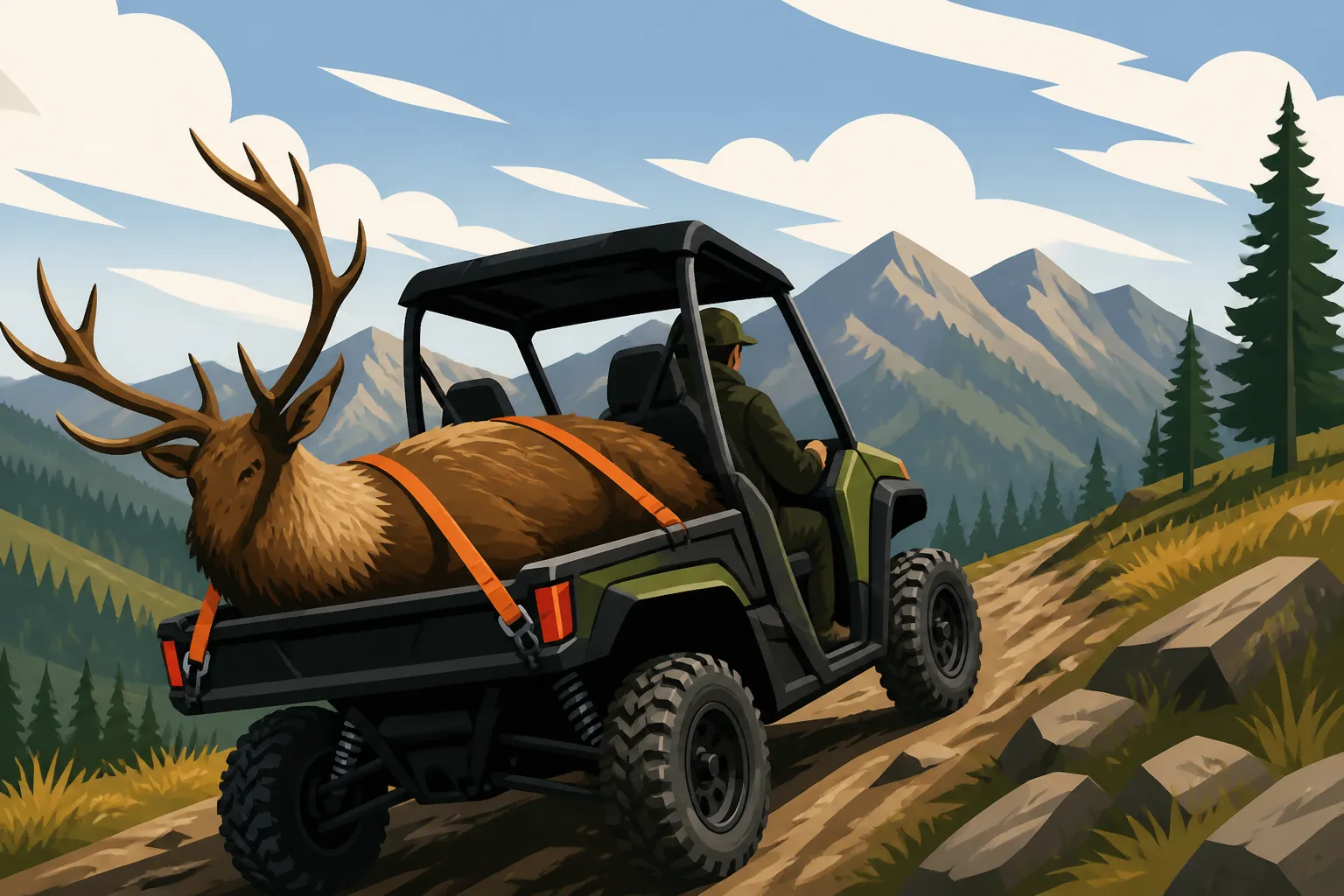
Check the machine’s owner’s manual for cargo limits and approved loading points. Do not assume that a rear rack, cargo box, or aftermarket attachment can carry any load that physically fits. A load that shifts, blocks controls, or changes handling can make a difficult route more dangerous. Secure the meat so it cannot slide, swing into moving parts, or interfere with the operator. Keep it clear of hot components and protect it from dirt and contact with the ground.
Make sure the OHV is set up for the kind of riding you intend to do. Montana Fish, Wildlife & Parks says a permanent registration decal must be displayed in a conspicuous location when an OHV is ridden off-highway on public land or trails. That decal is not a substitute for confirming that a route is open or that your machine has any required permit. Review What Montana Riders Need Before They Ride and Montana’s Non-Resident Temporary Use Permit if you need to check which trail pass or permit applies to your situation. Requirements can depend on residency, machine, and where you plan to ride, so confirm the current details with the relevant official source.
If any part of your plan involves a paved highway, do not treat an off-highway setup as automatically road-legal. Montana Fish, Wildlife & Parks says an OHV ridden on a paved highway must be street legal and have a license plate attached to the rear. The agency also requires at least one properly functioning stop lamp and a rearview mirror for an OHV operated on a paved highway. Check the full road-use requirements before planning a highway segment; a permitted trail ride and a legal road ride are not the same thing.
Bring only the equipment you can secure without compromising the machine or rider. Useful items may include game bags, gloves, a first-aid kit, tools suited to the machine, and tie-downs appropriate for the load. Inspect straps and attachment points before leaving, and keep anything you may need quickly accessible. If comparing game bags or tie-downs on Amazon, check the product’s dimensions and intended use rather than buying based on a photo alone. Then test how the packed load sits on your specific machine before relying on it in the backcountry.
A simple route plan should include:
- The legal staging point and the designated route you expect to use.
- The land manager for the area and a way to check current route status.
- A fallback plan if the animal lies beyond legal motorized access.
- A person who knows where you plan to go and when you expect to return.
- A way to carry meat from the animal to the machine without riding off-route.
For more on checking route status and planning around restrictions, see Checking Montana Trail Status Before You Drive and Reading a Montana Motor Vehicle Use Map. Maps are planning tools, not a guarantee that conditions or access have not changed.
Move the meat without overloading the ride
Once the elk is down, pause before loading. Confirm that the place where the machine is parked is legal, and make sure the planned route is still appropriate for the conditions. Then work out how to bring the meat to the OHV without crossing closed ground or creating a new route. If the legal route is farther away than expected, make multiple carries on foot or use another permitted method rather than driving cross-country.
Distribute the load carefully and secure it at stable attachment points. Follow the machine maker’s cargo guidance, and avoid piling meat so high or wide that it interferes with visibility or control. Keep the load balanced as much as practical. If it feels unstable while stationary, it is unlikely to become safer once the machine is moving.
Ride at a pace that gives you room to respond to the trail. A loaded machine may handle differently from an unloaded one, especially on uneven ground, slopes, or turns. Use extra care near edges, loose surfaces, and places where stopping or turning around could be difficult. Do not carry a passenger or additional gear in a way that pushes the machine beyond its design limits. If you cannot keep the load secure and the machine under control, reduce the load or make another trip.
Meat care is part of the plan, not an afterthought. Keep meat clean and protected in suitable game bags, and avoid letting it drag or rub against tires, exhaust, or the ground. Organize the load so you can unload it promptly at the destination. Follow hunting and meat-transport requirements for the animal, and check Montana’s current hunting rules for any tagging or handling details that apply. This is separate from OHV access: a legal way to transport the animal does not authorize travel on a closed route.
If the retrieval involves several trips, use the same legal route each time and keep track of changing conditions. A route that was passable on the first trip may become harder after weather, traffic, or a shifted load. Stop if you notice a strap loosening, a load moving, or handling becoming unpredictable. A cautious second trip is usually a better choice than trying to carry everything at once.
Make a field decision you can defend
When you reach the animal, the most important question is not simply whether the OHV can get there. Ask whether you are allowed to ride there, whether the route is open to your machine, and whether the load can be brought out safely. Those checks are worth doing even when the distance looks short.
Use this quick decision process:
- Identify the land manager. Determine whether the location is on federal, state, or private land, and find the rules for that specific area.
- Confirm the route. Check the current map or travel plan and verify that the route is open to your machine. Do not treat an informal track as an authorized route.
- Check retrieval language. If reaching the elk requires leaving a designated route on public land, confirm that the local plan specifically permits it. If you cannot confirm permission, do not ride off-trail.
- Confirm machine requirements. Check the applicable registration decal, trail pass, or permit requirements before riding. If a paved highway is part of the plan, verify that the machine meets road-use requirements.
- Choose a workable load. Follow the machine’s cargo guidance, secure the meat, and make more than one trip if needed.
- Stop when conditions or access are uncertain. Call the land manager or use a foot carry rather than guessing.
These steps help separate three questions that are easy to blur together: whether you can hunt in an area, whether your OHV may travel on a particular route, and whether you may ride off that route to retrieve game. One answer does not settle the others. Montana Rules on Private Land is useful when your access crosses private property, while What a Montana Warden Asks a Rider For can help you think through what to have ready during a ride.
The practical rule is straightforward: plan the retrieval around legal access, not around the machine’s ability to reach the elk. Confirm local travel-plan exceptions rather than assuming one applies, display the required decal when riding off-highway on public land or trails, and carry only a load you can secure and control. If a route or permission is uncertain, leave the OHV on an authorized route and bring the meat to it.
Disclaimer
This article is for general informational purposes only and does not constitute professional advice. Laws, prices and regulations vary by location and change over time. Consult a qualified professional for guidance on your specific situation.