Recovery Gear for a Montana Shelf Road
A UTV that slides toward the downhill edge of a Montana shelf road can turn a routine ride into a dangerous recovery fast. Loose rock, steep drop-offs, limited room to turn around, and patchy cell service all complicate the situation. This guide explains what recovery gear to carry, how to use it more safely, and when the smartest move is to stop and call for help.
Why shelf-road recoveries need a different plan
The edge changes what counts as a safe recovery
A machine bogged down on a wide, level trail may leave room to reposition, inspect the ground, and pull from a stable angle. A shelf road often offers none of those advantages. The uphill side may be a rock wall, while the downhill side falls away sharply. Even a small sideways shift can make the machine less stable.
Before anyone touches a winch, pause and look at the whole scene. Is the UTV still upright? Are its tires on solid ground? Is the trail undercut, crumbling, or wet? Is there space for the operator and helpers to stand well clear of the machine and the cable? If the answer is uncertain, keep people away from the edge and do not start a pull.
A recovery that would be routine in an open staging area can be unsafe on a narrow ledge. The machine’s position, the anchor, the direction of pull, and the condition of the trail all matter. If a machine is leaning toward a drop, hanging over an edge, or resting on unstable ground, avoid experimenting with a winch or another vehicle. Get professional assistance instead.
Protect the trail and the people nearby
Shelf roads can be fragile. Spinning tires may loosen rock, cut into the trail surface, or worsen a washout. A vehicle used as an anchor can also slide or break traction, especially on gravel, mud, or a steep grade. Recovery gear helps only when the ground and setup can safely support the forces involved.
Choose a stopping place that does not block the route or put other riders at risk. If you are with a group, have one person watch for approaching traffic while the rest stay clear of the recovery area. Keep children and bystanders well away. Do not stand beside a tensioned winch line, in the path of the machine, or between the machine and an anchor.
For route planning, review the trail’s legal access and conditions before heading out. A map app such as onX Offroad can help you save a route for offline reference, but it cannot tell you whether a particular slope or anchor is safe. Pair digital navigation with a paper map and a plan for turning around before the trail becomes too narrow. See [Recovery Gear for a Montana Shelf Road] and [Cell Service in the Montana Backcountry] for related preparation topics.
Recovery gear worth carrying on a Montana ride
Build a basic kit around your machine
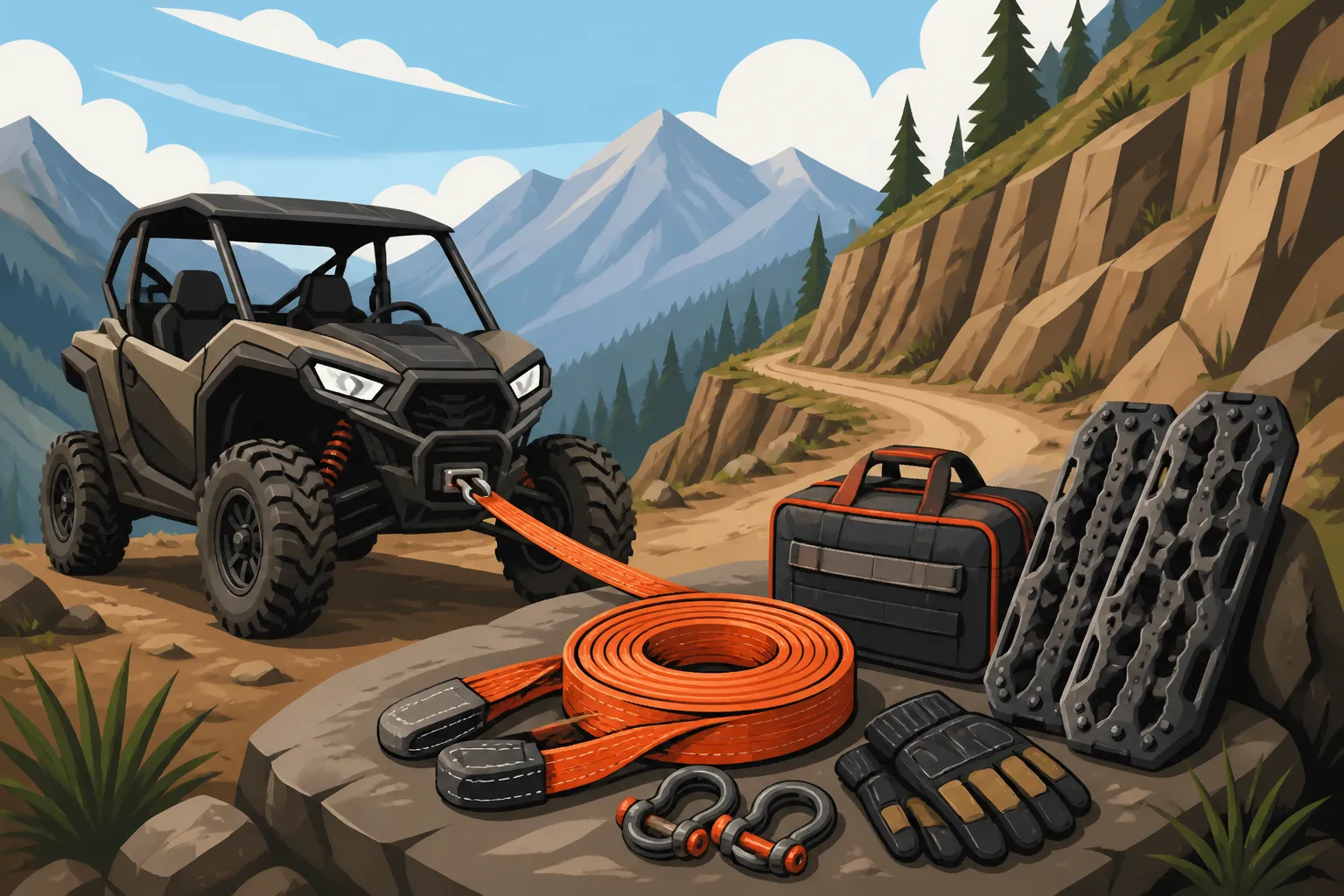
A practical recovery kit should match the weight and recovery points of your specific ATV or UTV. Read the vehicle and winch manufacturer’s guidance before buying or using equipment. Keep the kit together in a dry, secured storage bag, and make sure everyone riding with you knows where it is.
| Gear | What it is for | Important check |
|---|---|---|
| Winch and remote | Controlled pulling when a safe anchor and pull direction are available | Confirm the winch and mounting points are approved for your machine |
| Tree-saver strap | Protecting a suitable tree when it is used as an anchor | Use only where anchoring is allowed and the tree is sound |
| Rated soft shackles or recovery connectors | Connecting compatible recovery components | Inspect for wear, cuts, abrasion, or damage |
| Winch-line damper | Reducing the risk from a line under tension if it fails | Place it as directed by the manufacturer |
| Gloves and eye protection | Protecting hands and eyes during setup | Wear them while handling cable, rope, and hardware |
| Shovel and traction boards | Improving footing or clearing a small obstruction | Use only if there is stable ground and room to work |
| Headlamp and first-aid kit | Supporting a delayed return or minor emergency | Store where they are easy to reach |
A winch is useful, but it is not a complete recovery plan by itself. A winch line needs a safe anchor, a suitable attachment point on the machine, and a pull angle that will not drag the vehicle sideways toward the drop. A winch mounted to a bumper does not automatically mean that every bumper point is a safe recovery point.
Bring gloves even if your winch uses synthetic rope. A line can become dirty, frayed, or abraded, and handling it with bare hands is a poor choice. Check connectors and straps before each ride, not only after a recovery. A small cut or damaged fitting can be difficult to notice when you are cold, tired, and trying to clear a narrow road before dark.
Carry tools that help without adding risk
A folding shovel can help clear loose debris or make a small, safe approach path, while traction boards can help a machine regain grip on a firm, stable surface. They are not a fix for a vehicle that is perched at the edge, sliding sideways, or sitting on a crumbling trail. Do not dig out the uphill side if doing so could undermine the machine or the trail.
A kinetic recovery rope is designed to stretch and transfer force. That energy can make a recovery unpredictable when the vehicle is close to a drop-off, surrounded by other people, or attached to an unsuitable point. Do not use a rope or tow strap for a sudden jerk unless the equipment is specifically designed for that method and the situation is appropriate. A controlled winch pull is generally easier to stop and reassess, but it still must be set up safely.
The most useful “extra gear” may be communication and navigation equipment. Save your route offline with onX Offroad before leaving cell coverage, and carry a paper map as a backup. Pack a charged phone, a power bank, and a satellite messenger or other emergency communication device if your route takes you beyond reliable service. A navigation track does not replace a route plan: tell someone where you are going and when you expect to return. For a more complete remote-ride list, see [What to Carry on a Remote Montana Ride] and [Recovery Gear for a Montana Shelf Road].
How to assess a stuck machine before using a winch
Inspect the machine, trail, and anchor first
Start with the people. Make sure nobody is injured, and move everyone to a stable place away from the machine’s downhill side and any tensioned line. If the operator is still in the seat, agree on clear instructions before doing anything. One person should direct the recovery; conflicting signals from several riders can lead to a sudden, unsafe movement.
Next, inspect the machine without climbing into an unstable position. Look at tire placement, the vehicle’s lean, the condition of the ground, and whether any part is caught under a rock or against the uphill bank. Check for fuel leaks, damaged steering or suspension, and a winch line or cable that is already under tension. If the machine’s balance is precarious, do not try to reposition it by hand.
Only consider an anchor that is solid, appropriate, and permitted. A suitable tree may be an option where anchoring is allowed, but a thin, dead, damaged, or uprooted tree is not a safe anchor. Never attach a winch line to a fence, signpost, guardrail, or another object simply because it is nearby. Do not use a second machine as an anchor unless the equipment and conditions are suitable and the operators understand the risks; on a narrow shelf road, the anchor vehicle can also be pulled or tipped.
Keep the pull controlled and people clear
If the situation is stable enough for a recovery and you have a manufacturer-approved recovery point, set up the equipment according to its instructions. Keep the line as straight as practical, avoid sharp edges that can damage it, and use a line damper as directed. Stand clear of the line and connectors. No one should straddle a cable or stand in the likely path of the machine if a connection slips.
Use slow, controlled movement. If the vehicle shifts sideways, the anchor moves, the line starts to rub, or the trail begins to crumble, stop. Do not keep adding force in the hope that the machine will suddenly come free. Reassess from a safe position. A recovery can become more dangerous with every adjustment if the pull angle is wrong or the ground cannot hold the load.
Once the machine is back on stable ground, inspect it before riding on. Check the winch line, connectors, tires, steering, and undercarriage. Look for new leaks or damage, and do not continue if the vehicle’s handling has changed. Note that a machine can appear fine while having a damaged tire or steering component that becomes a problem on the next steep section. Related guidance includes [Winching on a Steep Montana Trail] and [Towing Off a Remote Montana Trail].
When to stop and get outside help
Warning signs that make a do-it-yourself pull a bad idea
Some situations call for stopping rather than trying one more setup. Do not attempt a recovery if the machine is leaning over a drop, partly suspended, sliding, or resting on ground that is actively breaking away. The same applies if a person would need to stand below the machine, on the downhill side, or in a spot where there is no clear escape route.
Avoid a pull when you cannot identify a trustworthy anchor, the winch line or connectors are damaged, or the machine has no approved recovery point. Do not use improvised attachments around the suspension, axle, steering components, or roll cage. These parts may fail or be damaged under loads they were not designed to handle, and failure can cause the machine to move suddenly.
Weather and visibility matter too. Rain can loosen dirt and rock; snow and ice can make footing unreliable; fading light makes it harder to judge the line, anchor, and machine position. If the route is becoming less safe and you are not confident in the setup, stop before fatigue or urgency pushes the group into a risky decision. See [First Aid When Help Is Hours Out] and [Riding Alone in the Montana Backcountry] for additional remote-trip planning.
Make a communication and turnaround plan before you ride
Before setting out, share your route, expected return time, and a check-in plan with someone who is not on the ride. Download your map area in onX Offroad while you have service, then verify that the saved map is available offline. Carry a paper map, too. If you use a satellite messenger, make sure it is charged and that you know how to send an emergency message before you need it.
Agree as a group that turning around is a valid outcome. A shelf road that looks manageable on a map may be too narrow, washed out, or exposed for your machine and experience. Decide in advance what conditions will make you stop, such as loose rock, a damaged edge, poor visibility, or a lack of safe passing or turning space. A route app can help with navigation, but it cannot make a dangerous road safe.
If you do need help, provide your location as clearly as possible, describe the machine’s condition, and explain whether anyone is injured or in immediate danger. Keep the group together in a safe place and conserve phone or satellite-device battery. Do not put another rider at risk by attempting an improvised rescue. For route checks and preparation, [Checking Montana Trail Status Before You Drive] and [Reading a Montana Motor Vehicle Use Map] can help you plan around access and closures.
Disclaimer
This article is for general informational purposes only and does not constitute professional advice. Laws, prices and regulations vary by location and change over time. Consult a qualified professional for guidance on your specific situation.