Shepherd Ah Nei Near Billings
Shepherd Ah Nei is a convenient off-highway vehicle destination for riders based in Billings, but a nearby trail system is not automatically an easy day out. You still need to check which routes are open to your machine, where public access begins, and what conditions are like. This guide covers practical planning, trail choices, permits, safety, and ways to avoid common trip-day surprises.
Getting to Know Shepherd Ah Nei
Where the riding area is and what to expect
Shepherd Ah Nei is an OHV riding area near Shepherd, north of Billings. Its location makes it a practical option for local riders who want time on the machine without committing to a long drive to Montana’s mountain trail networks. It is also a different kind of ride: expect an open, Eastern Montana landscape rather than dense forest, high alpine scenery, or long stretches of shade.
The area is commonly described as having about 50 miles of trails. Treat that figure as a general sense of the network’s scale, not a promise that every route will be open, connected, or suitable for every machine on the day you visit. Access can vary with route designations, land-management decisions, maintenance, and conditions. A map and a current check before leaving are more useful than relying on a mileage figure alone.
The surrounding landscape is part of the experience. In open country, you may have broad views and long sightlines, but wind, dust, changing light, and limited shade can become more noticeable than they would on a wooded trail. A route that looks straightforward on a screen may also feel more exposed when you are riding it, especially if you are new to the area or traveling with less experienced riders.
Who the area can suit
Shepherd Ah Nei can work well for a range of riders, from locals looking for a day ride to visitors staying in or near Billings. The important question is not simply whether the area is “beginner friendly.” It is whether the routes you choose match your experience, machine, and comfort with rough or unfamiliar terrain. A new rider may enjoy a short, conservative outing, while an experienced rider might plan a longer exploration.
Families can make the area manageable by setting a modest first-day plan. Choose a route length that leaves room for breaks, keep the group together, and agree on a turnaround point before anyone gets tired. If young riders are coming along, review age, supervision, helmet, and safety-education requirements before the trip. These details are easier to sort out at home than in a parking area while everyone is waiting to ride. See [Montana Rules for Riders Under 12] for one age-related topic to check.
A first visit is also a good time to prioritize orientation over distance. Stop at junctions, compare the signs with your map, and give the group time to get used to the surface and terrain. If someone is uncomfortable, changing the plan is a sensible decision, not a failure. For ideas about selecting a manageable outing, [Montana Trails Suited to Beginners] offers another useful planning topic.
How it differs from mountain riding
Many riders picture Montana OHV trips as forest roads, mountain passes, or high-country trails. Shepherd Ah Nei offers a more open-country setting near the Billings area, so the challenges can be different. You may spend less time dealing with thick tree cover and more time thinking about sun exposure, wind, dust, route visibility, and how far you are from shade or shelter.
Open terrain can make navigation seem easier because you can see a long way. But visible landmarks do not always make it obvious which track is designated for motorized travel. A faint track, an old two-track, or a line that looks rideable is not necessarily an authorized route. Stay on signed or officially mapped routes, and do not assume that an apparent shortcut is legal simply because it has tire marks.
The area’s proximity to Billings can also create a false sense that preparation is optional. You may be closer to town than on a remote mountain ride, but weather, mechanical problems, and poor reception can still complicate a day. Plan for self-sufficiency, especially if you intend to explore beyond a short loop or ride when conditions are changing.
Choosing Routes and Matching Your Machine
Start with route information, not assumptions
Before unloading, identify the trail network on an official land-manager map and check the route designations that apply to your machine. A route may be open to some kinds of OHVs but not others, or it may have seasonal or temporary restrictions. Signs at the riding area matter, too. If a sign and an old saved map appear to conflict, do not treat the older map as permission to proceed.
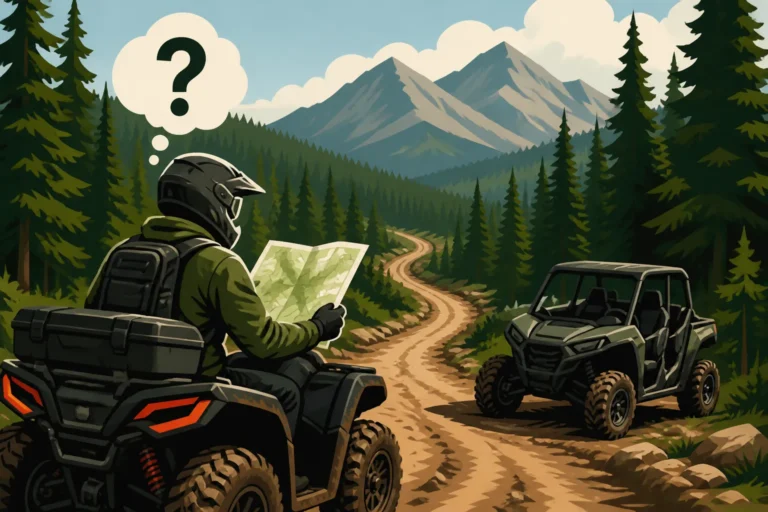
If you use a digital navigation tool such as onX Offroad, prepare the map before arriving. Download the relevant area for offline use when the service supports it, save your parking or staging location, and make sure everyone in the group knows how to read the map. A phone map is helpful, but it should not be the only way the group can find its way back if a battery dies, a device is damaged, or service drops.
Pair digital navigation with a paper map or another backup when practical. Mark the meeting point and identify major junctions before starting. If several riders have phones, agree on one source of truth for route decisions; otherwise, the group can end up debating conflicting map displays at a fork. For broader navigation preparation, see [Reading a Montana Motor Vehicle Use Map] and [Finding a Forest's Motor Vehicle Use Map].
Check machine fit before committing
Your machine needs to fit both the route rules and the physical trail. Width, turning room, ground clearance, tires, and the rider’s skill all affect how comfortable a route feels. A full-size side-by-side may be restricted from some trails or feel awkward where a narrower machine can turn more easily. Do not assume that a route is appropriate just because your machine can physically enter it.
For a wider UTV, look for route information that specifically addresses width or vehicle type, and pay attention to posted restrictions. Do not force a machine onto a route that is too narrow, scrape vegetation to make room, or block a junction while deciding what to do. If you are unsure whether your rig fits, choose a clearly appropriate route or postpone that section until you can confirm access.
Tires and ground clearance deserve a quick pre-ride check. Look for cuts, low pressure, loose lugs, leaking fluids, and anything hanging beneath the machine. A rough patch that is easy for one model to cross can be a problem for another, particularly if the machine is loaded with passengers or gear. A few minutes of inspection is far less frustrating than discovering a problem after you are well away from the staging area.
Set a realistic route for your group
Plan around the least experienced rider, the least capable machine, and the person with the tightest time limit. A group ride should not be built around the fastest person’s idea of a “quick loop.” Estimate travel time conservatively, include stops, and allow extra time for wrong turns or a route that feels rougher than expected.
Before setting out, agree on a simple group procedure. Decide who leads and who rides last, where the group will regroup, and what everyone should do if they lose sight of the riders ahead. At junctions, the lead rider can pause somewhere safe until the rest of the group arrives. This avoids the familiar problem of one person taking a different fork while everyone else assumes the group is still together.
Keep the first outing flexible. If trail conditions are rough, visibility is poor, or a rider is uncomfortable, shorten the route rather than trying to “make up” time. For ideas on planning a day that fits your group’s abilities, [Montana Trail Difficulty Ratings] can help frame the questions to ask before choosing a route.
| Planning question | What to check | Why it matters |
|---|---|---|
| Is the route open? | Current land-manager information and posted signs | Closures and restrictions can change |
| Does the route fit the machine? | Vehicle type, width limits, and physical clearance | A legal route may still be a poor fit for your rig |
| Can the group navigate it? | Offline map, backup plan, and marked meeting point | Service and batteries are not dependable everywhere |
| Is the day plan realistic? | Rider experience, daylight, weather, and breaks | A conservative plan is easier to adjust than an overambitious one |
Planning a Day from Billings
Prepare the trip before you leave town
A little advance planning can make Shepherd Ah Nei feel much less complicated. Confirm where the intended staging or access point is, how you will reach it, and whether the route you plan to ride is open. Check road conditions for the drive as well as trail conditions; a good riding day does not help if the access road is in poor shape or your trailer is not suited to it.
Make sure the vehicle and trailer are ready for the trip. Check lights, tires, tie-downs, registration documents, fuel, and the spare tire or repair supplies you may need. If you are hauling more than one machine, confirm that each is secured and that no loose gear can shift during the drive. Do not leave paperwork, tools, or personal items somewhere they can blow away when the trailer is opened in a gusty staging area.
Tell someone who is not riding where you plan to go and when you expect to be back. Give them the basic route or area, the vehicles you are taking, and a time to check in. This is a simple precaution that can matter if your group runs late or has a problem. For more planning ideas, [Planning a Montana Riding Trip] covers the broader trip-preparation process.
Think through fuel, water, and supplies
Fuel planning should account for the entire day, not just the distance you expect to ride. Machines can use more fuel in rough conditions, during frequent stops and starts, or when carrying passengers and equipment. Start with a full tank where possible, know your machine’s realistic range, and avoid treating the lowest-fuel warning as a planning tool.
Water is easy to underestimate in open country. Bring enough for the riders in your group, not just a single bottle per machine, and keep it accessible. Add snacks and basic first-aid supplies, and carry any personal medication you might need. Sun protection, a light layer, and protective riding gear are useful even when the forecast looks pleasant at home in Billings.
A practical kit can include a tire repair option suited to your machine, basic hand tools, a charged phone, a power bank, a flashlight, and a way to communicate if your usual phone service is unavailable. The right kit depends on the ride, but the goal is to handle a small delay without turning it into an emergency. For a more detailed checklist, see [What to Carry on a Remote Montana Ride].
Choose timing with conditions in mind
The best time to ride is not just a matter of the calendar. Recent rain, dry spells, wind, temperature, and visibility can change how a route feels. After precipitation, surfaces may become slick, rutted, or vulnerable to damage. In very dry conditions, dust can reduce visibility between machines and make close group spacing uncomfortable.
Consider starting early enough to avoid being rushed near the end of the day. A later start can leave little room for a slow repair, a route-finding pause, or a longer-than-expected ride. Give yourself a clear turnaround time that leaves daylight for loading and the drive back, rather than planning to reach the trailer at the last possible moment.
Weather can shift even when the forecast looks settled. Bring layers, keep an eye on clouds and wind, and be ready to shorten the ride if conditions turn. A rider who is cold, overheated, dehydrated, or tired is more likely to make poor decisions. For help thinking through changing trail conditions, [Checking Montana Trail Status Before You Drive] is a useful related topic.
Permits, Rules, and Responsible Riding
Confirm the requirements for your situation
Montana OHV requirements can depend on factors such as residency, machine type, where you plan to ride, and whether the machine is registered or otherwise covered under applicable rules. Do not assume that a plate or registration automatically satisfies every requirement for riding on public land. Check the rules that apply to your machine and intended route before the trip.
Out-of-state riders should pay particular attention to permit requirements. The rules for a visitor may differ from those for a Montana resident, and a permit that covers trail use may not authorize road riding or replace other requirements. Make sure you understand what the permit covers, where it must be displayed, and whether a separate requirement applies to the machine or rider.
If you are riding a borrowed or rented machine, ask who is responsible for permits and paperwork. Confirm that the machine is allowed in the area and that the operator has the documents they need. For a general overview of visitor requirements, see [Montana Rules for Visiting Riders] and [What Montana Riders Need Before They Ride].
Follow posted routes and closures
Ride only on routes open to your vehicle type. Do not create a new track around a closed gate, ride across vegetation to bypass a muddy section, or continue because another rider says the closure is “usually ignored.” A route closure may protect a trail, address safety concerns, or reflect a land-management decision. The responsible response is to turn around and choose an open route.
Pay attention to signs at junctions and access points. If signs are missing, damaged, or unclear, do not treat the uncertainty as permission. Stop in a safe place, check your map, and choose a route you can verify. Keep the group out of roadways and intersections while sorting things out so other riders and vehicles can pass.
Staying on designated routes also protects access for everyone. A few new tracks can spread into a web of damage, especially when riders go around wet spots or try to widen a trail for a larger machine. If a section looks too wet or fragile, turn back rather than driving through it. Read more about this issue in [Spring Mud and Montana Trail Damage].
Keep the experience considerate
Dust can make riding uncomfortable and dangerous, especially when one machine follows closely behind another. Leave space between vehicles, slow down when visibility drops, and avoid accelerating hard near other riders or people at the staging area. Give the dust time to settle before the group closes the gap.
Respect other visitors and nearby property. Keep noise reasonable, avoid unnecessary revving, and do not assume that every nearby track or parcel is open to public use. Stay on authorized routes and be mindful at access points, where local residents, workers, and other recreationists may be moving through the area.
If you encounter a group traveling more slowly, be patient and pass only when it is safe and appropriate. If you are the slower group, use a safe pullout when available rather than stopping suddenly in a narrow section. Simple courtesy helps prevent small misunderstandings from becoming dangerous encounters. For broader guidance on riding responsibly, see [Montana OHV Rules for First-Time Visitors].
Safety and Common Trail-Day Problems
Prepare for a breakdown or separation
A basic safety plan starts before the machines move. Make sure every rider knows the meeting point, understands the route plan, and can contact another group member. If a rider becomes separated, the group should have a clear response, such as stopping at the next agreed junction rather than continuing in different directions.
A small mechanical issue can become a long delay if nobody has the right tools or a way to communicate. Carry equipment suited to your machine, and know how to use it. Check the spare, tire repair supplies, and basic tools before leaving home; a repair kit that has never been checked may be missing the one item you need.
If a machine breaks down, move it and the group to a safe location if possible. Avoid blocking a trail or standing in a blind spot. Decide whether the problem can be fixed on site, whether the machine can be safely recovered, or whether someone needs to seek help. For more detailed preparation, [Towing Off a Remote Montana Trail] and [Fixing a Flat 60 Miles From the Nearest Shop] address problems that can affect a ride well beyond a paved road.
Manage heat, cold, dust, and visibility
Open terrain can expose riders to sun and wind for much of the day. Wear protective gear that suits the conditions, use eye protection, and bring enough water. If a rider shows signs of fatigue or discomfort, take a break in a safe spot and reassess the plan rather than pushing on because the group is “almost there.”
Dust is more than an annoyance. It can hide obstacles, reduce visibility, and make it hard to judge the distance to the machine ahead. Increase following distance, slow down, and avoid riding into a cloud when you cannot see clearly. If the dust is persistent, regroup or change the route so the group can travel more safely.
Light changes can also catch people off guard. A route that felt clear in the afternoon may be harder to follow as the sun gets low, especially if riders are unfamiliar with the area. Check that lights work before the ride and leave enough time to return before visibility deteriorates. If your group plans a late outing, review [Riding Back to Camp After Sunset] and [Smoke and Visibility in Montana Fire Season] for related considerations.
Ride with a clear group plan
Before starting, establish who is leading and who is sweeping at the back. The lead rider should avoid pulling far ahead, and the last rider should know the planned route and how to respond if the group becomes separated. At forks, regroup before moving on so nobody is left guessing which way the others went.
Make sure passengers understand basic expectations, including staying seated, using the machine’s restraints where fitted, and keeping hands and feet inside the vehicle. A passenger who is uncomfortable should say so early. Stopping to adjust the plan is easier than managing a nervous passenger after the group has traveled farther into an unfamiliar area.
Agree that anyone can call for a stop without being mocked or pressured. This matters for new riders, children, and anyone who is tired or unsure about a section. A group that communicates well is safer and usually has a more enjoyable day. For additional guidance around crash response and incident reporting, see [After a Crash on a Montana Back Road].
Making the Most of a Visit
Build a first visit around familiarizing yourself
If you are new to Shepherd Ah Nei, think of the first outing as an orientation day. Start with a route that is easy to verify and comfortable for the least experienced rider. Take time to learn the layout, note the signs, and identify junctions before adding more distance or choosing less familiar sections.
You do not need to ride every available mile to have a satisfying day. A shorter outing can leave time for a calm lunch break, a careful check of the machines, and a return to the trailer without rushing. It also gives you a better sense of what route lengths and surfaces your group enjoys.
Afterward, write down practical details while you remember them: where you parked, which routes suited your machine, what conditions were like, and what you wished you had brought. This turns the next visit into a better-planned trip instead of another round of guesswork.
Use maps without letting them replace judgment
Digital tools can make it easier to see route options and keep track of your location. onX Offroad can be useful for preparing a route and reviewing mapped access before you arrive, particularly if you save the area for offline use. Still, no app should override a posted closure or an official route designation.
A map is a planning aid, not a guarantee that a route is open or passable. Data can be incomplete, conditions can change, and a route may be unsuitable for a particular machine. Cross-check the map with current land-manager information and signs on the ground. If you cannot confirm that a route is authorized, choose one you can.
Use your navigation tools in a way that does not distract the driver. Set the route before moving, let a passenger handle the map when practical, and pull over somewhere safe if you need to make a decision. This is especially helpful when the group reaches a junction and everyone is tempted to stare at a screen at once.
Leave the area ready for the next visit
Before loading, do a final walkaround. Look for loose straps, forgotten tools, trash, and any gear left near the staging area. Check the machine for damage and make a note of anything that needs attention before the next ride.
If you notice a damaged sign, blocked route, or hazard, use the appropriate land-manager contact process to report it. Do not try to repair signs or remove barriers yourself unless you have clear authorization. A useful report can help the people responsible for maintaining the area understand what riders are encountering.
Most of all, leave the place as you found it. Stay on the route, pack out what you bring, and respect other visitors. Responsible riding helps protect the area’s trails and makes it more likely that locals and visitors can continue enjoying a close-to-Billings riding option.
Disclaimer
This article is for general informational purposes only and does not constitute professional advice. Laws, prices and regulations vary by location and change over time. Consult a qualified professional for guidance on your specific situation.