What Grizzly Country Asks of a Rider
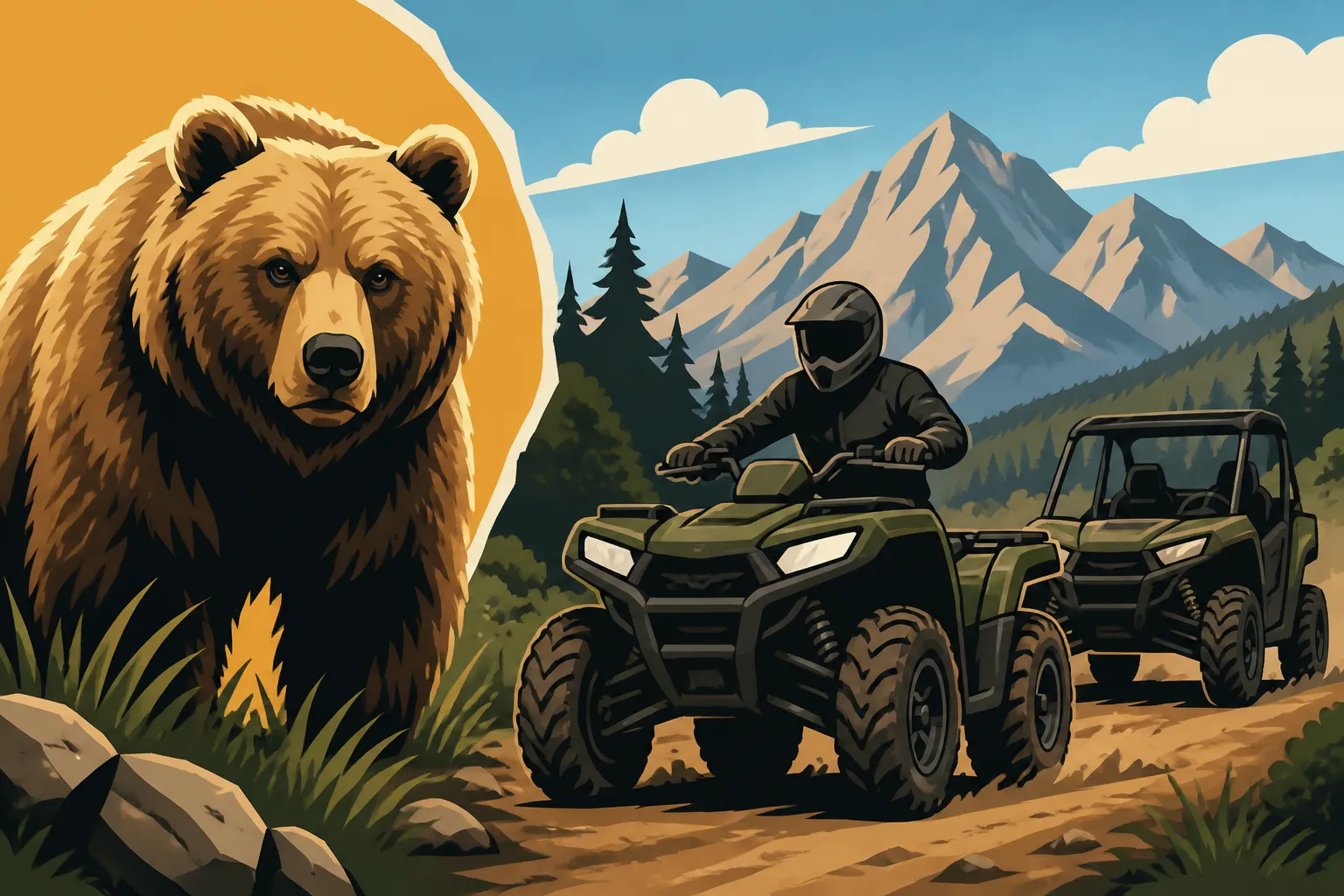
A ride through Montana’s forests can turn from a scenic outing into a close wildlife encounter in seconds, especially around blind corners, berry patches, or a fresh carcass. Grizzly country asks riders to do more than carry bear spray: plan the route, make their presence known, manage food and waste, and know what to do if a bear appears.
Why ATV and UTV Riders Need a Bear-Aware Plan
Understand where encounters can happen
Grizzly habitat is not limited to remote backcountry. Riders may encounter bears in forested valleys, along creek bottoms, near berry-producing slopes, or where wildlife is feeding. Areas around the Flathead, Cabinet, and Swan mountain ranges, as well as portions of the Lolo and Custer Gallatin national forests, include grizzly habitat. The precise risk changes with season, food sources, weather, and recent wildlife activity.
A bear encounter can happen on a busy trail, too. Traffic does not make every stretch safe, and a bear may be resting in thick cover just beyond a bend or feeding near a drainage. A quiet two-track near a creek can be as worth your attention as a remote trail. Treat every ride in bear country as a ride where an encounter is possible, even if you have ridden the route many times without seeing one.
An ATV or UTV does not remove the risk. A machine can provide distance from the ground, but it is not a guaranteed barrier or a substitute for awareness. Riders may also have less time to react because they are focused on ruts, loose rock, dust, other machines, and the trail ahead. The goal is not to ride in fear; it is to leave enough attention for the surroundings as well as the route.
Know the situations that make surprise encounters more likely
Bears can be difficult to see in dense timber, tall grass, or uneven terrain. Wind, running engines, helmets, and conversation can make it harder for riders to hear what is happening nearby. A bear focused on feeding or traveling through cover may not notice an approaching machine until the rider is close. For that reason, don’t assume the engine will always announce your arrival.
Blind corners, steep-sided cuts, narrow trails, and creek crossings deserve extra caution. Slow down before you reach them, look ahead for movement, and take a moment to scan the trail edges. If visibility is poor, speed is high, or another machine is close behind, the time available to respond shrinks further. Dust can also obscure what is ahead, so leave enough space between machines to see clearly.
Young animals, a bear at a carcass, and a bear surprised at close range are situations that call for particular care. If you see a bear, don’t move closer to get a better look or a photograph. Give it room to leave, and do not position your machine between a bear and its possible escape route. These basics complement route planning advice in [Montana's National Forest Trail Systems] and [What Grizzly Country Asks of a Rider].
Prepare Before You Leave the Trailhead
Choose a route you can ride responsibly
Check that your route is open to your type of machine and that you understand where motorized travel is allowed. In Montana, a line on a phone map is not proof that a route is open to OHVs. Consult the appropriate land manager’s current information and motor vehicle use map, and stay on designated routes. Be especially careful near wilderness boundaries and other areas closed to motorized travel.
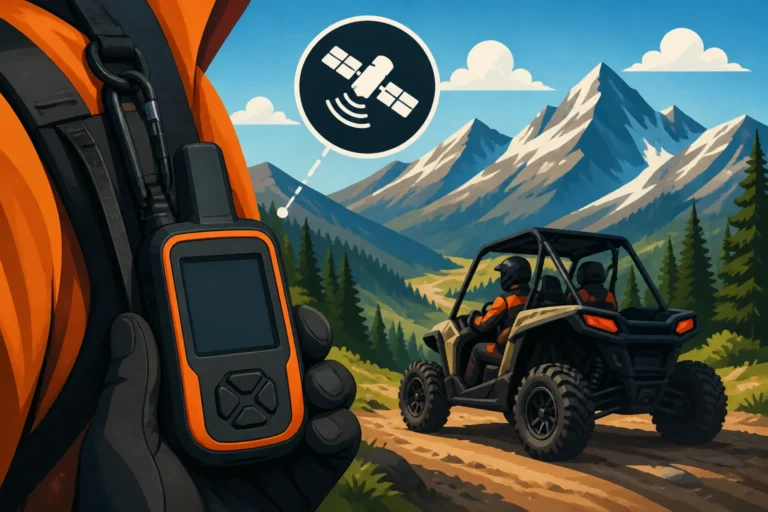
Apps such as onX Offroad can help riders organize routes and review mapped access, but treat digital mapping as one planning tool rather than the final word on closures or permissions. Download maps for offline use before losing service, and carry a paper map or another backup for remote trips. In places with limited cell coverage, including parts of the Swan Valley and the forests west of Kalispell, a route plan stored only online may not be much help once you are underway.
Plan a turnaround option. If a route becomes blocked, visibility deteriorates, you spot fresh bear activity, or conditions make the group uneasy, turning around may be the sensible choice. A map should help you understand how to get back, not pressure you to continue because the route looks short. For practical navigation habits, see [Reading a Montana Motor Vehicle Use Map] and [Checking Montana Trail Status Before You Drive].
Carry bear spray where you can reach it
Bear spray only helps if it is accessible and you know how to use it. Carry it on your body in a secure holster or another place you can reach quickly, rather than buried in a cargo box, under a seat, or packed at the bottom of a backpack. On a UTV, make sure every rider knows where the spray is and can reach their own canister without climbing out or digging through gear.
Before the ride, check the canister’s condition and expiration date, and read the label instructions. Learn how the safety mechanism works and how to remove it under stress. Practice with an inert training canister if you can get one. Bear spray is intended for use during an immediate bear threat, not as a trail or clothing repellent; spraying it around your camp or machine can create a new problem.
A canister can be hard to use if it is loose, obstructed, or tucked beneath bulky layers. Test your setup while wearing the gloves, jacket, and riding gear you expect to use. If you are riding with a passenger, talk through who has spray and what each person should do if a bear appears. [Bear Spray on an OHV] and [Riding Safely in Grizzly Country] offer related preparation topics.
| Before the ride | What to check | Why it matters |
|---|---|---|
| Route | Confirm motorized access, closures, and turnarounds | A mapped line may not be an open OHV route |
| Navigation | Download maps and carry a backup | Cell service may disappear in remote terrain |
| Bear spray | Check condition, expiration, access, and familiarity | A buried or unfamiliar canister may be difficult to use quickly |
| Group | Agree on spacing, signals, and who carries spray | A group can react more calmly when everyone knows the plan |
| Food and waste | Seal, secure, and pack out everything | Food odors can attract wildlife to stopping areas |
Ride in a Way That Reduces Surprise
Make your group easier to notice without becoming careless
Ride at a speed that gives you time to respond to what you can actually see. On a narrow forest road, that may mean slowing before a blind corner or stopping when dust blocks the view. A rider who is traveling fast and assumes wildlife will move away has less room to react if an animal is on the trail. Leave enough distance between machines to avoid crowding one another and to keep sightlines clear.
Conversation and occasional calls can help make a group’s presence more obvious, particularly where vegetation and terrain limit visibility. Be deliberate rather than relying on a constant engine roar. The sound of a machine may carry unevenly through a valley or be masked by wind and water. At the same time, making noise is not a guarantee that a bear will hear or avoid you, so continue to watch the trail and its edges.
Keep the group together, especially where the route narrows or visibility drops. A rider who gets separated may come around a corner alone or stop near cover without the support of the group. Agree on simple signals for stopping, slowing, and regrouping before you leave. If someone spots a bear, the priority is to alert the others and give the animal space, not to race ahead for a closer look.
Pause thoughtfully and avoid wildlife pressure
Choose stopping places with visibility and room to maneuver rather than pulling off beside dense brush, a carcass, or a cluster of berry bushes. Before anyone gets off a machine, look and listen around the area. Keep food secured and avoid leaving wrappers, drink containers, or scented items on a seat while the group takes a break.
If you see a bear at a distance, stop far enough away to avoid pushing it toward the trail or people. Keep your group together, speak calmly, and give the animal an unobstructed way to move away. Don’t follow it, surround it, or move closer for a photograph. If it remains near the route, calmly retreat along the way you came if that can be done without closing the distance.
A bear beside the trail can make a route temporarily unsuitable for riding. Don’t honk, rev the engine, or drive toward it to force it to move. If the bear does not leave and you cannot create safe distance, turn back or wait in a safe location rather than treating the encounter as an obstacle to push through. A cautious decision can protect the group and keep the bear from being stressed or displaced.
Handle an Encounter Without Escalating It
If you see a bear before it notices you
Stop at a safe distance and keep the group calm. Don’t approach, surround, or separate the bear from a cub. If it is moving away, give it time and space. If the bear is feeding, resting, or near a carcass, be especially cautious: leave the area rather than trying to pass close by.
If the bear notices you, speak calmly so it can identify you as human. Avoid sudden movements, and do not run. If you can retreat without approaching the bear, back away slowly and keep watching it. Don’t turn a close encounter into a chase by accelerating toward or past the animal. The safest choice may be to reverse direction or wait until the bear has left the area.
Bear behavior is not always easy to interpret, and there is no single response that fits every encounter. A bear may stand up to get a better look, for example, and that alone does not necessarily mean it is about to charge. Give it room, keep your actions controlled, and follow current guidance from Montana wildlife authorities for handling bear encounters.
If a bear approaches or charges
Have bear spray ready if a bear approaches closely or appears to be an immediate threat. Use it according to the product label and your training. Don’t wait until the canister is inaccessible, and don’t waste time trying to photograph an approaching bear. A machine’s handlebars, cab, or cargo area can complicate access, so practice locating and drawing the canister while seated and while standing beside the machine.
If a bear charges, avoid a sudden attempt to flee on foot or to drive directly at it. A charge can happen quickly, and a machine is not a dependable escape plan in tight or rough terrain. Focus on using the spray as instructed and maintaining a calm response. If you are riding with others, clear directions can help prevent riders from scattering or blocking one another.
If physical contact occurs, the appropriate response can depend on whether the bear’s behavior is defensive or predatory. Defensive encounters and persistent attacks are not handled identically, and details matter. Learn the current recommendations for grizzly encounters before your trip rather than trying to memorize a one-size-fits-all rule from a trail conversation. Never approach a bear after an encounter to check on it or retrieve equipment; move to a safe location and contact the appropriate authorities when needed.
Keep Food and Campsites From Drawing Bears
Secure food, garbage, and scented items
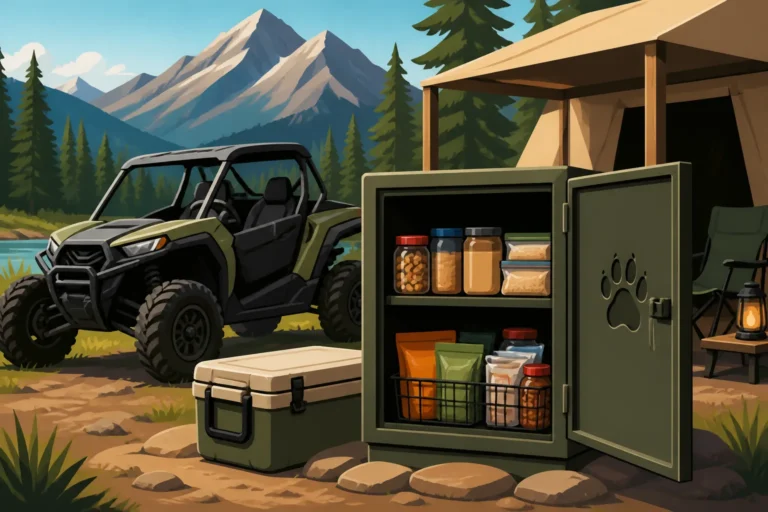
A snack left in an open cargo box, an unwashed cooking pot, or a bag of garbage beside a campsite can attract wildlife. Keep food and scented items secured according to the rules for the campground or public land you are using. Pack out wrappers, leftover food, and trash; don’t leave scraps behind or toss food waste into brush. A clean stopping area is better for people and wildlife alike.
If you are riding from a camp, organize food before departure rather than leaving it spread across the site. Put away coolers and cooking gear when they are not in use, and check the ground for dropped food before moving on. Even small items can be overlooked when a group is focused on loading machines, buckling helmets, and getting back onto the trail.
At a remote lunch stop, keep food contained and don’t feed wildlife. If you find a bear attractant, such as an open food container or a carcass, don’t linger to inspect it. Leave the area and report a concerning wildlife situation through the appropriate local channel when practical. For campsite planning, see [Dispersed Camping Rules on Montana Forest Land] and [Camping Beside Montana OHV Trails].
Treat a carcass or fresh bear sign as a reason to leave
A carcass can be a valuable food source that a bear may defend. If you see a carcass, fresh tracks, or signs that a bear is feeding nearby, don’t stop to investigate, take pictures, or ride closer. Calmly move away from the area using a route that does not bring you closer to the animal. If the route ahead passes right by the site, turn around rather than trying to squeeze through.
Fresh tracks, disturbed ground, scat, or a strong animal odor may suggest recent wildlife activity, but signs alone may not tell you whether a bear is still close. Use caution, increase distance, and avoid searching the area to confirm what made them. A group that presses forward to identify a track can accidentally close in on an unseen animal.
If the encounter or sign creates an immediate safety concern, report it to the relevant land manager or wildlife authority once you are in a safe place. Give a clear location and a factual description. Don’t post a precise location online while other riders may be drawn toward the site. In grizzly country, the best ride is not always the one that reaches the planned destination; sometimes it is the one that turns around in time.
Disclaimer
This article is for general informational purposes only and does not constitute professional advice. Laws, prices and regulations vary by location and change over time. Consult a qualified professional for guidance on your specific situation.