What Lenders Look at for a UTV Loan
Dreaming of hitting those Montana trails on a new (or new-to-you) UTV or ATV can be exhilarating, but the reality of financing often brings a cold splash of water to that enthusiasm. Many folks get excited, find the perfect side-by-side or quad, and then get hit with the surprise of what lenders actually scrutinize when you walk in to ask for a loan. It can feel like they're looking for reasons to say no, or that the process is designed to be opaque. This guide is here to pull back the curtain on what factors lenders truly consider for a UTV loan, helping you prepare so you can confidently secure the financing you need to get out on the open range or deep in the mountains.
Understanding the Lender's Mindset: It's All About Risk
When a bank, credit union, or dealership finances your UTV, they're essentially making an investment in you. Their biggest concern isn't just your ability to make payments, but the risk that you might not. Every piece of information they ask for, every number they crunch, is designed to assess that risk. The lower they perceive their risk, the more likely they are to approve your loan, and often, the better interest rate you'll get. It's not personal; it's just business, but understanding their perspective can make all the difference in your application process.
Your Credit Score and History: The First Hurdle
Your credit score is often the very first thing a lender will look at, and it's a huge determining factor. Think of it as your financial report card. It's a three-digit number that summarizes your past financial behavior, but it's really your full credit history they're diving into. They want to see how consistently you've paid your bills on time, how much debt you currently carry, and how long you've managed credit.
A strong credit score (generally 670 or above, with 740+ being excellent) tells them you're a responsible borrower. They'll look for things like a history of on-time payments, a mix of credit types (like a credit card, a car loan, maybe a student loan), and low credit utilization (meaning you're not maxing out your credit cards). If you're someone who's always paid their truck payment every month without fail, or you've kept your credit card balances low, that speaks volumes. On the flip side, missed payments, bankruptcies, or high existing debt can raise major red flags. A younger rider might find it harder to get a loan if they have little to no credit history at all, simply because there's not enough data for the lender to assess their reliability. It's not that you're bad at paying bills; it's just that you haven't had the chance to prove you're good at it yet. Building a solid credit history takes time, but even getting a small secured credit card and using it responsibly can help you start that journey.
Debt-to-Income Ratio: Can You Afford It?
Beyond your credit score, lenders really want to understand your capacity to take on new debt, and that's where your debt-to-income (DTI) ratio comes in. This number tells them how much of your gross monthly income goes towards paying your existing debts. To calculate it, they'll add up all your minimum monthly debt payments – think rent or mortgage, car loans, student loans, credit card minimums – and divide that by your gross monthly income (before taxes).
For instance, if you make $4,000 a month gross, and your total monthly debt payments are $1,000, your DTI is 25%. Lenders generally prefer a DTI ratio of 36% or lower, though some might go up to 43%, especially for a secured loan like a UTV. If adding a new UTV payment pushes your DTI too high, say into the 50s, the lender might worry you're overextended and won't be able to handle the additional financial strain, especially if an unexpected repair pops up. They don't want to see you stretching so thin that a flat tire on the trail means you can't make your UTV payment. They want to know that even with your new toy, you still have plenty of wiggle room in your budget.
The Down Payment: Skin in the Game
Making a down payment on your UTV purchase is incredibly powerful in the eyes of a lender. It's literally "skin in the game." A down payment reduces the amount you need to borrow, which immediately lowers the lender's risk. If you put down a significant chunk of money, it tells them you're serious about the purchase and have a vested interest in keeping up with the payments.
Think about it from their perspective: if you borrow 100% of the UTV's value, and something goes wrong, you might be more tempted to walk away if you haven't invested any of your own cash. But if you've already put down 10-20% of the cost, you're much less likely to let the machine go. A down payment also helps offset the rapid depreciation that many off-highway vehicles experience, especially used ones. For example, if you're buying a $20,000 UTV, putting down $2,000 to $4,000 (10-20%) shows a lot of commitment. It also helps you avoid being "upside down" on your loan, where you owe more than the machine is worth, which can happen quickly with depreciation. Even a small down payment can significantly improve your chances of approval and potentially secure a better interest rate.
The UTV Itself: An Asset, But What Kind?
While your financial health is paramount, the UTV you're looking to finance also plays a big role in the lender's decision. They're not just lending you money; they're taking a security interest in the machine itself. This means if you default on the loan, they can repossess the UTV to recover their losses. Therefore, they need to assess the UTV's value and how easily they could sell it if necessary.
New vs. Used Machines: Depreciation and Collateral
There's a noticeable difference in how lenders view new versus used UTVs. A brand-new machine, while more expensive initially, offers a few advantages for lenders. It typically comes with a manufacturer's warranty, reducing the risk of immediate mechanical issues, and its value is at its peak (though it will start depreciating the moment you drive it off the lot). Lenders often offer longer terms and sometimes better rates for new machines because they see them as more reliable collateral.
Used machines, on the other hand, present a higher degree of variability. Their condition, mileage, modifications, and overall market value can vary widely. Lenders might be more cautious, offering shorter loan terms or requiring a larger down payment. They'll definitely want to know the year, make, and model to assess its general market value. Before buying a used machine, it's always wise to get a professional inspection and to run its Vehicle Identification Number (VIN) to check its history. This isn't just for your peace of mind; it's also something a lender would appreciate knowing you've done. You definitely don't want to get stuck with a lemon, and neither does your lender! Make sure to read [Checking a Used Quad for a Theft Report] and [Running the Serial Number First] before you commit.
Value and Market Demand: Will It Hold Its Worth?
Lenders are interested in the market value of the UTV, not just the price you're paying. They'll often consult industry guides, like NADA Guides, to determine the average retail and wholesale value of a specific make and model. Popular brands and models that have strong resale value, like a Polaris Ranger for utility or a Can-Am Maverick for sport, might be easier to finance than a more obscure or heavily modified machine. This is because if they do have to repossess it, they want to be confident they can sell it quickly and for a good price.
If you're looking at a very niche or custom-built machine, you might find that lenders are more hesitant, or will only finance a smaller percentage of the purchase price. The machine's condition also plays a role. A well-maintained UTV with clear records will be viewed more favorably than one that looks like it's been through a demolition derby without proper care.
The Loan Term and Amount: Striking a Balance
The loan term (how long you have to pay back the loan) and the amount you're borrowing are also critical. Lenders will generally try to match the loan term to the expected useful life of the asset, or at least its significant depreciation period. For UTVs, terms typically range from 36 to 72 months, though some might go longer for new, higher-priced machines.
A longer loan term means lower monthly payments, which can be attractive, but it also means you'll pay more in total interest over the life of the loan. A shorter term means higher monthly payments but less interest paid overall. Lenders will also cap the loan amount based on the UTV's value. You generally can't borrow significantly more than the machine is worth, even if you want to include accessories or modifications in the financing, unless you roll it into a personal loan, which usually has a higher interest rate because it's unsecured. They want to ensure that their collateral covers the loan. This is all part of [Financing a Side-by-Side in Montana] and understanding what your options are.
Other Factors That Swing the Loan Decision
While credit and the machine itself are major players, several other factors can influence a lender's decision and the terms they offer. Sometimes, these small details can be the difference between an approval and a denial, or a good rate and a truly great one.
Proof of Income and Employment Stability
Lenders need solid proof that you have a reliable income stream to make those monthly payments. They'll ask for recent pay stubs (typically the last two or three), and sometimes W-2 forms or even full tax returns, especially if you're self-employed. For self-employed individuals, they often look for at least two years of consistent income and tax filings to establish stability.
Your employment history matters too. Someone with a stable job for several years at the same company is generally seen as less risky than someone who frequently changes jobs or has gaps in employment. They want to see a consistent ability to earn, not just a snapshot of your current paycheck. If you've been working the same ranch for a decade, that's a huge plus. If you just started a new seasonal guiding gig, they might be a bit more cautious.
Residency and Your Relationship with the Lender
Where you live, and your existing relationship with the lender, can also play a role. If you're looking for a UTV loan in Montana, local credit unions and banks often prefer to lend to established Montana residents, especially if you've been a customer with them for a while. They know the local market, the local economy, and they have a better sense of your overall financial picture if your checking, savings, or other loans are already with them.
Having an existing relationship can sometimes smooth the approval process or even unlock slightly better rates. If you're a new resident to Montana, bringing proof of address and perhaps even a letter from a previous bank showing good standing can sometimes help. Knowing [Montana Registration for a New Resident] can also be a helpful step to show you're settling in.
Insurance Requirements: Protecting the Asset
Just like with a car loan, lenders will almost certainly require you to carry full coverage insurance on your financed UTV. This typically means collision and comprehensive coverage, not just liability. Why? Because the UTV is their collateral. If the machine is stolen, damaged in an accident, or caught in a wildfire while you're out exploring, they want to ensure their investment is protected.
You'll need to provide proof of insurance before the loan can be finalized, and the lender will often be listed as a "loss payee" on your policy. This means if something happens, they get paid first from the insurance settlement. It's an important part of the financial equation, and you should factor the cost of comprehensive [Insuring an ATV in Montana] into your monthly budget when considering your loan.
Preparing Your Loan Application: Getting Your Ducks in a Row
The better prepared you are when you walk into a lender's office or fill out an online application, the smoother the process will be. Gathering all your necessary documents ahead of time, understanding your financial standing, and knowing your options can save you a lot of time and frustration. It's like preparing your machine for a big trip into the backcountry; you wouldn't just head out without checking your oil and tires, right?
Gathering Your Documents
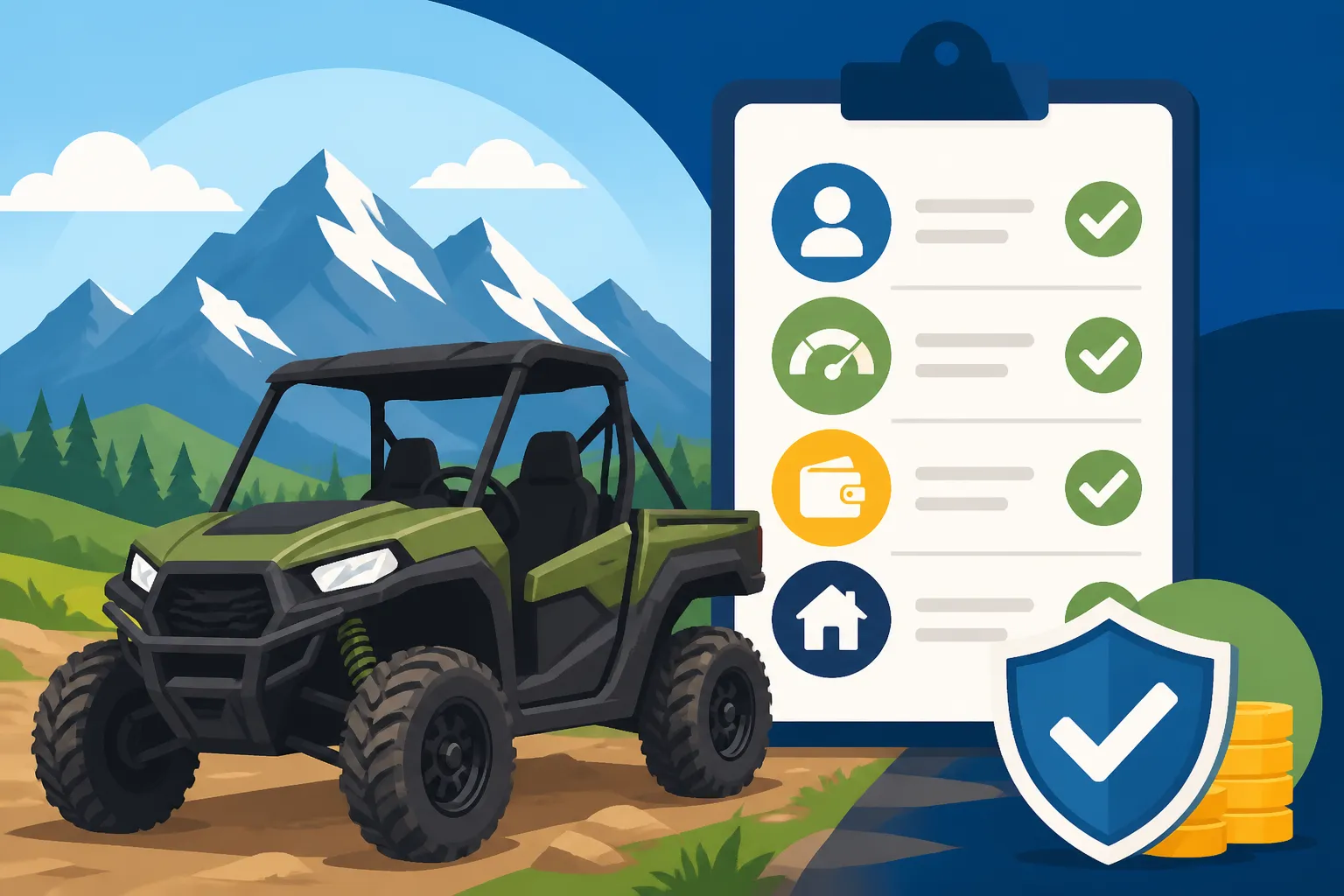
To make the application process as efficient as possible, have a clear list of common documents that lenders will typically request. This might include:
- Proof of Identity: Your driver's license or other valid government-issued ID.
- Proof of Income: Recent pay stubs (usually 2-3 months), W-2 forms from the last one or two years, or if self-employed, tax returns from the past two years and bank statements.
- Proof of Residency: Utility bills, lease agreements, or mortgage statements showing your current address.
- Existing Debt Information: Statements for any other loans (car, student, mortgage) and credit cards, showing your minimum payments and balances.
- Bank Account Information: You might need to provide bank statements to verify assets and payment history, or just routing and account numbers for automatic payments.
- UTV Information: The specific year, make, model, and VIN of the UTV you intend to purchase. If buying used, having a copy of the potential [What a Montana Bill of Sale Should Say] or any inspection reports can be helpful.
Having these ready to go shows you're organized and serious, which can create a positive impression with the loan officer. If you're buying from a private party, you may want to use a service like LawDepot to create a robust bill of sale to ensure you have all your ducks in a row for [Titling an OHV in Montana] later on, which lenders will also appreciate as a sign of proper ownership. For more on what is needed for official records, check out [Proof of Ownership for a Montana Title] and [Montana OHV Title Fee].
Getting Pre-Approved: Knowing Your Budget
One of the smartest things you can do before you even start seriously shopping for a UTV is to get pre-approved for a loan. Pre-approval means a lender has reviewed your financial information and tentatively agreed to lend you a certain amount of money, up to a specific limit, at an estimated interest rate. It's not a final loan offer, but it's a strong indication of what you can afford.
The benefits of pre-approval are huge:
- You know your budget: You'll know exactly how much UTV you can realistically shop for, which saves you the heartache of falling in love with a machine you can't afford.
- You become a cash buyer: When you walk into a dealership or talk to a private seller with a pre-approval letter, you're essentially a cash buyer. This gives you significant leverage in negotiations, as the seller knows you're serious and ready to buy.
- It speeds up the process: When you find the right UTV, much of the financing legwork is already done, allowing you to close the deal faster.
- You can compare offers: You can use your pre-approval as a benchmark to compare against any financing offers from a dealership, ensuring you get the best deal.
Exploring Lender Options: Dealer vs. Bank vs. Credit Union
Don't just jump at the first financing offer you see. It pays to shop around, as different lenders have different rates, terms, and requirements.
- Dealership Financing: Many UTV dealerships offer their own financing or work with a network of lenders. This can be convenient, often offering quick approvals, and sometimes they have special promotional rates, especially on new models. However, these rates might not always be the absolute best for your credit profile, and you might not get the full range of options.
- Banks: Traditional banks offer UTV loans and can be a good option, especially if you have an existing relationship. They often have competitive rates and a straightforward application process.
- Credit Unions: Often, credit unions offer some of the most competitive rates for vehicle loans, including UTVs. They are member-owned, so their focus is on providing benefits to their members. If you're a member of a credit union, or eligible to join one, it's definitely worth checking their rates. Many of them also offer unique programs like [Montana's One-Time Permanent OHV Registration] support for members.
By understanding what lenders look at and preparing thoroughly, you can navigate the financing process with confidence and get one step closer to enjoying the incredible UTV and ATV riding opportunities Montana has to offer.
Disclaimer
This article is for general informational purposes only and does not constitute professional advice. Laws, prices and regulations vary by location and change over time. Consult a qualified professional for guidance on your specific situation.