Where Montana Trail Pass Money Goes
Montana’s OHV trail passes help pay for the system that makes public riding possible, but the connection between a pass and a particular trail is not always obvious. Here’s how trail-pass revenue is generally used, who helps deliver the work, and how to check what a pass does—and does not—fund.
Which fees help fund Montana OHV trails
Montana’s resident trail pass and nonresident temporary use permit are part of the state’s system for funding and managing off-highway vehicle access. The resident pass and nonresident permit serve different riders and have different rules. Neither should be confused with every other fee a rider might pay when registering, titling, or using a machine.
The Montana’s Resident OHV Trail Pass and Montana’s Non-Resident Temporary Use Permit explain who needs each option. If you’re unsure whether you need a pass for a particular machine or kind of land, start with Montana Permit Rules on Public Land. Pass requirements depend on the circumstances, and a pass that covers trail use does not automatically grant permission to ride any route.
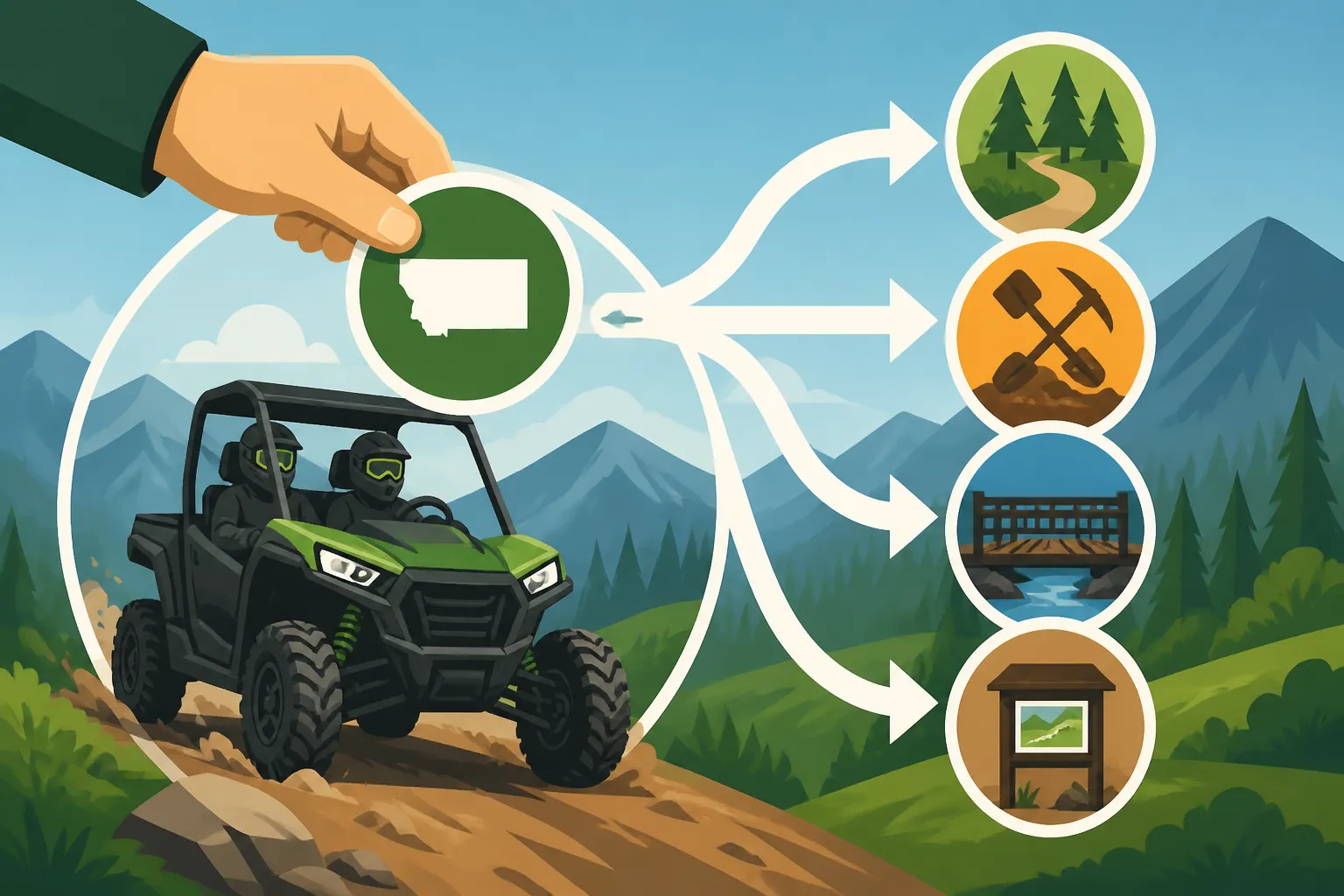
The central idea is that trail-pass revenue supports a broader OHV program rather than acting like a donation assigned to one named route. Money is pooled and used through public programs and funding processes. That can support work in different parts of the state, subject to program rules, available funds, land-manager approval, and the specific project.
A pass also sits alongside other sources of trail funding. Depending on the project and who manages the land, work might involve grants, local contributions, volunteer effort, or funding from a land-management agency. A trail project can rely on several sources at once. That makes it difficult to trace a single pass purchase to a particular sign, bridge, or maintenance day.
Keep these distinctions in mind:
- A resident trail pass and a nonresident temporary use permit are different products with different eligibility and use rules.
- A vehicle registration or title fee is not automatically the same thing as a trail-use fee.
- A trail pass does not create access where a route is closed or where the rider lacks permission.
- Grant funding may help pay for a local project, but the grant is part of a program—not necessarily a direct payment to the trail where a rider bought a pass.
- Public access work can include more than grading or clearing a route; planning, signs, facilities, and coordination may also be necessary.
For riders who are registering a machine, it’s worth checking how a pass relates to the registration process. The Trail Pass Credit Toward Permanent Registration explains a connection that can apply in the registration system. It does not mean every registration-related charge is a trail-maintenance payment.
What trail-pass money can support
The practical purpose of trail funding is to keep suitable riding opportunities usable and managed. That can involve routine work on existing routes as well as planning, access management, and improvements to trail facilities. The exact projects and eligible costs depend on the program rules and the details of each project.
| Type of work | What it can involve | Why riders may notice it |
|---|---|---|
| Trail maintenance | Clearing fallen material, repairing erosion damage, or restoring sections that have deteriorated | Routes may be safer or more passable, and damage can be less likely to worsen |
| Signs and route information | Installing or maintaining signs, markers, and directional information | Riders can follow open routes and avoid closed or unsuitable areas |
| Trailhead and access improvements | Work on staging or other facilities that support trail use | Parking, access, and basic trailhead function may improve |
| Planning and coordination | Route assessment, project design, consultation, and work with land managers | Needed before some physical work can happen, especially where multiple parties are involved |
| Grant-supported local projects | Eligible work proposed by a local organization, public body, or other qualified partner | Local knowledge and volunteer capacity can help direct work to specific needs |
| Program administration and oversight | Managing applications, agreements, reporting, and compliance | Public funds can be reviewed and projects can be tracked |
These are examples of the kinds of work that may be supported; they are not a promise that every project or expense is eligible. A program may set limits on what it will fund, and a land manager can set additional conditions. For example, a group cannot assume that a grant or pass revenue gives it permission to modify a route on public land. The relevant land manager must approve the work.
Maintenance is easy to picture, but it is only one part of keeping a route open. Work may start with identifying a problem, confirming who manages the land, deciding what repair is appropriate, and arranging any needed approvals. A short stretch of trail can require planning and coordination before a crew begins physical work.
Signs are another visible use of program effort. Clear route markers can help riders stay on designated routes and recognize closures or restrictions. That matters for trail sustainability as well as navigation: riding outside an authorized route can damage land, create conflict, and threaten continued access. Before a trip, use current information and check Reading a Montana Motor Vehicle Use Map and Checking Montana Trail Status Before You Drive. A pass is not a substitute for checking the route.
Trailheads and access points can also need attention. A project might address how riders reach a route or stage a vehicle, rather than changing the riding surface itself. Whether a particular facility can be funded depends on the program and the land manager’s plans.
Finally, some of the work is less visible to riders. A project may need assessment, design, communication with partners, or reporting before—or after—ground work. Those tasks can be part of responsible trail management, even when they do not immediately look like a repaired trail.
How funding reaches local trail work
Trail-pass revenue does not generally work like a vending machine: buy a pass, choose a trail, and have the fee spent there. Instead, funding is managed through public program processes. A local organization or other eligible partner may identify a need and seek support for a project. The proposal is considered under the applicable rules, and approved work may be supported through a grant or another program arrangement.
The state role and the local role can be different. State agencies administer programs and set requirements; local groups, public bodies, and land managers may identify or carry out work. A volunteer club might help maintain a route, while a land manager decides what work is authorized. In other cases, a public agency or contractor may take the lead. The arrangement depends on the site and project.
Grant programs are one way that funding can reach work on the ground. The Montana Trail Grants to Local Clubs and Montana State Parks Grants for Trails are useful starting points for understanding that project funding can be distributed through grant pathways. A grant is not automatic, however. Applicants must follow the program’s current eligibility and application requirements, and projects must meet land-management conditions.
Why land ownership and approval matter
Montana riding routes may cross lands managed by different public agencies or other landowners. A funding source does not override the rules of the place where a project is proposed. Before trail work can proceed, the responsible land manager may need to approve the project, its location, its methods, and any conditions attached to the work.
This can affect both the schedule and the scope. A route may need repair, but the proposed repair might not be allowed as described. A trail may cross more than one management area, requiring coordination with multiple parties. Seasonal restrictions, environmental considerations, and other site-specific requirements can also shape when and how work happens.
That is one reason local volunteers and clubs can be valuable partners: they may notice problems early and know the riding area. But local involvement does not make a route a club’s private property, nor does it give volunteers authority to change a public route without approval. It takes both a project need and permission to do the work.
Why grants do not guarantee a quick repair
A grant process can take time. A project may need to be proposed, assessed, approved, scheduled, and completed under an agreement. Funds may also be limited, and not every proposed project will be selected. If a trail is damaged, a pass purchase does not create a direct repair request or guarantee an immediate crew response.
For a rider who sees a problem, reporting it to the responsible land manager or a local trail partner can be more useful than assuming the pass program already knows about it. Share a clear location and description, and avoid making unauthorized repairs. If you want to take part in trail work, ask the relevant land manager or local organization about approved volunteer opportunities. Local clubs are among the groups that help keep trails open, as described in Montana Trails Kept Open by Local Clubs.
What a trail pass does not promise
A pass helps fund a trail system, but it is not a personal claim on a particular route. It does not mean that the pass holder can choose where funds go, that a favorite route will receive a specific amount, or that every trail will be maintained to the same standard.
Trail conditions vary for practical reasons. A route may be remote, difficult to reach with equipment, affected by weather, or subject to a closure. There may also be limits on what work is allowed in a particular area. Some routes are maintained by partners or land managers with different resources and schedules. As a result, a pass holder may see frequent work in one place and little visible change in another.
A pass also does not guarantee access. Routes can close because of conditions, land-management decisions, seasonal restrictions, fire activity, or other reasons. Riders remain responsible for following signs and current closures. A valid pass cannot turn a closed route into an open one or replace landowner permission.
Nor does a pass necessarily cover road riding, registration, insurance, or every permit a rider may need. Those are separate questions. If your trip includes riding on a road, check the road-use rules rather than assuming trail-use authorization applies. For broader trip planning, Montana Rules for Visiting Riders can help clarify the different requirements visitors may encounter.
The distinction between the pass and the route is especially important when a rider travels far to reach a trail. Check the land manager’s current route information before driving to the trailhead. A map may show a route, but current closures or seasonal conditions can affect whether it is available. See Checking Montana Trail Status Before You Drive for practical status-checking steps.
How to check where the money is going
For the most current picture, look for public information from the state program responsible for OHV trail-use funding and grants. Program pages, grant announcements, project summaries, and public budget or reporting materials can help explain what was funded and how the program is operating. Because grant cycles and program details can change, confirm current information with the responsible agency rather than relying on an older project notice.
A useful review focuses on several questions:
- What source of money is being discussed? A resident pass, nonresident permit, registration fee, grant award, or agency contribution may follow a different process.
- What kinds of expenses are eligible? Look for the program’s current rules rather than assuming all trail-related work qualifies.
- Who is responsible for the project? The applicant, grant recipient, land manager, and work crew may be different parties.
- Where will the work happen? A project description may identify a broad area or route system rather than a precise segment.
- What is the project status? An announced award is not the same as completed work. Check for updates or completion information where available.
- What other support is involved? A project may combine public funding with local labor, equipment, or other approved contributions.
These questions help distinguish a proposed project from a completed one and a general program purpose from a specific expenditure. A grant announcement, for example, can show that support was awarded for an eligible project, but the announcement may not tell you how every dollar was spent or what maintenance will be needed later.
Riders can also help improve the system without treating the pass as a direct service fee. Follow posted routes, respect closures, report damage through the appropriate channel, and participate in authorized volunteer work if it suits you. Those actions support access and reduce avoidable impacts, though they do not replace public funding or land-manager decisions.
If you are buying a pass, use an official or authorized sales channel and confirm which pass applies to your situation. Where to Buy a Montana Trail Pass covers purchasing options. Keep in mind that the pass helps support a shared program; it is not a payment for guaranteed access to one trail.
Frequently Asked Questions
Does my pass money go to the trail I ride most?
Not necessarily. Revenue is managed through a broader program and may support eligible work in different areas. Buying a pass does not assign its proceeds to a chosen route.
Does a trail pass pay for all Montana OHV trail maintenance?
No. Trail work can involve multiple funding sources, partners, and land managers. A pass supports the program, but it does not guarantee that every route receives maintenance or that every cost is covered.
Can I use a trail pass to ride a closed route?
No. A pass does not override closures, route restrictions, landowner permission, or other applicable rules. Check current route information before riding.
Who should I contact about a damaged trail?
Contact the responsible land manager or an appropriate local trail partner. Provide the location and a clear description. Do not make repairs unless the work has been authorized.
Disclaimer
This article is for general informational purposes only and does not constitute professional advice. Laws, prices and regulations vary by location and change over time. Consult a qualified professional for guidance on your specific situation.