Montana Helmet Requirements Under 18
Montana’s helmet rules can be easy to misread when a ride shifts from a trail to a road, or when a young passenger joins an adult. The practical rule is simple: riders under 18 should wear a properly fitted, compliant helmet whenever they operate or ride on an OHV in public-use settings. Here’s how to apply that rule, choose equipment and plan a ride.
Montana’s under-18 helmet rule
In Montana, a person under 18 should wear a helmet while operating or riding as a passenger on an off-highway vehicle in public-use settings. That includes typical ATV and UTV trail riding and OHV road use where riding is permitted. The rule applies to the young rider whether they are driving or sitting in a passenger seat.
A helmet is not a substitute for permission to ride. The route must still be open to the machine, and the operator must meet the applicable age, training and equipment requirements. Likewise, having a trail permit does not waive helmet rules. Visitors should review Montana Permit Rules on Public Land and Montana Rules for Visiting Riders before heading out.
A practical way to remember the requirement is:
- Rider under 18: Wear a helmet when operating or riding on an OHV in public-use settings.
- Operator or passenger: The requirement applies either way; being a passenger is not an exemption.
- ATV or UTV: The type of OHV does not make a young rider exempt.
- Public road or trail: A helmet is still part of the plan when the route is legally open to OHVs.
- Private property: Do not assume the public-use rule answers every question. The landowner’s rules, local requirements and other safety rules may also matter.
The law and equipment standards can depend on the precise riding setting. If your plan involves a private road, a special-use area, an organized event or an unusual vehicle, confirm the requirements for that specific situation with the responsible land manager or law enforcement agency. For normal public riding, requiring every rider under 18 to wear a helmet is the clearest and safest approach.
This is a minimum legal baseline, not a recommendation to skip helmets for adults. An adult may be outside the under-18 requirement in a particular setting, but a helmet still reduces the risk of serious head injury. See Montana Helmet Law for Riders Over 18 for the separate adult question.
Who counts as a rider
The requirement covers a young person riding on the machine, not only the person holding the controls. That matters most in a UTV, where an adult may assume that a child is protected simply because the child is seated inside the cab. A roll cage, doors, a roof or seat belts do not turn the vehicle into an enclosed passenger car or make a helmet unnecessary.
On an ATV, the distinction is just as important. A child riding behind an adult is still a rider. And if a machine is designed for one person, adding a passenger can create a separate safety and legal issue; wearing a helmet does not make an unsuitable passenger position safe. Review Montana Rules for a Child Passenger before carrying a young rider.
The under-18 rule is about age, not who owns the machine or where it was bought. It applies whether the ATV or UTV belongs to the family, is borrowed, is rented or is registered in a business name. A rental shop’s equipment or contract may add requirements, but it cannot make an otherwise required helmet optional. If a young rider will be a passenger, check Montana Rental Rules for Passengers and [Montana Helmet Rules for a Passenger Under 18] as well.
Road riding, trails and private property
Montana’s OHV use rules can change with the route. A machine may be allowed on one road, barred from another, or permitted only under certain conditions. The helmet question should be considered alongside the access question, rather than used as a shortcut to decide whether riding is legal.
For an OHV route on public land, follow the rules for that land and route, including any posted restrictions. On a public road open to OHVs, road-use requirements may also apply. A helmet does not authorize a rider to travel on a closed road, cross a highway where crossing is prohibited or ride beyond an approved route. Riding an OHV on the Road in Montana explains why route access and road requirements need to be checked separately.
Private property needs a little more care. A family riding on its own land may be in a different situation from visitors riding on a public trail, but that does not mean every private-property ride is automatically outside all requirements. A private road can connect to a public road, a trail can cross public land, and a landowner may set rules stricter than the legal minimum. For a private-ground scenario, check [Montana Rules on Private Land] and Do You Need a Permit on Deeded Montana Ground?.
A useful planning distinction is:
| Riding situation | Helmet plan for a rider under 18 | What else to check |
|---|---|---|
| Public OHV trail | Wear a compliant helmet | Route access, permits, age and training rules |
| Public road open to OHVs | Wear a compliant helmet | Local road authorization and road equipment rules |
| Public road not open to OHVs | Do not ride there unless access is authorized | A helmet does not make a prohibited route legal |
| Private property | Use a helmet; confirm the rules for that specific land | Landowner permission, route connection and local rules |
| Rental or borrowed machine | Bring or use an appropriate helmet | Rental requirements, passenger limits and machine fit |
| Organized ride | Wear a helmet and follow event instructions | Event rules, permits and land-manager conditions |
This table is a planning aid, not a substitute for checking the rules that apply to the exact route. Before a trip, identify whether the route is a public trail, public road, private road or a mix. Then verify that each segment is open to your machine and rider group. Montana Rules for a Rider Who Turns 16 and [Montana Rules for Riders Under 12] can help with age-related questions that may arise alongside helmet use.
Choosing a helmet that works
A helmet should meet the standard required for the riding setting, fit the rider securely and be in good condition. A helmet that is the wrong size or shifts around during a ride may offer less protection than one that fits correctly. Since young riders grow, do not assume last season’s helmet still fits.
Look for the required certification or compliance marking, and check the helmet’s instructions and label. A road-style motorcycle helmet commonly carries a DOT marking for the applicable federal helmet standard, but the important point is to verify that the particular helmet meets the standard accepted for the use in question. See Montana Helmet Standards and Who Must Wear One for more on helmet standards and markings.
When fitting a helmet, check that it:
- Sits level on the head and covers the forehead rather than tipping back.
- Feels snug all around, without painful pressure points.
- Does not rotate freely when the rider moves it by hand.
- Stays in place when the chin strap is fastened.
- Has a strap and buckle that work properly.
- Has no cracks, damaged parts or signs of a serious impact.
A helmet can look intact after a crash and still be damaged internally. Follow the manufacturer’s instructions about replacing a helmet after impact, wear or age. Do not use a helmet with an unknown history, such as one bought secondhand from someone who cannot confirm whether it has been dropped or involved in a collision.
Fit and style for ATVs and UTVs
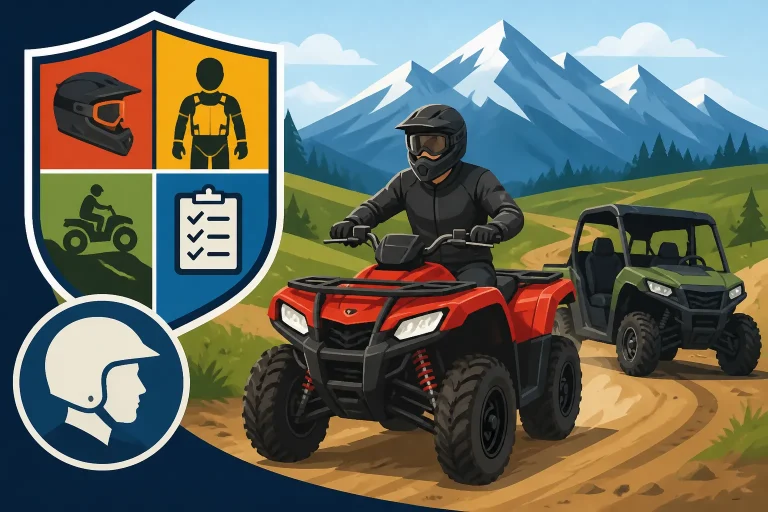
Full-face helmets offer more coverage around the face and chin than open-face styles. Riders should also consider eye protection. Dust, branches, wind and debris can make it difficult to see clearly, especially when riding behind other machines. A face shield or goggles should fit comfortably with the helmet and stay secure during movement.
A UTV’s cab is not a reason to leave the helmet behind. Before riding, check the vehicle’s occupant restraints and use them as intended. For young passengers, proper seating and restraints are important, but they do not replace a helmet. Review Montana Seat Belt Rules in a Side-by-Side and [Montana Helmet Rules for a Passenger Under 18] when planning a UTV ride with children.
ATV passengers need special attention because many ATVs are designed for a single operator. Never treat a helmet as a fix for a seat, passenger position or machine that is not designed for two people. The young rider’s ability to reach the footrests and hold on safely also matters. If the machine is too large or the rider cannot maintain a stable position, choose a different activity or vehicle.
Buying and checking equipment
A helmet’s appearance or product description alone is not proof that it meets the required standard. Check the actual label and product documentation, and buy from a seller that can clearly identify the model and its compliance information. Online marketplaces such as Amazon may list many options, but verify the exact helmet model, certification marking, sizing details and return policy before relying on a listing.
If you are buying for a growing rider, prioritize a proper fit over buying a helmet to “grow into.” A loose helmet can shift in a crash. Have the rider try it on with the strap fastened, and recheck the fit periodically during the season. If a shop cannot explain the helmet’s certification or the helmet lacks clear markings, choose another option.
Planning rides with young operators and passengers
Helmet preparation is one part of a larger safety plan. Before starting, confirm that the young rider is allowed to operate the machine, that the route is appropriate for their experience and that the vehicle is sized for them. An adult should also explain how to stop, what to do if separated from the group and which areas are off limits.
Montana has age and safety education rules that can affect young operators. Those rules are separate from the helmet requirement: taking a safety course does not remove the need for a helmet, and having a helmet does not satisfy an age or training requirement. Review Montana’s Safety Education Requirement and Montana Age Rules for Riders Under 16 before deciding who may operate the machine.
For a group ride, make helmets part of the departure check for every rider under 18. A quick check can catch a loose strap, a helmet left in the truck or a passenger who has been told that the UTV cab is enough protection. It also gives the adult a chance to check that the child’s helmet still fits and that eye protection is ready.
A practical pre-ride routine:
- Confirm the route is open to your type of OHV and that you have any required permits.
- Check each rider’s age, training and role as operator or passenger.
- Make sure every rider under 18 has a properly fitted helmet.
- Fasten and check chin straps before the machine moves.
- Confirm that the machine has appropriate seating and restraints for each occupant.
- Explain the route, signals, stopping points and what to do if the group becomes separated.
- Recheck conditions if the route changes from trail to road or crosses into another land-management area.
If you are visiting Montana, do not assume that a home-state helmet rule or registration automatically governs the ride. Montana rules apply to riding in Montana, while your own state may have additional requirements for a machine taken home. The permit itself does not determine the helmet standard. Montana’s Non-Resident Temporary Use Permit explains the visitor permit issue, and Riding a Montana Machine in Another State covers the separate question of taking a machine across state lines.
Rental groups should confirm helmet availability before the trip, especially when a child is riding. Ask whether the shop supplies helmets in the correct sizes, whether riders may bring their own, and what equipment the contract requires. Do not wait until check-in to discover that the available helmets do not fit a young passenger.
Common mistakes to avoid
Assuming a passenger is exempt. The rule is not limited to the operator. A young person riding in a UTV or on an ATV should wear a helmet in public-use riding settings.
Treating a UTV cab as equivalent to a helmet. A roof, roll cage, doors and seat belts provide different kinds of protection. They do not replace a helmet for a rider under 18.
Assuming a trail pass covers safety requirements. A permit or pass relates to access or use. It does not cancel helmet, age, training or equipment requirements.
Relying on the machine’s registration to answer the question. Registration status does not establish whether the rider is allowed to operate the machine, whether the route is open or whether the rider needs a helmet.
Using a helmet with an unclear certification. Decorative graphics, a product title or a seller’s broad claim are not enough. Check the physical marking and documentation for the specific model.
Passing down a damaged or poorly fitting helmet. A helmet with an unknown impact history or a loose fit should not be used just because it looks serviceable.
Assuming private property has no rules. Landowner permission and property boundaries matter, but other rules may still apply. Confirm the requirements for the specific land and route.
Forgetting that road use is a separate question. An OHV may be allowed on one road but not another. A helmet does not make road access legal, and road access does not remove the helmet obligation for a young rider.
A dependable family rule is to require helmets for every rider under 18, check the fit before each ride and confirm the route and machine rules separately. That approach is straightforward for mixed groups, rentals and rides that move between trails and roads.
Frequently Asked Questions
Does a passenger under 18 have to wear a helmet in a UTV?
Yes. A young passenger should wear a helmet in public-use OHV settings. A UTV cab, roof, roll cage or seat belt does not replace the helmet.
Does a helmet allow a young rider to operate any ATV?
No. Helmet use does not override age, training, supervision, passenger or machine-suitability rules. Check the requirements for the rider’s age and the specific machine.
Do visitors need to follow Montana’s helmet rules?
Visitors riding in Montana should follow the applicable Montana rules. A permit, home-state registration or out-of-state helmet rule does not automatically replace Montana requirements.
Can a young rider wear any helmet with a DOT sticker?
Do not rely on a sticker alone. Check that the helmet is genuine, correctly labeled, suitable for the activity and the right size. Follow the applicable standard and manufacturer’s instructions.
Disclaimer
This article is for general informational purposes only and does not constitute professional advice. Laws, prices and regulations vary by location and change over time. Consult a qualified professional for guidance on your specific situation.