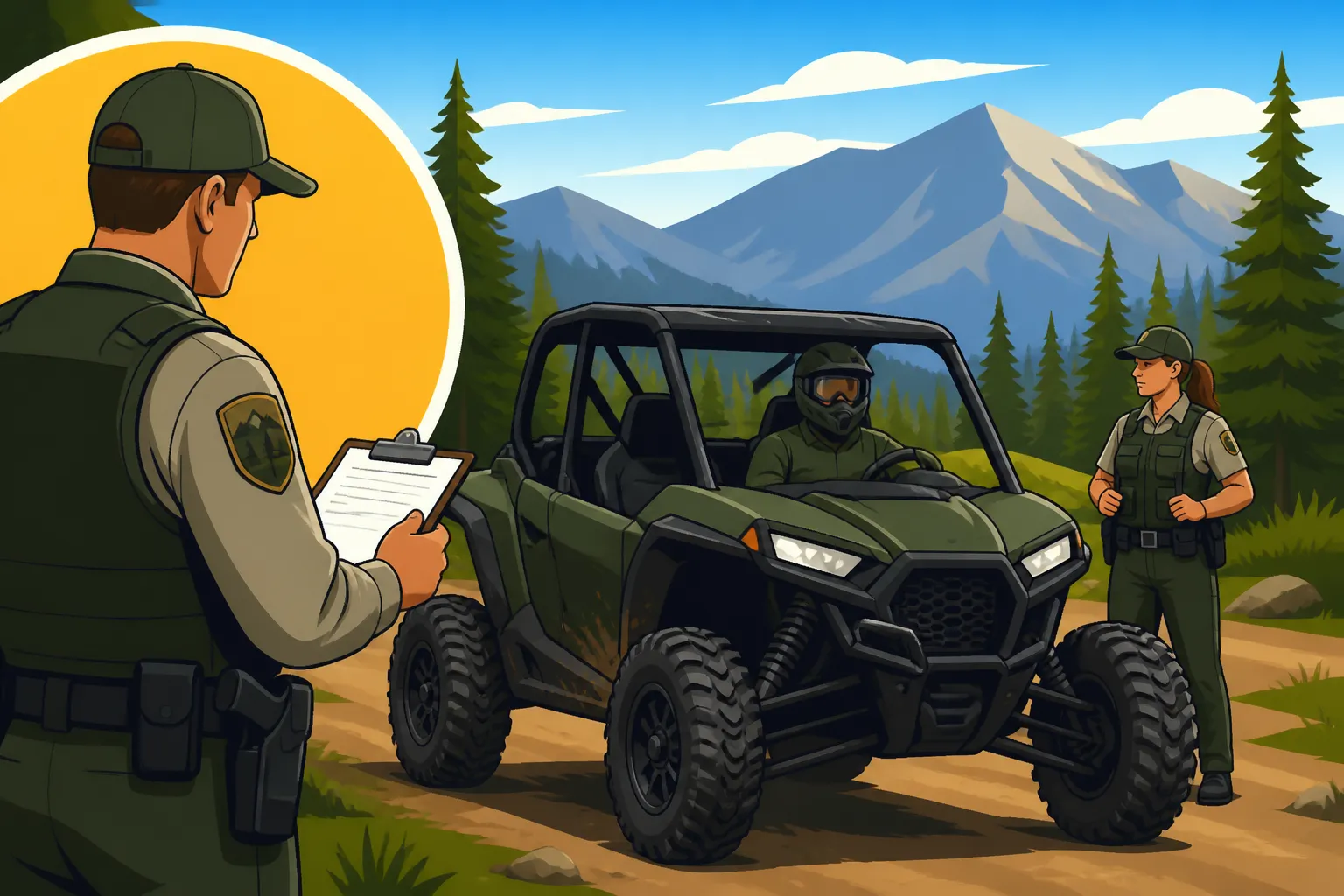
Montana Warden and Deputy Checkpoints
A Montana trail ride can bring you through a warden or deputy checkpoint, especially near a busy access point or during a focused enforcement operation. Knowing what an officer may ask for, which documents to keep handy, and how to handle a disagreement can make the stop calmer. The key is to understand that permits, registration, and road-use rules are separate questions.
Why wardens and deputies may stop riders
A checkpoint may be set up to check compliance, respond to a specific safety or wildlife concern, or manage traffic at a recreation area. An officer may also stop an individual machine after observing a suspected violation or unsafe riding. The reason and scope of an encounter depend on the circumstances; seeing a marked vehicle does not mean every rider is automatically being stopped.
Montana Fish, Wildlife & Parks wardens focus on wildlife and outdoor-recreation laws. A county deputy may address traffic, public safety, and other laws within the deputy’s authority. Their roles can overlap during recreation-area enforcement. Neither the uniform nor the location alone tells you exactly which rules are being checked.
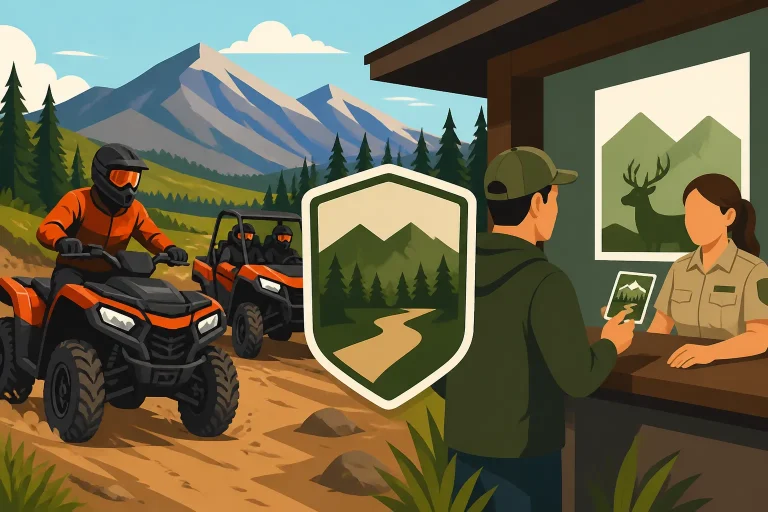
At an OHV stop, officers may ask about the machine’s authorization to operate in that place, its registration or title status where relevant, and whether the operator is following applicable riding rules. They may also ask questions connected to a suspected violation, such as where the machine has been riding or whether the group has permission to use a route.
A checkpoint is not necessarily a sign that you have done something wrong. A polite, routine document check may be aimed at several machines in the area. Still, a permit for one purpose does not automatically authorize every kind of riding. For example, permission to use a trail and permission to ride a road are different issues. Review Montana Permit Rules on Public Land before assuming a pass covers your planned route.
What officers may ask to see
The documents that matter depend on the machine, the location, and the reason for the stop. An officer may ask for proof of a required permit or pass, or for registration or ownership paperwork when relevant. A rider may also be asked about age, supervision, equipment, or authorization to ride a particular road or parcel.
A Montana title is not the same as an OHV permit. A title helps establish ownership; it does not by itself prove that a machine has the required trail authorization or that a particular road is open to OHVs. Similarly, a permit does not settle whether a machine is registered, whether the operator can use a road, or whether the route is open. What Montana Riders Need Before They Ride explains how those requirements fit together.
If you have a rental or borrowed machine, the shop or owner may handle some paperwork, but you should not assume that the operator’s documents travel with the machine or cover every rider. Ask what has been provided and what each document authorizes. For a rented machine, Montana Permit Rules for a Rented Machine is a useful starting point; for a borrowed one, see Montana Permits for a Borrowed Machine.
| What may come up at a stop | What it helps establish | What it does not establish by itself |
|---|---|---|
| Trail pass or permit | Authorization for a defined type of use, if required | That every road or trail is open |
| Registration paperwork | Registration status where applicable | Ownership in every situation or permission to ride a closed route |
| Title or ownership document | Evidence related to ownership | Current trail authorization |
| Route map or access information | Where you intended to ride and how you planned the route | That the route is currently open or legally accessible |
| Rider identification or safety certificate, when applicable | Information relevant to operator rules | That the machine or route meets every requirement |
Exact document requirements can vary with the machine and the riding situation. Confirm current requirements before the trip rather than relying on a document list from an older ride or a different state.
What to do during a checkpoint
A calm, predictable response usually makes a roadside interaction easier. Stop where directed, keep your hands visible, and avoid reaching suddenly into a storage box, pocket, or pack. If you need to retrieve paperwork, tell the officer where it is and wait for a direction if the officer is close to the machine.
Answer questions clearly and truthfully. If you do not understand what is being asked, say so and ask for the question to be repeated. Do not guess about where a route goes or claim that a permit covers an area if you are unsure. It is better to explain what you know and show the map or paperwork you have.
Keep required documents accessible, but secure them so they are not likely to be lost on the trail. A phone can help you show a digital record, but battery failure, weak coverage, a damaged screen, or a file that will not load can make it unreliable. If a paper copy is accepted for your document, carrying one as a backup can prevent a dead battery from turning a simple check into a delay.
If you are riding in a group, let one person speak for the group unless the officer asks others direct questions. Passengers should remain seated and avoid talking over the operator. Do not start the engine or move the machine until told that you may leave.
If the officer says a permit is missing, ask which requirement applies and what document or action would resolve the issue. You can request clarification without arguing beside the trail. If you disagree with a citation or the officer’s interpretation, stay respectful and use the formal process for contesting it rather than trying to settle the dispute at the checkpoint. Appealing a Montana OHV Citation covers that next step.
A checkpoint can also reveal an unexpected problem, such as a route closure, an authorization that does not cover your machine, or a mismatch between the paperwork and the machine. Do not ride away on a route you have just been told is closed. Ask whether there is a lawful way to turn around or reach the trailhead, and follow the officer’s instructions.
Questions, searches, and disagreements
A request to show a permit or other document is not automatically the same as a request to search your bags or machine. If an officer asks to look through a compartment, you can calmly ask whether the officer is requesting consent or requiring you to do so. If you do not consent to a search, say that clearly and politely; do not physically block the officer or interfere.
The rules that govern a search depend on the facts and applicable law. A roadside conversation is not the place to make a forceful legal argument or physically resist. If you believe your rights were violated, write down what happened as soon as you can, keep any paperwork, and seek advice from a qualified attorney.
Likewise, a citation is not proof that you have no options, but refusing to cooperate or making the stop confrontational can make matters worse. Ask how to obtain a copy of the citation and how to respond. Keep the citation, any permit records, maps, receipts, and notes about the route together.
Prepare before riding
The best way to avoid a permit-related surprise is to check the machine, route, and authorization separately before leaving. Do not use a previous rider’s experience as proof that the same access is still available. Closures, route rules, and permit requirements can differ by land manager and can change.
- Identify where you will ride. Note whether the route is on public land, a county road, private property, or a mix. A trail shown on a map may connect to a road with different rules.
- Check the current route information. Confirm that the route is open to your type of machine and that access is allowed for the dates you plan to ride. For public land, use the relevant official maps and notices; see Finding a Forest’s Motor Vehicle Use Map.
- Check the authorization that applies to your trip. Determine whether you need a resident pass, a nonresident permit, registration, or something else. Do not assume that a permit for one machine covers another. Montana’s Non-Resident Temporary Use Permit explains a common visitor question.
- Check machine and rider requirements. Consider the machine’s registration status, equipment, operator age, and any supervision or safety-education rules that may apply. A pass does not excuse compliance with those rules.
- Keep proof accessible. Store paper documents where they can be reached without unloading the machine. Save digital records offline and consider carrying a backup where appropriate.
- Tell your group the plan. Make sure every operator knows the route, where the paperwork is, and what to do if the group is stopped or separated.
Visitors should be particularly careful not to assume that an out-of-state registration automatically substitutes for Montana trail authorization. Reciprocity is not a general guarantee that another state’s documents cover every Montana use. Read Reciprocity Montana Does Not Offer and Montana Rules for Visiting Riders before relying on home-state paperwork.
Owners should also separate registration from access. Permanent registration, a title, a trail pass, and a nonresident permit serve different purposes. A machine can have evidence of ownership and still lack the authorization needed for a particular ride. Conversely, having a trail permit does not prove that the machine’s ownership paperwork is complete. What Permanent OHV Registration Includes can help clarify what registration does and does not provide.
If the checkpoint reveals a problem
If you discover that your pass is missing or you cannot prove that you have the right authorization, do not continue riding while hoping the issue will go unnoticed. Ask the officer what the immediate options are. Depending on the location and circumstances, the next step may involve turning around, leaving the route, or correcting paperwork before riding again. Do not assume that buying a permit after a stop will erase a violation that may already have occurred.
If your documents are present but do not match the machine, pause before continuing. A wrong VIN, an ownership transfer that was never completed, or a registration that belongs to a prior owner can create questions during a stop. Keep the seller’s paperwork and other ownership records together and resolve inconsistencies through the appropriate office. For a recently purchased machine, Re-Registering a Machine You Just Bought may help identify what needs attention.
A checkpoint is also a useful reminder to check route access beyond the permit itself. The route may be closed, the machine may be too wide for a designated trail, or road access may require separate authorization. Why Montana Road Access Depends on Who Owns the Road explains why a road that looks public or passable is not automatically open to OHVs.
Before each ride, check official information for the land you plan to use and confirm any current permit or registration requirements with the responsible agency. Keep your answers courteous, your documents organized, and your group ready to stop safely. Those habits will not guarantee that every question is resolved on the spot, but they help make a checkpoint more straightforward and reduce avoidable confusion.
Disclaimer
This article is for general informational purposes only and does not constitute professional advice. Laws, prices and regulations vary by location and change over time. Consult a qualified professional for guidance on your specific situation.