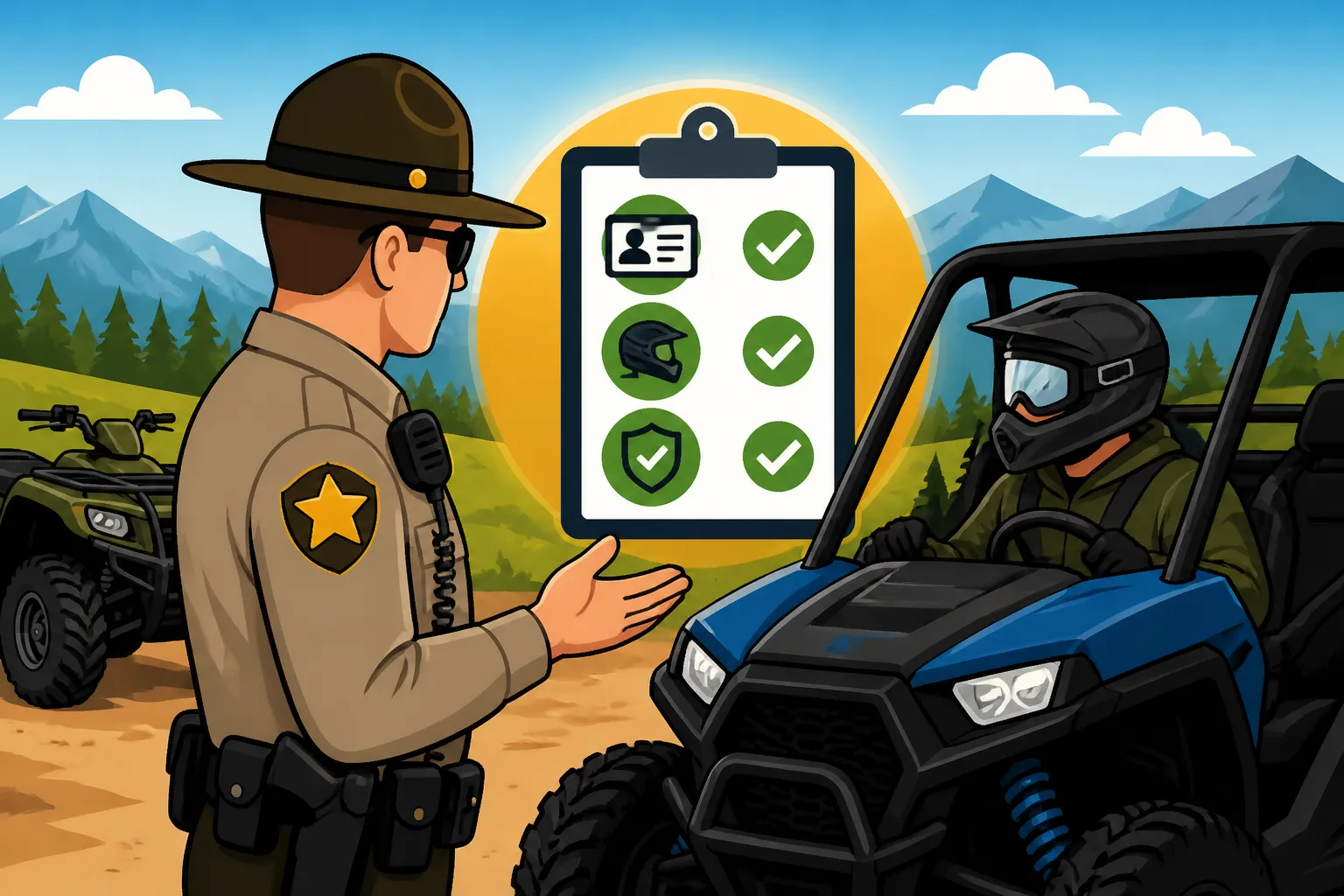
What a Montana Officer Asks For
A roadside or trail stop can feel confusing when you are unsure which papers apply to your machine and route. In Montana, the officer’s questions may differ for a public-land trail, a road section, or private property. Knowing what to carry—and what is not normally needed in your pocket—helps you answer clearly and get back to your ride.
What an Officer May Ask You to Show
There is no single document list that fits every Montana ATV or UTV stop. The requirements depend on whether you are riding on public land, a road open to OHVs, private property, or a mix of those places. Your residency and the machine’s registration status also matter.
An officer may begin with straightforward questions:
- Where did you come from, and where are you going?
- Are you riding on a trail, road, or private property?
- Is the machine registered or permitted for this use?
- Who owns it?
- Do you have the required license, safety credential, or other road-use qualifications for this ride?
The answers help establish which rules apply. For example, a machine being ridden on a public-land trail may need the applicable Montana OHV permit or pass. A road section can bring additional requirements, and road access may depend on the specific road and local authorization. A machine being used on private ground raises different questions from one being operated on a public trail.
A useful starting point is What Montana Riders Need Before They Ride. It helps separate the basic preparation questions from requirements that apply only to certain riders or routes.
On public-land trails
If you are riding a public trail, expect questions about the permit or pass required for your machine and rider status. Montana residents and nonresidents do not necessarily use the same authorization. The officer may want to see the required decal or permit displayed on the machine, rather than rely only on your explanation that you purchased one.
For a nonresident, review Montana’s Non-Resident Temporary Use Permit and What the Non-Resident Permit Covers before heading out. A visitor should not assume that an out-of-state registration, home-state sticker, or permit from another state automatically substitutes for Montana’s required authorization. Montana does not offer blanket reciprocity for every state’s OHV paperwork; check the applicable Montana requirement for the machine and intended use.
Residents should check Montana’s Resident OHV Trail Pass for the authorization that applies to their situation. Registration and trail-access requirements are related but not interchangeable in every circumstance. If your machine’s status is unusual—such as a recent purchase, a rental, or a machine registered outside Montana—verify the details before riding.
On a road or road section
An officer may ask for additional information when the route includes a public road. First, the road must actually be open to OHV use. A road that looks rideable is not automatically authorized, and access can depend on the road owner, local rules, and posted restrictions. Riding an OHV on the Road in Montana explains why road access should be checked separately from trail access.
When an OHV is being operated on a road, an officer may ask for the operator’s driver’s license or other qualification required for that particular use. Depending on the rider’s age and circumstances, a safety education credential may also be relevant. Check Montana OHV Safety Education Requirements before riding, especially if a young rider will operate the machine. Helmet and equipment rules can also differ by rider and road use; Montana Helmet Requirements Under 18 is useful for families planning a ride.
Do not treat a trail pass as permission to ride on any public road. A permit that covers trail use does not, by itself, establish that a road is open to OHVs or that the machine and operator meet road-use requirements.
Which Documents and Permits to Carry
A practical carry setup is one that lets you show the required authorization without turning a short stop into a search through bags or phone screens. Before leaving, match your paperwork to the route and the machine.
| Item | When it may matter | Practical preparation |
|---|---|---|
| Required Montana OHV permit or pass | Public-land riding, depending on residency and machine status | Confirm which authorization applies and make sure any required decal is properly displayed |
| Machine registration information | When an officer checks the machine’s registration status or ownership details | Keep registration information accessible; confirm the machine’s status before riding |
| Driver’s license | Road use or when an officer needs to identify the operator | Carry it if required for your route and circumstances |
| Safety education credential | When age or the type of riding makes a certificate relevant | Carry proof or know how to retrieve it, and confirm that the credential is accepted |
| Insurance information | If insurance is required for the specific road use, or after a collision | Check your policy and applicable road rules; keep proof accessible when required |
| Rental agreement or owner permission | When you do not own the machine | Keep the rental paperwork or clear owner contact information available |
| Route and access information | When road or trail access is unclear | Have a current map or route reference and be ready to explain where you are riding |
The table is a preparation checklist, not a claim that every rider must carry every item on every ride. For example, a title is an ownership record, but it is not usually the everyday document riders need to keep on the machine during a ride. If an officer has a question about ownership, the officer may ask for details or check the machine’s identification number. Carrying a title loose in a vehicle or cargo box can also expose an important document to loss or damage.
Registration papers and a permit are not the same thing. Registration relates to the machine’s registration status. A trail permit or pass relates to the authorization needed for a particular type of riding. Do not assume that having one resolves the other question. For the distinction between the paperwork and the display requirements, see Do You Carry Paperwork on a Montana Trail?.
For a current permit or registration question, use the official process for the applicable authorization before riding. If the machine was just purchased, borrowed, or brought in from another state, make sure you understand how its status affects the ride. Montana Rules for Visiting Riders can help nonresidents identify issues to settle before they reach a trailhead.
Make the permit easy to verify
If the authorization requires a decal or other visible display, attach it where the applicable instructions require. Keeping a receipt on your phone does not necessarily replace a required decal on the machine. Conversely, a decal alone may not answer every question about registration, operator eligibility, or road access.
If you are not sure whether your permit is valid for the planned route, pause and check before unloading. That is especially important when a trip moves from a public trail to a town street, county road, or another land manager’s route. The right paperwork for one part of a ride may not cover the next.
Keep proof readable and protected
Paper documents can be damaged by water, dust, fuel, or repeated handling. A resealable pouch or small waterproof document sleeve can help protect the papers you actually need to carry. If you buy a pouch through Amazon or another retailer, choose one that fits securely in your gear and does not interfere with safe storage or access to the machine’s controls.
Digital copies can be useful backups, but do not rely on a phone alone if the required proof must be displayed physically or if you may lose service or battery power. Keep original documents secure at home when they are not required on the ride.
Special Situations That Change the Questions
Some rides need extra preparation because the machine or operator does not fit the simplest resident-owner scenario. Sorting these out before riding is easier than trying to explain a paperwork gap during a stop.
You are visiting from another state
A home-state registration can be relevant, but it does not automatically answer whether a visiting rider has the Montana authorization required for public-land riding. Check the current nonresident permit rules for each machine you plan to use and confirm what the permit covers. Do not assume a permit purchased for one machine covers every machine in a group.
The officer may ask where you are from, how long you plan to ride, and whether you have the permit required for the route. Be ready to explain which machine belongs to which rider and where the applicable permit is displayed. For questions about other states’ paperwork, see Reciprocity Montana Does Not Offer and confirm the rules for your specific situation.
You recently bought or borrowed the machine
A recent purchase can create a gap between the seller’s paperwork, your ownership documents, and the machine’s current registration or permit status. A bill of sale can help explain how you acquired it, but it does not necessarily replace required registration or trail authorization. Before riding, check what must be completed for the specific machine and route.
A borrowed machine raises a different practical issue: the officer may ask who owns it and whether you have permission to operate it. Keep the owner’s contact information handy, and make sure the owner has not assumed that their own permit automatically covers your use. Read Montana Permits for a Borrowed Machine if someone else’s ATV or UTV will be part of your trip.
You rented the machine
A rental operator may handle some paperwork or explain what is included, but ask rather than assume. Confirm whether the rental includes the required permit, whether the permit is attached to the machine, and which routes the agreement allows. A rental company’s permission to use its machine does not automatically make every road or trail open to it.
Keep the rental agreement available and follow the shop’s route instructions. If you are unsure what the company has arranged, Does a Montana Rental Include the Trail Pass? covers a useful question to ask before leaving the rental location.
A young rider is operating
An officer may ask about the rider’s age, supervision, helmet, and safety education requirements. Those details can affect what is allowed, particularly if the ride uses a road rather than staying on a trail or private property. Do not assume that the rules for an adult rider apply unchanged to a child or teenager.
Parents should confirm requirements for the rider’s age and the planned route before the trip. Keep any required certificate accessible, and make sure the young operator can explain where the group is going and who is supervising.
The machine is being used on private property
A ride on private land is not the same as a ride on a public trail. The landowner’s permission matters, and public-land permit rules may not apply in the same way to a ride confined to private ground. But if the route leaves that property—even briefly—the public-land or road requirements may become relevant.
If a route crosses a public road or reaches public land, do not assume that starting on private property removes the rules for the rest of the trip. Explain the route accurately if asked, and make sure you have permission for the places you are entering.
How to Handle a Stop Calmly and Avoid Problems
A roadside or trail contact is easier when you can answer clearly and show what is required. Stop in a safe place, turn the machine off if instructed or appropriate, and follow the officer’s directions. Keep your hands visible and avoid reaching suddenly into a storage compartment while the officer is speaking with you.
A simple, factual answer is usually better than guessing. If you do not know whether a road is open or which permit applies, say what you know and show the information you have. Do not claim that a pass covers a route unless you have verified that it does. An officer may check the permit, decals, operator qualifications, machine identification, or road-use requirements depending on the circumstances.
Before a ride, use this short sequence:
- Identify every type of route in the plan: trail, road, private land, or a combination.
- Check that each route is open to the machine you are bringing.
- Confirm which permit, pass, registration, or operator credential applies.
- Inspect the machine to make sure required decals or displays are in place and readable.
- Put required documents where the operator can retrieve them without unloading gear or searching through loose items.
- Make sure every rider knows the route, the group’s leader, and who owns or rented each machine.
If an officer says something is missing, stay courteous and ask which requirement applies if you do not understand. Record the details later, and use the appropriate official channel to clarify a disputed requirement. Do not argue on the trail or attempt to ride away while a question is unresolved.
The most reliable preparation is not carrying every document you own. It is knowing what the route requires, having the applicable permit correctly displayed, and keeping the supporting documents you may need within reach. Recheck requirements after a route change, a machine purchase, or a change in rider status. That small review can prevent a permit issue from disrupting the day.
Disclaimer
This article is for general informational purposes only and does not constitute professional advice. Laws, prices and regulations vary by location and change over time. Consult a qualified professional for guidance on your specific situation.