What a Montana Warden Asks a Rider For
There's nothing quite like the feeling of hitting a Montana trail, the engine purring beneath you, the Big Sky country unfolding in every direction. But that peace of mind can quickly vanish if you see flashing lights in your rearview mirror, or a warden steps out from behind a stand of pines. Being stopped by a game warden or sheriff's deputy while out on your ATV or UTV can be a nerve-wracking experience, but knowing exactly what they might ask for and why can turn that moment of anxiety into a quick, respectful interaction. This guide will walk you through the common questions and requests you'll encounter from a Montana warden, helping you ride confidently and legally.
Essential Documents a Montana Warden Expects to See
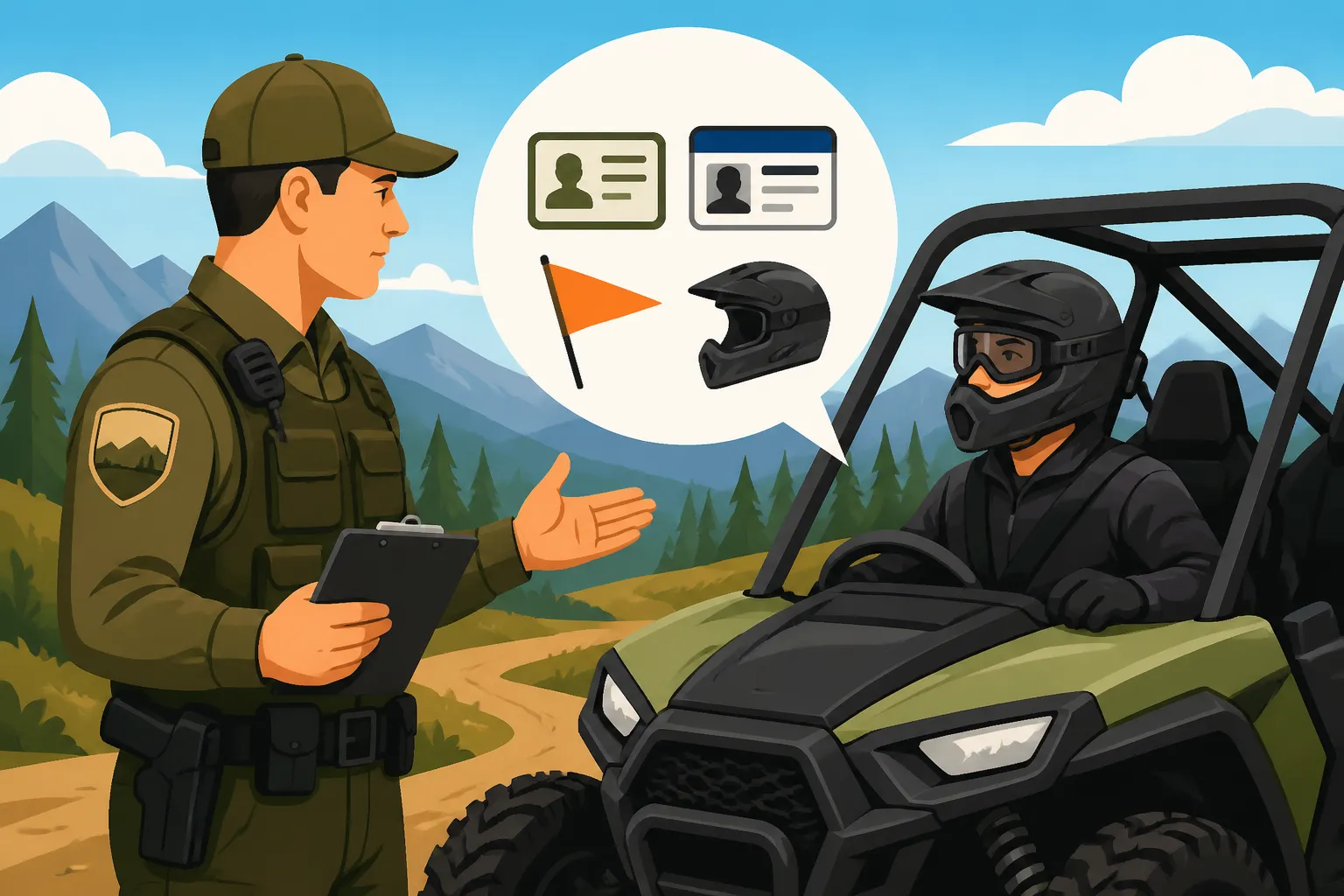
When a warden signals you to pull over, their primary goal is usually to ensure you're operating your off-highway vehicle (OHV) safely and legally. The first thing they'll likely ask for are your essential documents. Think of it like a traffic stop in your truck – you need to prove who you are, that the machine is yours, and that it's allowed to be where it is. Having these papers readily accessible, in a waterproof bag or pouch on your machine, can make the interaction smooth and quick.
Proof of Ownership and Registration
This is foundational. Every OHV operated on public lands in Montana needs to be properly registered. When a warden asks for proof of ownership, they're looking for the official document that links you to the machine. This could be your title, or if you're the registered owner but don't carry the title, your current registration certificate. The important thing is that the name on the registration matches your identification.
For example, if you just bought a used side-by-side from a private seller last week, and you haven't had a chance to visit the county treasurer yet, you might only have a bill of sale. A warden will still want to see that bill of sale, along with your ID, to verify the transfer of ownership. It’s always a good idea to have a clear, well-documented bill of sale when buying privately. Services like LawDepot can help you generate comprehensive legal documents, including a bill of sale, to ensure you have proper proof, which is incredibly helpful if you're ever stopped before the official title or [Titling an OHV in Montana] is complete. They'll compare the VIN on your paperwork to the VIN on the machine, so make sure those numbers match perfectly. If you're a new resident, you have a deadline to get your machine registered here, and wardens understand that transition period, but they still expect to see your documentation.
Your Driver's License or ID
Just like driving a car, you need to identify yourself when operating an OHV. A warden will ask for your driver's license or another form of government-issued identification. This helps them verify your identity and, if you're operating on a county road or another designated route where a driver's license is required, confirm you meet that specific legal requirement.
It's not just about proving you're old enough to ride; it's about accountability. In the event of an accident or if there are other issues, your identification is crucial. Keep your ID separate from your machine's paperwork, perhaps in your wallet or a pocket, so you can easily access it. Remember, if you're operating an OHV on a public road, even a designated county road, your driver's license is absolutely mandatory. For more on this, check out [Do You Need a Driver's License to Ride a Montana Road?].
OHV Safety Education Certificate (for certain riders)
Montana has specific rules for younger riders regarding OHV safety education. If you're between the ages of 12 and 18, and operating an OHV on public lands, you generally need to have completed an approved OHV safety education course and carry proof of that completion. A warden will certainly ask for this if you appear to be in that age range.
This isn't just a formality; it's about ensuring young riders understand the risks and proper operation of these powerful machines. Imagine a young rider on a borrowed machine, cruising through a state park. If a warden stops them, asking for that certificate ensures they've had the proper training. Even if you're an adult, knowing the rules outlined in a safety course can prevent common mistakes. This requirement helps keep everyone on the trails safer. You can learn more about this by reading [Montana's Safety Education Requirement].
Other Relevant Permits or Licenses
Depending on where and when you're riding, a warden might ask for additional permits. For instance, if you're riding on state lands, or specifically within a state park or a designated trail system, you might need a Montana OHV Trail Pass, especially if you're a non-resident. If you're riding during hunting season and carrying a firearm, they might also ask to see your hunting license and ensure you're following all hunting regulations while operating your machine.
Consider a scenario where you're deep in the Custer Gallatin National Forest, packing out an elk during hunting season. Not only will the warden be looking for your OHV registration and proof of ownership, but they’ll also want to see your hunting license. If you're using your OHV to retrieve game, there are specific rules about how far off-trail you can go. Having all these permits in order shows you're a responsible recreationist. For specific insights into hunting season rules, refer to [Montana OHV Rules During Elk Season].
| Document Type | Purpose | Who Needs It | Where to Get It |
|---|---|---|---|
| Registration | Proves machine is legally allowed on public lands | All OHV operators on public land | Montana County Treasurer |
| Proof of Ownership | Shows you legally own the machine (title, bill of sale) | All OHV owners | Seller (Bill of Sale), County Treasurer (Title) |
| Driver's License | Identifies operator; required for road use | All OHV operators, especially on public roads/trails | State Department of Motor Vehicles (DMV) |
| Safety Certificate | Ensures proper training for young riders | Riders 12-18 on public land | Approved OHV safety course providers |
| Trail Pass/Permit | Grants access to specific state lands or trail systems | Non-residents, or residents on specific trails | FWP online licensing, County Treasurers, some vendors |
| Hunting/Fishing Lic | Required if engaging in these activities while operating OHV | Hunters/Fishers using OHV to access areas | FWP online licensing, authorized vendors |
Machine-Specific Details a Warden Will Inspect
Beyond your personal documents, a Montana warden will also be paying close attention to your OHV itself. They're looking for signs that it's in proper working order, legally equipped, and not causing undue environmental impact. These inspections are about safety for you and other riders, and protecting Montana's natural resources.
Registration Decals and Plate Placement
One of the first things a warden spots, even from a distance, is your OHV registration decal. Montana requires these decals to be clearly visible on the machine, usually on the rear or side. If you're operating a side-by-side, the decal placement might be slightly different than a quad. The warden will check to ensure the decal is current and properly affixed.
Imagine you're riding a scenic two-track in the Lolo National Forest. A warden might just be driving by and notice your decals are missing or expired. That's a quick and easy reason for them to pull you over. They'll also check if the decals match the machine you're operating. A common mistake is buying a machine and forgetting to update the decals right away. Always ensure your [Montana OHV Decals and Rear Placement] are correct and current.
Required Safety Equipment
Montana has specific equipment requirements for OHVs, particularly when they're ridden on public roads or trails. A warden will check for things like working headlights and taillights, especially if you're riding near dusk or in low-light conditions. They'll also ensure your brakes are functional and that you have a rearview mirror if required for road use.
This isn't just about avoiding a ticket; it's about your safety and the safety of others. Picture this: you're coming down a winding forest road after a long day of riding, and the sun is starting to dip below the peaks. If your taillights aren't working, another rider or vehicle might not see you. Wardens are also looking for a properly installed spark arrester on your exhaust, which is critical for preventing wildfires in Montana's dry summers. For more details on what your machine needs to have, review [Headlight and Taillight Rules in Montana] and [Muffler and Spark Arresters in Montana].
Verification of VIN Number
Just as they'll check the VIN on your documents, a warden will physically locate and verify the Vehicle Identification Number (VIN) on your ATV or UTV. This crucial step confirms that the machine you're operating is indeed the one described in your registration and ownership papers. This helps prevent theft and ensures that stolen machines aren't being unknowingly (or knowingly) operated on public lands.
Finding the VIN can sometimes be a little tricky, as manufacturers place them in different spots. On a side-by-side, for example, it might be on the frame near a wheel well, under the seat, or in the engine compartment. If you're unsure where yours is, take some time before your next ride to locate it. This small check by a warden can quickly clear up any discrepancies or, unfortunately, flag a potentially stolen machine. Make sure to know [Where a Side-by-Side Hides Its VIN] on your particular model.
Understanding Your Rights and Responsibilities During a Stop
Being stopped by law enforcement, even a game warden, can be intimidating. Knowing your rights and responsibilities can help you navigate the interaction respectfully and efficiently. Remember, wardens are typically out there to educate and ensure compliance, not just to issue tickets.
Cooperating with the Warden's Requests
The best approach is always to be cooperative and respectful. When a warden asks you to pull over, do so safely and in a visible spot. Turn off your engine, remove your helmet if requested, and keep your hands visible. Present your documents promptly when asked. Arguing or being uncooperative can escalate the situation unnecessarily.
Wardens often have extensive knowledge of the local terrain, wildlife, and OHV regulations. They're a resource for information as much as they are an enforcement arm. If you have questions about specific trail access, seasonal closures, or rules, a stop can sometimes turn into an educational conversation. However, remember they are also enforcing the law.
Laws Regarding Alcohol and Drugs
Just like operating a motor vehicle on the highway, operating an OHV under the influence of alcohol or drugs is illegal and extremely dangerous in Montana. A warden will be trained to look for signs of impairment, and if they suspect you've been drinking or using drugs, they will investigate further. This could involve field sobriety tests.
The same blood alcohol concentration (BAC) limits that apply to driving a car apply to operating an OHV on public roads and trails. The consequences of an OHV DUI can be severe, including fines, loss of riding privileges, and even jail time. Your safety, and the safety of others, depends on sober operation. For more on this, check out [Montana Alcohol Limits for OHV Operators].
Trespass and Land Use Rules
Montana is a state with vast public lands, but also extensive private property. Wardens are vigilant about trespass violations. They will ask if you know whose land you are on, especially if you are near boundaries or in areas that might be ambiguous. Riding on private land without permission, or going off designated trails onto sensitive areas, is a serious offense.
This is where local knowledge and good map-reading skills come into play. Always consult a Motor Vehicle Use Map (MVUM) for forest service roads and trails. These maps clearly show what's open to OHVs and what's not. If you're on private land, ensure you have explicit permission. [Montana Trespass Law for Riders] is something every OHV enthusiast should be familiar with, as violations can lead to hefty fines and even loss of equipment.
Common Reasons for a Stop and How to Avoid Them
While some stops are random checks, many are initiated because a warden observes something that raises a red flag. Knowing these common reasons can help you avoid unnecessary interactions and ensure your ride is uninterrupted.
Unregistered or Improperly Registered Machine
This is probably the most common reason for a stop. If your OHV's registration is expired, or if you're operating a machine that was never registered in Montana, a warden will almost certainly pull you over. The state has invested in OHV trails, and registration fees help maintain them.
Make it a habit to check your registration expiration date annually. If you just bought a new-to-you machine, make getting it registered at the county treasurer a priority. Delays in registration, especially for out-of-state buyers, can quickly lead to penalties. The fees for an unregistered machine can be significant, so it's always worth the small effort to stay current. This issue is often covered in [Fines for an Unregistered OHV in Montana].
Missing or Expired OHV Decal
Closely related to registration, a missing or expired decal is another easy catch for a warden. These decals are visual proof of current registration. If yours has peeled off, faded, or simply expired, you're signaling to law enforcement that your machine might not be legal to ride.
It's tempting to put off replacing a peeling decal, especially after a long winter. But don't wait. Wardens are trained to spot these discrepancies. You can usually get a replacement decal from your county treasurer if yours is damaged or lost. Just make sure the original registration is current. Consider the guidance in [Replacing a Montana OHV Decal] to ensure you're always compliant.
Illegal Road Riding
Montana has specific rules about where OHVs can and cannot operate on public roads. While some county roads and municipal streets are open to OHVs by local ordinance, state highways and federal interstates are generally off-limits. Riding your ATV or UTV on an unauthorized road is a clear signal to a warden that you might be in violation.
This is a hot topic and can vary greatly from one county to the next, and even from one town to the next. Always research the local ordinances for the area you plan to ride. Don't assume that because you see one OHV on a particular road, it's legal for everyone. Ignorance of the law is not an excuse. Many riders, especially visitors, often get [Montana Road Rules Riders Get Wrong] and end up getting stopped.
Riding Off Designated Trails or in Closed Areas
Montana's public lands are often managed with specific guidelines to protect fragile ecosystems, wildlife habitats, or archaeological sites. Riding off designated trails, crossing closed areas, or otherwise engaging in resource damage is something wardens take very seriously. They are often patrolling areas specifically to prevent this type of activity.
These rules are in place to preserve the very landscapes we love to ride in. Going around a "Closed" sign, or cutting a new trail through the backcountry, isn't just disrespectful; it's illegal. Wardens use their knowledge of the land, sometimes even aerial surveillance, to identify these violations. Always stick to marked trails and respect all closure signs to ensure these pristine areas remain open for future generations.
Disclaimer
This article is for general informational purposes only and does not constitute professional advice. Laws, prices and regulations vary by location and change over time. Consult a qualified professional for guidance on your specific situation.