Montana Passenger Rules on a Road Section
Navigating Montana's vast and beautiful landscapes on an ATV or UTV is an absolute dream, but when you decide to take that adventure onto a public road, things can get a little tricky, especially when you're bringing passengers along. It's not always clear what the state expects, and the last thing anyone wants is a run-in with law enforcement or, worse, a preventable accident. This guide is here to clear up the confusion, walking you through Montana's specific rules for carrying passengers on your off-highway vehicle when you're on a designated road section.
The Basics of Montana's OHV Road Access and Passengers
Riding an off-highway vehicle (OHV) in Montana is often about freedom and exploration, but that freedom comes with a significant responsibility, particularly when you transition from private land or dedicated trails to public roads. The moment your tires hit asphalt or a graded county road, you're entering a different regulatory world, and the rules around passengers become much more stringent. It's not just about what your machine can physically carry; it's about what the law says is safe and permissible.
Why Road Rules Change the Game for Passengers
On a private ranch or a remote trail, the "rules" might be more about common sense, the owner's discretion, and your own risk assessment. You might cram an extra person onto the back of a quad for a quick hop across the field, or have three people in the bed of a UTV going slow down a two-track. But the moment you venture onto a public road—whether it's a quiet county road, a small town's main street, or even just crossing a highway—the game changes entirely. The state has a vested interest in public safety, and OHVs on roads present unique challenges due to their design, speed capabilities, and interaction with traditional motor vehicles. This means that passenger rules, which might seem arbitrary on a trail, become legally binding requirements when you're sharing the road. Ignoring these rules can lead to fines, citations, and in the worst-case scenario, serious liability issues if an accident occurs. It's a fundamental shift from recreational trail riding to operating a registered vehicle within a regulated traffic system. You're no longer just enjoying the outdoors; you're a part of the greater traffic flow, subject to the same scrutiny as any car or truck. Understanding [What Montana Requires on an OHV Road Ride] is crucial here, as it lays the groundwork for all other regulations.
General Passenger Capacity for OHVs
The most fundamental rule regarding passengers on an OHV, especially on a road, is dictated by the machine's design and manufacturer specifications. Simply put, an OHV can only carry as many passengers as it was designed and equipped to carry. For ATVs, this generally means one operator and no passengers, unless the ATV is specifically designed by the manufacturer for two riders, often identifiable by an extended seat and footpegs for a second person. These are sometimes called "two-up" ATVs. Trying to squeeze a passenger onto a single-seat ATV, even for a short distance, is a recipe for instability and a definite violation of road rules in Montana.
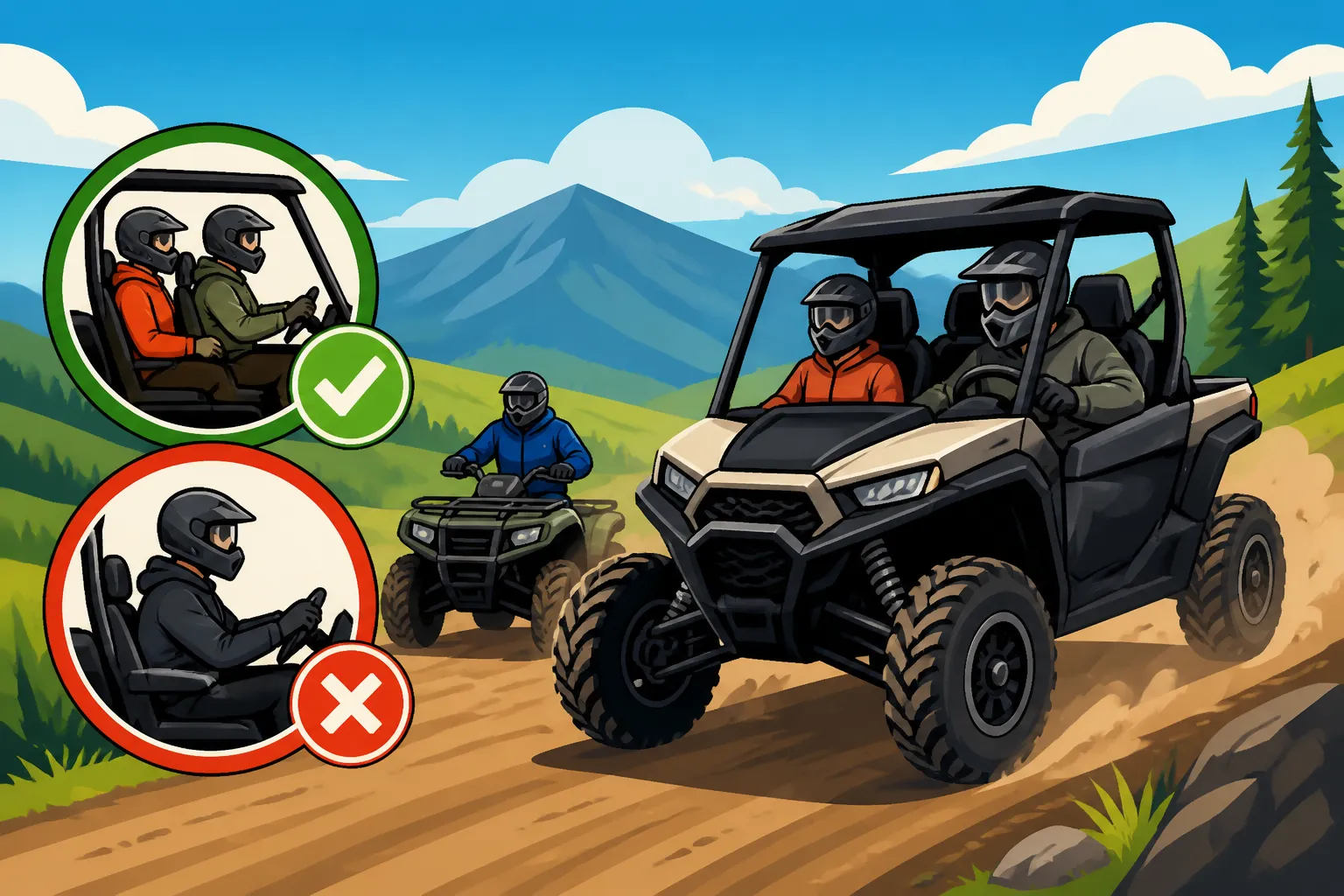
For UTVs (side-by-sides), the situation is usually more straightforward as they come equipped with multiple seats, seatbelts, and often roll cages. The number of designated seating positions, each with its own seatbelt, determines the maximum number of passengers you can legally carry. For example, a UTV with two bucket seats is for two people. A UTV with a bench seat designed for three is for three. You can't have two small kids and an adult crammed onto a bench seat meant for two, even if they physically fit. Each person needs their own designated, secured seating position. This isn't just a legal nicety; it's a critical safety measure. Overloading an OHV, especially on a road where speeds can be higher and maneuvers more abrupt, significantly compromises handling, braking, and stability, putting everyone at risk.
Age and Supervision for Young Passengers on Montana Roads
When children are involved, Montana's rules for OHV operation, especially on roads, become even more specific and protective. The state recognizes that young passengers have different needs and vulnerabilities, and places a strong emphasis on ensuring their safety through age restrictions, supervision requirements, and proper training. It’s not just about fitting them into a seat; it's about their understanding of safety and their physical ability to withstand the rigors of road travel.
Riders Under 12 and the Roadway
Montana law has clear stipulations regarding how young passengers can ride in or on an OHV, particularly when that machine is operating on a public road. Generally, children under the age of 12 face significant restrictions. They often cannot operate an OHV on a public roadway, and their ability to ride as a passenger might also be limited depending on the machine type and the specific road. For instance, on roads where OHV use is permitted, younger children typically must be able to reach the footrests and hold onto the handholds, or be secured by a seatbelt in a UTV, ensuring they can safely maintain their position.
There's a critical distinction to be made here between riding on private land and riding on a public road. A child might be perfectly safe and allowed to ride as a passenger on a family ranch, but taking that same child on a side-by-side down a county road requires adherence to stricter age-based guidelines. The operator's judgment, while always important, is superseded by state law in these scenarios. Always confirm the specific age restrictions for passengers on road-legal OHVs, as these are designed to protect the youngest and most vulnerable riders from the inherent dangers of sharing the road with other vehicles. These rules tie into the broader [Montana Age Rules for Riders Under 16].
Teen Passengers and Safety Education
As children get older and enter their teenage years, some of the stricter age-based restrictions might ease, but new requirements related to safety education often come into play. While typically focused on operators, sometimes states recommend or require safety courses for passengers of a certain age, or at least for the operators who carry them. In Montana, ensuring your teen passenger is safe often involves them understanding basic riding etiquette and safety principles, even if they aren't actively operating the machine.
For a teen riding as a passenger, particularly in a UTV with seatbelts, the key is still proper securement and understanding the operator's instructions. While a formal safety course might not be mandated for passengers, it's highly advisable for the operator to have completed [Montana's Safety Education Requirement]. An educated operator is better equipped to teach their passengers safe practices and to respond appropriately to different road conditions. Teenagers are often eager to explore, but their enthusiasm must always be tempered with strict adherence to safety rules, especially on public roadways where they are exposed to traffic.
Supervising Youth: The Adult's Responsibility
When you have a minor as a passenger on your OHV on a public road, the adult operator carries a tremendous amount of responsibility. This isn't just about following the letter of the law; it's about making sound judgments that prioritize the child's safety above all else. The adult operator must ensure that the child is appropriately seated, wearing all required safety gear, and understands the importance of staying put and following instructions. They are also responsible for choosing routes and speeds that are safe for the minor's experience and comfort level.
This responsibility extends beyond just the initial setup. Throughout the ride, the adult needs to remain vigilant, constantly assessing road conditions, traffic, and the child's well-being. If a child becomes restless, uncomfortable, or scared, the adult must take action, whether that means pulling over, slowing down, or choosing an alternative route. Remember, an OHV ride on a public road exposes children to faster speeds, other vehicles, and potentially uneven surfaces, making the adult's supervision and decision-making paramount. It's not just a fun outing; it's a serious commitment to safeguarding your young passengers.
Safety Gear Requirements for Passengers on Montana Roads
Safety gear isn't just for the person behind the handlebars or steering wheel; it's equally, if not more, critical for passengers, especially when you're riding on public roads in Montana. The risks associated with road riding – higher speeds, potential collisions with other vehicles, and unexpected maneuvers – necessitate specific protective measures for everyone on board. Skipping out on proper gear for a passenger is a gamble no responsible operator should take.
Helmet Laws for Younger Passengers
Montana has specific helmet laws that apply to OHV operators and passengers, particularly for those under a certain age, when operating on public roads. For any passenger under the age of 18, wearing an approved helmet is typically mandatory. This isn't a suggestion; it's a legal requirement designed to protect the most vulnerable part of the body in the event of a crash. An approved helmet usually means one that meets Department of Transportation (DOT) standards. It should fit snugly, be in good condition, and be properly fastened.
Imagine you're taking your 14-year-old niece on your side-by-side to grab some burgers in a nearby small town where OHVs are allowed on town streets. While it might feel like a low-speed, low-risk jaunt, that child must have a DOT-approved helmet securely on her head. Even a slow-speed tip-over on pavement can cause severe head injuries without proper protection. As the operator, you are responsible for ensuring your young passengers comply with this law. Not only is it vital for their safety, but failing to do so can result in a citation for you. Understanding [Montana Helmet Rules for Riders Under 18] is not just good practice; it's the law.
Eye Protection and Other Essential Gear
Beyond helmets, eye protection is a non-negotiable piece of gear for all OHV passengers, regardless of age, when riding on a public road. Whether it's goggles or a face shield on a helmet, protecting the eyes from dust, debris, insects, and wind is crucial. Losing sight for even a split second due to an object hitting the eye can lead to an accident, and the long-term consequences of eye injury are severe.
In addition to eye protection, encourage passengers to wear appropriate clothing. This includes long pants, long-sleeved shirts, and sturdy, closed-toe footwear that offers ankle support. While not always legally mandated like helmets or eye protection, this type of clothing provides crucial abrasion protection in case of a fall or slide on pavement or gravel. Think about the surfaces you might encounter on a road ride versus a soft dirt trail – pavement is far less forgiving. Also, consider weather conditions; layers are always a good idea in Montana's unpredictable climate, ensuring passengers stay comfortable and focused on the ride, not on being too hot or cold. While SuperATV offers fantastic windshields and enclosures that greatly enhance comfort and protection from the elements, they are not a substitute for personal eye protection or appropriate clothing in the event of an accident.
Seat Belts and Roll Cages in Side-by-Sides
One of the significant safety advantages of UTVs (side-by-sides) over traditional ATVs when carrying passengers, especially on roads, is the presence of seatbelts and integrated roll cages. These features are designed to keep occupants contained within the vehicle's protective space and provide a measure of rollover protection. For any UTV passenger on a public road in Montana, using the factory-installed seatbelt (or an approved aftermarket harness) is absolutely mandatory. Just as you wouldn't drive a car without seatbelts, you shouldn't operate a UTV on a road with unbuckled passengers.
The roll cage, combined with seatbelts, forms a safety cell for the occupants. However, this system only works if passengers remain properly seated and belted. Leaning out of the cage, unbuckling prematurely, or standing up can defeat the purpose of these safety features and dramatically increase the risk of injury in a sudden stop or rollover. It's the operator's responsibility to ensure all passengers are properly buckled before moving, and to remind them to stay buckled throughout the ride. While aftermarket cages and doors from companies like SuperATV can enhance the aesthetics and perceived robustness of your UTV, they must be properly installed and maintained to offer the intended protection. Never assume a custom setup automatically meets road-legal safety standards without checking specific regulations. Understanding [Roll Cages on a Road Ride] will give you a better grasp of these features.
Machine-Specific Passenger Considerations for Road Use
The type of off-highway vehicle you operate profoundly impacts what's permissible for carrying passengers on public roads in Montana. While both ATVs and UTVs fall under the OHV umbrella, their fundamental design differences lead to very distinct rules and safety considerations when it comes to bringing people along for the ride. It's crucial not to generalize from one machine type to another, as doing so could lead to dangerous situations or legal trouble.
ATVs: One Seat, One Rider (Mostly)
For the vast majority of ATVs, the design is unequivocally for a single operator. They have one seat, one set of handlebars, and are balanced by the rider's active input and weight shifting. Trying to carry a passenger on a single-seat ATV, especially on a public road, is not only incredibly dangerous but almost universally illegal in Montana. Adding a second person completely throws off the ATV's balance, makes steering and braking unpredictable, and drastically increases the risk of a rollover or loss of control, particularly at road speeds or when encountering uneven terrain.
While there are "two-up" or "tandem" ATVs specifically manufactured with an extended seat and dedicated passenger handholds and footpegs, these are the exception, not the rule. If your ATV is designed for one, stick to one rider on public roads. It might seem like a quick trip, or a small child won't make a difference, but the stability of an ATV is finely tuned for its intended capacity. Violating this rule is an easy way to get a citation, and more importantly, put yourself and your passenger in grave danger. For more information on this particular risk, refer to [Doubling Up on a One-Seat Quad].
UTVs: Designed for Multiple Riders
UTVs, or side-by-sides, are inherently designed to carry multiple passengers, making them a much more practical and safer option for road-legal travel with company. With their automotive-style seating, seatbelts, and roll cages, UTVs resemble small cars in their passenger carrying capabilities. However, even with UTVs, it is absolutely critical to adhere to the manufacturer's designated seating capacity. If your UTV has two seats with two seatbelts, it's a two-person machine. If it has a bench seat with three seatbelts, it's for three.
You cannot, for example, have an adult and two small children squeezed into a single seatbelted position, even if they physically fit. Each person must have their own dedicated seat and seatbelt. Overloading a UTV beyond its designed capacity compromises its handling, braking, and overall safety, just like it would in an overloaded car. While a UTV might feel stable, exceeding its limits, especially on a public road where you might encounter traffic or higher speeds, significantly increases the risk of an accident. Always check your owner's manual for precise passenger capacities and never exceed them.
Aftermarket Seating and Legalities
The world of aftermarket OHV accessories is vast, with many companies, including SuperATV, offering components to customize your machine. Sometimes, these accessories include additional seating options or components that seem to increase passenger capacity. However, when it comes to road legality in Montana, simply adding an aftermarket seat or bench does not automatically increase your OHV's legal passenger capacity.
State regulations are often based on the original manufacturer's design and certification, or on very specific requirements for aftermarket modifications that must meet safety standards. An aftermarket seat might be perfectly safe for trail use on private property, but it might not be approved for public road use, especially if it doesn't integrate properly with seatbelt systems or if the machine's overall weight distribution and handling characteristics are negatively affected. Before considering any aftermarket seating for road use with passengers, it is imperative to thoroughly research Montana's specific laws and potentially consult with the Department of Motor Vehicles or a qualified professional. Ignoring these legalities could not only lead to fines but also void your insurance coverage in the event of an accident, leaving you in a very difficult position.
Operator Responsibilities and Liabilities with Passengers
When you choose to take an OHV onto a public road with passengers in Montana, you're not just taking them for a ride; you're taking on a significant set of legal and moral responsibilities. The operator of the machine is the one ultimately accountable for the safety and legal compliance of everyone on board. This goes far beyond simply driving the vehicle; it encompasses everything from ensuring proper gear to understanding how your insurance might respond if something goes wrong.
The Operator's Ultimate Legal Duty
As the operator of an OHV on a Montana public road, you bear the primary legal responsibility for the safety of your passengers and for adhering to all traffic and OHV-specific laws. This means you must ensure that every passenger is seated appropriately, wearing all required safety gear (like helmets for minors and eye protection for all), and buckled up if the machine is equipped with seatbelts. You're also responsible for operating the machine in a safe and prudent manner, considering the added weight and potentially varied experience levels of your passengers.
If a passenger is injured, or if you are stopped by law enforcement and found to be in violation of passenger rules (e.g., carrying too many people, minors without helmets), the citations and legal repercussions will fall squarely on you, the operator. Fines for such violations can add up quickly, and repeat offenses or serious infractions could even lead to the suspension of your OHV operating privileges. Understanding the full scope of [Montana Fines for Illegal Road Riding] highlights the seriousness of these responsibilities. It’s not just about getting from point A to point B; it’s about conducting that journey with utmost care and legal adherence.
Insurance Implications for Passenger Injuries
One of the most critical, yet often overlooked, aspects of carrying passengers on an OHV on a public road is the insurance coverage. While you might have liability insurance for your OHV, it's absolutely vital to understand what that policy covers regarding passenger injuries, especially if you're involved in an accident. Not all OHV insurance policies are created equal, and some might have specific exclusions or limitations for passengers, particularly if you were found to be operating illegally (e.g., carrying more passengers than allowed, or a minor without a helmet).
Before you ever take a passenger on a road ride, review your insurance policy with your agent. Ask specific questions: "Does my policy cover injuries to passengers?" "Are there any exclusions if I am found to be in violation of state passenger laws?" "What are the liability limits for passenger claims?" The last thing you want is to be personally financially responsible for medical bills and damages if a passenger is injured in an accident. Good coverage offers peace of mind and protection against potentially devastating financial losses. For more details on protecting yourself, see [Insuring an ATV in Montana].
Explaining the Rules to Your Passengers
Beyond legal duties, you also have a moral obligation to ensure your passengers are informed and comfortable. This means clearly communicating the rules and expectations before you even start the engine. Explain why seatbelts are mandatory, why helmets are required for younger riders, and why it's important to keep hands and feet inside the vehicle. If you're on an ATV, make it clear where they should hold on and how they should brace themselves.
For children, this conversation needs to be age-appropriate and firm. Emphasize that these rules are for their safety. For adult passengers, make sure they understand any specific handling characteristics of your machine or the particular road section you're on. A quick, clear safety briefing goes a long way in preventing misunderstandings, ensuring compliance, and fostering a safer, more enjoyable experience for everyone. A well-informed passenger is a safer passenger, contributing positively to the overall safety of your road adventure.
Montana Passenger Rules for OHV Road Sections
When it comes to carrying passengers on an OHV on Montana's public roads, there are definitive rules that depend on the type of machine, the age of the passenger, and the specific road you're on. While ATVs and UTVs both fall under the OHV umbrella, their design differences lead to very specific guidelines.
| Feature / Machine Type | ATV (Single-Rider Design) | ATV (Two-Up Design) | UTV (Side-by-Side) |
|---|---|---|---|
| Passenger Capacity | Generally ZERO (illegal) | ONE (designed for 2 total) | As many as seats/seatbelts |
| Minimum Age (Passenger) | N/A (not applicable) | Varies, often no specific minimum if secure and proper gear. Operator must be 16+. | Varies, often no specific minimum if secure, proper gear, and reaches footrests. Operator must be 16+. |
| Helmet Required (Passenger) | N/A (not applicable) | YES, if under 18 years old | YES, if under 18 years old |
| Eye Protection Required | N/A (not applicable) | YES (all ages) | YES (all ages) |
| Seatbelts Required | N/A (not applicable) | N/A (ATVs don't have them) | YES (all ages, for all occupants) |
| Legal Basis | Montana OHV Statutes, local ordinances (if any) for [Montana City Streets and Municipal Ordinances] and county roads. | Montana OHV Statutes, local ordinances. | Montana OHV Statutes, local ordinances. |
| Operator Age Req. | 16+ for road use | 16+ for road use | 16+ for road use |
| Driver's License Req. | YES for road use | YES for road use | YES for road use |
Disclaimer
This article is for general informational purposes only and does not constitute professional advice. Laws, prices and regulations vary by location and change over time. Consult a qualified professional for guidance on your specific situation.