Montana Age Rules for Riders Under 16
Montana Age Rules for Riders Under 16
A child can be ready to ride on a ranch but still be too young, untrained or improperly equipped for a public trail or road. In Montana, the rules depend on where the machine is used and what kind of riding is planned. This guide explains the age-related issues parents should check before handing over the keys, including safety education, helmets, passengers, machine size and public-road use.
Start With Where the Child Will Ride
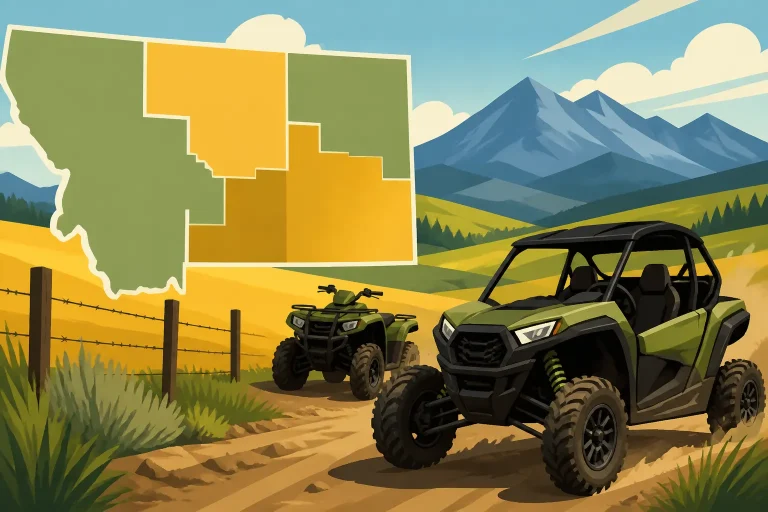
There is no single age rule that answers every question about a child operating an ATV or UTV in Montana. A youth’s age matters, but so do the land, route, machine and circumstances. A private ranch, a public trail and a road open to OHV traffic are different settings, and permission to ride in one does not automatically carry over to another.
Before a young rider starts, identify the riding area and what kind of access it allows:
- Private property: The landowner’s permission matters. Public-land permit rules may not apply in the same way, but permission is not a substitute for safe instruction, appropriate equipment or any other applicable requirement.
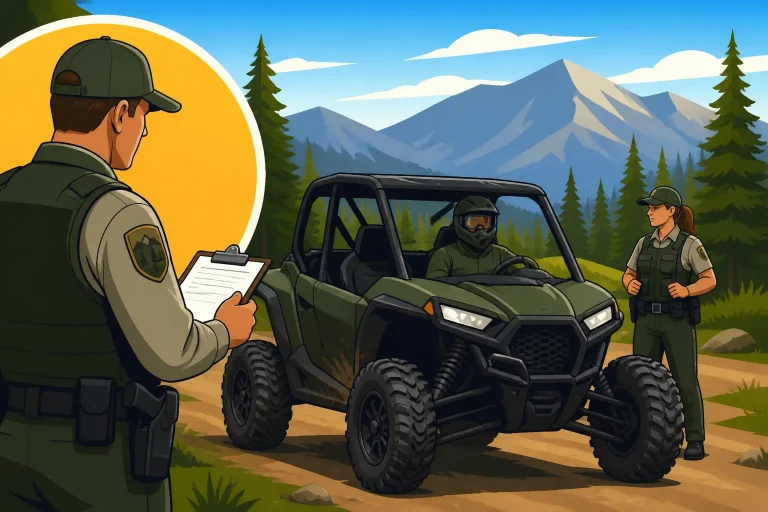
- Public trail or other public land: Check the land manager’s rules, Montana’s youth safety education requirements and any permit requirements for the rider and machine. A child who is allowed to ride on private land should not be assumed to meet the rules for public land.
- A road open to OHVs: Road riding has additional legal and equipment requirements. A route that looks like a convenient connection between trails is not automatically open to OHVs.
- A road crossing or road section: The rules may differ from riding entirely off-road. Check whether the specific road is open to OHVs and what applies to the child operating there.
For background on the training question, see [Montana OHV Safety Education Requirements] and Who Must Take the Montana Course. For public-land access, [Montana Permit Rules for Youth Machines] can help you separate a young rider’s eligibility from a machine’s registration or permit status.
A practical way to frame the issue is to ask four questions before each ride:
- Is this child allowed to operate this machine in this location?
- Has the child completed any required safety education?
- Is the machine suitable for the child and legal for this type of use?
- Can the child ride it safely without carrying a passenger or entering a road they are not qualified to use?
If any answer is unclear, pause and confirm the current rule with the relevant land manager or Montana agency before riding. Age alone does not tell you whether a child is ready, and a parent’s permission does not override a public-land or road-use restriction.
Age, Training and Supervision
Parents often ask for one minimum age. In practice, the more useful question is whether the child meets the requirements for the planned ride. Training is a central part of that check, especially for public-land use. Do not assume that a child is exempt because they are riding with a parent, because the machine belongs to the family or because they have ridden on private land before.
Safety education is more than a certificate
A course can teach a young rider to recognize hazards that are easy to miss when all attention is on the throttle. Topics may include controls, stopping, turning, terrain, protective equipment, passengers, trail etiquette and what to do when a machine becomes stuck or breaks down. Those lessons matter even on a familiar route: conditions change, and a child may respond differently to a steep grade, loose gravel, a rut or approaching traffic.
Check whether the child must complete an approved course for the intended type of operation. If the child has taken training in another state, ask whether Montana accepts that certificate for the activity planned. Do not assume that a school course, a dealer orientation or an online video counts as the required safety education.
If you are checking the age range and course details, the related articles Montana Rules for Riders Aged 12 to 15 and [Montana Rules for Riders Under 12] address age groups separately. The exact rule can depend on whether the child will be riding on public land, on a public road or only on private property. Verify the current requirement with the responsible authority rather than relying on a rule remembered from another state.
Supervision has to be active
An adult’s presence is not a substitute for supervision. A responsible adult should be able to see or quickly reach the young rider, communicate clear limits and step in before a small problem becomes a serious one. Following far behind, riding several machines away or assuming a child will copy the group is not meaningful supervision.
Before starting, agree on basic rules such as:
- The child stays within sight and does not ride ahead around blind corners.
- The child stops when asked and does not follow another rider onto an unfamiliar route.
- The child does not cross a road or enter a different trail without adult direction.
- The child reports a change in the machine’s sound, handling or controls rather than trying to continue.
- The adult chooses a pace and route the child can manage, not merely one the adult wants to ride.
Supervision should match the child, not just the calendar age. A confident child may still have poor judgment at speed; a cautious child may need time to build basic control. If the child cannot reliably stop, turn, keep a safe following distance and respond to directions, the ride should be shortened, simplified or postponed.
The child operating the machine is the rider
Do not treat a child as a passenger if they are actually controlling the machine. If the child has their hands on the controls, they are operating it and should meet the requirements for an operator. Likewise, an adult riding beside a child does not make an otherwise prohibited road route lawful.
Keep proof of any required training with the family’s riding paperwork. If you are unsure what to carry, see Do You Carry Paperwork on a Montana Trail?. A certificate is useful only if it is the right kind of certificate and applies to the use being made.
Choosing a Machine a Child Can Control
A machine’s engine size is only one part of whether it is suitable for a young rider. Weight, width, speed, throttle response, braking, seat height and the child’s physical reach all matter. A child who can sit on a machine may not be able to control it on a slope or stop it quickly on loose ground.
Do not rely on a seller’s description, a model name or a child’s confidence as proof that the machine is appropriate. Read the manufacturer’s age guidance and operating instructions for the specific model. Then consider the terrain where the child will ride. A machine that feels manageable on a flat, open area may be difficult to control on a narrow trail or uneven hillside.
Check fit and control before the ride
With the engine off and the machine on level ground, check whether the child can:
- Reach and operate the controls without stretching or losing balance.
- Sit in the intended position with a stable grip and secure footing.
- Turn the handlebars through their full range without being pushed off balance.
- Reach the brake controls and use them firmly.
- Understand the throttle and demonstrate a smooth, controlled start.
- Stop promptly and park without the adult having to catch the machine.
A demonstration on flat ground is only a first check. The rider also needs practice stopping, turning and handling small changes in surface before attempting a trail. Start with a route that leaves room to stop and turn around. Avoid steep grades, deep water, loose rock, narrow edges and routes with fast-moving traffic until the child has the skill and judgment for them.
Engine size and age guidance
Parents sometimes look for a single displacement limit that determines what a child may ride. Do not assume that one engine-size number is the complete answer for every ATV or UTV and every use in Montana. The applicable legal restriction, the manufacturer’s age recommendation and the machine’s safe fit are separate questions. Confirm the current rule for the exact machine and location, and read the manufacturer’s guidance rather than applying a rule from a different state or vehicle category.
For a closer look at this issue, see Youth Machine Size Rules Montana Parents Ask About. A smaller engine does not automatically make a machine safe for a child: a powerful machine can still have a sharp throttle, and a heavy machine can still be difficult to stop or turn. Conversely, choosing a machine based on the child’s ability to control it does not by itself establish that the child may operate it on a particular public route.
Use a gradual progression
A sensible progression gives the child time to build control before adding speed, passengers, difficult terrain or longer distances.
- Learn the controls while stationary. Explain the kill switch, brakes, throttle and any selector or parking mechanism. Make sure the child knows how to shut the machine off.
- Practice starts and stops in a clear area. The child should be able to start smoothly and stop on command before moving to an uneven surface.
- Add gentle turns and changes in surface. Watch for overcorrection, looking down at the controls or using too much throttle.
- Practice on a short, familiar route. Keep the adult close enough to intervene and avoid mixing the child into a faster group.
- Increase difficulty only when the child has demonstrated control. A longer ride is not automatically a better ride. Stop if fatigue, frustration or poor attention appears.
If a child cannot keep a steady pace or respond reliably to directions, do not try to solve the problem by riding closer to faster adults. Make the route easier or end the session.
Helmets, Protective Gear and Passenger Safety
A helmet is an essential part of planning for a young rider. Check the rules that apply to the specific setting and make sure the helmet is appropriate for the activity, fits correctly and is in good condition. A helmet that is loose, damaged or not designed for the type of riding offers less protection than a properly fitted one.
Use the same care with eye protection, gloves, sturdy footwear and clothing that covers exposed skin. Dust, branches, rocks and sudden changes in weather can make a short ride uncomfortable or dangerous. On a longer ride, pack water and an extra layer for the child, even if the day begins warm.
For a legal overview, see Montana Helmet Requirements Under 18. The rules can depend on where the machine is being operated, so check the requirement for the route rather than assuming that a family’s private-land practice applies on public land or a road.
Fit the helmet before you leave
Try the helmet on before the ride, not at the trailhead. It should sit level, stay in place when the child moves their head and fasten securely. A helmet that shifts over the eyes or wobbles when the child turns their head needs adjustment or replacement. Check the manufacturer’s fit instructions and the helmet’s labeling, and replace it if it has taken an impact or shows damage.
Families comparing helmets or other gear may use Amazon to look at styles and sizing information, but an online listing is not a fit test. Check the product’s safety labeling and return policy, then have the child try it on before depending on it for a ride. Do the same for goggles: they need to stay in place and provide suitable visibility without interfering with the helmet.
Do not make a child a passenger by default
A passenger must have a proper place to sit and hold on. Never carry a child on a machine designed for one rider, on a rack, in a cargo area not intended for passengers or in a position that interferes with the operator. A child passenger also needs to be able to sit securely and keep hands and feet where they belong.
UTVs have their own passenger considerations. Use the designated seat, seat belt and other occupant restraints as intended. The child must be able to sit back in the seat and remain properly restrained. Do not treat a cargo bed as a passenger compartment, and do not let a child ride unrestrained because the trip is short.
The operator remains responsible for choosing a safe speed and route for everyone aboard. If the child is too small to sit securely or use the restraint system correctly, do not carry them in that machine.
Fatigue changes a child’s ability to ride
Young riders can become tired without recognizing it or telling an adult. Watch for drifting, slow responses, irritability, missed directions or repeated mistakes. Take breaks before the child is exhausted. A child who has ridden well for the first hour may be less able to react safely near the end of a long trip.
Protective gear also needs to work in the actual conditions. A dusty trail can make eye protection important; cold wind can make a child lose focus; heat can lead to dehydration. Gear does not make a difficult ride appropriate, but planning for conditions reduces avoidable distractions.
Public Trails, Permits and Road Riding
A young rider’s age, training and equipment are only part of the public-land checklist. The machine may also need a registration, decal, trail pass or other permit for the particular use. Requirements can differ for residents and visitors, and public-land access is not the same as legal road use.
For permit questions, start with [Montana Permit Rules for Youth Machines] and What Montana Riders Need Before They Ride. A youth’s permit needs may not be identical to the adult’s, so do not assume that one family pass or one adult’s paperwork automatically covers every child and machine. Confirm whether each machine or rider needs separate documentation.
Trail access is not road access
A public trail being open to OHVs does not mean the nearby road is open to them. Roads may have separate restrictions, and a route can change from trail to road without an obvious physical barrier. Check the official map or land-manager information for the exact route. Do not rely only on a GPS line, a social media post or another rider’s recollection.
If the child will be operating on a road, review Riding an OHV on the Road in Montana and Montana Rules for a 12-Year-Old on a Road. Road use can involve age, training, licensing, equipment and route-specific requirements. A child who is allowed on a trail is not automatically qualified to ride on a road.
Never let a child cross a highway or ride along a road simply because the group is taking that route. Confirm that the crossing or road section is legally open and that the child meets the requirements for it. If the child does not, choose a route that avoids the road or have an eligible adult transport the machine.
Keep the route within the child’s ability
Public trails can include steep grades, drop-offs, loose surfaces, water crossings, narrow turns and other riders. A route rating is a useful starting point, not a promise that every section will suit a particular child. Conditions can change after rain, snowmelt, maintenance or heavy use.
Before riding, check the trail’s current status and restrictions. Use an official map or land-manager information, and make sure the machine’s width and type are permitted on the route. Do not let a child follow an adult onto an unmarked spur, closed route or trail beyond the child’s ability to turn around safely.
A careful family plan includes:
- A short route with clear turnaround points.
- A check-in plan if the group becomes separated.
- Enough fuel and water for the child as well as the adult.
- A way to contact help if cell service is unavailable.
- An adult who is not distracted by managing several riders at once.
If the child is new to public trails, avoid busy holiday periods and crowded staging areas where other machines may be moving in different directions. A quieter route gives the child more time to practice without pressure.
Visitors and borrowed machines
A family visiting Montana should check both the child’s eligibility and the machine’s paperwork. A permit that applies to the vehicle does not necessarily satisfy an age or safety education requirement for the rider. Likewise, a certificate accepted in the child’s home state may not automatically be accepted for a specific Montana activity.
If the child is using a rental or borrowed machine, ask the owner or rental business about age limits, passenger restrictions, approved routes and permit arrangements. A business may set stricter age or supervision conditions than the minimum legal rules. Read the contract before riding; do not assume the adult booking the machine can authorize a child to operate it.
A Parent’s Pre-Ride Checklist
A pre-ride check makes it easier to spot a problem before the child is on a moving machine. Use this list every time the location, machine or riding conditions change.
Confirm the legal requirements
- Identify whether the ride is on private property, public land, a public trail, a road or a road crossing.
- Confirm the current age and training rules for that kind of operation.
- Check whether the child’s safety certificate is approved for the planned ride.
- Confirm what permits, registration or decals the machine needs.
- Verify that the chosen route is open to that type and width of machine.
- Check road-use requirements separately if any part of the ride involves a road.
Check the child and the machine
- The child can reach and operate the controls comfortably.
- The child can start, stop, turn and shut off the machine as instructed.
- The child understands the route boundaries and can follow directions.
- The machine is in working order, including brakes, tires, throttle and safety switches.
- The child has a properly fitted helmet and suitable eye protection.
- Any passenger has a designated seat and can use the restraint system properly.
- The child is rested, dressed for the conditions and carrying water.
Set limits before the engine starts
Tell the child where they may ride, how far ahead they may go and when they must stop. Establish a simple signal for stopping, regrouping or asking for help. Explain that the child must not take a side route, race another rider or carry a passenger without permission.
Keep the first ride conservative. Agree that the adult can end the ride at any time, and that the child should report discomfort, confusion or a mechanical problem immediately. A child should never feel that they need to continue just to avoid disappointing the group.
If you are looking for helmets, goggles or other riding gear, Amazon can be one place to compare available options. Check the fit, safety labeling and manufacturer instructions rather than relying on a product photo or a broad age label. For critical protective equipment, buy only when you are confident the item is suitable for the child and can be fitted correctly.
Common Mistakes to Avoid
Treating private-land experience as public-land qualification
A child may ride well on familiar, flat ground and still lack the training or judgment needed for a public trail. Public routes bring changing terrain, other riders, signs, closures and sometimes road crossings. Make the transition gradually and confirm the rules for the new location.
Assuming an adult can make any route legal
An adult’s supervision can be important, but it does not automatically satisfy every age, course, permit or road-use requirement. Check the actual requirement for the child and the activity. If the child is not qualified for a road section, choose another route instead of riding beside them and hoping that is enough.
Choosing a machine by age label alone
Age guidance is useful, but it cannot account for every child’s size, strength, experience or the terrain. A machine that fits the child on level ground may be too heavy or powerful for the planned route. Test the child’s control and choose an easier setting before adding difficulty.
Carrying a child where there is no proper seat
A rack, cargo bed or one-person ATV is not a safe passenger seat. Use a machine designed for the number of people riding, with the intended seating and restraints. If the child cannot sit and hold on securely, they should not ride as a passenger.
Letting a group set the pace
Children may try to keep up with adults or older riders even when they are tired or unsure. Keep the child close, set a pace they can handle and stop when their attention begins to fade. The group should adapt to the youngest rider, not expect the youngest rider to catch up.
Relying on outdated or out-of-state advice
A rule from another state, a past season or an informal online post may not match the current Montana requirement or the rules of a particular land manager. Confirm current details with an official source before the trip, especially when age, road access, permits or safety education are involved.
Parents comparing a child’s training options may see courses and equipment discussed on Amazon or other retail sites, but a retailer’s description does not establish that a course is approved or a product meets the rule for the planned ride. Verify approval and requirements through the relevant Montana authority or land manager.
Disclaimer
This article is for general informational purposes only and does not constitute professional advice. Laws, prices and regulations vary by location and change over time. Consult a qualified professional for guidance on your specific situation.