Adult Supervision Expectations in Montana
Montana parents and adult riders often ask whether a child can ride an ATV or UTV alone, and whether an adult must be nearby, riding along, or watching from the trailhead. The answer depends on the rider’s age, where the machine is operated, and the applicable safety rules. Here’s how to think about supervision before a ride.
What adult supervision means in Montana
“Adult supervision” can refer to several different things: an adult riding with a young operator, an adult staying close enough to intervene, or an adult meeting a specific legal condition for a rider on public land or a road. Those are not interchangeable. A parent’s permission, for example, does not automatically satisfy a legal requirement that applies to a particular age group or riding location.
For Montana OHV riding, start with three questions:
- How old is the person operating the machine?
- Is the ride on private land, public land, or a road open to OHVs?
- Does the rider meet any applicable safety-education, licensing, permit, and equipment requirements?
Rules for younger riders can differ between trail riding and road riding. The conditions for using a machine on public land also do not necessarily match the rules on a private ranch or other private property. That is why there is no reliable one-line answer such as “a child can ride alone if a parent is nearby.”
Montana’s youth and education requirements are covered in Montana OHV Safety Education Requirements and Montana Age Rules for Riders Under 16. Those rules are a better starting point than assuming that an adult’s presence is always enough, or that a completed course means no supervision is needed.
Supervision is not the same as training
A responsible adult can teach a young rider practical skills, but informal instruction is not a substitute for an approved safety course when the course is required. The reverse is also true: completing a course does not automatically resolve every age, road-use, or supervision condition.
Treat each requirement as a separate item to check:
- Safety education: Does the rider need an approved course or certificate for the planned use?
- Adult accompaniment: Does the rider’s age or operating location require an adult to accompany them?
- Road-use qualifications: If the route includes a road open to OHVs, does the rider meet the applicable age and operating conditions?
- Machine suitability: Is the ATV or UTV an appropriate size and type for the rider?
- Land access and permits: Is the machine allowed in the area, and does the rider or machine need a pass or permit?
A pass or registration does not prove that a young rider meets safety-education or supervision requirements. Likewise, an adult accompanying a rider does not grant permission to travel on a route that is closed to OHVs.
How age and location affect the answer
Age is central, but it is not the only factor. The same young person may face different requirements on a forest trail, a private ranch, and a road section designated for OHV use. Before setting out, identify the entire route, not just the trailhead or final destination.
Public land and trails
On public land, check the rules that apply to the rider’s age and safety education before riding. Montana has age-specific requirements, and adult accompaniment may matter for younger operators. Do not assume that the rules for one age bracket apply to every rider under 16, or that the same condition applies on every type of route.
For the specific age range covered in Montana’s Rule for Riders Aged 12 to 15, check whether the planned use calls for a safety certificate, adult accompaniment, or other conditions. Pay close attention to whether the information concerns general trail operation or operation on a road open to OHVs. A requirement that applies in one setting may not answer the question for another.
Public-land rules also address where a machine may travel. A supervising adult cannot make an unauthorized route legal. Check the route’s current access information and any posted closures. Montana Permit Rules on Public Land explains why a permit question and a route-access question need to be considered separately.
Roads open to OHVs
Road riding deserves its own check. An OHV may be allowed on some roads and prohibited on others, and additional operating conditions can apply even where road access exists. Young riders may need to meet age-specific rules involving a safety certificate, a driver’s license, or an accompanying adult.
Do not assume that a rider who is allowed on an off-road trail is also allowed to operate on the road section that connects that trail to town. Review Who Needs the Course on a Public Road and Driver’s License or a Safety Certificate if the planned ride includes a road. Then verify that the specific road is open to OHVs; general permission to ride on certain roads does not mean every road is available.
A parent riding behind a child does not necessarily satisfy every road-use requirement. Confirm what the rule requires of the adult, including any age or licensing condition, and whether the adult must be on the machine, alongside the rider, or simply accompanying them. When the published wording is unclear, ask the relevant land manager or law-enforcement agency before the ride.
Private land
Private land can have different rules from public land, but “private” does not always mean every condition disappears. The property owner may set stricter limits, and other requirements may still apply depending on the activity and location. Permission to ride is not the same as a guarantee that a machine, route, or rider is safe.
A ranch owner might allow a child to ride only on a familiar field, with an adult within sight. Another property may have steep terrain, irrigation ditches, cattle, fences, gates, or equipment traffic that make unsupervised riding unsafe. For land-specific questions, see [Montana Rules on Private Land], and confirm the property owner’s conditions directly.
A practical rule for families is to treat adult supervision as a safety plan even when a particular law does not require an adult to accompany the rider. A young person can be skilled and still be vulnerable to a rollover, mechanical problem, bad weather, or separation from the group.
| Riding situation | What to check before the ride | Why adult supervision may matter |
|---|---|---|
| Public-land trail | Age rules, safety education, permits, route access, and closures | A youth rider may have age-specific conditions, and an adult must also help manage route and emergency risks |
| Road open to OHVs | Whether the road is open, plus age, certificate, license, and accompaniment rules | Road use can involve distinct qualifications and traffic hazards |
| Private property | Owner permission, property rules, hazards, and any applicable legal requirements | The owner’s permission does not remove the need to assess terrain, other users, and the rider’s ability |
| Group ride | Each rider’s age and qualifications, machine fit, route difficulty, and group plan | A single adult cannot automatically supervise several scattered riders effectively |
What useful supervision looks like
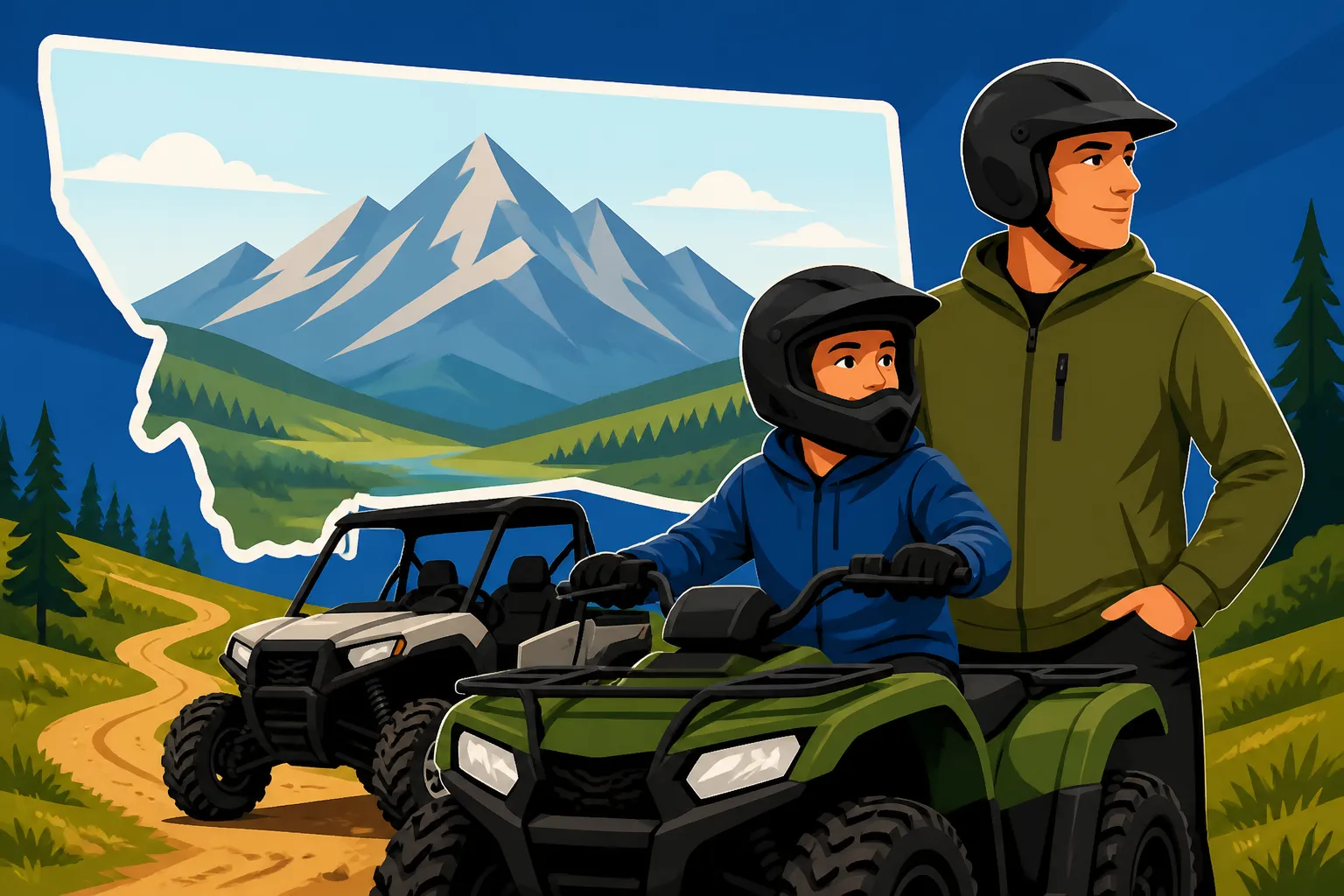
Supervision is more than having an adult somewhere on the property or at the staging area. The adult needs a plan that matches the rider, machine, terrain, and group. For a younger or less experienced operator, that usually means staying close enough to observe the ride and respond quickly.
Match the adult to the ride
The supervising adult should understand the route, the machine, and the rider’s current ability. A person who has never operated a UTV may not be prepared to spot a developing rollover risk or help with a recovery. An adult who knows the area can still make a poor choice if the route is too difficult for the young rider.
Before leaving, agree on who is responsible for the young operator. In a large group, avoid vague arrangements such as “the adults will keep an eye out.” Name the adult who will ride with or directly monitor the child, and make sure that person knows the route and the group’s plan.
When several youth riders are present, think about how the group will stay together. One adult cannot provide close supervision to riders who are spread across different trails or out of sight around bends. Keep the pace slow enough for the least experienced rider, and set a clear regrouping point before anyone needs one.
Set boundaries before the engine starts
A short briefing can prevent confusion once riders are moving. Explain which route is allowed, what terrain is off-limits, how far ahead a rider may go, and what to do if they lose sight of the group. Set expectations for stopping at intersections, trail junctions, gates, road crossings, and other decision points.
Useful boundaries include:
- Stay within sight or an agreed distance of the supervising adult.
- Do not pass the lead adult or leave the group without permission.
- Stop at every trail junction until the adult confirms the route.
- Do not cross a road or enter a new trail without the group.
- Stop and wait if the machine has a problem or the rider feels unsure.
- Do not ride beyond the machine’s capacity or the rider’s comfort level.
These instructions should be simple enough for the rider to remember. A young operator who is worried about being scolded may keep going after a problem instead of stopping. Make clear that reporting trouble promptly is the right choice.
Supervise the machine, not just the child
A rider’s age and ability need to match the ATV or UTV. Machine fit includes more than whether the operator can reach the controls while sitting still. The rider needs to use the controls correctly, understand how the machine responds, and manage its weight and power on the terrain.
For a UTV, confirm that every rider uses the correct seating position and restraint system for that vehicle. A child should not be treated as a passenger simply because there is an open seat. Read the machine’s operating instructions and check the applicable passenger and equipment rules before carrying a child. Montana Rules for a Child Passenger is useful if the question is whether a child can ride as a passenger rather than operate the machine.
For an ATV, do not carry a passenger on a model designed for one rider. A second person can interfere with control and balance, especially during turns or on uneven ground. Follow the machine manufacturer’s instructions and the relevant Montana rules.
Inspect the machine before the ride. Check controls, tires, brakes, lights where relevant, and any protective equipment required for the planned use. A child may not recognize that a brake feels wrong or a throttle is sticking, so the adult should make sure the machine is ready.
Adjust supervision as conditions change
A route that is manageable in dry daylight may become a poor choice in dust, rain, snow, low visibility, or after a rider becomes tired. Supervision should change with conditions. Slow the group, shorten the route, or turn back when the youngest rider’s attention or control starts to decline.
Adults should also watch for separation and fatigue. Young riders may focus so intently on the machine that they miss a turn, lose track of the group, or fail to notice changing weather. Agree on a check-in plan and stop periodically to make sure everyone is comfortable and accounted for.
A pre-ride checklist for adults and youth riders
Use this checklist before every ride, especially when the route or machine is unfamiliar. It is not a substitute for checking the current rules, but it helps catch common gaps before leaving the staging area.
- Confirm the route. Identify whether it includes private land, public land, a road open to OHVs, or more than one setting. Check access and closures for the full route.
- Check the rider’s age requirements. Confirm the rules that apply to that age group and type of riding. Do not assume a rule for a public trail also answers a road-use question.
- Verify safety education. Check whether the rider needs an approved course or certificate and whether the adult’s presence changes any condition for the planned use.
- Confirm the supervising adult’s role. Decide who is responsible for the rider and what “accompanied” means for that situation. If the legal wording requires a particular kind of adult, verify that the adult meets it.
- Assess the machine. Make sure it fits the rider and is appropriate for the terrain. Check the owner’s instructions and do not exceed its passenger capacity.
- Review protective gear. Confirm required helmets and other equipment for every rider and passenger. Montana’s requirements for minors are addressed in Montana Helmet Requirements Under 18.
- Set the group rules. Choose a pace, route, spacing, stopping points, and a plan for a rider who becomes separated or has a mechanical problem.
- Carry essentials. Bring water, a first-aid kit, communication equipment suitable for the area, and basic tools or recovery gear appropriate to the route.
- Reassess at the trailhead. If the actual trail is rougher, busier, or less visible than expected, change the plan rather than pressuring a young rider to continue.
A checklist is particularly useful when a family brings a machine to Montana from another state. The home state’s rules may not match Montana’s, and a registration or permit from elsewhere does not necessarily satisfy Montana’s requirements. Visitors can review Montana Rules for Visiting Riders and confirm the current requirements for their machine and intended riding area.
Common misunderstandings about supervision
“A parent is present, so the rider can go anywhere”
An adult’s presence does not open a closed road or trail, replace a required permit, or waive every age and training condition. Supervision helps manage the rider’s safety; it does not override land access rules.
“The rider passed a course, so an adult is no longer needed”
A safety certificate and an adult-accompaniment requirement are separate questions. A course may satisfy one requirement without resolving another. Check the rule for the rider’s age and the location where the machine will operate.
“The child is riding on private land, so no rules apply”
Private land can change which public-land conditions apply, but property owners still control access and may set their own restrictions. Other legal requirements may also depend on the activity. Confirm the relevant rules rather than relying on a broad assumption.
“The same adult can supervise everyone in the group”
That may not be realistic if riders are spread out, operating different routes, or traveling at different speeds. Decide how the adult will keep the young rider within sight or otherwise meet the applicable accompaniment condition. If the group cannot do that, reduce the group size or add another capable adult.
“The route is easy, so supervision is optional”
A familiar route can still include hazards, traffic, other machines, livestock, water, or a sudden change in weather. Experience helps, but it does not replace a plan that fits the rider and conditions.
Frequently Asked Questions
Does a Montana parent always have to ride on the same machine as a child?
Not necessarily. The answer depends on the child’s age, the location, and the exact rule that applies. Check whether the requirement calls for an adult to accompany the rider and what that means for the planned use. Riding separately may be appropriate in some situations, but do not assume it meets a legal condition without confirming.
Can a young rider operate an OHV alone on private property?
Do not assume that private property makes solo operation automatically acceptable. Check applicable law, obtain the landowner’s permission, and consider the child’s ability, the machine, and the property’s hazards. A family may choose closer supervision than the minimum legal requirement.
Does a Montana trail pass replace adult supervision or safety education?
No. A trail pass or other permit addresses access or use requirements; it does not, by itself, establish that a youth rider has met age, training, or supervision conditions. Verify each requirement separately.
What should an adult do if the rules are unclear?
Pause the ride and confirm the rule with the relevant land manager or agency before operating. Be specific about the rider’s age, machine, route, and whether the plan includes a road. Those details can change the answer.
Disclaimer
This article is for general informational purposes only and does not constitute professional advice. Laws, prices and regulations vary by location and change over time. Consult a qualified professional for guidance on your specific situation.