Becoming a Licensed Outfitter in Montana
If you plan to charge people for guided ATV or UTV rides in Montana, a trail pass alone is not enough to establish that your business is authorized to operate. The key is to check which state license and land-use permissions apply to your exact service, route and customers before you advertise or take bookings.
First, find out whether your service needs an outfitter license
Montana regulates outfitters through the Montana Board of Outfitters. The important first step is to describe your proposed business to the Board and ask whether your particular paid activity falls under its licensing requirements. Do not assume that a guided ATV or UTV trip is exempt simply because it is not a hunting or fishing trip—or that every recreational ride is automatically covered by the same license.
The details matter. A business that supplies machines, guides, transportation, meals or other services may be treated differently from an independent guide who provides a limited service. The land where you operate and the activities you include can also affect which approvals you need. A trip that adds hunting, fishing, camping or other commercial services may involve additional rules beyond the vehicle ride itself.
Before applying, give the Board a clear description of the operation:
- What you charge for and what the customer receives
- Whether you provide the ATV or UTV, or customers bring their own
- Whether a guide accompanies each group
- The routes and land types you expect to use
- Whether the trip includes hunting, fishing, lodging or other services
- How often you plan to run trips and how many customers you expect to serve
Ask the Board what license category applies, what qualifications are required, and whether any conditions change if you provide machines as well as guides. Confirm application steps, insurance requirements, renewal obligations and current fees directly with the Board. Requirements and amounts can change, so an old checklist or another operator’s experience is not a substitute for a current answer.
It helps to keep the state licensing question separate from land access. A business may need a state license and also need permission from the owner or manager of the land. One approval does not automatically satisfy the other.
| Approval or document | What it addresses | What it does not automatically authorize |
|---|---|---|
| Montana outfitter license, if required | Whether the business may provide regulated outfitting services | Commercial use of a particular trail or parcel |
| Land-manager authorization | Whether a paid operation may use specified land or routes | Every route, season, group size or activity |
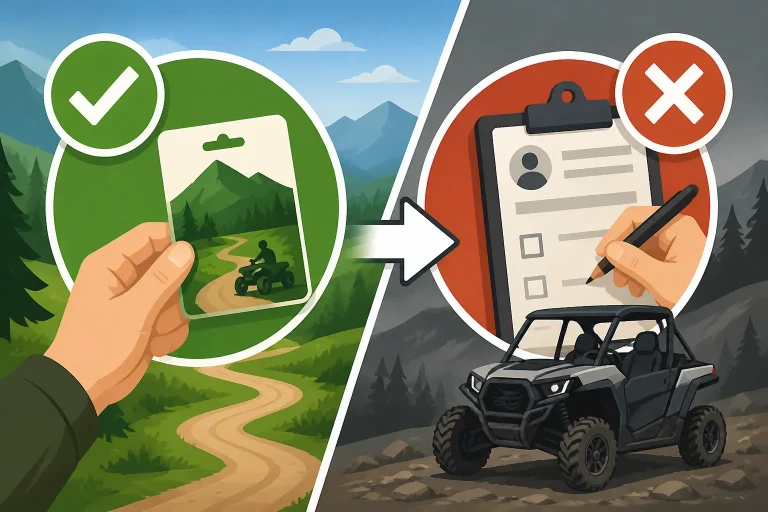
| Rider permit or trail pass | A rider’s applicable access or registration requirements | Operating a paid guided business |
| Local business approval | Applicable local business or operating rules | State licensing or land-manager permission |
| Insurance documents | Financial protection required by a land manager or business arrangement | Permission to guide on land |
For an overview of the activity-specific questions, see Guiding OHV Trips for Pay in Montana and Montana Permits for a Guided Trip. If your business also plans to organize a group event rather than routine guided trips, check whether Montana Permits for an Organized Ride applies to that separate activity.
Get permission for each land type and route
A state license does not give an outfitter permission to use public land commercially. Before choosing a route, identify who manages each section and ask whether commercial guiding is allowed there. A trip may cross several types of property—federal, state, county, municipal and private—and each may have different rules.
On federal land, contact the relevant land manager before advertising a route. Commercial guiding on Forest Service land may require a special authorization, such as an outfitter-guide permit. The agency may limit where and when you operate, the number of trips or clients, and the activities you can offer. Start with Forest Service Permits Montana Riders Need and confirm requirements with the local Forest Service office responsible for the area.
On BLM-managed land, a paid recreational operation may require a Special Recreation Permit, depending on the activity and location. A permit can be tied to specific routes, operating conditions or capacity. Read BLM Special Recreation Permits in Montana and ask the local BLM office whether your proposed service needs authorization before you take customers onto the land.
State trust land and local property need their own checks. If a route crosses private land, get the owner’s permission for the commercial use—not just informal approval for personal riding. If it uses a county road, town street or other local route, ask the relevant local authority what rules apply. A public road open to ordinary traffic is not necessarily a permitted commercial tour route.
Build a route map that shows every land boundary, access point, staging area and road connection. Then make a contact list for the agencies and owners responsible for each segment. Ask about:
- Whether commercial guiding is allowed at all
- Which permit or written authorization is required
- Approved routes, trailheads and staging locations
- Seasonal closures and operating hours
- Limits on group size, trip frequency or vehicle type
- Insurance, emergency plans and reporting obligations
- Restrictions on advertising a route as available
- Whether customers may ride their own machines
Do not rely on a trail map or a recreational-use permit as proof of commercial access. The map may show that a route exists, but not that a paid guide may use it. Similarly, a rider’s permit may cover an individual’s trail use without authorizing a business to lead commercial trips. For broader public-land requirements, see Montana Permit Rules on Public Land.
Separate business permissions from rider permits
Visitors and residents may have individual permit or registration obligations when they ride. Those obligations are different from the permissions needed to operate a guiding business. A customer’s permit does not authorize your company to sell a tour, and your business authorization does not necessarily satisfy each rider’s requirements.
If customers ride machines that they own, explain before booking which personal permits, registrations and equipment they must bring. If your company supplies machines, check what applies to the machines and to each person riding them. Confirm the details for the routes you actually use; requirements can differ by land manager and type of access.
For visiting riders, Montana’s Non-Resident Temporary Use Permit explains the personal permit issue, while Why the Non-Resident Permit Covers Trails Only helps distinguish trail access from road use. Do not describe a nonresident permit as permission to join a commercial tour unless the applicable land manager and permit terms support that claim. Road access is a separate question, and trail access should not be presented as blanket permission to ride on public roads.
A practical booking process should spell out what the customer is responsible for and what the outfitter provides. Put the information in writing before the trip. For example, state whether the price includes a machine, helmet, fuel, route instruction, a guide, permits or transportation. Avoid promising that permits are included until you have confirmed which specific permits the business can obtain and which ones the rider must secure.
If your route changes, recheck the permissions. A detour may cross another jurisdiction, enter a closed area or move onto land where commercial use is not authorized. Keep the approved route and any operating conditions accessible to guides, and give staff a simple process for canceling or rerouting a trip when a closure or land restriction applies.
Prepare the operation before taking bookings
Once you know which licenses and land permissions apply, organize the business so that its actual operation matches the approved plan. A license or permit may set limits that affect your advertising, equipment, schedules and staff. Make sure the people answering booking questions and leading rides understand those limits.
Keep copies of the relevant documents in a business file, including applications, approvals, maps, insurance records, correspondence and renewal information. For each route, record the responsible land manager and the conditions that apply. Set reminders to check for closures or changed access before trips, rather than relying on conditions from the previous season.
Plan for safety and customer communication as part of the service, not as an afterthought. Decide how guides will handle a breakdown, injury, severe weather, wildfire closure or rider who cannot complete the route. Explain the expected riding ability, machine requirements, passenger rules and any age restrictions before someone pays. Ask land managers and insurers what emergency planning and documentation they expect for your operation.
Insurance deserves direct attention. Ask the insurer to describe the coverage available for paid guided ATV or UTV activity, including the machines you provide, customers who ride them, employees or contractors, and the kinds of routes you use. Then compare the policy terms with any requirements imposed by the state licensing process or land manager. A general business policy may not cover every part of a motorized tour operation.
Before opening bookings, work through this sequence:
- Write down exactly what the business will provide and where it will operate.
- Ask the Montana Board of Outfitters whether the service requires a license and what qualifications or conditions apply.
- Identify each landowner and land manager along the proposed route.
- Obtain required commercial-use authorizations and confirm that the route, season and group size are allowed.
- Confirm local business and road-use requirements for staging areas and route connections.
- Check which personal permits, registrations and safety requirements apply to customers and machines.
- Review insurance terms against the operation and the land managers’ conditions.
- Match advertising, booking materials, guide procedures and customer instructions to the approvals received.
The order matters. Choosing a route first and seeking permission later can leave a business with bookings it cannot legally fulfill. If a land manager will not authorize commercial use, find a different route before investing in promotion or equipment. If the Board says the activity requires a license, do not treat the land permit as a substitute.
Montana’s resident and nonresident riding rules can be confusing when visitors arrive with machines from other states. Reciprocity questions concern whether a rider’s credentials or permits are recognized; they do not automatically grant a commercial operator access to a route. See Does Any State Honor Montana Registration? for a related distinction, and confirm rider requirements separately from your business approvals.
There is no single document that makes every paid ATV or UTV tour lawful everywhere in Montana. The reliable approach is to establish the state licensing answer, get written authorization from each relevant land manager, and communicate rider requirements accurately. That takes more work before the first trip, but it reduces the risk of canceled bookings, unauthorized commercial use or customers arriving without what they need.
Disclaimer
This article is for general informational purposes only and does not constitute professional advice. Laws, prices and regulations vary by location and change over time. Consult a qualified professional for guidance on your specific situation.