Keeping Registration Papers on the Machine
There's nothing quite like the freedom of tearing up a Montana trail on your ATV or UTV, feeling the grit and the wind on your face. But that feeling can quickly turn to a knot in your stomach if a warden stops you and you're scrambling to find the right paperwork. This guide will walk you through exactly which registration papers you should keep on your machine, why it matters, and the smart ways to do it, making sure your next Montana adventure is worry-free.
The Core Documents Your Montana OHV Needs Onboard
Picture this: you're out on a beautiful trail in the Custer Gallatin National Forest, enjoying the crisp mountain air. Suddenly, you see a warden waving you over. Your heart might do a little jump, but if you're prepared, it's just a quick chat and you're on your way. Knowing exactly what documents to have on hand, and what to leave safely at home, is key to keeping those mountain adventures smooth.
Understanding Your Montana OHV Registration
Your Montana OHV registration isn't just a piece of paper; it's your official ticket to ride on designated trails and public lands. It's the documented proof that you've paid your fees to the state, contributing to trail maintenance and access, and that your machine is legally permitted for off-highway use. This document typically contains crucial information like your name, the machine's Vehicle Identification Number (VIN), the make and model, and the date of registration. Even though Montana boasts a [Montana's One-Time Permanent OHV Registration] system for residents, meaning it doesn't expire annually, you still need to prove it exists.
The physical registration document is vital because it provides an immediate, verifiable record for law enforcement. While the decal on your machine is a clear visual indicator that you've registered, it doesn't provide all the necessary details. A warden will often want to cross-reference the VIN on your machine with the VIN on your registration to confirm everything matches up and that you are indeed the rightful operator. Without the physical document, even with a decal, you might face delays or further questions, potentially cutting into your precious riding time. For all the ins and outs of getting that initial paperwork, check out our guide on [Registering an OHV in Montana].
Proof of Ownership vs. Proof of Registration
This is a common point of confusion for many riders, and it's super important to get straight. Think of it this way: your title is the definitive proof that you legally own the machine, much like the deed to your house. It shows who has legal claim to the ATV or UTV. The registration, on the other hand, is proof that your machine is legally allowed to operate on specific public lands and trails within Montana. These are two distinct documents serving different purposes.
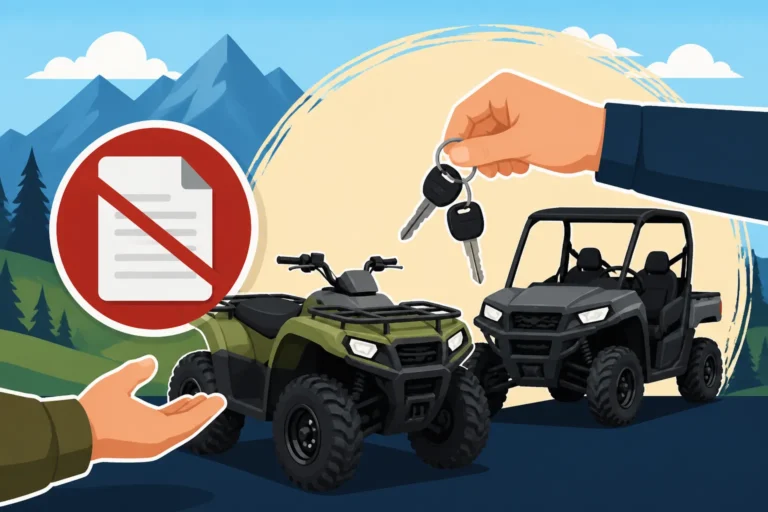
Generally, you should never carry your original title on your machine. This is a crucial piece of paper that should be kept in a secure location, like a safe at home, a bank deposit box, or with other important legal documents. Why? Because if your machine is stolen, or if you lose the title on the trail, replacing it can be a hassle, and having the title in the wrong hands could complicate recovery or even make it easier for thieves to sell your machine. The title is what you use when you want to sell the machine or transfer ownership, not for everyday riding. If you need more details about securing that official ownership document, our article on [Titling an OHV in Montana] can help. For information on what you'll need to show you own the machine when you title it, see [Proof of Ownership for a Montana Title].
Decals Are Not Enough: Why the Paperwork Still Matters
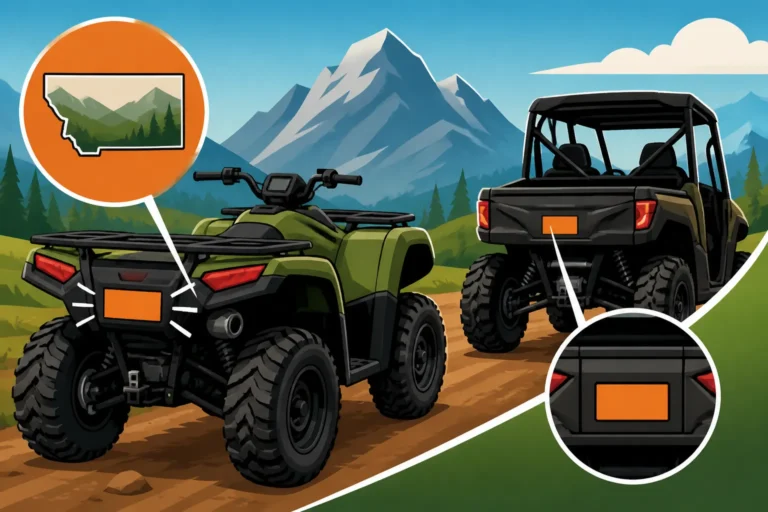
Many new riders, especially those from out of state, assume that simply having the registration decal prominently displayed on their machine is enough. While the decal is certainly a critical component of your Montana OHV registration – and required to be displayed correctly, as detailed in [Where a Montana OHV Decal Goes] – it's not a substitute for the actual paper document. The decal is merely a visual confirmation for passing wardens or other riders that your machine appears to be registered.
However, a quick visual check doesn't provide any specific details. When a Montana Fish, Wildlife & Parks warden, Forest Service officer, or local sheriff's deputy stops you, they're going to ask for more than just a glance at your sticker. They need to verify the VIN, ensure the registration is current (even permanent ones need to be verified against the state's system), and confirm you are the registered owner or have permission to operate it. This is particularly true if there's any suspicion of foul play, if you're involved in an incident, or even during a routine check at a trailhead. Having the physical or an easily accessible digital copy of your registration ensures a smooth interaction, allowing you to quickly get back to enjoying the trails. Our article [What a Montana Warden Asks a Rider For] goes into more depth on this. Remember, [What Permanent Registration Actually Buys You] is peace of mind and lifetime trail access, but the paper still needs to be available.
Practical Ways to Secure Your OHV Documents on the Trail
The Montana backcountry is beautiful, but it's also rugged. Dust, mud, water, and rough terrain are all part of the adventure. This means that simply tossing your registration papers into a glove box or backpack isn't going to cut it. You need a reliable system to protect these essential documents from the elements and keep them secure, yet easily accessible.
Weatherproofing and Protection Strategies
The single biggest enemy of paper documents on an OHV ride is Mother Nature. A sudden downpour, a splash through a deep ford, or even just persistent trail dust can turn your neatly printed registration into an illegible mess. To prevent this, think about robust weatherproofing.
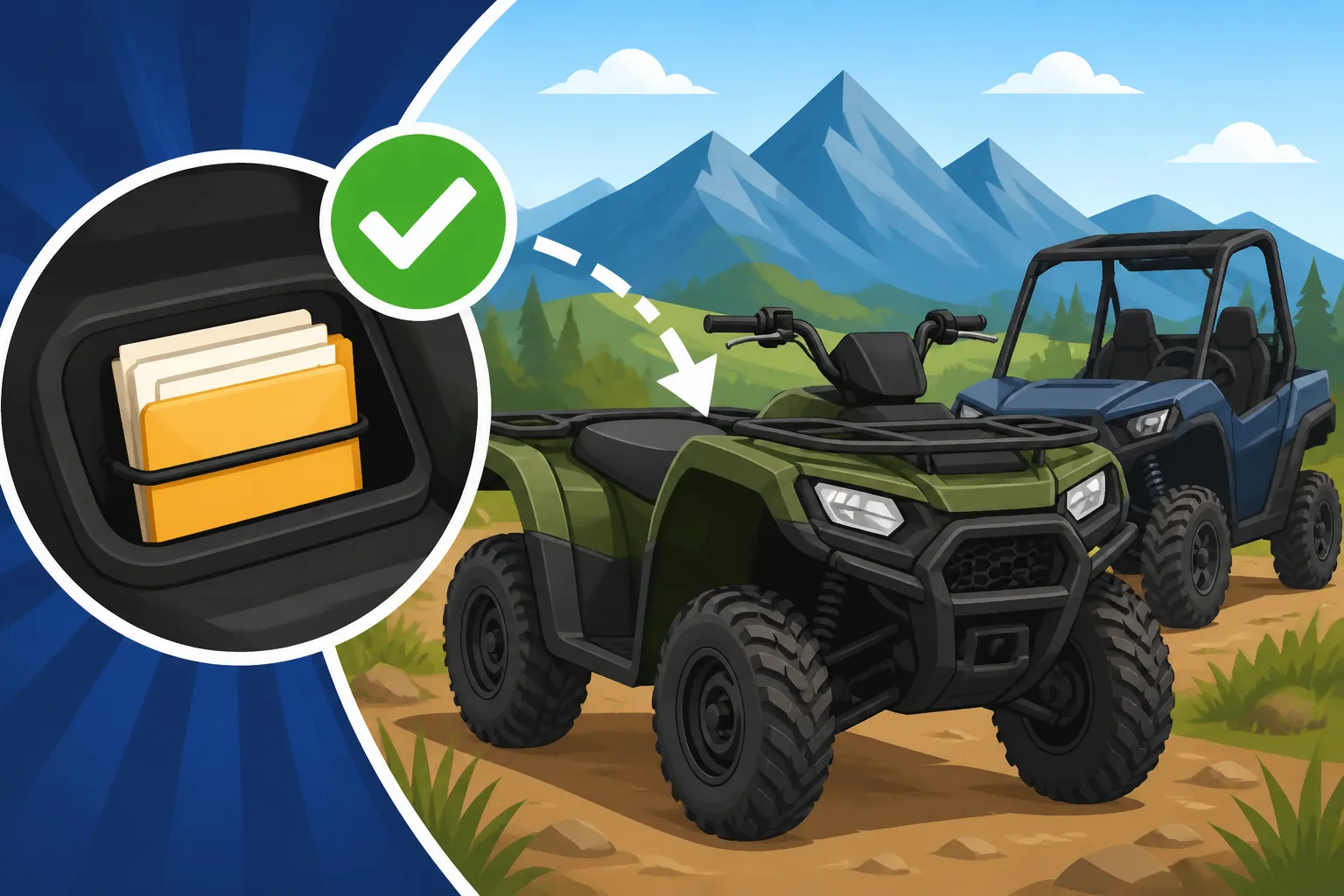
One of the simplest and most effective methods is to laminate a copy of your registration. This creates a durable, waterproof barrier that can withstand splashes and dust. If lamination isn't an option, a heavy-duty, sealable waterproof bag (like those used for camping or boating) is an excellent choice. You can find these at any outdoor gear store. For extra protection, consider a small, rugged hard case designed for electronics or valuables. These cases often come with foam inserts that can be customized to snuggly hold your documents, providing both weather protection and impact resistance. Many ATVs and UTVs have built-in storage compartments – a glove box, under-seat storage, or even a small compartment in a tool kit. Utilize these, but always place your documents inside a waterproof container within these compartments for an extra layer of security.
Digital vs. Physical Copies: What Montana Accepts
In our increasingly digital world, it's natural to wonder if a photo of your registration on your smartphone is sufficient. The good news is that many Montana law enforcement officers will accept a clear, legible digital image of your registration. It's certainly a convenient option, and having it on your phone means you're less likely to forget it.
However, there's a significant "but" when you're out in the vastness of Montana. Cell service can be extremely spotty, if not entirely non-existent, in many prime riding areas. Imagine being pulled over deep in the Lolo National Forest, and you can't access your photo because you have no signal. This is why it's always, always recommended to have a physical copy of your registration as a backup. Treat the digital copy as a convenient secondary option, but never rely on it as your sole proof. A printed, weatherproofed copy ensures you're covered, regardless of your phone's battery life or signal strength.
Safeguarding Against Theft or Loss
The last thing you want is for your important documents to fall into the wrong hands or simply disappear on the trail. This is why we stress keeping your original title safely at home. For the copy of your registration that you carry, discretion is key. Don't leave it lying openly in an unlatched compartment where it could easily blow away or be spotted by someone with ill intentions.
Instead, keep your documents stored securely in a zippered pouch within a glove box, or a dedicated, lockable storage compartment if your machine has one. Make sure it's accessible to you, but not easily grabbed by others. If you've recently purchased your machine, especially through a private sale, it's also a good idea to carry a copy of your bill of sale. This can provide additional proof of recent ownership if questions arise, even before the new registration is fully processed. You can find reliable templates for a bill of sale through services like LawDepot, which can make creating this simple legal document a breeze. Having a record like that, even a copy, just gives you an extra layer of confidence. And if the worst happens and your decal goes missing, remember there's a process for [Replacing a Montana OHV Decal].
Beyond Registration: Other Important Papers (And When You Might Need Them)
While your OHV registration is the primary document to carry, there are a few other pieces of paper (or digital proof) that could save you a lot of hassle depending on where and how you ride in Montana. Being prepared for these less common, but still important, scenarios is part of being a responsible and savvy rider.
Proof of Insurance for Road-Legal Riding
Montana offers some unique opportunities for OHV riders to use certain public roads, especially county roads and specific city streets, to connect trails or access services. However, if you plan to utilize these road sections, your machine must meet specific requirements, and often, that includes carrying proof of liability insurance. This isn't just a suggestion; it's a legal requirement in many jurisdictions if you're operating on a public roadway.
Your OHV registration doesn't cover insurance. You need a separate policy for that. Make sure you understand the rules of the specific county or town you're riding in, as regulations can vary. If you're pulled over on a county road and asked for proof of insurance, having a current insurance card or digital proof readily available can prevent a citation and keep your ride moving. Consult our article on [Insuring an ATV in Montana] for more information on coverage and requirements.
Safety Education Certificates for Young Riders
Montana takes the safety of its young riders seriously, and for good reason. The state has specific age restrictions and requirements for operating OHVs, particularly for those under the age of 16. A key component of these rules is the requirement for young riders to complete an approved OHV safety education course.
If you have a child between 12 and 16 years old operating an ATV or UTV, they are often required to carry their safety education certificate as proof of completion. This certificate demonstrates that they've learned the fundamental rules of safe operation, trail etiquette, and Montana's specific OHV laws. Think of it as their driver's license for the trails. Without it, even if they've completed the course, they could face penalties or be prevented from riding. Always ensure your young rider has their certificate, or a copy, on their person or securely on the machine. To understand all the rules for youth riders, take a look at [Montana's Safety Education Requirement].
Permission Slips and Private Land Access
Montana is a state with vast private and public lands, and distinguishing between them can sometimes be tricky. While the focus of OHV registration is primarily on public land access, there are many instances where you might ride on private property, whether it's a friend's ranch, a leased hunting parcel, or a section of land you own.
If you are operating your OHV on private land that you don't own, it is incredibly wise to carry written permission from the landowner. A simple, signed permission slip can prevent misunderstandings, accusations of trespassing, and potential legal issues. This is especially important in areas where public and private lands are intermingled, or if you're using a private access road to reach public trails. Even if you have verbal permission, having something in writing provides irrefutable proof, giving both you and law enforcement clarity. You can find various templates for basic permission slips and agreements through legal document services like LawDepot, making it straightforward to create a document that clarifies your right to be there. For general rules on private property, see [Montana Trespass Rules Along Roads].
Here's a quick reference table to help you keep track:
| Document Category | On Machine (Copy Recommended) | Keep at Home (Original) | Why It Matters |
|---|---|---|---|
| Registration | Montana OHV Registration Certificate (current) | N/A (Keep original if you prefer, but a copy is better on the machine) | Required by law for public land use; verifies VIN, owner, and legality. |
| Ownership | Bill of Sale (if recently purchased, copy) | Montana Certificate of Title | Title proves legal ownership; Bill of Sale confirms recent transaction. |
| Insurance | Proof of Liability Insurance (if riding on roads, copy or digital) | Full Insurance Policy Documents | Required for road-legal operation; protects you financially. |
| Safety Training | OHV Safety Education Certificate (for riders under 16, copy or digital) | Original Certificate (if desired for safekeeping) | Mandated for young riders; proves competency and knowledge of rules. |
| Land Access | Written Permission Slip (for private land, copy) | Land Lease Agreement, Property Deed (if applicable) | Prevents trespass issues and clarifies right to be on private property. |
| Identification | Driver's License/State ID (for riders of driving age) | N/A | Proves your identity to law enforcement; required for road use. |
Disclaimer
This article is for general informational purposes only and does not constitute professional advice. Laws, prices and regulations vary by location and change over time. Consult a qualified professional for guidance on your specific situation.