Montana Trailhead Parking for a Toy Hauler
A toy hauler can make a Montana ATV or UTV trip wonderfully self-contained, but its length and turning radius can turn a simple trailhead arrival into a stressful squeeze. This guide explains how to check access, choose a practical staging area, park without blocking other users, and plan for the realities of towing on Montana’s forest and backcountry roads.
Check whether the trailhead can handle your rig
Confirm access before towing in
A trail that looks easy to reach on a map may end at a narrow gravel lane, a tight switchback, or a small parking area intended for pickups and trailers—not a truck towing a long toy hauler. Before leaving pavement, check the route all the way from the highway to the staging area. Look for restrictions on vehicle size, seasonal closures, road conditions, and whether trailers are allowed to park at the trailhead.
Start with the land manager responsible for the access road and parking area. A route may pass through National Forest, Bureau of Land Management, state, county, or private land, and each segment can have different rules. A Forest Service road shown on a map does not automatically mean the trailhead has space for a large trailer. If the parking setup is not clear, call the managing office or ask a nearby campground or local OHV business before committing to the drive.
Maps are useful for planning, but they are not a substitute for checking current conditions and posted signs. A tool such as onX Offroad can help you review routes and identify nearby roads or staging areas, but verify access and parking restrictions with the relevant land manager. For broader trip planning, [Reading a Montana Motor Vehicle Use Map] can help you understand how designated motorized routes are represented.
Look beyond the trail and evaluate the parking area
Think of the whole arrival as a maneuver, not simply a destination. A safe staging area needs room to enter, turn or back, unload your machine, and leave again without blocking the road. If the only available space is a narrow pullout, a steep shoulder, or a turnaround that other vehicles need, it may not be suitable for a toy hauler even if a smaller trailer could fit.
Pay attention to the approach as well as the parking space. A tight bend, soft shoulder, drainage ditch, uneven grade, or low-hanging branch can create trouble before you reach the trailhead. A road that is passable for a short pickup-and-trailer combination may be uncomfortable or unsafe with a longer rig. When in doubt, stop somewhere wide and safe before the tight section, then reassess rather than discovering the problem at a dead end.
It can help to compare access notes with the local trail information for the area you plan to ride. For example, riders considering the Flathead region may also want to review [Riding Montana's Flathead National Forest], while trips near Billings may involve [Riding Shepherd Ah Nei From Billings]. These are planning references, not guarantees that a particular trailhead has room for a large camping trailer. Confirm the exact staging location and its rules before towing there.
Choose a parking plan that fits the trailer
Compare trailhead parking with a nearby base camp
The best place to sleep is not always the best place to unload. A large toy hauler may be easier to manage at an established campground, RV park, or other authorized overnight area, with the tow vehicle taking the machines to a smaller day-use staging area. This can reduce the chance of getting trapped at a crowded trailhead or leaving the trailer where overnight parking is not allowed.
A trailhead may work well for unloading and riding during the day if parking is permitted and there is enough room. Overnight stays are a separate question. Do not assume that permission to park for riding also allows camping, or that a pullout beside a public road is an approved campsite. Check posted signs and the land manager’s rules, and use a designated or otherwise authorized overnight location.
| Parking approach | When it may work well | What to confirm |
|---|---|---|
| Park the toy hauler at the trailhead | The area is large, accessible, and clearly permits trailers | Turning room, posted restrictions, overnight rules, and whether parking blocks other users |
| Stay at an established campground | You want a more dependable place to leave the trailer overnight | Trailer length, access road, reservation requirements, and whether machines may be hauled to the trail |
| Use an authorized dispersed site | The site is open to camping and can accommodate the full rig | Current land-manager rules, road access, surface conditions, and space to turn around |
| Leave the trailer at a private RV facility | The trailhead is too tight or remote for the complete rig | Permission, security arrangements, transport distance, and any facility-specific rules |
If you are planning a multi-day trip, compare the trailhead with nearby places to stay rather than assuming the nearest flat spot is suitable. [Montana Trailhead Parking and Staging] offers related planning context, and [Dispersed Camping Near Montana Trailheads] can help you think through the distinction between trail access and overnight camping. Confirm the specific site before you go; conditions and allowed uses can vary from one area to another.
Choose a staging area with an exit plan
Before parking, decide how you will get out. A spot that is easy to enter from one direction may be awkward to leave if other vehicles arrive, if the ground becomes muddy, or if someone parks across the turning area. Try to avoid positioning the trailer where you must reverse a long distance on a narrow road. If you need to back, agree on signals with a spotter and move slowly, stopping whenever the spotter is out of view.
Look for firm, reasonably level ground. A sloped or soft shoulder can make unloading uncomfortable and can leave the tow vehicle struggling for traction when it is time to pull out. Avoid blocking gates, driveways, road junctions, turnarounds, access to facilities, or the space another driver needs to pass. Keep your machines and loading gear within your permitted parking area rather than spreading them across a road or trail entrance.
The “exit plan” also includes the trip back to pavement. A narrow road may be manageable on the way in but feel much harder after a long ride, particularly if dust, rain, darkness, or traffic has changed conditions. Use [Checking Montana Trail Status Before You Drive] before the trip and again if plans change. If a route becomes unsuitable for your trailer, turn around at the first safe opportunity instead of pressing on because the destination is close.
Tow and unload with Montana conditions in mind
Prepare for narrow, rough, and changing roads
Montana access roads can change quickly with weather, maintenance, seasonal conditions, and traffic. Gravel can washboard, shoulders can be soft, and spring runoff can affect low crossings or approaches. A route that was comfortable for a small vehicle on a dry day may be a poor match for a long toy hauler after rain or snowmelt. Check conditions close to departure and be prepared to use a different staging area.
Before towing, inspect the trailer’s tires, hitch connection, lights, safety chains, and load. Keep heavier gear secured and avoid letting loose items shift during rough travel. If your trailer has a water tank, generator, ramp door, or exterior storage, account for each item when judging clearance and weight. A trailer can feel very different when fully loaded than it did on a test drive at home.
Plan fuel, food, water, and communications with the distance between services in mind. Some trailheads are remote, and cell service may be limited. A map app can help with route orientation, but do not rely on a phone connection to navigate every turn. Carry an offline map or another backup, and tell someone where you plan to ride and when you expect to return. For remote-area preparation, [Cell Service in the Montana Backcountry] and [What to Carry on a Remote Montana Ride] are useful companion topics.
Unload without creating a bottleneck
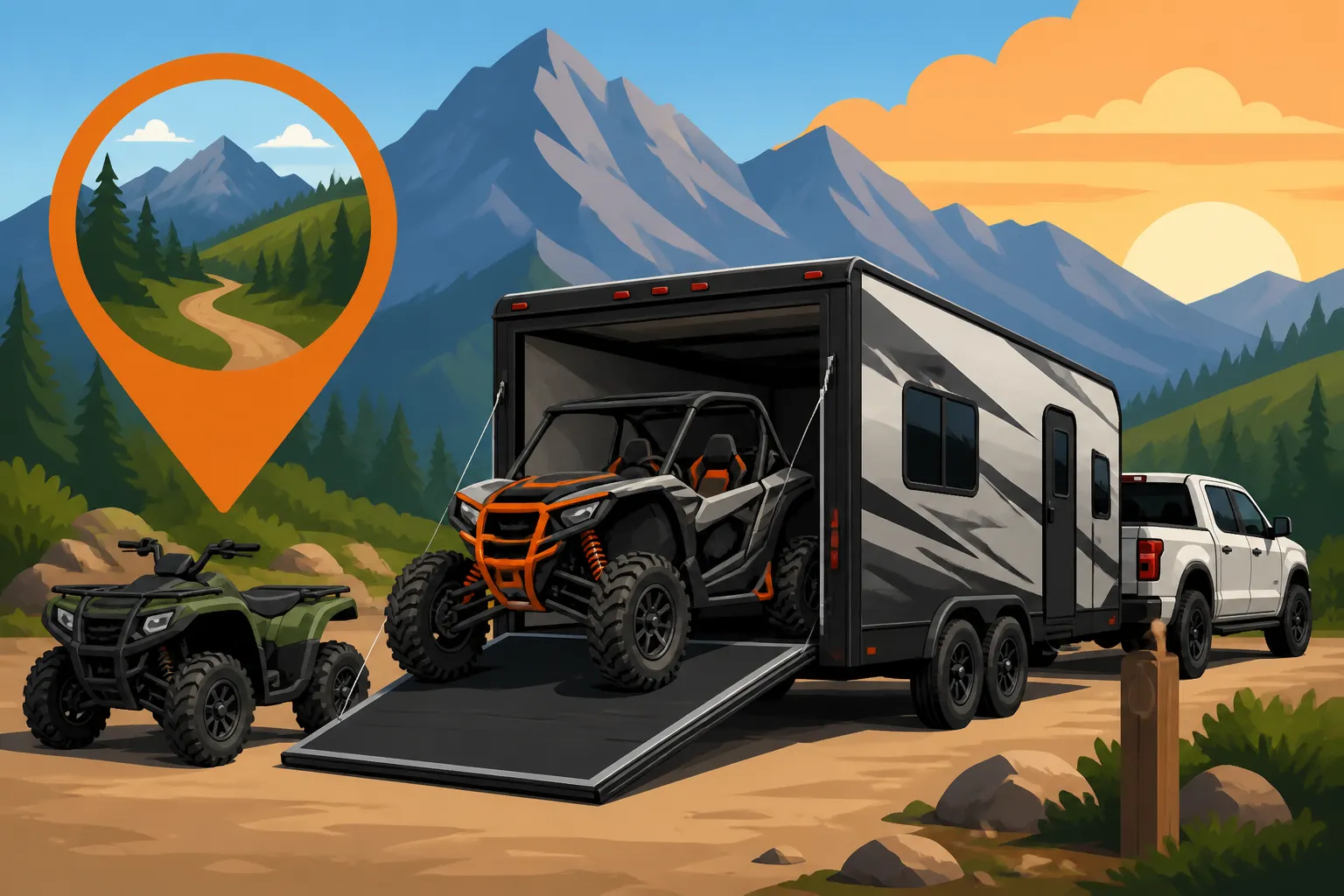
When you arrive, pause before opening the ramp or unloading machines. Check that the trailer is fully out of the travel lane, that there is room for other users to pass, and that the ramp will not extend into a road or trail. If the space is crowded, wait for a safer opening or move to another authorized area. A few minutes of patience is better than forcing other vehicles to squeeze around equipment.
Unload in a deliberate order. Set the parking brake, stabilize the trailer as appropriate, and keep children and pets clear of the ramp and moving machines. Make sure each ATV or UTV is ready for the route and that the riders have the required permits, safety equipment, and paperwork. If you are visiting from outside Montana, review [Montana Rules for Visiting Riders] and [Montana's Non-Resident Temporary Use Permit] before heading to the trail.
Before riding away, take a moment to check the parking area from the perspective of someone arriving behind you. Are the truck and trailer still clear of the road? Are ramps, tie-downs, tools, and loose gear secured? Can another vehicle turn around without crossing your setup? Keeping the site orderly is especially important at popular areas such as Wild Bill OHV Trails, Blue Mountain near Missoula, and trail systems around West Yellowstone, where multiple groups may be arriving and unloading.
Make a backup plan before you leave home
Identify a second place to park
A good trip plan has a fallback. Choose a second staging area, campground, or authorized parking option in case the first one is full, closed, too rough, or too tight for the trailer. Save the location offline and note how to reach it without relying on a weak signal. If the backup requires a substantial detour, decide in advance whether you would rather park the trailer elsewhere and shuttle the machines.
Ask specific questions when contacting a land manager or campground. Instead of asking only whether “trailers are allowed,” explain the approximate length of your tow vehicle and toy hauler, whether you need daytime parking or overnight camping, and whether you plan to unload machines there. A clear description makes it easier for staff to flag a tight entrance, limited turnaround, or rule that might affect your plan.
Use onX Offroad or another mapping tool to compare possible routes and nearby access points, then confirm important details with the land manager. Do not treat a mapped road as proof that your entire combination can safely reach it. If signs or local instructions differ from what you expected, follow the posted direction and choose your backup.
Use a simple arrival checklist
Before turning onto a remote access road, make a quick check:
- Confirm the road and trailhead are open to your vehicle and trailer.
- Check for posted restrictions, seasonal closures, and parking rules.
- Verify that the route has a practical turnaround or a safe place to reverse.
- Confirm that the parking area can accommodate both the tow vehicle and trailer.
- Decide whether you are parking for the day, camping overnight, or both.
- Make sure the tow vehicle and trailer are ready for the road conditions.
- Save a backup parking location and share your riding plan with someone.
- Leave enough room for other vehicles, emergency access, and trail users.
The most useful decision is often made before you reach the trailhead: whether to bring the toy hauler all the way in at all. If access looks uncertain, base the trailer at a suitable campground or authorized parking area and take only the tow vehicle to the staging point. That may add a little driving, but it can save you from a stressful backing maneuver, a blocked trailhead, or a long reverse down a rough road.
Disclaimer
This article is for general informational purposes only and does not constitute professional advice. Laws, prices and regulations vary by location and change over time. Consult a qualified professional for guidance on your specific situation.