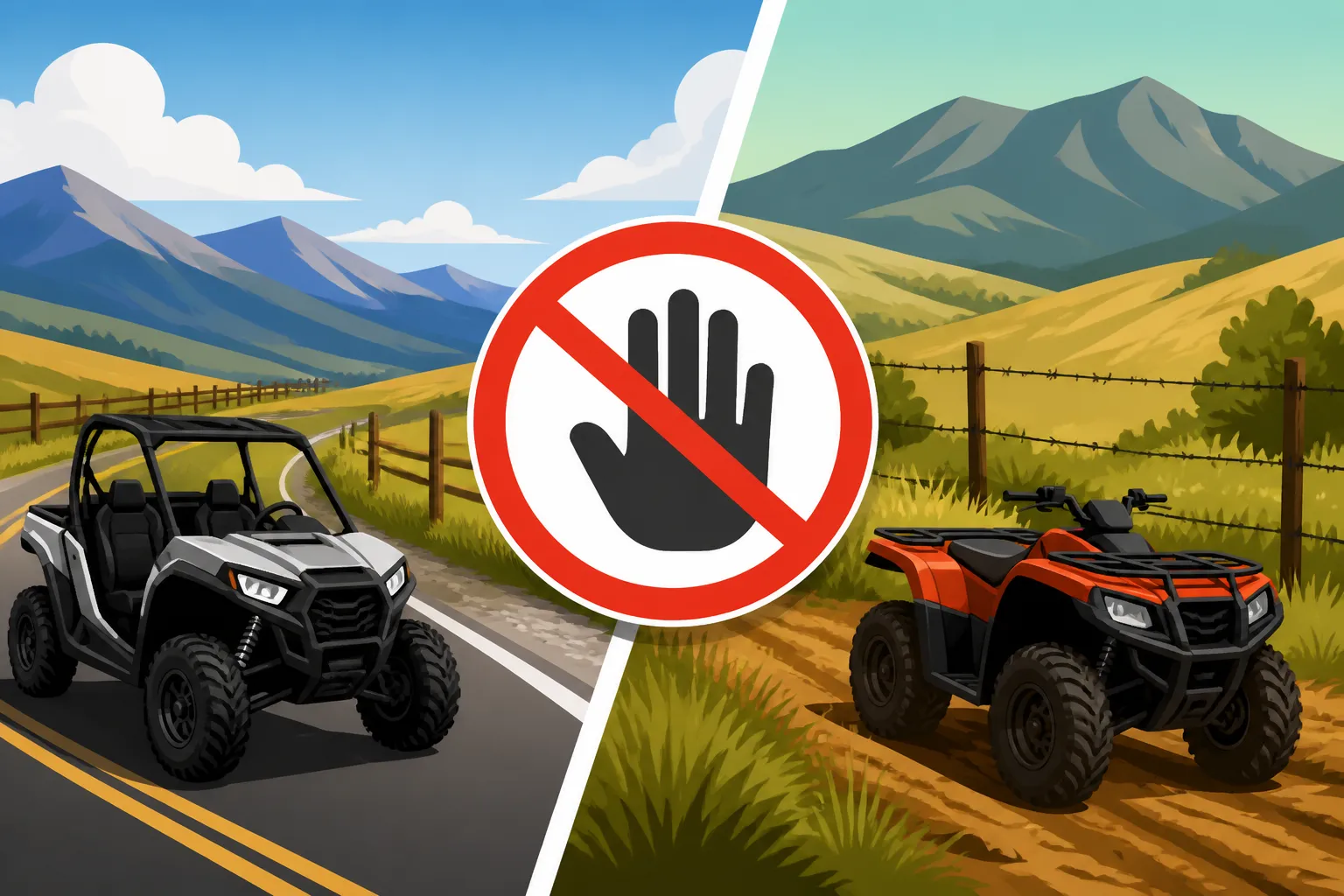
Montana Trespass Rules Along Roads
There’s nothing quite like the freedom of exploring Montana on your ATV or UTV, feeling the open air and soaking in those big sky views. But that sense of freedom can quickly turn to anxiety when you're navigating those winding backroads, wondering if the beautiful terrain just beyond the shoulder is fair game or if you're about to unknowingly roll onto someone's private property. This guide will help you understand Montana's trespass rules, especially when you're riding near roads, so you can enjoy your adventures without the worry of legal headaches or awkward confrontations.
Understanding Montana's Trespass Landscape for OHVs
Riding an off-highway vehicle (OHV) in Montana is an incredible experience, but it comes with the responsibility of knowing where you can and cannot go. The lines between public and private land, especially along rural roads, can often feel blurry or even invisible. This ambiguity is a significant source of frustration for many riders who genuinely want to respect property rights but find the signs, or lack thereof, incredibly confusing. It's not always as simple as a clearly marked trailhead leading to a defined public area; often, the very roads we use to access these areas are bordered by private parcels.
The Frustration of Unmarked Boundaries
Imagine cruising down a beautiful gravel road, perhaps one that winds through rolling hills or dense timber, and you see what looks like an inviting two-track veering off into the trees. Your natural inclination might be to explore, to see where it leads. However, in Montana, that seemingly innocuous side trail could lead directly onto private property, even if there isn't a single "No Trespassing" sign in sight. This is where the frustration really sets in for riders. You're not trying to break rules, but without clear markings, it's incredibly difficult to determine ownership from the seat of a moving UTV, especially when you're focused on the road and surroundings.
The problem is exacerbated by the sheer vastness of Montana. Many roads cut through enormous ranches or tracts of private timberland, where the property lines might be miles long without a single fence or sign. A small, overgrown fence line might be the only indicator, easily missed if you're not specifically looking for it. This situation leaves many riders feeling like they're constantly guessing, which takes away from the enjoyment of the ride itself.
Public Road vs. Private Land: The Illusion of Access
One of the most common misconceptions among OHV riders, and even many drivers, is that if a road is public, then the land immediately adjacent to it, like the shoulder or a small ditch, is also public or somehow grants access. This is a critical misunderstanding in Montana. While the public often has an easement for the road itself, extending perhaps a few feet beyond the paved or graveled surface, this easement does not typically grant access to the private land beyond it. The shoulder of a county road, a small turnaround, or even a grassy pull-off area can absolutely be private property.
This means that even if you're pulling over for a quick photo, to check your map, or to let a faster vehicle pass, you could technically be trespassing if you step or roll your tires off the established road surface and onto private ground. It's a subtle but hugely important distinction that can catch even seasoned riders off guard. Always assume that land beyond the defined public right-of-way is private unless you have clear information to the contrary, such as a large sign welcoming public access or a known public staging area.
Montana's General Trespass Laws Brief Overview
At its heart, Montana's trespass law is about respecting private property rights. Generally, a person commits trespass if they enter or remain on any land, property, or premises of another without permission. This applies broadly, whether you're on foot, horseback, or operating an OHV. While some states have very specific requirements for posting "No Trespassing" signs for enforcement, Montana's law makes it clear that entry without permission is trespassing, regardless of whether a sign is present or not. However, the presence of signs certainly strengthens a landowner's case and removes any plausible deniability.
The key phrase here is "without permission." Permission can be explicit (like a landowner telling you, "yes, you can ride here") or implied (like an open gate leading to a public access trail where no signs prohibit entry). For OHV riders, this often means checking maps, looking for official signs, and when in doubt, assuming it's private. Ignorance of the property line is generally not a valid defense if you're caught trespassing, so proactive diligence is always the best approach. [Montana Trespass Law for Riders] delves deeper into the specifics of what defines trespass from a rider's perspective.
Identifying "No Trespassing" in Montana's Backcountry
When you're out exploring Montana's vast landscapes on your ATV or UTV, knowing how to identify private property is paramount to being a responsible rider. It's not always as obvious as a big, red "KEEP OUT" sign; sometimes, the indicators are more subtle, yet legally binding. Understanding these visual cues can save you a lot of trouble and keep your ride enjoyable.
The Role of Signs and Fences
The most straightforward way for a landowner to communicate "No Trespassing" is through signs. These can range from professionally printed metal signs posted at regular intervals along a property line to handwritten notices tacked to a tree. You'll often see these signs at common access points, along fence lines, or where a public road meets private property. Always take these signs seriously. They are a direct communication from the landowner, and ignoring them is a clear act of trespass.
Fences also serve as a crucial indicator of property boundaries and often imply private land, even without explicit "No Trespassing" signs. While some fences might simply be for livestock containment, they generally denote a division between parcels, and crossing them without permission is a bad idea. A fence, combined with any type of "No Trespassing" or "Private Property" sign, creates a very clear boundary that must be respected. Even a partial or dilapidated fence should be treated as a boundary.
Montana's Purple Paint and Orange Post Marks
Montana has a specific, legally recognized way for landowners to mark their property lines without needing to erect miles of expensive "No Trespassing" signs. This is through the use of purple paint on trees or orange paint on fence posts. If you're riding through an area and see purple paint on trees or orange paint on fence posts, consider that a clear and unambiguous "No Trespassing" warning. It carries the same legal weight as a written sign. This method is particularly common in forested or rural areas where traditional signs might be difficult to maintain or easily vandalized.
The paint must be visible, and it's typically applied at consistent intervals, usually at eye level, along the property boundary. This is a really important detail for OHV riders because you might be focused on the trail ahead and miss these markers if you're not actively looking for them. Knowing what to look for, and understanding its legal significance, is crucial for avoiding accidental trespass. You can learn more about this specific marker in [Montana's Purple Paint and Orange Post Marks].
Unmarked Private Land: When in Doubt
Here's where it gets truly tricky: what about land that has no signs, no fences, and no purple or orange paint? It's easy to assume that if there are no markers, the land must be public or at least open for recreational use. This assumption can lead to significant problems. In Montana, the absence of "No Trespassing" signs or other markers does not automatically mean the land is public or open for access. Much of Montana's vast private land remains unmarked, especially in remote areas or along lesser-used roads.
When you encounter land that appears to be unposted, the best and safest approach is to assume it is private. This "when in doubt, stay out" mentality is the most responsible way to ride. This is where tools like mapping apps, such as [onX Offroad for Montana Trails], become invaluable. These apps often overlay property boundaries onto topographical maps, allowing you to see exactly whose land you're on or approaching, even when there are no physical markers. Relying on these resources, combined with a cautious approach, is essential for truly respectful and lawful OHV riding in Montana.
| Marker Type | Legal Significance in Montana | Best Practice for Riders |
|---|---|---|
| "No Trespassing" Sign | Clear warning, legally binding | Do not enter. |
| "Private Property" Sign | Clear warning, legally binding | Do not enter. |
| Purple Paint (on trees) | Legally equivalent to a sign | Do not enter. |
| Orange Paint (on fence posts) | Legally equivalent to a sign | Do not enter. |
| Fence (without signs) | Implies private boundary | Treat as private; do not cross without explicit permission. |
| No Visible Markers | Can still be private land | Assume private; use maps, or obtain permission if uncertain. |
Common Trespass Scenarios Along Montana OHV Routes
Even with the best intentions, it's surprisingly easy to accidentally trespass when riding an OHV near Montana roads. The rugged terrain, the allure of exploration, and sometimes simply a lack of awareness can lead riders off public rights-of-way and onto private land. Understanding these common scenarios can help you recognize potential pitfalls and avoid them.
Taking a "Shortcut" Off a County Road
One of the most frequent ways riders inadvertently trespass is by taking what appears to be a shortcut or a convenient deviation from a main county road. You might be on a gravel road, see a faint two-track or an old logging road that looks like it cuts through a bend or offers a more direct route to where you think you're going. It might even appear to be an extension of the public road. However, these side trails almost always lead onto private property.
These "shortcuts" are rarely maintained for public access and are often part of a private landowner's network for ranching, logging, or personal use. Rolling your tires onto one of these without permission, even for a short distance, constitutes trespass. It's crucial to stick to clearly marked and officially designated public roads and trails. If a route isn't on a recognized public access map or clearly signed for OHV use, it's best to assume it's private. [Montana OHV Rules on Forest Service Roads] and [Montana OHV Rules on BLM Roads] are excellent resources for understanding where designated public riding areas exist.
Parking and Staging on Private Shoulders
You've finally reached the trailhead, or a scenic overlook, and you need a spot to pull over, unload your machine, or just take a break. It seems logical to pull your rig off the main road and onto the shoulder. But as we discussed, that shoulder itself can be part of private property. Many landowners own land right up to the edge of the paved or graveled road, sometimes even beyond. Parking your truck and trailer, or even just your OHV, on what you assume is a public shoulder could mean you're actually parked on someone's private land.
This scenario becomes even more problematic if you or your group start to set up camp, build a fire, or even just hang out for an extended period. It's not just about the vehicle; it's about your presence on private ground without permission. Always look for designated public staging areas, parking lots, or pull-offs that are clearly marked for public use. If there are no such amenities, be extremely cautious about where you stop and consider moving further down the road to a more obviously public area, even if it means driving a little extra.
Riding "Just Over" the Line to Avoid an Obstacle
Montana's backcountry roads can be challenging. You might encounter a large puddle, a mud bog, fallen timber, or an erosion rut that makes passage difficult. Your instinct might be to veer slightly off the established road or trail to navigate around the obstacle, perhaps rolling your wheels "just over" a fence line or into the adjacent field. While this might seem like a minor deviation in the moment, it is still a form of trespass.
Even a few feet off the public right-of-way can put you squarely on private land. This is especially true if you are bypassing an obstacle that a landowner has deliberately placed to funnel traffic or protect their property. The cumulative impact of multiple riders making these small deviations can lead to significant erosion, damage to vegetation, or disturbance to wildlife on private property, which can understandably upset landowners. It's far better to turn around, find an alternative route, or wait for assistance than to knowingly or unknowingly trespass to avoid a minor inconvenience.
Following Game or Exploring an Old Road
The call of the wild is strong in Montana, and for many OHV enthusiasts, it's about more than just the ride; it's about experiencing nature. You might spot a herd of elk or a magnificent deer in the distance, and the temptation to follow an old, faint track that leads in their direction can be overwhelming. Or perhaps you come across a fascinating old cabin, a dilapidated mining structure, or an intriguing historical marker just off the main path.
These situations often present a high risk of accidental trespass. What looks like an old, abandoned track or an unmaintained access road might still be private, even if it appears to lead to public land or interesting features. Wildlife frequently crosses property lines, and pursuing them off-trail will almost certainly lead you onto private ground. Similarly, historical sites are often located on private land, and exploring them without permission is a direct violation of property rights. Always resist the urge to chase after wildlife or explore enticing, unmarked paths. Stick to designated trails and roads to ensure you remain on public land. [Riding Posted Ground in Montana] provides further context on the implications of venturing onto private land.
Consequences and Legal Ramifications of OHV Trespass
Trespassing on private property in Montana, even if accidental, carries real consequences beyond just an awkward encounter. Landowners have legal rights, and enforcement agencies take those rights seriously. Understanding the potential repercussions can help reinforce the importance of responsible riding and property line awareness.
Confrontation with Landowners: De-escalation Strategies
One of the most immediate and uncomfortable consequences of trespassing is a confrontation with the landowner. Montana is a state where people take their property rights very seriously, and rightfully so. You might encounter a landowner who is upset, protective, and possibly armed, especially in remote areas where property damage or poaching are ongoing concerns. This can be a very tense and potentially dangerous situation.
If you find yourself confronted, the absolute best strategy is de-escalation. First, stop your machine immediately, turn off the engine, and remove your helmet to show you are listening and not fleeing. Maintain a calm demeanor, apologize sincerely, and explain that you were unaware you were on private property. Do not argue, become defensive, or make excuses. Ask politely for directions back to public land or the nearest public road. Cooperate fully and leave the property immediately as instructed. Remember, even if you feel you were in the right, a confrontation on private land is not the time or place to debate legalities. Your priority is to safely and respectfully remove yourself from the situation. Building a good reputation for OHV riders in Montana starts with these respectful interactions.
Fines and Penalties for Riding Posted Ground in Montana
Trespassing on private land, especially land that is clearly marked with "No Trespassing" signs, purple paint, or orange posts, can lead to significant legal penalties. In Montana, trespassing can be a misdemeanor offense. A landowner has the right to contact law enforcement, and if a sheriff's deputy or game warden arrives, you could be issued a citation. The fines can vary depending on the specific circumstances, whether it's a first offense, and if any property damage occurred.
Beyond monetary fines, repeated or egregious trespassing can lead to other complications, such as your OHV being impounded. In some cases, especially if you're found damaging property or disturbing livestock, the penalties can be more severe. It's not just an inconvenience; it can be a stain on your record and a significant hit to your wallet. Law enforcement, including county sheriffs and game wardens, actively patrol popular riding areas and respond to landowner complaints. [Fines for Riding Montana Without a Permit] (though focused on permits, the principle of fines for violations applies) and [Sheriff Enforcement on Montana Back Roads] provide insight into enforcement actions you might face.
Civil Liability and Property Damage
The legal consequences of trespassing aren't limited to criminal charges or fines. You can also face civil liability. This means a landowner could sue you for any damages you caused while on their property. This isn't just about physical damage to fences, gates, crops, or land; it can also include damages for disturbance to livestock, disruption of hunting leases, or even emotional distress if your actions significantly impacted their peace and privacy.
Imagine, for instance, that you ride your UTV through a freshly planted field, damaging crops, or you accidentally leave a gate open, allowing cattle to wander off. The costs associated with these types of damages can quickly escalate, far exceeding any criminal fine. Even if you don't intend to cause harm, the mere act of being on private property without permission makes you liable for any negative outcomes. This potential for civil action adds another layer of risk to riding on unmarked or questionable land, emphasizing why it’s so critical to ensure you're on public ground or have explicit permission. Remember that responsible riding means not only adhering to the law but also protecting the peace and livelihood of Montana's landowners.
Responsible Riding and Avoiding Trespass
Riding an OHV in Montana offers unparalleled experiences, and ensuring those experiences remain positive for everyone, including landowners, comes down to responsible riding practices. Proactively preventing trespass is not just about avoiding trouble; it's about respecting the land, the people, and the privilege of enjoying Montana's natural beauty.
Utilizing Technology: GPS and Mapping Apps
In today's world, there's no excuse for getting lost or accidentally trespassing, thanks to incredible advancements in mapping technology. Apps like onX Offroad (and others like Gaia GPS or Garmin BaseCamp) have revolutionized how OHV riders navigate the backcountry. These platforms often provide detailed topographical maps overlaid with property boundaries, showing public land, private parcels, and even land ownership information. They can be invaluable tools for identifying exactly where you are and what type of land you're on.
Before you head out, download maps for your intended riding area for offline use, as cell service is often nonexistent in Montana's remote regions. Take the time to study your route and identify any potential private land bottlenecks or sections where public and private property intermingle closely along roads. Pay attention to the property lines displayed on your device as you ride, and use them as a primary guide, especially when physical markers are absent. This kind of preparation, aided by tools often enhanced by accessories from brands like SuperATV that help mount devices securely, is the single most effective way to prevent accidental trespass. [onX Offroad for Montana Trails] offers more guidance on leveraging this technology.
Obtaining Permission: The Golden Rule
The simplest, most effective, and most respectful way to ride on private land is to obtain explicit permission from the landowner. If you're interested in exploring a specific area that appears to be private, or if you know a property owner, simply ask. A friendly, respectful inquiry can go a long way. Many Montana landowners are generous, especially if you approach them with respect for their property and an understanding of their concerns.
When asking for permission, be clear about your intentions: what kind of machine you'll be riding, how many people are in your group, and the general area you'd like to traverse. Reassure them you'll stay on designated routes, close all gates, and pack out everything you pack in. Always get specific instructions if they grant permission, and stick to those instructions precisely. Never assume that permission once granted applies to future visits or different areas without reconfirming. This "golden rule" of asking permission builds goodwill and ensures you're riding legally and respectfully.
Sticking to Marked Trails and Public Easements
The most straightforward way to avoid any trespass issues is to stick exclusively to clearly marked public trails and roads. If a trail or road is not designated for OHV use on an official map (like a National Forest Motor Vehicle Use Map or a BLM travel management map) or doesn't have clear signage indicating public access, it's safest to avoid it. This is especially true for any side routes or unmarked tracks that branch off main roads.
Even on public roads, be mindful of the public easement. This typically extends only a limited distance from the edge of the travel surface. Do not pull far off the road, park deep in the ditch, or ride into adjacent fields unless it's a clearly designated public parking or staging area. When you're driving your truck and trailer, use official pull-offs and parking areas. When you're riding your OHV, stay within the defined boundaries of the trail or road. This cautious approach ensures you're always operating within established public access points.
Understanding Montana's Block Management Land and OHVs
Montana offers a unique program called Block Management, which is designed to provide public hunting access to private lands while compensating landowners. While primarily for hunters, it's important for OHV riders to understand how Block Management Areas (BMAs) operate, as some may have roads or trails that pass through or adjacent to them.
Access to BMAs is strictly controlled by the landowner, often with specific rules regarding motor vehicle use, open dates, and permitted activities. Never assume that a road or trail within or bordering a BMA is open for general OHV recreation unless it's explicitly stated in the BMA's specific rules, which you would obtain from the landowner or Montana Fish, Wildlife & Parks. Generally, OHV use within BMAs is limited to hunter access and typically requires permission or a sign-in at a station. Blatantly riding through a BMA for recreational purposes without explicit permission is a form of trespass. Always check the specific BMA rules if you are riding in an area near one, especially during hunting season. [Montana Block Management Land and OHVs] offers more detail on how this program impacts recreational access.
Disclaimer
This article is for general informational purposes only and does not constitute professional advice. Laws, prices and regulations vary by location and change over time. Consult a qualified professional for guidance on your specific situation.