Enforcement and Checkpoints in Montana
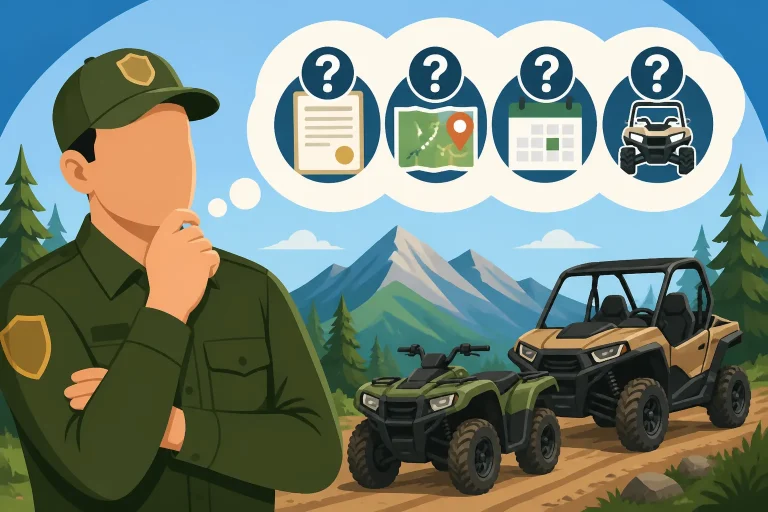
Montana ATV and UTV enforcement can happen on a trail, at a staging area or during a road ride. A stop may involve more than checking a permit: officers can also look at where you’re riding, whether your machine is properly identified and whether the route is open to motorized use. Knowing what to have ready can make an encounter calmer and help you avoid preventable problems.
Who may enforce Montana ATV and UTV rules
The officer you meet depends partly on where you are and what kind of rule is involved. Montana Fish, Wildlife & Parks wardens enforce many outdoor recreation and wildlife rules. Local law enforcement may deal with traffic and local road ordinances, while federal land managers may enforce rules on land they manage. More than one agency can have a role in the same area.
That means a machine can be subject to several sets of requirements at once. A permit that allows a visitor to ride on certain public trails does not automatically authorize travel on a town street. A road-legal setup does not give you permission to ride on a closed forest road or across private land.
An officer may be checking for different things depending on the situation, including:
- Whether the machine has the permit or registration required for that rider and use.
- Whether its permit or decal is displayed as required.
- Whether the trail or road is open to that type of motorized vehicle.
- Whether the rider meets age, supervision, helmet or safety education requirements that apply.
- Whether the machine and its equipment meet applicable rules for a road ride.
- Whether the rider is complying with wildlife, fire, noise, trespass or resource-protection rules.
An enforcement stop does not always mean an officer believes you have broken a rule. Officers may be checking machines at a busy staging area, responding to a complaint or checking that riders understand a temporary closure. If you are stopped, stay calm, keep your hands visible and listen to the instructions. If you are uncertain why you have been stopped, you can ask politely.
Rules can depend on land ownership, route designation, machine type, rider age and the way the machine is being used. Before leaving, read Montana Permit Rules on Public Land and check the land manager’s current route information. For road-specific questions, What Montana Requires on an OHV Road Ride covers a separate set of issues from trail access.
What a checkpoint or trail stop may involve
A checkpoint is not necessarily a permanent booth or a formal roadblock. Riders may encounter officers at a trailhead, access road, staging area or route junction. They may also be stopped while riding. A check can be brief, or it can take longer if the officer needs to confirm the machine’s identity, the permit category or whether a route is open.
Expect practical questions such as where you are headed, where you entered the trail system and whether the machine has the required permit or registration. Officers may look at a displayed decal, ask to see relevant documents, or check the machine’s identifying information. The exact questions vary with the circumstances. What a Montana Officer Asks For explains the kinds of information riders may be asked to provide.
A useful approach is to stop in a safe place without blocking traffic or other trail users. Turn off the engine if asked, remove your hands from controls when appropriate, and avoid reaching into a bag or storage compartment without telling the officer what you are doing. If you are carrying paperwork, let the officer know where it is before retrieving it.
Do not assume that every document must be carried on your person, or that a photo on your phone will satisfy every requirement. Requirements can differ by document and situation. Before your trip, confirm what proof you need to have available and how a permit or decal must be displayed. If a paper document is required, keep it protected from weather and easy to retrieve.
An officer may also notice an issue unrelated to the original reason for the stop. For example, a rider who is asked about a permit may also be riding on a route that is closed to motorized traffic. A machine that is properly registered may still be on private property without permission. Address each question honestly rather than treating one valid document as proof that every part of the ride is allowed.
If you disagree with an officer’s interpretation, avoid arguing beside the trail or trying to continue the ride before the issue is resolved. Ask what rule or route restriction applies, and take note of the information you are given. If you receive a citation, follow the instructions on it for next steps. You can seek qualified legal advice if you need help understanding your options.
Permits, registration and the limits of reciprocity
A common source of confusion is treating a permit, registration and road authorization as if they were interchangeable. They serve different purposes. A permit may authorize a particular kind of trail use; registration can identify the machine and show that it has been registered under applicable rules; and road access may depend on a separate law, local ordinance or route designation.
The right requirement can vary based on whether you are a Montana resident or visitor, where the machine is registered, the machine’s classification and where you plan to ride. Do not rely on a plate or decal from another state as proof that Montana’s trail requirements are satisfied. Montana does not necessarily recognize another state’s permit in place of a Montana requirement. See Why Reciprocity Ended for Montana Riders and confirm the rules for your machine before traveling.
| Item | What it generally addresses | What it does not automatically authorize |
|---|---|---|
| Trail permit or pass | A type of riding access on specified public lands or routes | Riding on every public road, closed route or private parcel |
| Registration | Identification and registration status of a machine under applicable rules | Access to land or a route that is closed or restricted |
| Road-use requirements | Whether and how a machine may be operated on an authorized road section | Trail access where a separate permit or route rule applies |
| Private-land permission | Consent to ride on land controlled by another owner | Access to nearby public land or a connecting road |
For visiting riders, check [What the Non-Resident Permit Covers] and Montana’s Non-Resident Temporary Use Permit. For residents, confirm how registration and a trail pass apply to the machine and the route you intend to use. Requirements and ways of displaying proof can change, so consult Montana Fish, Wildlife & Parks and the relevant land manager for current instructions.
A permit is not a substitute for checking the route. Public land can include roads and trails with different motorized-use rules, seasonal restrictions or closures. A route that appears on a map may not be open to your machine or open on the day you arrive. Check signs at the trailhead and consult the applicable motor vehicle use map or current land-manager notice. Montana Permit Rules at a State Park is also useful if your trip includes a state park, where site-specific rules may apply.
Private land creates another distinction. A public-land permit does not grant permission to cross a ranch or other privately controlled parcel. Get permission from the landowner or manager before riding there, even if the route looks like a convenient connection. For more on the difference, see Do You Need a Permit on Deeded Montana Ground?.
If you are traveling from another state, avoid relying on what was accepted at home. Permit systems are not uniform, and a home-state registration or decal may not meet Montana’s requirements. What Montana Riders Need Before They Ride can help you make a pre-trip checklist.
Documents and equipment to prepare before riding
The easiest checkpoint is often the one you have already prepared for. Before you leave, match the paperwork and equipment to the rider, machine and route. A single family checklist may not be enough if the group includes visitors, young riders or machines with different registration status.
Start with the machine’s identity. Check that the VIN or other identifying number is readable and matches the paperwork you have. If the number is obscured by mud, a cargo rack or an accessory, clean or clear the area before the ride. Do not alter the identifying number. If you discover a mismatch, resolve it before setting out rather than hoping it will not be noticed.
Then confirm the applicable permit or registration. Verify that it is valid for the machine and rider, and that any decal is attached in the required place and remains legible. A loose decal in a glove box may not meet a display requirement. Placement can differ by machine or permit type, so follow the relevant instructions rather than copying the location on another rider’s vehicle. For resident machines, the registration process may be part of the answer; Montana County Treasurer OHV Registration explains the county registration context.
For younger riders, check both the age-related requirements and any safety education rules that apply to the planned ride. A course certificate or adult supervision may be relevant in some situations, but do not assume one requirement replaces another. Consult Montana’s Safety Education Requirement and Montana Age Rules for Riders Under 16 when a rider under 16 is in the group.
A road ride needs its own check. A county road, town street and trail are not necessarily governed by the same access rule. Where riding is allowed, road-related equipment and operator requirements may apply. Confirm the route is open and check the required equipment, rider qualifications and any applicable insurance rules before using it. Montana Road Rules Riders Get Wrong covers issues that are easy to confuse with trail permit rules.
Use this sequence before the day’s ride:
- Identify each machine and its registration status.
- Confirm whether each rider needs a permit, pass or other proof for the planned use.
- Check how the permit or decal must be displayed.
- Verify that every intended road and trail is open to that machine and rider.
- Review age, supervision, safety education and road-use requirements.
- Put relevant documents somewhere dry and accessible.
- Tell the group what to do if an officer stops them or a route is closed.
For a group, do not assume the lead rider’s paperwork covers every machine. Each machine may have its own permit, and each rider may have separate qualifications. If someone is borrowing a machine, check that the permit and ownership information still match the actual machine and intended use. Montana Permits for a Borrowed Machine addresses that situation.
How to respond to a citation or disputed access issue
If an officer says a permit is missing, a decal is improperly displayed or a route is closed, take the concern seriously. Ask which machine or rule is involved, and listen before trying to explain. A misunderstanding may be fixable on the spot, but continuing to ride after being told a route is closed can make the situation worse.
If you receive a citation, read it carefully and keep it in a safe place. Note the date, location, machine involved, route name or number and any relevant conversation while the details are fresh. Save permit confirmations, registration documents, photographs of signs and maps you relied on. Do not edit or discard material that may help explain what happened.
Follow the instructions and deadlines printed on the citation or provided by the issuing authority. If you believe the citation is incorrect, use the stated process to dispute it rather than ignoring it. A citation can have consequences beyond the immediate fine, depending on the violation and applicable rules, so consider professional legal advice if the stakes are significant. Guidance on a particular case cannot be replaced by general riding information.
For a route dispute, record the exact location and check the official map or closure notice that applies to that land. Signs and route conditions can change, and a screenshot saved earlier may not show a newer closure. Contact the appropriate land manager for clarification before returning to the area.
If you find that your permit or decal is missing, do not assume a receipt alone authorizes you to keep riding. Stop and confirm what is acceptable with the issuing authority or land manager. A lost or damaged permit may have a replacement process, but the replacement rules and proof requirements should be checked before you continue. Replacing a Montana OHV Decal is relevant when a Montana decal is lost or damaged.
Prevention is usually simpler than sorting out a disputed stop. Keep the machine’s permit visible as required, carry or retain the proof the rules call for, and check both the route and the land manager’s current notices. If a checkpoint changes your plan, treat the officer’s directions and posted closures as a reason to pause and verify access before choosing another route.
Frequently Asked Questions
Can an officer stop an ATV or UTV at a Montana trailhead?
Officers may conduct checks at trailheads, staging areas or on routes, depending on the circumstances. A check may involve permits, machine identification, rider requirements or compliance with route restrictions.
Does a Montana permit let me ride on any road?
No. A trail permit does not by itself make a road open to OHVs. Road access depends on the specific road, local rules and any requirements for operating there.
Will my home-state permit work in Montana?
Do not assume it will. Permit recognition depends on the applicable rules, and Montana may require its own permit or pass. Check current Montana requirements for your machine and planned use before traveling.
What should I do if I think a checkpoint citation is wrong?
Stay calm, keep the citation and related records, and follow the instructions and deadlines on the notice. Use the formal process to challenge it, and consider qualified legal advice if needed.
Disclaimer
This article is for general informational purposes only and does not constitute professional advice. Laws, prices and regulations vary by location and change over time. Consult a qualified professional for guidance on your specific situation.